Are you familiar with the federal soil quarantine map, associated pests of concern

During soil testing season, we often get calls about what laboratory to send samples to and what to test for. You may not know that under certain circumstances USDA-APHIS may have a quarantine for a particular plant or animal pest that can be carried in soil, and movement of soil from that region is restricted and requires a permit. This includes all territories of the United States such as Guam, Hawaii, Puerto Rico, and the U.S. Virgin Islands. APHIS also restricts the movement of domestic soil from areas within the continental United States that are under quarantine for specific plant pests and adjoining countries. For example, currently soil cannot enter the U.S.  from Canada if from the following areas of Alberta: A farm unit and associated land located near the municipality of Fort Saskatchewan; and a farm unit and associated land located near the municipality of Spruce Grove; British Colombia: That portion of the municipality of Central Saanich on Vancouver Island, ease of the west Saanich Road; Newfoundland and Labrador: The entire Island of Newfoundland; and Quebec: The municipality of Saint- Amble.

The Federal Domestic Soil Quarantines Map provides an overview of the plant pest quarantines that affect the movement of soil. USDA recently updated their Federal Domestic Soil Quarantine Map on February 10, 2022 which is available as a pdf at:

https://www.aphis.usda.gov/aphis/newsroom/stakeholder-info/stakeholder-messages/plant-health-news/federal-domestic-soil-quarantine-map-2-10-22

This map contains a lot of information that is useful for producers, growers and consumers who are purchasing plant materials that may contain soil to be mindful of the presence of significant plant pests of concern that have not yet made it to New Jersey, and to do their part to not bring them here. While many are limited to infestations along the west coast and gulf coast, others are closer to home. For example, the golden nematode is a potato nematode that is quarantined in some parts of western New York State. The pale cyst nematode is another potato nematode of concern that is quarantined from a small area of Idaho and the island of Newfoundland, Canada.

Others like the imported fire ant continue to spread and are now found in hot spots in Alabama, Arkansas, California, Florida, Georgia, Louisiana, Mississippi, New Mexico, North Carolina, Oklahoma, South Carolina, Tennessee, Texas, Virginia, and Puerto Rico. Quarantine efforts thus far have been able to limit the spread of witchweed to locations in South and North Carolina.

If you have specific questions about bringing in soil from any of these areas denoted in this USDA soil quarantine map or about these quarantine pests, contact the USDA-APHIS NJ state office, state plant health director at (609) 259-5244 or for more contact information see https://www.aphis.usda.gov/aphis/ourfocus/planthealth/ppq-program-overview/sphd/new+jersey


NJ Pesticide Credits. March 24th Weed Management Webinar

For NJ applicators in 10, 1A and PP2

4 category credits.

A virtual workshop will be held on March 24 from 8 am to 11 am for farmers interested in learning how to use integrated weed management (IWM)) techniques to control  troublesome weeds in their fields. This is the fifth year for the workshop series, which is a collaborative effort between the University of Maryland, Virginia Tech, and the University of Delaware.

Education regarding weed identification and integrated management strategies continues to be critically important to enable early intervention and effective management options.  2022 is shaping up to be especially challenging with anticipated shortages of many commonly used herbicides. The 2022 workshop series will provide tactics to manage important weeds given limited herbicide availability and increased input prices. Material covered will target row-crop production systems, but tactics learned may be applicable to other systems. These workshops are free, but participants will need to register at https://go.umd.edu/IWM.

Pesticide credits will be available for MD, DE, NJ and WV. Two hours of CCA continuing  education credits will be offered for each session.

For more information, contact Kurt Vollmer at (443) 446-4260 or Ben Beale at (301) 475- 4481.

If you are attending from NJ, contact Melissa Bravo to upload your pesticide license and photo i.d. at 856-340-6582. This meeting counts as an ‘in person’ meeting as long as you stay on camera. If you cannot stay on camera the entire time, no credits will be awarded. 

NJ Applicators remember, attendees of online courses can earn 25% of their credits for each category from online sources.  Only those whose 5-year recertification period is ending 10/31/2022 are eligible to earn 100% of their credits online.  Attendees can check their eligibility online at www.pcpnj.org.

Kurt M. Vollmer, Ph.D.

Extension Specialist-Weed Management
University of Maryland
Wye Research and Education Center
124 Wye Narrows Drive
Queenstown, MD 21658
(443) 446-4260

Wondering what manure is worth right now?

Given the high costs of ‘commercial’ fertilizer components (N, P, K), many are looking at the range of nutrient credit from “unmanipulated animal or vegetable manure”1 sources.

Here is a very comprehensive calculator created by The University of Minnesota Extension for growers who keep track of all costs associated with fertilizer application.

To fine tune your estimates consider the following when calculating benefit of nutrients in manure vs fertilizer:

Manure nutrients are applied at a ton per acre rate basis to give the equivelent unit of nutrient in fertilizer that is applied at a pound per acre rate basis. Different species create vastly different nutrient credits.

On average,

Poultry manure contains the most nutrients per ton requiring the least tons per acre (1.5 to 3 tons/acre) to be equivalent to purchased fertilizer Nitrogen units of 50 lbs. (Please read the PPA post on poultry manure import restrictions due to High Path Avian Influenza)

Fresh beef manure generally requires 20 to 25 to 30 tons/acre to be equivelant to purchased fertilizer Nitrogen units of 50 lbs.

Fresh horse manure contains the least amount of Nitrogen and requires 100 tons per acre to be equivalent to purchased fertilizer units of 50 lbs, but as horse manure ages, the organic credit increases as the carbon:nitrogen ratio comes into equilibrium. Take this into consideration as aged piles many have much higher value.

  • Use an actual analysis of composted, bedding manure or fresh manure
  • Composted manure includes the shavings, straw, hay. Fresh manure is raw product, very little foreign material
  • Test aged piles separately from fresh
  • Aged piles (broken down, look like soil) can be sent in as soil test if well composted
  • Fresh samples must be sent in as fresh manure, vented properly and packaged properly so they do not cause issues in transit. Read the laboratories instructions on shipping carefully 
  • Account for cost to ship samples to lab
  • Capture in analysis the organic nitrogen credit
  • Capture in analysis micronutrient credits as these trace minerals add value to ‘manure’ beyond just the major three nutrients (N, P, K).
  • Know the common weed seeds most likely to be in fresh manure
  • Know the common weed seeds most likely viable in aged manure
  • Consider value of aged manure (organic nitrogen, soil health, worm castings, actual worms) vs fresh (hot) manure (higher N value)
  • Account for moisture content in figuring rate per acre, tons per load etc. as analysis will be on a DM basis
  • Laboratory fees range from $14.00 per test to $60.00 per test. Check current prices online before submitting sample, and use the laboratories submission form
  • Consider transporation costs
  • Consider spreading costs (manually vs manure spreader)
  • Be aware of any restrictions (days since application etc.) on using fresh or unaged manure on crops that will be harvested for human consumption (fresh market etc.) in particular be aware of FSMA Final Rule on Produce Safety that states”the final rule as of 12/02/2021 requires that untreated biological soil amendments of animal origin, such as raw manure, must be applied in a manner that does not contact covered produce during application and minimizes the potential for contact with covered produce after application. For more information on this rule, see https://www.fda.gov/food/food-safety-modernization-act-fsma/fsma-final-rule-produce-safety


Footnotes:

For information on what constitutes sale of a commercial ‘fertilizer’ see  https://www.nj.gov/agriculture/divisions/md/pdf/FertilizerLaw.pdf

An indepth fact sheet on manure can be found at https://ag.umass.edu/crops-dairy-livestock-equine/fact-sheets/manure-nutrient-resource


Permitting Procedure for Importation of Poultry, Hatching Eggs, or Poultry Waste from Highly Pathogenic Avian Influenza (HPAI) States

Producers, please be aware of the following permit requirements. The updated list of states with detections can be accessed at

https://www.aphis.usda.gov/aphis/ourfocus/animalhealth/animal-disease-information/avian/avian-influenza/2022-hpai

The following information is from the NJ Dept. of Agriculture

https://www.nj.gov/agriculture/divisions/ah/diseases/avian_influenza.html

  • Only poultry or hatching eggs moving into New Jersey live bird markets, from HPAI states, require a permit and 72 hour test.
  • The collection date, collection time, laboratory result, laboratory accession number and laboratory name must be recorded on the CVI
    accompanying the shipment.
  • A copy of the laboratory report must also accompany the shipment.
  • No poultry waste shall be imported from HPAI states, without prior approval and permit issued by the State Veterinarian.
  • For information about testing please refer to the N.J.A.C. 2:3-7.4 (b) at the link below:
    http://www.nj.gov/agriculture/divisions/ah/pdf/NJACChapter3.pdf

STEP ONE:

  • Print and complete the form below and send to the Division of Animal Health by email or fax.
    Email –state.veterinarian@ag.nj.gov
    Fax – 609-671-6413
  • This form is to be used to facilitate the receipt of information. Submission of this form is not a permit for movement.

STEP TWO:

  • Call the Division of Animal Health at 609-671-6400, Monday through Friday, with the exception of holidays, from 8:45 AM to 4:45
    PM (EST), to confirm the Division’s receipt of the information.

STEP THREE:

  • If the application is complete, a permit number will be issued and a copy of the completed form with permit number will be
    emailed or faxed back to the requester.

“Folks who plan to import poultry product into NJ are recommended to call the Division of Animal Health (609-671-6400) to inquire if their intended purchase requires a permit. If yes, we can walk them through the process. The need for a permit might depend on the product, the location of the origin site, testing, etc…” – NJ Animal Health communication

RCE Seeks Input Regarding COVID-19 Resources For 2022 Season

Rutgers Cooperative Extension’s EXCITE team is requesting NJ farmers input via a short five-minute survey about COVID-19-related resources for the upcoming growing season.  

Please click here to go to the survey: https:/go.rutgers.edu/mcgr9pzt 

This survey is totally anonymous, you do not have to answer any questions you do not want to, and you can stop at any time.  

After taking the survey, please take a minute to forward this post to other NJ farmers who may not see this message. You can copy the link or just forward this message.  

Thank you. 

Wheat Stand Coming into 2022 and Sky-high Fertilizer Prices

The excessive amount of rainfall in October (5.06 inches) delayed planting of winter wheat and other fall grain cover crops in some areas of the state. As recorded by the Rutgers NJ State Climatologist Monthly Climate Tables, in Salem County, the precipitation in October (3.74 inches) was near normal (30-year average) and temperatures averaged a high of 63.2 degrees F. Small grains that benefited from this moisture put on more above ground biomass than November plantings if they were not planted in overly saturated soil conditions conducive for causing poor stand establishment.

In November, state-wide saw only .98 inches fall compared to the norm of 3.36 inches. In Salem County, the deficit was even more, with only .72 inches falling compared to the norm of 3.18 inches with temperature highs of 44.7 degrees. Carry over moisture from October should have been adequate in most areas of the county to optimize seed germination. Late plantings in December were possible due to above normal temperatures of 43.9 degrees, but soil moisture was lacking due to only 1.18 inches falling compared to the thirty-year average of 4.0 inches.

The back-to-back months of little precipitation coupled with windy conditions did not yield rapid development of the crop compared to field observations in 2020. Despite the near normal precipitation state-wide in January (3.45 inches) small grains gained little beyond shoot and early tillering stage with average temperature highs of only 28.7 degrees state-wide and 31.4 degrees in the county the first month of 2022.

Temperatures were all over the place in February with two days above 70 degrees the week of February 20th in Salem County, enough to bring winter wheat out of dormancy since February 7th. Near normal precipitation (2.88 inches) in February encouraged growth and applications of nitrogen fertilizer are ongoing as the crop rapidly develops.

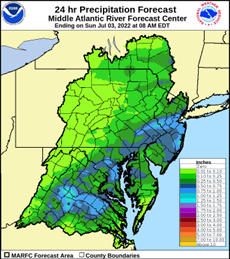
Nitrogen fertilizer prices have climbed steadily since this time last year, and more than doubled since the crop was planted in October. The combination of moisture, warm weather and soil conditions should optimize any recent applications. Areas that received more than a half an inch in the last seventy-two hours (Estimated Precipitation, Mid-Atlantic River Forecast Center)  should monitor moisture conditions carefully to track utilization of applied nitrogen if future precipitation exceeds 3 inches in the next two weeks. In February, nitrogen prices were still well above $600 /ton for products like UAN28, UAN32 and Urea. DAP, MAP, and Potash remained above $800/ton and anhydrous ammonia soared above $1000/ton.

Fertilizer pricing real time: