Drought driven cow culling. Opportunity for replacement heifers in 2023?

The July 1, 2022, beef cow inventory compiled by USDA NASS indicates the national beef replacement heifer inventory is below 5 million head. Unprecedented cow culling is occurring in the southwest due to the ongoing drought conditions. To put that in perspective, the United States has not seen numbers this low since 1972 and 1973 when the national beef replacement heifer inventory hovered around 7 million head. Even in 1965, beef cattle replacement heifer inventories were above 5 million head nationally.

New Jersey reported 5,000 head of beef cattle replacements in 1973 and only 2,500 head in 2019. With all cattle and calve numbers in 2020 reported at 28,000 head down 2,000 head from 2019, it is probable that state raised beef heifer replacement numbers are below 5,000 head going into the fall of 2022.

What is more contrasting compared to 1973 is the difference in calf crops. In 1973, the national calf crop was estimated at 50 million head. Going into summer of 2022 the calf crop is estimated at 25 million head. With an estimated 5,000 of these 500 lb calves or less in weight coming from New Jersey and only half assumed to be heifers, these heifers have considerable value beyond the feedlot, if they have brood cow qualities.  Maintaining those selected for replacement herd purposes requires considerable attention to body conditioning to grow a weaned heifer to be bred at 15 months to meet industry replacement standards.

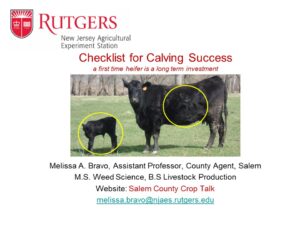
To learn more about raising replacement heifers contact Melissa Bravo for a copy of ‘A Checklist For Calving Success.  A first-time heifer is a long-term investment.’

What are replacement heifers worth? The USDA AMS Show-Me-Select Special – Carthage, MO Livestock, Poultry, & Grain May 2022 report is a good example of the criteria that brings $1450.00 to $3,100 bred replacement heifer sale prices. Remember, these heifers were born, weaned, and fed through 15 months of age on 2019 (conception), 2020 (birth year), 2021 (breeding year) feed prices.

  • All met minimum standards for reproductive soundness, pelvic size, body condition and weight.
  • All immunized including Brucellosis calf-hood vaccination and tested negative for PI BVD.
  • Heifers bred to bulls meeting strict calving ease or birth weight EPD’s.
  • Many were synchronized and artificially bred.
  • Projected calving dates were given.
  • All heifers pregnancy checked within 30 days of sale.
  • Sale animals screened for blemishes, muscle, frame and body condition score, and disposition.
  • Heifers sorted and sold according to calving dates and similar body types.
  • The average price per head was $1913.00. The highest selling lot brought $3100.00 per head.
  • The A.I. bred heifers brought $141.00 more than natural bred heifers.
  • About 40% of the heifers were black, 30% black, white-face, and 30% red.

Salem County Producers: If you would like to host a calf crop evaluation pasture walk for replacement heifer qualities, contact Melissa Bravo at the Salem County Extension Office.
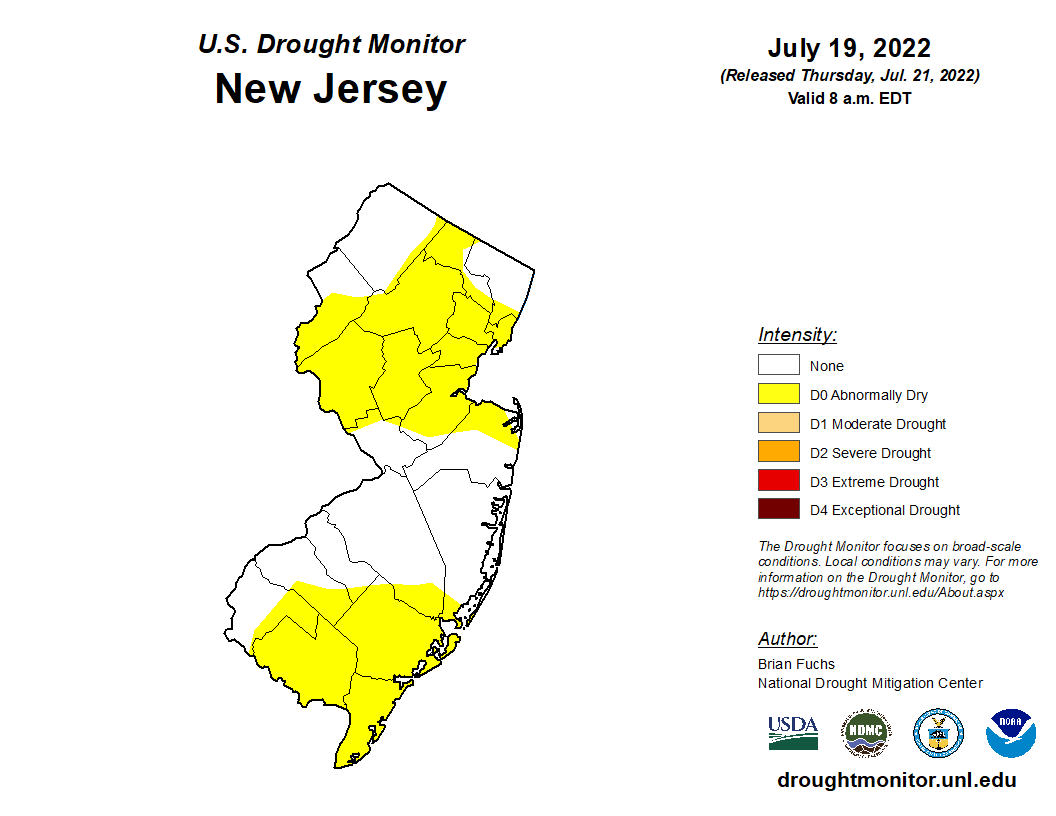


Crop progress: Drought stress continues

Drought conditions continue to stress crops in South-Central counties and a significant portion of northern NJ. Although the US Drought Monitor indicates conditions are only in the abnormally dry category, local conditions along the Pilesgrove-Upper Pittsgrove border west of the Salem River and adjoining areas of Gloucester County are experiencing moderate drought conditions in some fields; but not others due to the sporadic precipitation paths of recent storms. All stages of corn and soybeans in affected fields are showing signs of yield reduction due to disruption of pollination and seed set.

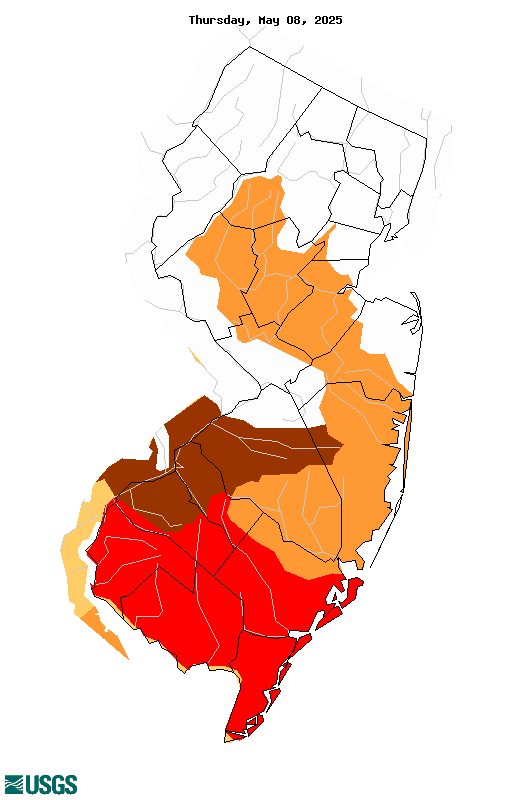
The USGS Below Normal 7-Day Average Streamflow Condition Map more accurately reflects a moderate hydrologic drought (darker orange colored area). A significant portion of the region has seen below normal precipitation for the past seven days. A streamflow which is less than the 25 percentile is considered below normal. The darker orange shaded areas of South-Central NJ of the USGS map represents 6-9 percentile stream flow activity.

below normal 7-day average streamflow condition map


Another way to observe increasing crop stress is to look at the cubic feet per second discharge of streams in the area since planting season. As seen in this graph of the Maurice River at Norma, NJ, current stream level discharge is well below the median daily discharge value over the past 88 years.


For information on USDA available drought related programs by commodity, see the poster:

Click to access farmersgov-disaster-assistance-brochure-07-21-2022.pdf

Pesticide Applicators Seminar – Credits Available

Over the past two years in-person trainings for pesticide applicators to obtain recertification credits have been a challenge. To educate licensed pesticide applicators and help them to receive credits, a 3-hour seminar will be held on Tuesday, October 18, 2022 from 9:00AM to 12:00PM at the Rutgers Cooperative Extension office in Gloucester County, 254 County House Rd, Clarksboro, NJ 08020. The meeting will be in the Sullivan Room auditorium. Attendees can enter through the ramp on the far right side of the main building. 

Presenter: Michelle Infante-Casella, Agricultural Agent

Schedule:
9:00 AM……………..Pesticide Storage Facilities and Pesticide Disposal

10:00 AM……………Pesticide Record Keeping, Notification, and Posting

10:30 AM……………Insect Identification and Life Cycles for Proper Control Strategies in Landscapes, Turf, and Farm Fields

11:00 AM…………….Weed Identification: Annuals and Perennials: Know Your Weeds in Landscapes, Turf and Farm Fields

11:30 AM…………….Common Plant Diseases of Major Crop/Plant Groups

12:00 PM …………….Pesticide Credits and Adjourn

The following credits have been assigned by NJ DEP:
3 – CORE Credits 
3 – PP2 Credits 
3 – 3A Credits 
3 – 3B Credits 
3 – 1A Credits 

Call 856-224-8040 ext. 1 or email jmedany@co.gloucester.nj.us to pre-register or for more information.

There is a $50.00 fee per participant. Only checks or cash will be accepted. Please make checks payable to “Rutgers the State Univ. of NJ”

Pre-registration is appreciated, and walk-in participants are welcome and can pay at the door. To find more information see: https://go.rutgers.edu/Oct18PesticideSeminar


Temporary Seasonal help needed for the Rutgers Vegetable IPM Program

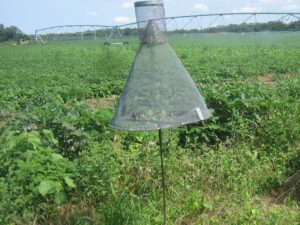
There are still positions available for seasonal, temporary worker(s) for the Rutgers Vegetable IPM program.  The work entails checking insect traps and doing some field scouting with farms in southern New Jersey (Burlington, Camden, Gloucester, Atlantic, Cumberland, and Salem counties).  There will be on-the-job

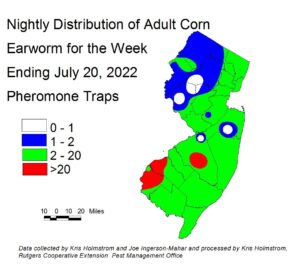
Corn earworm pheromone trap

training.  Hourly wages are up to $20/hour, depending upon experience and/or areas of study.  Applicants must have vehicles and will be reimbursed for mileage.  For more details and to fill out an application, please go to https://jobs.rutgers.edu/postings/158384

Veterinary livestock case studies and pinkeye alert

Livestock producers will benefit from a blog on the South Dakota University website for the Department of Veterinary & Biomedical Sciences documenting interesting case diagnostics. The site can be found at  https://www.sdstate.edu/veterinary-biomedical-sciences/whats-doc-case-reports.

Additional veterinary livestock case study sites:

https://tvmdl.tamu.edu/case-study-library/case-study-library-bovine/

If you don’t already have this book in your library, consider getting a copy of the https://www.merckvetmanual.com/.

Pinkeye reports are coming in more frequently in drought stricken areas of the western Unite States. With show season underway and cattle moving across states, be on the alert for pinkeye cases cropping up as dry and hot weather conditions continue.

University of Kentucky resource: https://ruminant.ca.uky.edu/files/factsheet_on_pinkeye_final.pdf


Summer sick lambs and goats. Is it Barber’s Pole Worm?

Barber’s pole worms are the most common ailment of lambs, kids and adult sheep and goats around the globe. As weather patterns shift, producers must shift management strategies to prevent economically debiliating infestations from taking over their herd.

To learn more about Barber’s Pole Worm, read my recent article in Progressive Forage ” Managing Barber’s Pole Worm“.

Barber’s pole worms are animal-parasitic nematodes that complete part of their lifecycle in pastures where infected fecal matter has been deposited. The egg’s hatch when temperatures rise above 50°F and moisture is abundant. The larva can then to develop to the L3 stage that is ingested by animals when they graze in seven to ten days. The higher the temperature, the quicker they develop. Timing dewormers to the infection rate of barber pole worm larva, and choosing the right wormer for the given conditions is a must strategy all producers need to implement to limit dewormer resistance.

When temperatures are cooler, the hatch rate of larva can take seven to ten days or more. They are rapidly reinfecting animals when temperature rise into the 80’s and 90’s as the hatch rate interval decreases to five days or less. As the infection interval decreases and parasitic load increases, producer’s may have to worm every three weeks.

HINDSIGHT HERD PLAN SCENARIO

2022 Barber’s Pole Hatch Recap (Woodstown, NJ Example)

January: Less than three consecutive days of temperatures over 50 degrees and less than eight days of temperatures over 50 degrees. Hatch rate low. What does this mean? Animal’s unlikely to have a heavy reinfestation load after fall deworming. This is the best month here locally to get base line fecal counts on the herd to detect animals with the most worm load. 

February: Three different weeks saw four consecutive days of temperatures over 50 degrees and into the 60’s. Hatch rate increasing. What does this mean? Animal’s likely to be exposed to Barber’s pole worms that were dormant since the end of summer. Barber’s pole worms time emergence to coincide with lambing season. Only certain dewormer’s can be given during the last trimester of lambing.

Lamb’s are most susceptible to barber pole worm infestations 60 days after lambing through 120 days after lambing

March: The last week of February through March 12 was less favorable temperatures and hatch rate should have decreased. Hatch rate lower.

Mid March: Ten consecutive days of temperatures above 50 degrees and into the 60’s. Hatch rates increasing. The time from ingesting L3 infective larvae to adults and more egglaying is typically between 16 and 21 days. First dewormer ideally targeted to end of March.

April:  Temperatures above 50 degrees and into the 60’s nearly every day. Temperatures over 80 degrees on April 13th. Days to re-infection decreasing from seven to five. Evaluate animals. Do not treat animals with low number of fecal counts to prevent dewormer resistance. If fecal counts are high, and worming is necessary: Second dewormer, four weeks since last March deworming.

May: Temperatures above 50 degrees and into the 60’s nearly every day. Temperatures over 80 degrees on May 20, 21 and 22. Days to reinfection decreasing from seven to five. Check animal’s not wormed in April to see if fecal counts are higher. If fecal counts are high, and worming is necessary: Third deworming, four weeks since April deworming.

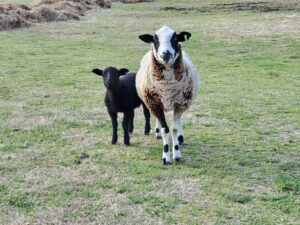
Sheep and lamb

June: Ten consecutive days above 80 degrees in early June increased days to hatch. The remainder of the month saw temperatures rose above 80 degrees for most of the month. Days to infection most likely within five days. Next dewormer in the schedule should be administered in three weeks not four.  After worming, move animals to a ‘rest’ pasture that has not been grazed since February-March (load worm pressure month) to break the cycle and reduce spread of resistant worms. 


July: Hatch rates continue to increase since the begining of the month. Days to reinfection within five days if no management strategies have been implement yet. Next dewormer in the schedule should be administered in three weeks not four. After worming, move animals to a ‘rest’ pasture that has not been grazed for 5 to 6 months (since January) to break the cycle and reduce spread of resistant worms. This is one of the most critical components of a limited acreage, high stocking density Barber’s pole management plan. 

Hot days ahead: The larval populations will crash when very hot dry weather occurs. This is why it is recommended, that on the hottest day of the year, heavily infested pastures should be mowed short to ‘cook’ the larva that use the grass blades to vector to grazing animals.

All dewormers have a slaughter and milk withdrawal days on the label. If animals are intended for slaughter or milk is intended for consumption, check the label and use the appropriate dose

Tailor your own deworming schedule? Interested in developing a Barber’s pole management plan projection like this one for your farm in NJ? (Deworming Schedule, FAMACHA Scoring, Fecal Egg Counts, Pasture Rotation). This is a step that can be done simultaneously with your state law required animal waste management plan. For assistance, contact Melissa Bravo, ANR Agronomic and Livestock Agent at the Salem County Extension Office.