Upcoming Research Field Tour in Burlington County

Rutgers Cooperative Extension of Burlington County will host a research and demonstration plot field tour at the Burlington County Agricultural Center on Wednesday, September 14, 2022. Pesticide recertification credits will be available: CORE (2) plus categories 1A (3), 10 (3), and PP2 (3).

Space is limited and REGISTRATION IS REQUIRED. Please contact Sandra Trossbach at 609-265-5051 or strossbach@co.burlington.nj.us to register by Wednesday, September 7.
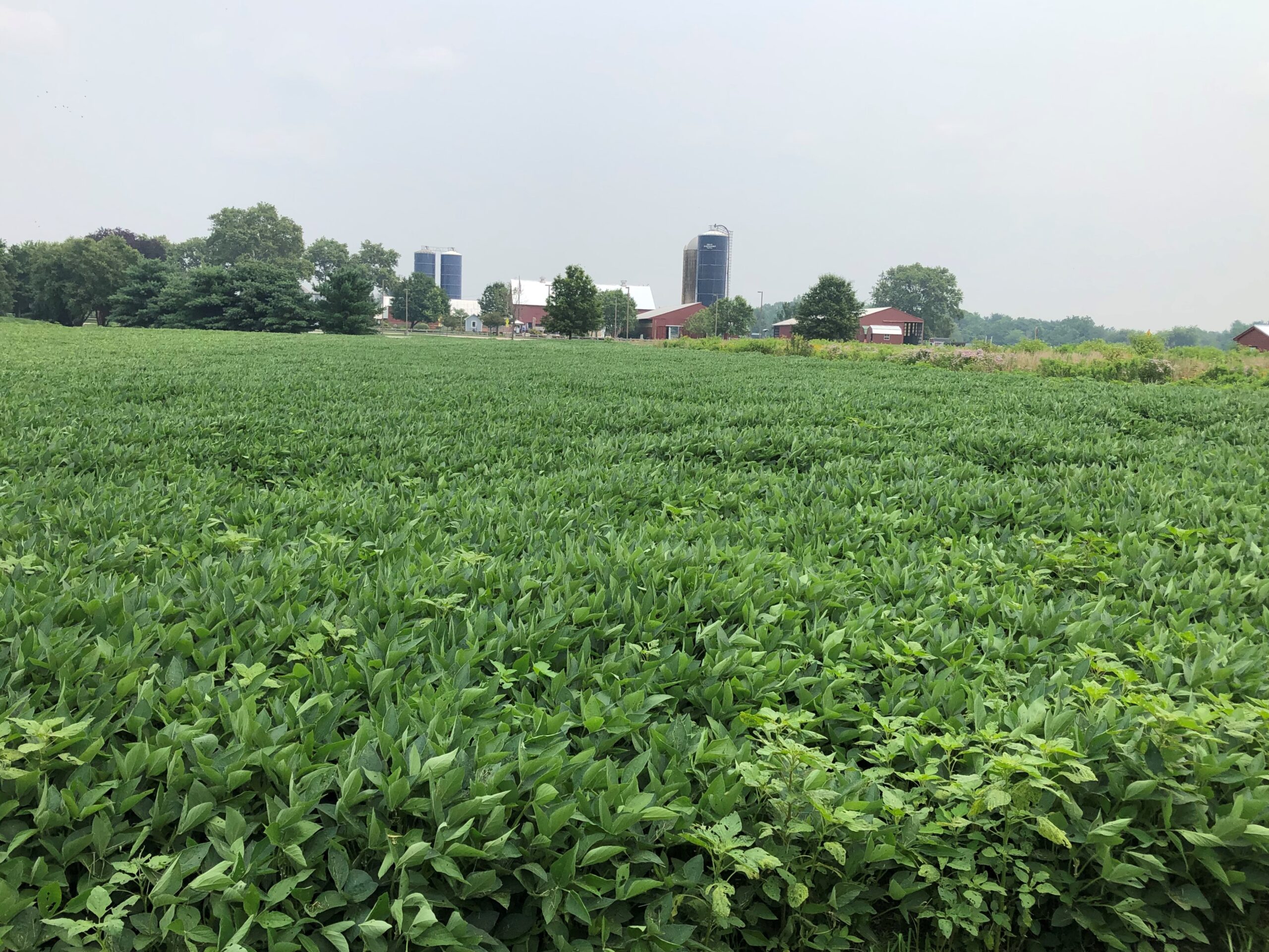
soybean field

Soybeans in research plot at Burlington County Agricultural Center.

PROGRAM AGENDA

5:15 p.m. Meal and Registration (in the red market barn)

6:00 p.m. Walk to demonstration plots

6:15 p.m. How low can you go? Impact of soybean planting population on yield efficiency and crop management.

  • Bill Bamka, Agricultural Agent, RCE-Burlington County

6:45 p.m. Off-target herbicide movement and response of economically important vegetable crops to sub-lethal rates of dicamba

  • Thierry Besançon, Extension Specialist in Weed Science – Specialty Crops, Rutgers NJAES

7:15 p.m. Walk back to market barn

7:30 p.m. Beyond the active ingredient: Additives to the pesticide spray tank

  • Kate Brown, Program Associate, RCE-Burlington County

8:00 p.m. Pesticide Recertification Credits and Adjourn

The flyer for this event is available at https://events.rutgers.edu/pdfs/Flyer_Research-Tour-at-Ag-Center-2022.pdf.
Rutgers Private Applicator 2023 Online License Renewal Assistance

The New Jersey Department of Environmental Protection has released an announcement “Pesticide License Renewal Info 2023” to licensed applicators via email. The announcement is posted at https://www.nj.gov/dep/enforcement/docs/Pesticide-License-Renewal-Info-2023.pdf?utm_medium=email&utm_source=govdelivery.  See today’s companion post to the Plant & Pest Advisory entitled “Private Applicators: NJDEP August Mailing of 2023 Invoices & Recertification Credit Status“. All Private Applicators are now […]

Private Applicators: NJDEP August Mailing of 2023 Invoices & Recertification Credit Status

On August 11, 2022,  the New Jersey Department of Environmental Protection released an email announcement entitled “NJDEP Pesticide Licensing & Registrations – 2023 Pesticide License Renewal Information.” If you cannot locate it in your email, the entire notice is posted for you at Pesticide-License-Renewal-Info-2023. Their notice explains that the NJDEP will be sending paper license […]

Much Needed 72 Hour Precipitation Accumulations

Doppler radar polarimetric technology from iWeatherNet.com: Rainfall totals for the last 24 hours to 3 days – high resolution map shows a widespread system brought much needed precipitation to South-Central NJ Sunday, July 31st though the 72-hour period ending August 2, 2022. In Salem County, areas along the Delaware River to west of Woodstown received 5/10ths to 9/10ths in parts of Mullica Hill. A wider swath through Woodstown and Glassboro provided 3/10ths to less than an inch. A narrower swath of 7/10ths to one inch fell from Elmer to Williamstown. Localized areas west of Salem City and South of Abbottstown Meadow received an inch of accumulation. Less than 3.0 inches of rain have been recorded below Memorial Lake at the USGS 393838075194901 Woodstown USGS Gauge for the month of July.

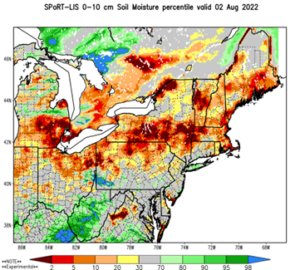
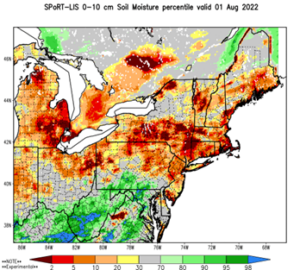
Looking at the Short-term Prediction Research and Transition Center map, soil moisture for surface to ten cm depth readings shifted from below the 3-percentile category for much of the county on August 1st to the 30th percentile as of August 2, but a large area of production remains in the five to ten percentile.

Emerging Foreign Notifiable Diseases in Livestock. Know the Signs

The discovery of the Asian longhorn tick (Haemaphysalis longicornis) in a flock of sheep in NJ in 2017 is a reminder to producers that foreign diseases and or foreign vectors of diseases can and have come to the United States in recent times. Livestock producers are the first line of defense in recognizing a foreign notifiable disease or vector. With the veterinary shortage unresolved, producers must rely on their own knowledge of signs of a disease not previously known to occur in the United States and be aware of current outbreaks in other countries of diseases not previously detected in North America.

The below table lists notifiable foreign diseases of cattle, and links to fact sheets providing further information.

Cattle Disease Disease scientific Name, Vector Detected in United States
Bovine babesiosis Tick borne Babesia bovis, B. bigemina Mexico/U.S Border regions
Bovine spongiform encephalopathy (BSE)


Through August 2018, BSE surveillance has identified 26 cases in North America: 6 BSE cases in the United States and 20 in Canada
Contagious bovine pleuropneumonia Mycoplasmamycoides mycoides Reportedly eradicated in United States in the mid-20th century
Hemorrhagic septicemia Pasteurella multocida, serotypes B/Asian or E/African  Hemorrhagic septicemia-causing strains are not thought to circulate in North America. The disease was reported to the WOAH from Colombia in 2007, Venezuela in 2015 and Ecuador in 2018
Lumpy skin disease


Fly, mosquito, and tick vectored Capripoxvirus North and South America continents have not seen this disease before and cattle will have no naïve immunity
Theileriosis  Tick borne Theileria species
Trichomoniasis


sexually transmitted protozoan parasite TRCH 25 different states and a total of 3,817 reported cases nationwide 2015-2019
Trypanosomosis Tsetse fly-transmitted Trypanosoma species Tsetse flies are not found in North America


In the News: Monkey pox is an example of an emerging notifiable disease of humans that does not affect livestock that is spreading around the world in 2022. An emerging pox outbreak in cattle in 2022 is lumpy skin disease, a capripoxvirus that causes a debilitating disease of particular concern in lactating European breeds of dairy cattle that have no naïve immunity like indigenous breeds in the countries where the disease has evolved.

Currently lumpy skin disease, a Capripoxvirus of cattle and water buffalo endemic to Africa has spread from the Middle East to south-east Europe, affecting EU Member States (Greece and Bulgaria) and several other countries in the Balkans in 2012. A major risk factor for the spread of livestock diseases and their vectors is the uncontrolled transboundary movement of live animals for trade, grazing or due to war and conflict. Since its first outbreak in 1928 in Africa, no direct transmission of LSD to humans has been reported. Since 2012, war, famine, and normal trade of livestock across borders is spreading the disease unchecked in the Middle East. In 2021, the World Organization for Animal Health reported that since 2015, “the disease has spread to most of the Balkan countries, the Caucasus and the Russian Federation, where the disease continues to spread, making the risk of an imminent incursion into other unaffected countries very high.” Lumpy skin disease was first reported in Asia and the Pacific region in 2019 in north-west China, Bangladesh and India. During the northern summer of 2020, LSD has continued its spread across continental Asia with many members in South and South East Asia confirming outbreaks. As of May 2022, an estimated five million dairy farmers and meat sellers in Pakistan have had an outbreak in their cattle. India is now experiencing an unchecked outbreak of the disease in dairy cattle in many western states.

From the WOAH Fact Sheet

Frequently Asked Questions (FAQ) on lumpy skin disease (LSD)

What is lumpy skin disease (LSD)? Lumpy skin disease (LSD) is caused by lumpy skin disease virus (LSDV), a virus from the family Poxviridae, genus Capripoxvirus. Sheeppox virus and goatpox virus are the two other virus species in this genus.

What domestic animals may be affected by LSD? LSDV is highly host specific and causes disease only in cattle (Bos indicus and B. taurus) and water buffalo (Bubalus bubalis). There is evidence from a study in Ethiopia of differential breed susceptibility to LSD, with Holstein Friesian or crossbred cattle exhibiting higher morbidity and mortality due to LSD when compared with local zebu cattle. LSDV is not zoonotic, so humans cannot get affected by the disease.

Are there any recent LSD cases in sheep and goat? There are no reports of LSD in sheep and goats or of their epidemiological involvement in the disease despite being kept in close proximity to cattle.

For more information read the entire fact sheet at https://www.woah.org/app/uploads/2022/06/faq-lsd-faired-v2-4forpublication.pdf

Signs a veterinarian looks for to detect a notifiable reportable disease in livestock

  • Unexplained sudden onset of high morbidity and high mortality
  • Severe abortion storms of unknown etiology
  • Severe respiratory conditions
  • Vesicular lesions (blistering skin not associated with sunburn)
  • Pox or lumpy skin conditions
  • Poor or no response to treatment when response is expected
  • Atypical findings at necropsy
  • History of foreign travel, foreign visitors, or receipt of foreign parcels (from a region where disease is present, accompanied by any of these symptoms)
  • Recent importation of animals, embryos, or semen (accompanied by any of these symptoms)
  • Undiagnosed encephalitic (CNS) conditions

For more information on foreign disease in livestock response, visit https://www.aphis.usda.gov/aphis/ourfocus/animalhealth/animal-disease-information


Special IPM Update – Fall Armyworm Alert

Sweet Corn – Fall Armyworm

As of Wednesday (7/27) evening, significant fall armyworm (FAW) infestations were found in whorl stage sweet corn in Cape May County.  These infestations were nearing 50% of plants infested, and are an indication that all sweet corn growers in southern NJ should be checking fields regularly for signs of FAW feeding.  This pest often hits earliest and hardest in coastal areas, and new infestations have been detected up the coast to Monmouth County.  Northern infestations have been much lower, and very recent.

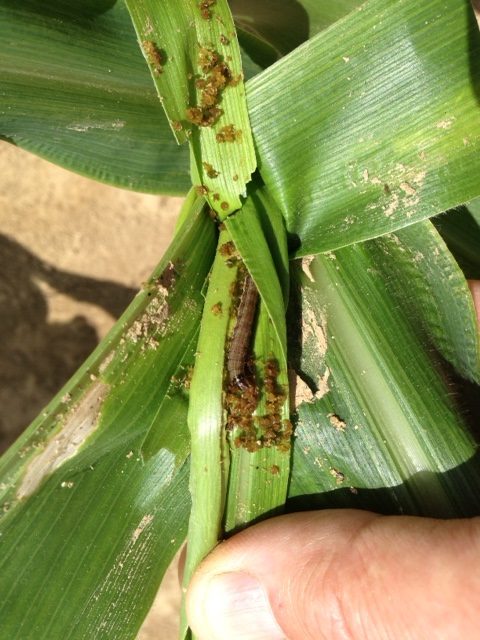
Look for extensive foliar feeding in sweet corn ranging from seedling to pre-tassel stage.   FAW create large volumes of droppings that often cover larvae while feeding in the whorl.  Untreated infestations can result in severely stunted plants.  Consider treating when FAW feeding alone, or in combination with European corn borer exceeds 12%.  Insecticides in the IRAC 28 class (diamides) and IRAC 5 class (spinosyns) work well against FAW.