Veterinary livestock case studies and pinkeye alert

Livestock producers will benefit from a blog on the South Dakota University website for the Department of Veterinary & Biomedical Sciences documenting interesting case diagnostics. The site can be found at  https://www.sdstate.edu/veterinary-biomedical-sciences/whats-doc-case-reports.

Additional veterinary livestock case study sites:

https://tvmdl.tamu.edu/case-study-library/case-study-library-bovine/

If you don’t already have this book in your library, consider getting a copy of the https://www.merckvetmanual.com/.

Pinkeye reports are coming in more frequently in drought stricken areas of the western Unite States. With show season underway and cattle moving across states, be on the alert for pinkeye cases cropping up as dry and hot weather conditions continue.

University of Kentucky resource: https://ruminant.ca.uky.edu/files/factsheet_on_pinkeye_final.pdf


Summer sick lambs and goats. Is it Barber’s Pole Worm?

Barber’s pole worms are the most common ailment of lambs, kids and adult sheep and goats around the globe. As weather patterns shift, producers must shift management strategies to prevent economically debiliating infestations from taking over their herd.

To learn more about Barber’s Pole Worm, read my recent article in Progressive Forage ” Managing Barber’s Pole Worm“.

Barber’s pole worms are animal-parasitic nematodes that complete part of their lifecycle in pastures where infected fecal matter has been deposited. The egg’s hatch when temperatures rise above 50°F and moisture is abundant. The larva can then to develop to the L3 stage that is ingested by animals when they graze in seven to ten days. The higher the temperature, the quicker they develop. Timing dewormers to the infection rate of barber pole worm larva, and choosing the right wormer for the given conditions is a must strategy all producers need to implement to limit dewormer resistance.

When temperatures are cooler, the hatch rate of larva can take seven to ten days or more. They are rapidly reinfecting animals when temperature rise into the 80’s and 90’s as the hatch rate interval decreases to five days or less. As the infection interval decreases and parasitic load increases, producer’s may have to worm every three weeks.

HINDSIGHT HERD PLAN SCENARIO

2022 Barber’s Pole Hatch Recap (Woodstown, NJ Example)

January: Less than three consecutive days of temperatures over 50 degrees and less than eight days of temperatures over 50 degrees. Hatch rate low. What does this mean? Animal’s unlikely to have a heavy reinfestation load after fall deworming. This is the best month here locally to get base line fecal counts on the herd to detect animals with the most worm load. 

February: Three different weeks saw four consecutive days of temperatures over 50 degrees and into the 60’s. Hatch rate increasing. What does this mean? Animal’s likely to be exposed to Barber’s pole worms that were dormant since the end of summer. Barber’s pole worms time emergence to coincide with lambing season. Only certain dewormer’s can be given during the last trimester of lambing.

Lamb’s are most susceptible to barber pole worm infestations 60 days after lambing through 120 days after lambing

March: The last week of February through March 12 was less favorable temperatures and hatch rate should have decreased. Hatch rate lower.

Mid March: Ten consecutive days of temperatures above 50 degrees and into the 60’s. Hatch rates increasing. The time from ingesting L3 infective larvae to adults and more egglaying is typically between 16 and 21 days. First dewormer ideally targeted to end of March.

April:  Temperatures above 50 degrees and into the 60’s nearly every day. Temperatures over 80 degrees on April 13th. Days to re-infection decreasing from seven to five. Evaluate animals. Do not treat animals with low number of fecal counts to prevent dewormer resistance. If fecal counts are high, and worming is necessary: Second dewormer, four weeks since last March deworming.

May: Temperatures above 50 degrees and into the 60’s nearly every day. Temperatures over 80 degrees on May 20, 21 and 22. Days to reinfection decreasing from seven to five. Check animal’s not wormed in April to see if fecal counts are higher. If fecal counts are high, and worming is necessary: Third deworming, four weeks since April deworming.

Sheep and lamb

June: Ten consecutive days above 80 degrees in early June increased days to hatch. The remainder of the month saw temperatures rose above 80 degrees for most of the month. Days to infection most likely within five days. Next dewormer in the schedule should be administered in three weeks not four.  After worming, move animals to a ‘rest’ pasture that has not been grazed since February-March (load worm pressure month) to break the cycle and reduce spread of resistant worms. 


July: Hatch rates continue to increase since the begining of the month. Days to reinfection within five days if no management strategies have been implement yet. Next dewormer in the schedule should be administered in three weeks not four. After worming, move animals to a ‘rest’ pasture that has not been grazed for 5 to 6 months (since January) to break the cycle and reduce spread of resistant worms. This is one of the most critical components of a limited acreage, high stocking density Barber’s pole management plan. 

Hot days ahead: The larval populations will crash when very hot dry weather occurs. This is why it is recommended, that on the hottest day of the year, heavily infested pastures should be mowed short to ‘cook’ the larva that use the grass blades to vector to grazing animals.

All dewormers have a slaughter and milk withdrawal days on the label. If animals are intended for slaughter or milk is intended for consumption, check the label and use the appropriate dose

Tailor your own deworming schedule? Interested in developing a Barber’s pole management plan projection like this one for your farm in NJ? (Deworming Schedule, FAMACHA Scoring, Fecal Egg Counts, Pasture Rotation). This is a step that can be done simultaneously with your state law required animal waste management plan. For assistance, contact Melissa Bravo, ANR Agronomic and Livestock Agent at the Salem County Extension Office.

Crop progress, droughty conditions persist

Despite the thunderstorms that rolled through on Tuesday night, Salem County and others bordering the Delaware River have experienced 27 weeks of severly dry conditions according to the NJ DEP Drought Information website for Regional Water Supply Indicators for the 90 day stream flow reporting.  

Salem County: The National Integrated Drought Information System created by NOAA and the US Drough Monitor website have most of Salem County listed as abnormally dry but not yet in a declared drought situation.

Crop scouting observations (Salem County)

May planted corn is beginning to tassle with most fields exhibiting exceptional height, uniformity and color. Drought stress during pollination this week; along with moderate silk clipping pest pressure (june bugs, japanese beetles, grasshoppers) could impact kernal development.

Weed control in corn is generally good to excellent. Velvetleaf, cocklebur, jimsonweed, ivy leaf, common morning glory, giant ragweed, cocklebur and shattercane are noticeable along field edges.

Double cropped corn after small grains, and later planted corn is exhibiting water stress with many fields under three feet tall remaining curled at 7:30 am.

National Integrated Drought Information System, NOAA. July 14, 2022

The next brood of grasshoppers has hatched in alfalfa fields and looks as abundant as in 2021. The good news is the brood hatches in May and June did not appear to be as prolific as last year’s. Hay and soybean producers should monitor the grasshopper pressure in individual fields for signs the population is going to surpass economic thresholds. Corn fields planted in high infestation areas last year may also see some significant feeding as the drought continues. Effective control methods are only useful on nymph stage grasshoppers. Contact the Salem County office to let Melissa know if you are seeing significant grasshopper damage.

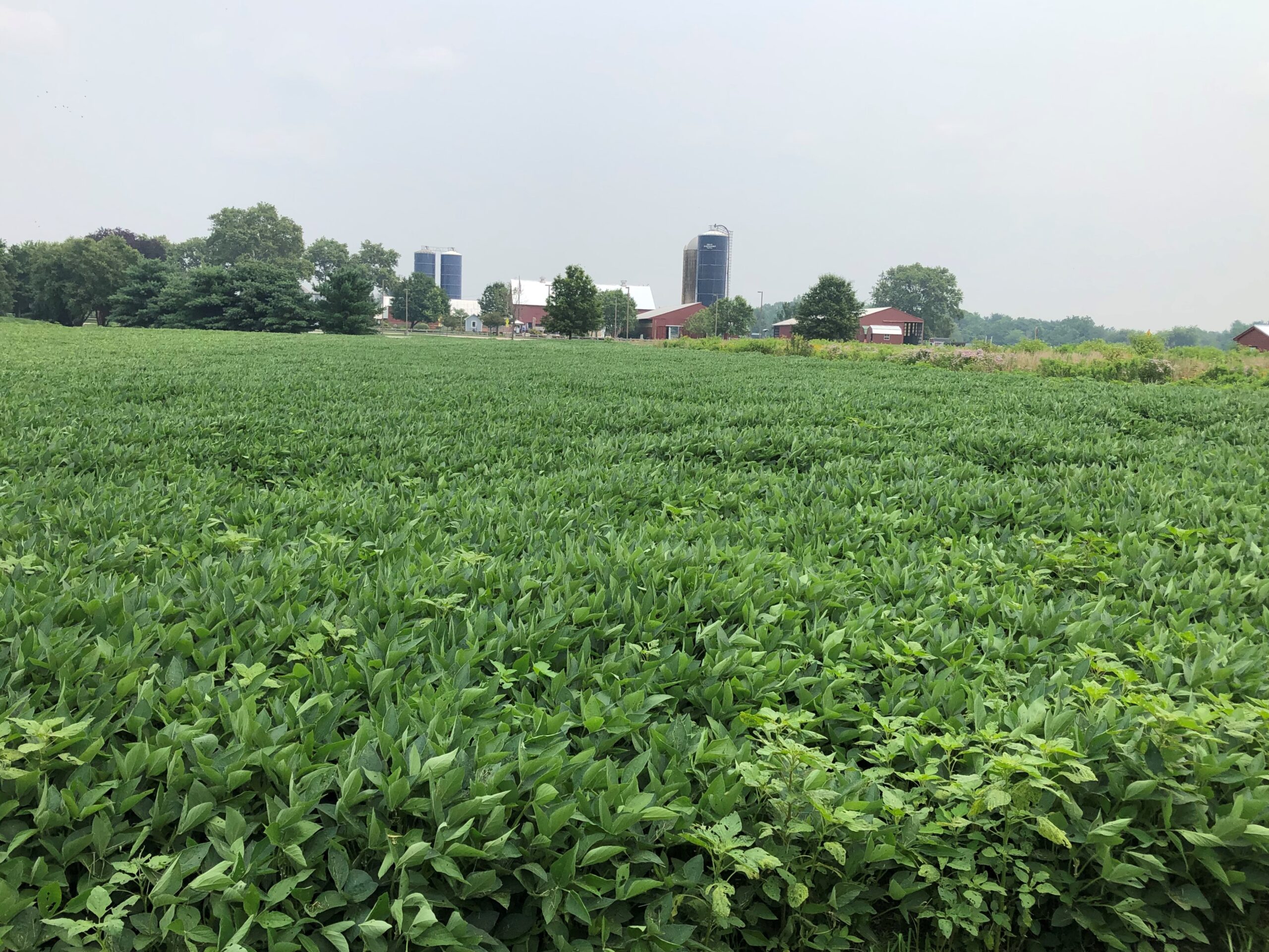
Green-redroot pigweed, spiny pigweed, palmer amaranth are outpacing soybean height in fields yet to be sprayed. Weed control in soybeans is noticeably better this year compared to conditions this time last year.

Herbicide Plant-Back Restrictions Explained: Purpose and Application

Are you crystal clear on the purpose of plant-back restrictions and on the length of time required between a herbicide application and the planting of your next crop or cover crop? If not, the guidance below should help. It was developed based on a poster presentation made during the 2022 annual meeting of the Weed Science Society of America (WSSA). For further information regarding the plant-back restrictions for vegetable crops, please refer to Pest Management section (p. 110-118) of the 2022/2023 Commercial Vegetable Production Recommendations.

  • What is a plant-back interval?
    A plant-back interval is the minimum period of time between a pesticide treatment and the planting of your next crop. The EPA establishes plant-back intervals as label requirements for herbicides, insecticides, fungicides, plant growth regulators and other types of pesticides.
  • What’s the purpose of a plant-back interval?
    EPA’s primary focus in setting plant-back intervals is to protect human health by preventing over exposure to pesticide residues in crops – including fruits and vegetables. Regulatory experts include all residue sources when assessing human dietary exposure.
  • Do plant-back intervals also address crop phytotoxicity concerns?
    While pesticide registrants may choose to add label instructions to address potential crop injury or phytotoxicity concerns, these instructions are independent of EPA-mandated plant-back restrictions that focus on limiting human exposure to pesticide residues. If your crop is intended to be harvested for human or animal consumption, you must still comply with the minimum residue-based plant-back intervals, regardless of whether phytotoxicity guidance is given.
  • How are plant-back intervals established?
    EPA requires that pesticide registrants submit residue studies to document pesticide levels and related metabolites. Study data is then used to develop appropriate plant-back interval guidance based on allowed tolerance levels in the plant-back crop. All residue sources from pesticides applied within the current and previous growing seasons are included when assessing human dietary exposure. It is important to note that the plant-back intervals specified by EPA are crop specific. The interval specified for tomato, for example, might vary from that established for cole crops.
  • What should I do if I’m planting a crop that isn’t specified on the label?
    Crops that are not specifically addressed on the label fall into the “other crops” category and require the maximum plant-back interval indicated on the label.
  • Do plant-back intervals apply to both my rotational crop and my cover crop?
    If the crop is harvested for human consumption or is grazed by or fed to livestock that will be consumed by humans, the crop is considered a “rotational crop” and requires an appropriate plant-back interval to protect human health.
    Seasonal plantings that will not be consumed directly by humans or by livestock that will then be consumed by humans are considered “cover crops.” Cover crops such as ryegrass or hairy vetch are grown to improve soil quality, reduce erosion or manage weeds. Since there is no risk of dietary exposure, plant-back restrictions do not apply when planting cover crops.
  • How do I calculate the plant-back interval?
    To comply with the mandated plant-back interval, use the date of the last pesticide application as a starting point. If, for example, the crop selected has a 365-day plant-back interval, the 365-day window begins on the day after the last pesticide application to the previous crop. You can plant that next crop 365 days later.

Resources for New Jersey Licensed Private Pesticide Applicators & Growers – 2022 Meetings Tools for Regulatory Compliance

In 2022 Rutgers provided growers with regulatory updates in presentations at NJACTS, the Blueberry Open house and South Jersey Vegetable and Field Crop, North & South Jersey Tree Fruit, and Blueberry Twilights.  Thanks to all host farms. Laminated WPS Pesticide Safety Posters and other WPS Resources were distributed at all Twilight meetings. Specific tools for […]

Crop progress and sicklebarring palmer greenstalks

Salem County: Two plus inches of June precipitation on the 9th and 12th carried non-irrigated corn and soybean through the month with only trace amounts of precipitation until the 24th when some areas received another half inch.

In exceptionally wet fields, climbing humidity levels on the 13th, 14th, and 15th were high enough to allow for foliar disease development in beans. But the following week of low humidity was less than conducive for disease proliferation until the 22nd through the 25th when humidity levels briefly rose and remained in the high 80’s and 90’s for three days, before dropping nicely to the mid 60’s the last two days of June. However, wind speeds of 15 to 25 mph from June 13th to June 19th wicked moisture out of corn and soybeans leaving the crops in a moisture deficit.

This is confirmed in ‘The Evaporative Demand Drought Index’ (EDDI) monitoring tool for South-Jersey. This tool created by the NOAA Physical Science Laboratory is an indicator of both rapidly evolving “flash” droughts and sustained droughts. “EDDI can offer early warning of agricultural drought, hydrologic drought, and fire-weather risk.”

Pest pressure: Producers should monitor beans for Japanese beetle, green stink bug and grasshopper feeding going into July and be alert to excessive damage from flea beetles on crops stressed from wind evaporation. Palmer amaranth is exceptionally tolerant to droughty conditions and thrives under stresses that wilt other pigweed species. Shattercane and johnsongrass are both warm-season grasses that also thrive under these weather conditions.

Mechanical options: In addition to chemical control options, if droughty evaporative weather persists, producers should consider manually removing seedhead stalks to protect maximum yield projections in soybeans. The ideal mechanical tool to do this would be a front mounted sickle bar mower. Do-it-yourself fabricators maybe interested in this attachment created specifically to deal with palmer amaranth by a Kansas farmer. (A cooperative build, purchase, may be a good investment for combine and spray rig operators in the County). https://www.rowshaver.com/

Forecast: Going into this weekend, the 24-hour precipitation forecast for

New Jersey anticipates a tenth of an inch to half inch of rainfall for most of Salem County through July 3 and much-needed swath probable for the northern counties where drought conditions the last seven days are 51% to 75% below normal.