Emergency Prepardness Poster’s for Producers

Emergency prepardness poster’s are available from the New Jersey Department of Agriculture on the website page “Emergency Preparedness/ Homeland Security, CART” at the link: https://www.nj.gov/agriculture/news/hottopics/topics050107.html

The green and white poster’s provide a quick checklist on Being Alert, Being Secure, Being Clean, and Who to Contact if suspicious activity of unexplained illness occurs on your farm. Take the time to print the most appropriate poster for you operation and add the contact information for your designated county emergency management official and designated county agent for farm related evacuations and call center activities. Remember, If you do not have your county agent phone number in your cell phone they most likely do not have yours.

SPECIFIC POSTERS

Agriculture Aviation
Animal Feed Industry
Aquaculture Industry
Cattle Industry
Dairy Industry
Equine Industry
Farmstand/Roadside Market
Fertilizer Manufacturer/Distributor Industry
Grain and Forage Producer Industry
Livestock, Poultry Auction
Poultry Industry
Slaughterhouse Industry
Small Ruminant Industry
Swine Industry
Veterinary Hospitals
Wholesale Produce Industry
Zoos, Animal Exhibits, Shows, Fairs and Petting Zoos

For all producers and pet owners, species-specific information related to evacuations and shelter locations can be found in the County Animal Response Teams (CART) tab at https://www.nj.gov/agriculture/animalemergency/

Specific information useful to livestock and equine owners is also available at https://www.fema.gov/blog/preparing-farm-animals-disaster

*Producers farming in the ten-mile radius emergency planning zone of the Salem Nuclear Power Plants should print and post the most recent addition of the New Jersey-Delaware Emergency Plan Information Booklet. 

**Salem County producers, if you would like to participate in a ‘mock evacuation’ planning session for livestock and horses, and fill out your customized plan, contact Melissa Bravo at the County Extension Office.


Shovel solutions to biennial thistles

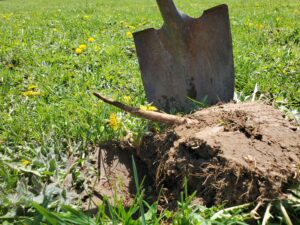
Noxious weeds are insidious destroyers of land value and productivity and a legacy one does not want to leave for the next generation. The wind blown seeds of biennials like dandelion, musk and bull thistle are readily visible this time of year in lawns and pasture. While perennial weeds like canadian thistle and horsenettle are often too numerous to control manually, musk and bull thistle can be eradicated with just a shovel or post hole digger.

In a year when fertilizer, herbicide and hay purchases are exceptionally high, managing these noxious weeds manually before they produce a seed head later this summer is a win-win investment of your time.

This weekend, I spent an hour shoveling out one hundred and thirty eight first year and second year rosettes of musk and bull thistle in a four acre section of a permanent pasture. Shoveling out thistle rosettes is a great low intensity whole body workout, and a great way to destress while soaking up vitamin D. Collecting soil from each hole will also work as a randomized soil sample.

The growth habit of non-bolting (first year rosettes) and bolting (second year rosettes) are easily distinquishable from the two leaf stage of leafing out Canadian thistle.

If the infestation is significant, focus your time on just the large dense rosettes that are taller and wider than the low to the ground rosettes. These larger rosettes are most likely second year growth and the ones that will bolt a flower stalk. If allowed to go to seed, each individual plant can send out thousands of wind blown seeds.

While walking the pasture, take note of emerging Canada thistle shoots and calculate if the area can be treated with just a back pack sprayer or is a boom sprayer more appropriate. Other stand reducing weeds like curly dock, stinging nettles and buttercups are easily seen this time of year. Monitoring the proliferation of these weeds in a pasture is a good indication of the pH level and productivity of the existing grass sward. Rumex species are distributed by visiting waterfowl and buttercups are notorious for cropping up after flooding. If hay was purchased from out of state last year and you noticed feed refusal, pay particular attention to areas where hay was fed for signs of common mixed grass hayfield contaminants like Pennsylvania smartweed, multiflora rose and catchweed bedstraw.

If you would like to host a pasture walk this season to identify weeds of concern and learn how to best manage them on your farm in Salem, or nearby in Cumberland or Gloucester County, contact Melissa Bravo at the Salem County office.

Drought planning. Monitoring real time stream flow

With dry conditions occurring as planting season is underway monitoring real time stream flow is a useful tool.

Non-irrigation users as well as those who rely on irrigation can use this tool to forecast short term and long term conditions that will benefit or impact when and what to plant, when to water, and how precipitation or the lack thereof will help or hurt applications of nitrogen fertilizer and herbicides that require surface moisture for activation.

Here is the link to the USGS real time stream flow readings on the National Water Dashboard for Salem County and surrounding areas. Chose stream level data and aquifer type in the legend box to see streams near your location.

At the end of March, the county was about at an inch and a half deficit for rainfall compared to the 30-year average. Despite the inches received in April, streamflow readings at nine locations in the coastal plain aquifer system of South-Central NJ are much below normal. Ten readings are below normal, and one reading on Mantua Creek in Pitman, NJ is at an all-time low for this day.

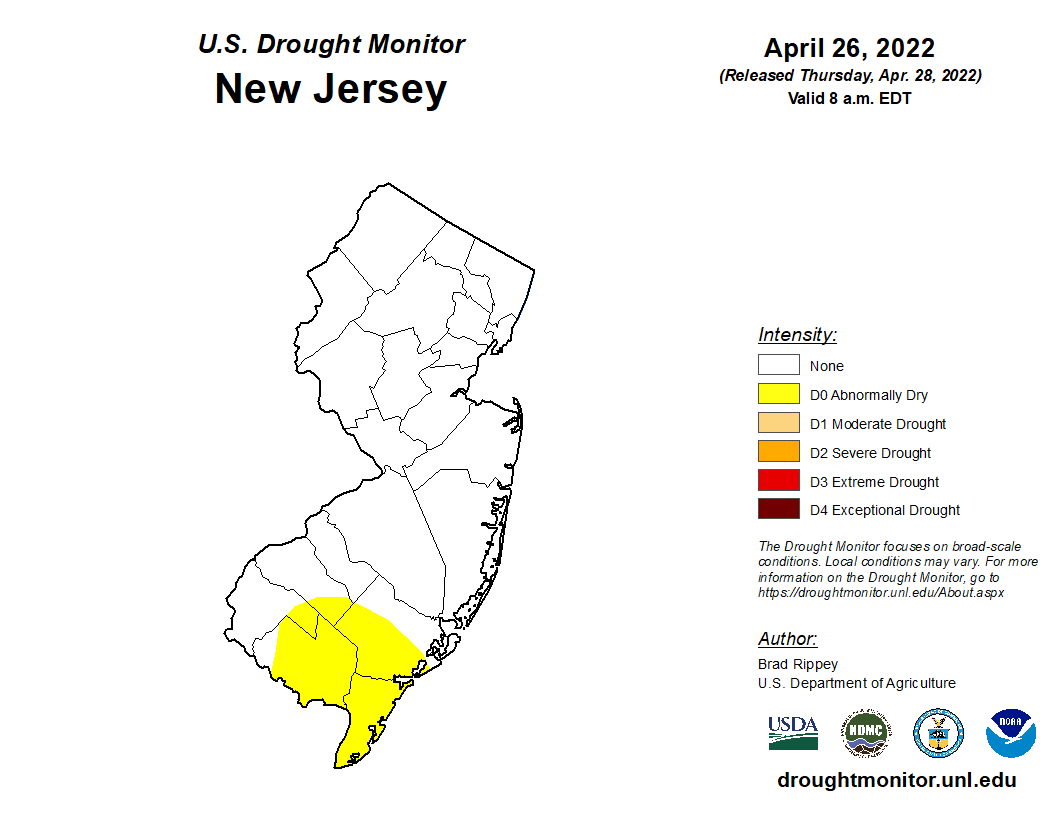
If we use the US Drought Monitor comparison slider, we can see that much of Cumberland County and parts of Salem and Gloucester are experiencing drier conditions then this time last year. Gusty winds and below average high temperatures the last three days of April stressed spring seedling flower transplants and annual crop germinations. The duration of wind significantly dried surface soil moisture limiting transplant root expansion and delayed new seeding Adventitious roots from expanding deeper into the soil. Comparing this information to last year’s crop progress and monitoring root development (moisture seeking behavior) can help producer’s estimate crop progress and response to droughty conditions going forward.

The current forecast has a good chance of rain on Wednesday and again on Friday and Saturday. After the rains, revisit the real time stream monitoring site and see if local conditions have changed. If stream discharge improves, this is a good indication sub soil has adequate moisture, and in sandy soils this will help roots to expand deeper into the soil profile.


Pesticide Applicator or Dealer Storage Inventory with Cover Letter Due May 1st to Fire Department

All licensed pesticide applicators, as well as dealers, who store pesticides are required by law to send a copy of their storage inventor(ies) with an explanatory cover letter to the local fire company by May 1st each year. In New Jersey, all licensed pesticide applicators and dealers who store pesticides are required per N.J.A.C. 7:30-9.5 […]

April is National Sexual Harassment Awareness Month – Farm Workers at Risk

From MorningAgClips.com posting (4/7/22) <https://www.morningagclips.com/free-training-tools-available-to-address-sexual-harassment-of-farmworkers/> from 4/5/22 press release from Equitable Food Initiative <https://equitablefood.org/latest-news/free-training-tools-available-to-address-sexual-harassment-of-farmworkers/>

Free training tools available to address sexual harassment of farmworkers

Equitable Food Initiative supports awareness initiatives during Harassment Prevention Month

WASHINGTON — Equitable Food Initiative, the workforce development and certification organization that partners with growers, farmworkers, retailers and consumer advocacy groups, has collaborated with Pacific Northwest Agricultural Safety and Health Center (PNASH), a part of the University of Washington Department of Environmental and Occupational Health Sciences, to support the development of a worksite training and toolkit, ¡Basta! Preventing Sexual Harassment in Agriculture.

April is National Sexual Harassment Awareness and Prevention Month, and EFI is using the time to shine a light on this important topic. Several studies have found that 75%-80% of female farmworkers have experienced sexual harassment at work, compared to 50% in non-agricultural office settings as reported by the Equal Employment Opportunity Commission.

The EFI website offers statistics, facts and study citations on harassment at work, links to access the ¡Basta! Preventing Sexual Harassment toolkit, which features videos in both English and Spanish, and educational materials that can be used in workplaces (posters, shareable graphics and a detailed fact sheet). The information and resources can be found at equitablefood.org/harassment, and all are provided free of charge.

“Development of the ¡Basta! toolkit was catalyzed by female farmworkers in Eastern Washington who brought the issue of sexual harassment to PNASH,” explained Dr. Jody Early, a professor at University of Washington who worked on the project. “This is the first program created by and for agricultural stakeholders to address the prevention of sexual harassment, and we tailored it to the needs of Latino/a/x farmworkers, growers and supervisors.”

The PNASH team worked for six years and engaged more than 48 different stakeholders in the development – including farmworkers, grower associations, health care advocates, human rights organizations, state and federal agencies, farmworker rights groups, private businesses and nonprofits like Equitable Food Initiative.

“This can be a difficult topic, but it’s essential that we address it industrywide,” said LeAnne Ruzzamenti, director of marketing communications for EFI. “We know that harassment happens more frequently among farmworkers, we know that it goes unreported, and we know that agriculture workplaces include characteristics that make women more vulnerable to it.”

EFI’s certification program goes beyond a simple audit and introduces workforce development solutions along with training in communication, conflict resolution, problem-solving and collaboration. Third-party evaluation studies have found that the program fosters culture shifts on farms that result in respectful and trusting workplaces where women and indigenous workers report reduced harassment and discrimination.

“EFI’s mission is to improve the lives of farmworkers by bringing everyone in the system together to address the fresh produce industry’s most pressing problems,” Ruzzamenti continued. “I can’t think of a more important goal than creating safer and healthier workplaces through a zero-tolerance approach to harassment.”


About EFI
Equitable Food Initiative is a nonprofit certification and skill-building organization that seeks to increase transparency in the food supply chain and improve the lives of farmworkers through a team-based approach to training and continuous improvement practices. EFI brings together growers, farmworkers, retailers and consumers to solve the most pressing issues facing the fresh produce industry. Its unparalleled approach sets standards for labor practices, food safety and pest management while engaging workers at all levels on the farm to produce Responsibly Grown, Farmworker Assured® fruits and vegetables. For more information about Equitable Food Initiative, visit equitablefood.org.

View a list of EFI-certified farms at equitablefood.org/farms.

–Equitable Food Initiative

Crop progress report. April showers needed

The U.S. Drought monitor release March 31, 2022 for the period ending March 29, 2022 had all of NJ experiencing abnormally dry conditions, and all of south Jersey experiencing moderate drought conditions.

New Jersey Year to Date Precipitation Departures as determined by NOAA indicates year to date mean aerial precipitation for south Jersey of 7.5 to 9.1 inches as of April 1, is about 2 inches below normal for this time of year. https://www.weather.gov/marfc/NJPrecipitationYTD

Follow this link to review moisture conditions in mid-April last year and pre herbicide considerations.  https://plant-pest-advisory.rutgers.edu/soybeans-planted-already-weather-and-pre-herbicide-considerations/

Follow this link to review recommended spray tank ingredients to combat difficult to control weeds before they germinate or before they are more than a few inches tall. https://plant-pest-advisory.rutgers.edu/a-spray-tanks-last-check-list-visual-aide-for-corn-and-soybean-weed-management/


Map released: Thurs. March 31, 2022
Data valid: March 29, 2022 at 8 a.m. EDT

https://droughtmonitor.unl.edu/CurrentMap/StateDroughtMonitor.aspx?NJ

The U.S. Drought monitor map March 29, 2022
