Archives for March 2026

Early Season Tree Fruit Pest Control in 2026

Dormant Oil Sprays: In recent growing seasons, San Jose scale and white peach scale populations have been causing increasing amounts of damage. These pests create a superficial spotted injury caused by crawler stage feeding on the skin of apples and peaches, making the fruit unmarketable. In severe infestations, heavy crawler populations feeding on the sap of tree limbs can cause severe dieback. Scale overwinter on the limbs of trees asimmature crawlers under their protective waxy covering. In the spring when temperatures begin to rise, they respire through this covering. Dormant oil sprays are your first line of defense as they work to coat the protective covering of the scale and prevent respiration. Dr. Anne Nielsen’s lab found that another effective option at the delayed dormant timing is Centaur at 34.5 oz/A.

European red mite is another pest of concern that can be targeted at this stage. These mites feed on the foliage of tree fruit causing a bronzing symptom. Feeding from this pest can reduce fruit quality and tree vigor. European red mites overwinter in orchards as eggs. These eggs begin to hatch just prior to pink through bloom in apples. Dormant oil efficacy improves the closer you are to egg hatch for this pest so an application should be timed for green tip-half inch green in apple.  
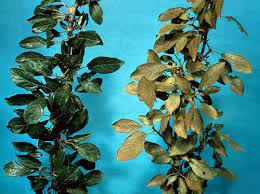
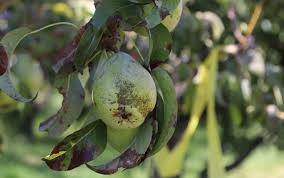
Pear psylla typically become active and begin laying eggs in NJ in mid-late March. Nymph stage pear psylla feed on the sap of pear trees and excrete honeydew which causes black sooty mold on fruit making it unmarketable. This pest also injects a toxin into the leaves as it feeds causing the leaves to blacken and eventually leads to defoliation. Dormant oil works to deter pear psylla from laying eggs and acts as a first line of defense against this pest.  
Proper coverage with dormant oil is essential for it to work properly. Due to this, dormant oil should be applied as a full block spray instead of alternate row middle. It is important to ensure your sprayer is properly calibrated and that you are using a sufficient spray volume. Dr. Brett Blaauw from the University of Georgia found that 100 gal/A is a sufficient volume for coverage IF the trees are properly pruned prior to the dormant oil application (see University of Georgia factsheet). It is possible to achieve almost 100% coverage by making multiple dormant oil applications. This strategy is optimal because it also allows you to target both scale and mites at their optimal timings. One application can be made early on when temperatures first begin to rise above 51°F to target scale and a second application can be made between green tip and ½” green to target mites and continue controlling scale. An oil application at ½” green combined with Esteem at 4-5 oz/A will also provide control of aphids including wooly apple aphid. Wooly apple aphid populations have been becoming more prevalent in NJ apple orchards in recent years, likely due to dry end of summer conditions and pyrethroid use flaring populations. The first place this pest will begin to pop up will be pruning cuts so be sure to keep an eye out as the season progresses since early action is critical for effective control.  

Dormant oil application rates depend on the phenological stage and the crop you are spraying. Typically, oil is recommended at a 2% rate or 2 gallons of dormant oil per 100 gallons of spray mix. You can perform concentrated sprays of 6 gallons of dormant oil per 100 gallons of spray mix in pome fruit based on the dilute volume of 300 gallons per acre (amount generally considered to cover a mature semi dwarf apple to the point of drip). In stone fruit, a concentrated spray would include 4 gallons of dormant oil per 100 gallons of spray mix based on the dilute volume of 200 gallons per acre (amount generally considered to cover a mature peach tree to the point of drip). Oil can safely be applied up to the pink stage of tree fruit, but the rate should be dropped the closer you get to this stage. For example, in pome fruit a full rate can be applied up to ½” green, this rate should be halved up to tight cluster and then halved again up to pink.   

When applying dormant oil, it is important that you do not make an application within 2 days of the temperature dropping below 32°F. Another important consideration is that oil should not be applied within 2 weeks of Captan due to phytotoxicity concerns. There are other insecticides that can be mixed with dormant oils to target these pests; however, results are variable on whether the addition of these insecticides improves efficacy over oil alone. 

Dormant Season Copper Sprays: Fire blight can be targeted at the dormant stage using copper as your first line of defense. The copper targets cankers caused by fire blight and reduces the amount of bacterial inoculum present in the field. Early season copper sprays can also be effective against apple scab if some green tissue is present in the bud. Copper should not be applied after ½” green due to concerns with phytotoxicity and fruit russeting. If tank mixing copper with dormant oil, extra precaution should be taken to ensure there is no risk of freezing temperatures since this can exacerbate issues with phytotoxicity and injure the tree.  

The bacteria causing fire blight can only survive inside of living tree tissue. The winter is an optimal time to remove infected branches since the sap is not flowing, this reduces the risk of spreading the inoculum to your next cut. Removing the cankers caused by this disease where most of the bacteria are surviving will reduce your inoculum levels and make this disease easier to manage during the spring. It is a good practice to flag limbs that were infected with fire blight in the previous season to make the cankers easier to find when it comes time to prune. Pruning crews should be trained to look for sunken, dark, cracked areas on the tree bark that may be cankers. A knife can be used to peel away the tree bark to confirm the presence of the canker. If it is in fact a canker, the sapwood will be brown. You can continue peeling the bark away until you find the margin of the canker where the sapwood is still healthy and green. The pruning cut should be made at least 8 inches below the canker to ensure no inoculum is left behind in the tree. All canker prunings should be removed from the orchard since they can still act as a source of inoculum if left behind on the orchard floor.  

If peach leaf curl was not targeted in the late fall at leaf drop, a fungicide application is also effective in the late winter prior to bud swell. Copper, Ziram, and Bravo (Chlorothalonil) are the most effective options at this timing.  

Dormant Season Urea Sprays: Dormant season urea sprays are an extremely effective tool to reduce inoculum in orchards with high apple scab pressure. These sprays help to break down the leaf litter more quickly, which isessential for orchard sanitation and reduction of foliar disease inoculum. Urea applications are most effective if applied after leaf drop in the fall, but if you didn’t have a chance to make the application, it is not too late! Urea can be applied to leaf litter in the late winter or early spring using an airblast sprayer with nozzles pointed towards the ground or a boom sprayer at a rate of 40 lb/A in 100 gallons of water. A flail mower can also be used to chop leaf litter,which allows it to decompose more quickly. By using these methods, you can reduce your apple scab inoculum by 80% or more, which will make management easier and more effective during primary scab infection. 
South Jersey Calibration Grower Meeting

March 25, 2026

2:30 pm – 6:00 pm

Rutgers Agricultural Research & Extension Center                 

121 Northville Road, Bridgeton, NJ

Program

2:30 PM – Registration

3:00 PM – Welcome and Introductions

3:15 PM – Airblast Sprayer Calibration Techniques

Chris Lovenduski, Central Jersey Equipment

4:15 PM – Early season management in peaches

 Anne Nielsen PhD, Professor and Extension Specialist in Entomology

4:45 PM – Light fare & refreshments (pre-registration required)

5:00 PM – Coverage Counts: How to make the most of a pesticide application

Karly Regan PhD, Certis Biologicals

5:30 PM – Pesticide Safety and Regulations for Specialty Crops

Janine Spies PhD, Rutgers Cooperative Extension

6:00 PM – Pesticide Recertification Credits and Adjourn

NJDEP Pesticide Recertification Credits are anticipated.

Registration cost per person: $10.

Cash or check (made payable to Rutgers The State University) will be collected at the door.

Pre-register by Thursday March 19.

Click here to register: South Jersey Calibration Event Registration – Fill out form

Program Chair: Janine Spies, Agriculture and Natural Resources County Agent III, Statewide Program Leader in Fruit IPM

If you have any questions please contact Janine Spies: (352) 231-6330, janine.spies@rutgers.edu

North Jersey Calibration Grower Meeting

March 24, 2026

2:30 pm – 6:00 pm

Clifford E. & Melda C. Snyder Research & Extension Farm                                  

140 Locust Grove Road Pittstown, NJ

Program

2:30 PM – Registration

3:00 PM – Welcome and Introductions

3:15 PM – Airblast Sprayer Calibration Techniques

Chris Lovenduski, Central Jersey Equipment

4:15 PM – Importance of Calibration for Optimal Pest Control and Resistance Management

Kaitlin Quinn, Rutgers Cooperative Extension

4:45 PM – Light fare & refreshments (Pre-registration required)

5:00 PM – Coverage Counts: How to make the most of a pesticide application

Karly Regan PhD, Certis Biologicals

5:30 PM – Pesticide Safety and Regulations for Specialty Crops

Janine Spies PhD, Rutgers Cooperative Extension

6:00 PM – Pesticide Recertification Credits and Adjourn

NJDEP Pesticide Recertification Credits are anticipated.

Registration cost per person: $10.

Cash or check (made payable to Rutgers The State University) will be collected at the door.

Click here to register: North Jersey Calibration Event Registration – Fill out form

Pre-register by Wednesday March 18.

If you have any questions please contact Kim Cromelin: (908) 788-1338, kfrey@co.hunterdon.nj.us

Program Chair: Janine Spies, Agriculture and Natural Resources County Agent III, Statewide Program Leader in Fruit IPM

South Jersey Vegetable Integrated Crop Management Twilight Meeting

Vegetable Integrated Crop Management

Twilight Meeting

Wednesday, April 8, 2026

6:00 p.m. – 8:30 p.m.

East Vineland Fire Hall

4931 Landis Ave. across from the Savoy Restaurant

(park behind the building and enter conference room door in rear)


Hosted by RCE of Atlantic, Cumberland, and Gloucester Counties

6:00 pm        Soilborne Disease Identification and Control in Seedlings and Transplants

  • Patrick McMullen, RCE Atlantic

6:30 pm        Vegetable Disease Control Options for Spring Crops

  • Andrew Wyenandt, Extension Specialist, RAREC

7:00 pm        USDA Natural Resources Conservation Service Programs for Crop Production

  • Michelle Pedano, District Conservationist, NRCS

7:30 pm        On-Farm Food Safety and Food Safety Modernization Act Updates

  • Wesley Kline, RCE Cumberland

8:00 pm        Pesticide Regs & Worker Protection Standards Update for the Coming Season

  • Michelle Infante-Casella, RCE Gloucester

8:30 pm        Adjourn

Pesticide Recertification Credits offered include 1 CORE, 2 1A, 2 10, and 2 PP2.


Please call 609-625-0056 with any questions.

Hope to see you there!


Sincerely,


Patrick W. McMullen, Wesley L. Kline, and Michelle Infante-Casella

Agricultural Agents of Atlantic, Cumberland, and Gloucester Counties


ALERT – Potential for Ambrosia Beetle flight early next week – if you regularly have issues with this pest – take notice

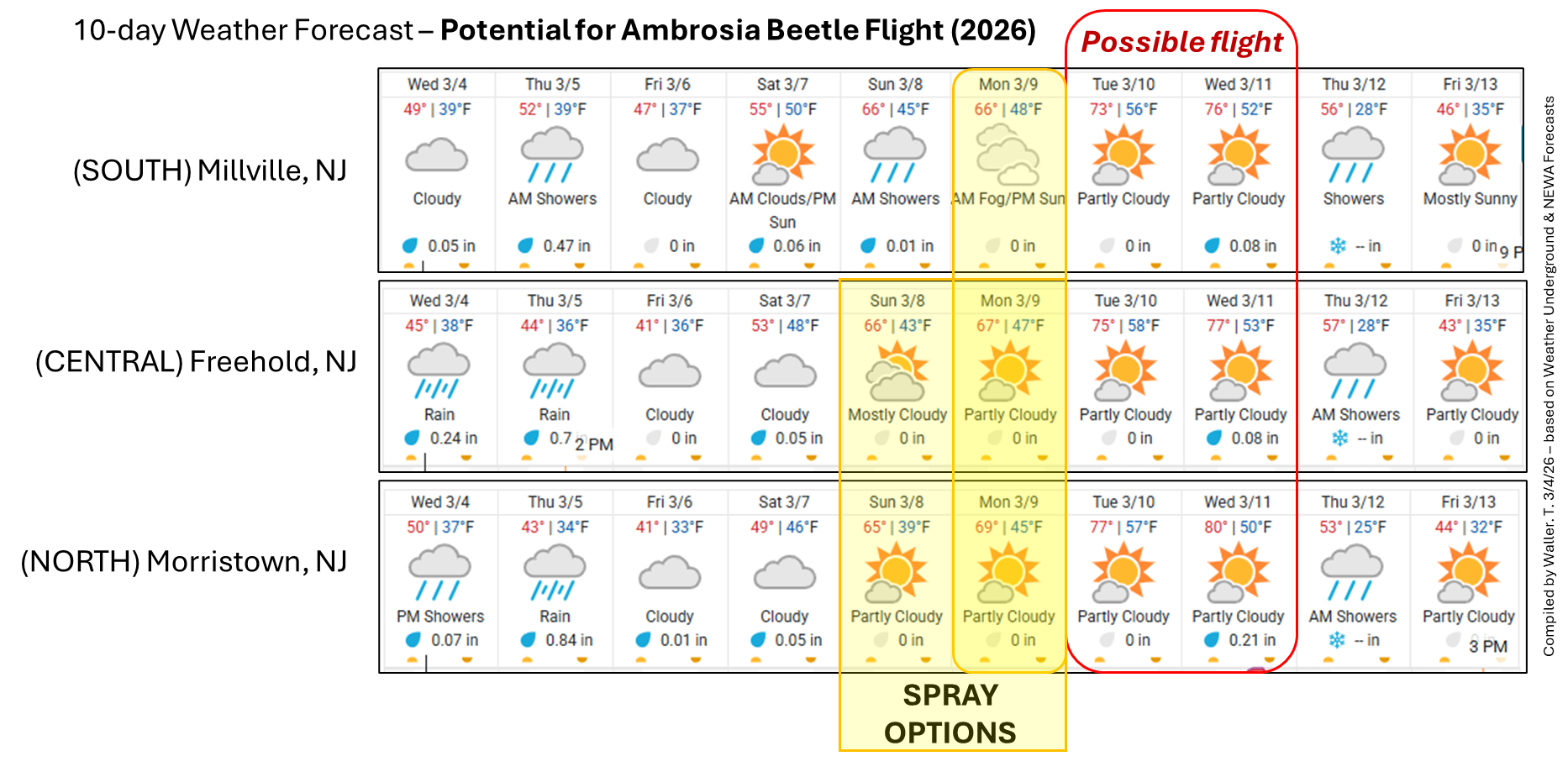
The last few seasons we have seen an upswing in ambrosia beetle activity in nursery production, principally in field grown nursery stock of thin barked trees (commonly – dogwood, honey locust, magnolia, maple, redbud, zelkova, styrax, Prunus spp.). Based on evidence from multiple lines of trap collection data throughout the United States, adult female flights appear to be correlated to consecutive days (2-3) of 70F temperatures (highs) with daily average air temps around 65F (max+min/2). That is extremely close to what we will have throughout most areas of NJ early next week, based on 10-day weather forecasts. Note: this is historically very early for treatment of this pest and it will get colder the following days, however, we have missed control opportunities over multiple years so take treatment into consideration if you regularly encounter this pest.

Consider using pyrethroids in your production areas next Monday or Tuesday (weather dependent) if this pest has been a regular problem.

Contact insecticides: 

  • Pyrethroids [3A]: –thrins (bifenthrin, permethrin, etc.) – Pyrethroids longer lasting residual activity is why these materials are so effective against ambrosia beetles. 
  • Systemic insecticides DO NOT WORK


Potential for adult female ambrosia beetle flight 2026

Stay informed:

  • Sign up for the 2026 – Rutgers Ornamental IPM Program – click here to sign up
  • First webinar 4/14/26
  • Program is free, but registration is required – Registration includes:
    • Site visit to your ornamental nursery/farm from Rutgers agents
    • Delivered printed IPM resources (Guides, factsheets, bulletins)
    • Free pheromone & sticky trap kit + guidance on setup/monitoring (for commercial nursery/greenhouse and Christmas tree farms)
    • Access to live bi-weekly webinars (Zoom)
    • (First session TUESDAY 4/14 @ 12PM)
    • Every Second and Fourth, Tuesday, April through September

[Read more…]

Approaching boxwood blight season – 2026 (threat this week in Central and Southern NJ)

March weather is always unpredictable, however, if we have sustained periods of increased temperatures (above 50F) and spring rains, boxwood blight (BWB) can become an issue quickly.

[pictorial tri-fold] Common Boxwood Pests and Diseases (click-here). This includes Box Tree Moth images. Print the PDF out double-sided, then fold.

If you suspect Boxwood Blight and would like to have this verified – please contact the Rutgers Plant Diagnostic Laboratory (click here) for sample submission instructions

Boxwood Blight Risk Assessment as of 3/2/2026
Region Location Station

CODE

MON TUE WED THU FRI SAT
2-Mar 3-Mar 4-Mar 5-Mar 6-Mar 7-Mar
Southern Upper Deerfield NJ50 Very Low  Very Low  Very Low  Infection Risk Low Low 
Southern Vineland NJ73 Very Low  Very Low  Low  Infection Risk Infection Risk Infection Risk
Southern Millville KMIV Very Low  Very Low  Low  Infection Risk Low  Low 
Southern Bridgeton D4116 Very Low  Very Low  Very Low  Infection Risk Low  Low 
Southern Mays Landing G4661 Very Low  Very Low  Low  Infection Risk Low  Low 
Central Howell / Freehold NJ10 Very Low  Very Low  Very Low  Low  Low  Low 
Central Princeton F0303 Very Low  Very Low  Very Low  Low  Infection Risk Very Low 
Central Somerville F6261 Very Low  Very Low  Very Low  Low  Infection Risk Infection Risk
Northern High Point NJ59 Very Low  Very Low  Very Low  Very Low  Low  Low 
Northern Randolph AU137 Very Low  Very Low  Very Low  Very Low  Low  Low 
Northern Belvidere E7133 Very Low  Very Low  Very Low  Very Low  Low  Very Low 
Please check your local boxwood blight risk at (https://uspest.org/risk/boxwood_app)  

There is a minor potential for boxwood blight infections this Thursday, Friday, & Saturday throughout Southern and Central NJ. Incoming rains, coupled with warmer temperatures may initiate boxwood blight infections this week. This will likely extend into the following week with anticipated higher temperatures.

  • It is time to begin protective fungicide applications in boxwoods throughout the state if you have not already done so. 

  • If BWB is important to your business Use the USPEST – PUSH Alerts – (click here) – to setup weekly email alerts. Create an account, watch the tutorial, and then set up your subscriptions. You select which locations (as many as you like), days you want to receive emails, and what you would like to receive alerts about (BWB and a variety of other pests and diseases). Rutgers is not directly affiliated, however this is an incredible tool. 

[Read more…]
