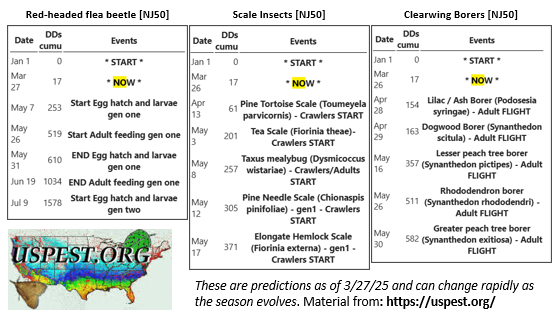
In response to the increased air temperature highs and averages, accumulating growing degree-days, increasing soil temperatures, and expected rainfall and overcasts days the following pest alerts have been generated for boxwood blight, ambrosia beetle, white pine weevil, and clearwing borers. Oomycete/Phytophthora treatment considerations are also listed at the bottom of the posting.
Stay informed:
- Sign up for the 2026 – Rutgers Ornamental IPM Program – click here to sign up
- Program is free, but registration is required – Registration includes:
- Site visit to your ornamental nursery/farm from Rutgers agents
- Delivered printed IPM resources (Guides, factsheets, bulletins)
- Free pheromone & sticky trap kit + guidance on setup/monitoring (for commercial nursery/greenhouse and Christmas tree farms)
- Access to live bi-weekly webinars (Zoom)
- (First session TUESDAY 4/14 @ 12PM)
- Every Second and Fourth, Tuesday, April through September
Boxwood Blight: high potential for new /spreading infections this week in Southern NJ
[pictorial tri-fold] Common Boxwood Pests and Diseases (click-here). This includes Box Tree Moth images. Print the PDF out double-sided, then fold.
If you suspect Boxwood Blight and would like to have this verified – please contact the Rutgers Plant Diagnostic Laboratory (click here) for sample submission instructions
| Boxwood Blight Risk Assessment as of 3/30/2026 | ||||||||
| Region | Location | CODE | MON | TUE | WED | THU | FRI | SAT |
| 30-Mar | 31-Mar | 1-Apr | 2-Apr | 3-Apr | 4-Apr | |||
| Southern | Upper Deerfield | NJ50 | Very Low | Low | Very Low | Infection Risk | Very Low | Infection Risk |
| Southern | Vineland | NJ73 | Very Low | Low | Very Low | Infection Risk | Low | Infection Risk |
| Southern | Millville | KMIV | Very Low | Very Low | Low | Infection Risk | Very Low | Infection Risk |
| Southern | Bridgeton | D4116 | Very Low | Low | Very Low | Infection Risk | Very Low | Infection Risk |
| Southern | Mays Landing | G4661 | Very Low | Very Low | Very Low | Low | Very Low | Infection Risk |
| Central | Howell / Freehold | NJ10 | Very Low | Low | Very Low | Low | Very Low | Low |
| Central | Princeton | F0303 | Very Low | Low | Very Low | Low | Very Low | Low |
| Central | Somerville | F6261 | Very Low | Low | Very Low | Low | Very Low | Low |
| Northern | High Point | NJ59 | Very Low | Low | Very Low | Very Low | Very Low | Very Low |
| Northern | Randolph | AU137 | Very Low | Low | Very Low | Very Low | Very Low | Very Low |
| Northern | Belvidere | E7133 | Very Low | Low | Very Low | Low | Very Low | Low |
| Please check your local boxwood blight risk at (https://uspest.org/risk/boxwood_app) | ||||||||
-
It is time to begin protective fungicide applications in boxwoods throughout the state if you have not already done so.
- If BWB is important to your business – Use the USPEST – PUSH Alerts – (click here) – to setup weekly email alerts.
- Please visit the USPEST.ORG Boxwood Blight Risk Model – CLICK HERE TO CHECK YOUR LOCAL PREDICTIONS)
Fungicides;
- You very well may have these materials already applied as ‘cover-sprays’ – But – be mindful that protectant fungicides loose efficacy the more rain (or overhead irrigation) they are subjected to, and reapplication may be warranted.
- ROTATE between Fungicide Resistance Action Committee (FRAC codes) to avoid this pathogen becoming resistant to specific chemicals
Format: [FRAC code]: Chemical name (Trade names * no endorsement implied, other options exist)
- [M05]: Chlorothalonil (Daconil WS)
- [M05 + 1] Chlorothalonil + Thiophanate methyl (Spectro 90WDG)
- [11] Trifloxystrobin + [7] Fluopyram (Broadform)
- [11] Trifloxystrobin + [3] Triadimefon (Armada 50WDG)
- [M03] Mancozeb
- [12] Fludioxonil (Medallion WDG)
- [3] Tebuconazole (Torque)BW
Approaching boxwood blight season – 2026 (threat this week in Central and Southern NJ)
Ambrosia beetle adult flight will VERY LIKELY occur this week throughout most of NJ.
The last few seasons we have seen an upswing in ambrosia beetle activity in nursery production, principally in field grown nursery stock of thin barked trees (commonly – dogwood, honey locust, magnolia, maple, redbud, zelkova, styrax, Prunus spp.). Based on evidence from multiple lines of trap collection data throughout the United States, adult female flights appear to be correlated to consecutive days (2-3) of 70F temperatures (highs) with daily average air temps around 65F (max+min/2), i.e. THIS WEEK IN NJ.
Consider using pyrethroids in your production areas if this pest has been a regular problem OR there are water stressed (typically flooded / slow draining) plants.
| (generic) Ambrosia Beetle Flight Predictions – as of 3/30/2026 | ||||||||||||
| Region | Location | Metric | MON | TUE | WED | THU | FRI | SAT | SUN | MON | TUE | WED |
| 30-Mar | 31-Mar | 1-Apr | 2-Apr | 3-Apr | 4-Apr | 5-Apr | 6-Apr | 7-Apr | 8-Apr | |||
| Southern | Millville | High Temp [ºF] | 69 | 78 | 82 | 55 | 71 | 77 | 75 | 59 | 59 | 58 |
| Low Temp [ºF] | 57 | 62 | 50 | 45 | 58 | 57 | 47 | 40 | 41 | 43 | ||
| Average [ºF] | 63 | 70 | 66 | 50 | 64.5 | 67 | 61 | 49.5 | 50 | 50.5 | ||
| High at/above 70ºF | FALSE | TRUE | TRUE | FALSE | TRUE | TRUE | TRUE | FALSE | FALSE | FALSE | ||
| Avg at/above 65ºF | FALSE | TRUE | TRUE | FALSE | FALSE | TRUE | FALSE | FALSE | FALSE | FALSE | ||
| Adult flight risk | Probable flight | Potential flight | ||||||||||
| Central | Freehold | High Temp [ºF] | 71 | 80 | 83 | 48 | 67 | 75 | 75 | 59 | 58 | 58 |
| Low Temp [ºF] | 57 | 63 | 45 | 42 | 58 | 52 | 46 | 40 | 41 | 42 | ||
| Average [ºF] | 64 | 71.5 | 64 | 45 | 62.5 | 63.5 | 60.5 | 49.5 | 49.5 | 50 | ||
| High at/above 70ºF | TRUE | TRUE | TRUE | FALSE | FALSE | TRUE | TRUE | FALSE | FALSE | FALSE | ||
| Avg at/above 65ºF | FALSE | TRUE | FALSE | FALSE | FALSE | FALSE | FALSE | FALSE | FALSE | FALSE | ||
| Adult flight risk | Probable flight | Potential flight | ||||||||||
| Northern | Hackettstown | High Temp [ºF] | 70 | 77 | 75 | 47 | 65 | 75 | 69 | 57 | 58 | 57 |
| Low Temp [ºF] | 55 | 60 | 45 | 39 | 54 | 49 | 42 | 36 | 38 | 39 | ||
| Average [ºF] | 62.5 | 68.5 | 60 | 43 | 59.5 | 62 | 55.5 | 46.5 | 48 | 48 | ||
| High at/above 70ºF | TRUE | TRUE | TRUE | FALSE | FALSE | TRUE | FALSE | FALSE | FALSE | FALSE | ||
| Avg at/above 65ºF | FALSE | TRUE | FALSE | FALSE | FALSE | FALSE | FALSE | FALSE | FALSE | FALSE | ||
| Adult flight risk | Potential flight | Minor risk | ||||||||||
| Air temperatures: Weather Underground (https://www.wunderground.com/) and NEWA: (https://newa.cornell.edu/) | ||||||||||||
| Compiled by Waller. T. 3/30/2026 [twaller@njaes.rutgers.edu] | ||||||||||||
Contact insecticides:
- Pyrethroids [3A]: –thrins (bifenthrin, permethrin, etc.) – Pyrethroids longer lasting residual activity is why these materials are so effective against ambrosia beetles.
- Systemic insecticides DO NOT WORK
White Pine Weevil (WPW) may have already emerged during the last heat wave, but if not, it will very likely occur this week throughout NJ.
Factors leading to this post include increased air temperatures and climbing growing degree-days (WPW adult movement and egg laying is around 7-58 growing degree-days (GDD50)), and most importantly rising soil temperatures as this pest typically begins movement with soils hovering around 50F. All of these factors lead to WPW movement this week and growers may wish to utilize a preventative, long lasting residual spray (pyrethroids) to target adults before they begin egg laying in the upper canopy.
So we have:
- Within the GDD window for adult movement and egg laying (~58 GDD50)
- Soil temperatures in NJ are at or above 50F.
- Increased air temperatures and insect mobility
| White Pine Weevil (Pissodes strobi) – as of 3/30/2026 | |||||||||
| Region | Location | CODE | METRIC | MON | TUE | WED | THU | FRI | SAT |
| 30-Mar | 31-Mar | 1-Apr | 2-Apr | 3-Apr | 4-Apr | ||||
| Southern | Upper Deerfield | NJ50 | GDD50 | 81 | 98 | 117 | 117 | 117 | 118 |
| High Temp [ºF] (Average) | 69 (63) | 78 (70) | 82 (66) | 55 (50) | 71 (64.5) | 77 (65) | |||
| 24hr Average – Soil TEMP [ºF] | 54 | <- (This will change over time / no prediction available) | |||||||
| Central | Freehold / Howell | NJ10 | GDD50 | 68 | 83 | 100 | 100 | 100 | 100 |
| High Temp [ºF] (Average) | 70 (64) | 80 (71.5) | 83 (64) | 48 (45) | 67 (62.5) | 75 (63.5) | |||
| 24hr Average – Soil TEMP [ºF] | 55 | <- (This will change over time / no prediction available) | |||||||
| Northern | HACKETTSTOWN | G5633 | GDD50 | 59 | 72 | 89 | 89 | 89 | 89 |
| High Temp [ºF] (Average) | 69 (62) | 77 (68.5) | 75 (60) | 47 (43) | 65 (59.5) | 75 (62) | |||
| 24hr Average – Soil TEMP [ºF] | 54 | <- (This will change over time / no prediction available) | |||||||
| USPEST.ORG – Model: simple average/growing degree-day, Min: 50F – Max: 95F, NMME forecast | |||||||||
| GDD Forecast: 7-month NMME based seasonal climate forecast (USPEST.ORG) – Subject to change regularly = Check Often | |||||||||
| Air temperatures: Weather Underground (https://www.wunderground.com/) and NEWA: (https://newa.cornell.edu/) | |||||||||
| Soil temperatures (10cm): https://www.greencastonline.com/tools/soil-temperature | |||||||||
| Compiled by Waller. T. 3/30/2026 [twaller@njaes.rutgers.edu] | |||||||||
Chemical Controls for WPW at this stage of the season:
Chemical insecticides against white pine weevils during the spring period are only effective when adults are feeding & before females lay eggs. Arial sprays only need to be applied to cover the terminal leaders at the tops of trees. Pyrethroids sprayed on the bark can have an effective residual of up to 3-weeks. Included within this group of insecticides include bifenthrin (e.g., Onyx), permethrin (e.g., Astro) & cyfluthrin (e.g., Tempo). Since an extended egg-laying duration occurs with this pest, a second application may be recommended.
White Pine Weevil: Overwintering Adults Become Active in March & April
Clearwing borers: Be prepared to manage these pests in the coming weeks.
If you are a commercial grower signed up for the 2026 Rutgers Ornamental IPM program (click here to register), please contact twaller@njaes.rutgers.edu for clearwing pheromone trap kits.
| Clearwing Borer Flight (GDD model) as of 3/30/2026 | ||||||
| Events / Pests | Southern NJ | Central NJ | Northern NJ | |||
| UPPER DEERFIELD (NJ50) | HOWELL (NJ10) | RANDOLPH (AU137) | ||||
| Date | DDs | Date | DDs | Date | DDs | |
| * START * | 1-Jan | 0 | 1-Jan | 0 | 1-Jan | 0 |
| * NOW * | 29-Mar | 76 | 29-Mar | 64 | 29-Mar | 71 |
| Lilac / Ash Borer (Podosesia syringae) | 18-Apr | 149 | 30-Apr | 151 | 5-May | 153 |
| Dogwood Borer (Synanthedon scitula) | 19-Apr | 154 | 1-May | 158 | 6-May | 161 |
| Lesser peach tree borer (Synanthedon pictipes) | 12-May | 362 | 21-May | 352 | 25-May | 352 |
| Rhododendron borer (Synanthedon rhododendri) | 23-May | 516 | 1-Jun | 515 | 5-Jun | 513 |
| Greater peach tree borer (Synanthedon exitiosa) | 27-May | 583 | 5-Jun | 584 | 9-Jun | 578 |
| USPEST.ORG – Model: simple average/growing degree-day, Min: 50F – Max: 95F, NMME forecast | ||||||
| Forecast: 7-month NMME based seasonal climate forecast (USPEST.ORG) – Subject to change regularly = Check Often | ||||||
| Compiled by Waller. T. 3/30/2026 [twaller@njaes.rutgers.edu] | ||||||
Early season management of Phytophthora, Pythium, Phytopythium should be initiated throughout NJ in sensitive plant species, areas with known histories of disease, and in Christmas tree plantations.
| Oomycide Considerations in Ornamentals – (Phytophthora, Pythium, Phytopythium) | |||||
| Prepared by T. Waller – Rutgers Cooperative Extension – 2026 for use in New Jersey | |||||
| FRAC | Risk of pathogen resistance |
Active ingredient | Tradename examples* |
(Review each specific label) Notes |
Translocation Movement in plant |
| P07 | Low | Phosphonates. Aluminum tris (O-ethyl phosphonate) |
Areca, Aliette, generic fosetyl-Al |
See label. Foliar and drench/soil reapplication interval is 30d or greater. Do not apply group P07 and copper-based fungicides within 14d of one another |
Fully systemic – xylem and phloem mobile (amphimobile) |
| P07 | Low | Phosphonates. Mono-and di- potassium salts of phosphorus acid | Alude, Reliant, Rampart, K-Phite 7LP | See label. Generally, soil drench minimum reapplication interval is 30d and foliar applications, less than. Do not apply group P07 and copper-based fungicides within 14d of one another | Fully systemic – xylem and phloem mobile (amphimobile) |
| 40 | Low to Medium | Dimethomorph, Mandipropamid | Stature SC, Micora | See label. Foliar, drench, soil directed, and chemigation applications. | Translaminar systemic – local translocation |
| 40 + 45* | Medium + High* | Dimethomorph + ametoctradin* | Orvego | See label. Foliar, drench, soil directed, and chemigation applications. | Translaminar systemic – local translocation |
| 49 | Medium to High | Oxathiapiprolin | Segovis | See label for use restrictions and tank-mix compatibility. | Xylem mobile systemic – translocation upwards (acropetal) |
| 11 | High | Fenamidone | Fenstop | See label: Now labeled for outdoor nurseries. Reapplication interval is 28d | Xylem mobile systemic – translocation upwards (acropetal) |
| 43 | Medium | Fluopicolide | Adorn | See label. Foliar, drench, and chemigation applications. No more than 2 applications per crop cycle. Minimum reapplication interval – 14d. | Xylem mobile systemic – translocation upwards (acropetal) |
| 4 | High | Mefenoxam | Subdue Maxx, Subdue GR, generic Mefenoxam | See label. Typically, spring and fall drench applications with total allowable of 6lb/A/year (Subdue Maxx). Foliar, drench, soil directed, soilless media incorporation, and chemigation applications. See label for minimum reapplication intervals for drench applications (ranging from 3 weeks to 4 months). Mefenoxam resistance has been detected in the USA. | Xylem mobile systemic – translocation upwards (acropetal) |
| 21 | Medium to High | Cyazofamid | Segway-O, Celoxid SC | See label. Minimum reapplication interval 14 – 21d. No more than 2 applications per crop cycle. Applied as drench or soil directed. |
Protectant – no systemic activity |
| BM02 | Unknown (likely low) | Biologicals | Rhapsody (bacteria), Root Sheild Plus (fungi) | See label. Reapplication interval typically very rapid at 3-10d. | Antagonistic – hinders pathogen colonization of host tissues |
| – | – | Quaternary ammoniums | KleenGrow, Uptake, Physan 20, Green Shield | See label. Typically used in sanitation efforts, irrigation maintenance (biofilms), and some labels allow for application to plant surfaces. Phytotoxicity concerns are rate and label specific. Generally considered broad spectrum fungi/bacteria/oomycete pesticides. |
Direct contact – varying residual activity, no systemic activity |
| – | – | Hydrogen dioxides | Zerotol, Oxidate | ||