Peach:
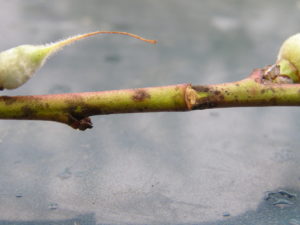
Bacterial Spot: Generally we recommend starting at 0.5 ozs metallic copper and gradually lowering the rate as the season progresses. The rate applied will depend on the formulation. Dr. Lalancette published a chart listing common copper formulations and rates for peach and nectarine applications. Avoid combining copper with captan especially if it has been overcast for several days. Also avoid acidic spray solutions when applying copper. Dr. Lalancette has published a handy guide for copper applications in early covers. Antibiotics such as Mycoshield or Fireline may also be used and may offer slightly more residual activity during long wetting periods. Bacterial Spot leaf symptoms have began appearing in southern county orchard during the week of 5/8. These infections probably occurred mostly during the heavy rains that occurred on 4/30-5/1. Fruit symptoms from this set of infections have so far not appeared. This week no significant increase in symptoms was noted.
Oriental Fruit Moth: A biofix point for OFM was set on 4/10 in both northern and southern counties. All timings for first generation OFM have past.
| OFM 2nd Generation Timing | |||
| Insecticide Type | |||
| County/Region | Degree Days by 5/24 base 45 | Conventional
1450-1500 |
Diamide
1300-1400 |
| Gloucester – Southern | 603 | 1st –too far off
2nd – too far off |
1st –too far off
2nd – too far off |
| Middlesex – Northern | 578 | 1st –too far off
2nd – too far off |
1st –too far off
2nd – too far off |
Plum Curculio; Tarnished Plant Bugs; and Other Catfacing Insects: Plum Curculio start to move into orchards at about 88-100 degree days base 50 after January 1. Applications for PC should be initiated once all petals are off, with a second application made with ovicidal materials at 379-402 DD. Additional applications with effective materials may be made between 520 and 730 DD base 50. Currently we have accumulated about 498 DD base 50 in southern counties, and 426 DD base 50 in northern counties. Growers can monitor degree day development at their site by finding the nearest weather station and using the degree day development tool at NEWA. Catfacing insects are active, but will become more of an issue as temperatures warm and mowing and other ground cover activities become more common.
Scale Insects: White peach scale crawlers have begun emergence in southern counties and will continue emergence for the next few weeks. San jose scale crawlers typically begin emergence about late May or Early June and continue emergence for up to 6 weeks. Control options during crawler emergence include Neonicitiniods (suppression only), and the IGR’s Esteem and Centaur. See the NJ Commercial Tree Fruit Production Guide and the product labels for more information.
Apples and Pears:
Diseases: Now that primary scab is nearing the end, or has ended, the focus turns toward summer diseases such as fruit rots (esp. Bitter rot), and sooty blotch and fly speck. Bitter rot control has been difficult at best in recent years even where management programs have been rigorous. Research has suggested Products such as Merivon, Luna Sensation and Inspire Super may be effective, and longtime reliable broad spectrum fungicides such as captan and ziram should provide control. Experience has suggested that the addition of phosphorous acid products such as Prophyt or Rampart to captan sprays may improve control. Observations are that these products improve control of other summer diseases such as sooty blotch and flyspeck, and may help suppress scab infections where present.
Fire Blight: Infections can still occur post bloom so covers with antibiotics when infection events are forecast using the NEWA fire blight model may be beneficial. Remember to rotate streptomycin and oxytetracycline products. Fire Blight symptoms began appearing in southern county apple and pear orchards the week of 5/1. Typically it is recommended to cut out infected limbs however this is a practical decision that must be made. This blog post from Michigan State may be helpful to decide whether it is worth cutting out infected tissue.
Codling Moth (CM): The first codling moth flight has started. A biofix was set for CM on April 17th in both northern and southern counties.
| Codling Moth Degree Day Timing | ||||||||
| Application and Insecticide Type | ||||||||
| County Area | Biofix | Rimon:
75-100DD + 14-17 days later
|
Intrepid
150 + 450 DD Diamides – Altacor, Voliam mixes: (150-200 DD) |
Cyd-X, Carpovirusine
250 DD + every 7-9 days during brood hatch (later if first spray is an IGR) |
Standard Insecticides – Delegate, Avaunt, OP’s, carbamates, pyrethroids
250 DD + 550 DD
|
|||
| DD | 75 | 100 | 150 | 450 | 250 | 250 | 550 | |
| Southern | April 17 | past | past | past | 6/4 | 5/21 | 5/21 | 6/7 |
| Northern | past | past | past | 6/6 | 5/23 | 5/23 | 6/11 | |
Tufted Apple Budmoth (TABM): A biofix for TABM was set in southern county orchards on 5/8. Nothing needs to be done for TABM at this point. The first alternate middle applications for TABM will be on or about 6/3 in southern counties. This has been considered a minor pest in recent years. Many materials used for Codling Moth will also control TABM.
Pear: Second generation pear psylla began hatching about 5/15. Options for control include spynosyn products such as Delegate and Entrust, and the neocitinoids (IRAC group 4A). The addition of 0.25-1 gal of summer oil may improve control. Other options include Movento, and products containing abamectin. Be sure to read and follow the label instructions regarding the addition of penetrants for these products.
Tree Fruit Trap Captures – Southern Counties
| STLM | TABM-A | CM | BMSB | OFM-A | DWB | OFM-P | TABM-P | LPTB | PTB | |
| 4/15/2023 | 433 | 20 | 1 | |||||||
| 4/23/2023 | 423 | 1 | 13 | 8 | 4 | |||||
| 4/30/2023 | 417 | 7 | 15 | 4 | 1 | 0 | ||||
| 5/06/2023 | 9 | 2 | 3 | 1 | 0 | 0 | ||||
| 5/13/2023 | 18 | 2 | 7 | 2 | 3 | 0 | 6 | 6 | ||
| 5/20/2023 | 5 | 18 | 6 | 0 | 51 | 0 | 13 | 67 |
Tree Fruit Trap Captures – Northern Counties
| STLM | TABM-A | CM | BMSB | OFM-A | DWB | OFM-P | TABM-P | LPTB | PTB | |
| 4/8/2023 | 10 | |||||||||
| 4/15/2023 | 20 | 3 | ||||||||
| 4/30/2023 | 28 | 11 | 6 | |||||||
| 5/06/2023 | 22 | 2 | 19 | 9 | ||||||
| 5/13/2023 | 34 | 1 | 3 | 2 | 5 | 0 | ||||
| 5/20/2023 | 31 | 6 | 7 | 1 | 6 | 0 |
Phenology Table: Based on annual observations made in Gloucester County.
| Pest Event or Growth Stage | Approximate Date | 2023 Observed Date |
| Bud Swell (Redhaven) | March 23 +/- 15 Days | March 7 |
| 1/4″ Green Tip Red Delicious | March 31 +/- 13 Days | March 27 |
| Pink Peach (Redhaven) | April 4 +/- 15 Days | March 24 |
| Tight Cluster Red Delicious | April 9 +/- 13 Days | April 7 |
| Full Bloom Peach (Redhaven) | April 9 +/- 14 Days | April 4 |
| Pink Apple (Red Delicious) | April 14 +/- 12 Days | April 11 |
| Full Bloom Apple (Red Delicious) | April 22 +/- 11 Days | April 16 |
| Petal Fall (Redhaven) | April 22 +/- 10 Days | April 15 |
| Petal Fall (Red Delicious) | April 27 +/- 13 Days | May 3 |
| Shuck Split (Redhaven) | April 30 +/- 11 Days | April 21 |
| Pit Hardening | June 15 +/- 9 Days |