Pest Counts & Action Thresholds in the Greenhouse

Scouting Methods & Options:

There are essentially three options available when scouting your greenhouse crops for insect/mite pests. 1- No scouting performed with pesticides being applied on a calendar timetable. 2- Simply scouting for pest existence  with pesticides applied when presence is observed. 3- Scouting crop and making pesticide application decisions based on pest counts and action thresholds. The third option is part of an integrated pest management (IPM) approach that has been promoted throughout the green industry the past few decades.

Greenhouse pest populations are measured by trapping or direct plant inspection, and both involve determining pest numbers. Counting pests and using action thresholds requires time and knowledge, but results in less pesticide use, reduced potential for insect resistance, and can improve plant quality. It is important to remember that trapping (e.g., yellow, or blue sticky cards) improves the efficiency when scouting your greenhouse but does not replace the actual inspection of individual crop plants (Fig. 1 & Fig. 2). This is particularly the case when scouting for aphids and mites.

Fig.1. Yellow or blue colored sticky traps are used to capture flying insect pests in the greenhouse. The blue traps attract the western flower thrips more effectively. (Photo Credit: Steven K. Rettke, Rutgers Coop. Ext.)
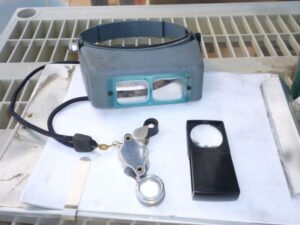
Fig. 2. The optivisor (3x) at top of photo works best when counting or viewing the insects captured on sticky traps. The other magnifiers shown (5x, 16x, 20x) are used to more closely view pests on crop plants. (Photo Credit: Steven K. Rettke, Rutgers Coop. Ext.)


[Read more…]

Weed Science Webinar Series

Weed Science Webinar Series

USDA – ARS and the Weed Science Society of America (WSSA) are co-hosting 10 webinars on weed science and research. Beginning April 5, presentations will be given by ARS weed science research experts.

The webinars will occur every Tuesday from 2-3p.m. Eastern Time (ET) and include an interactive Q&A session.

Register Here Today!

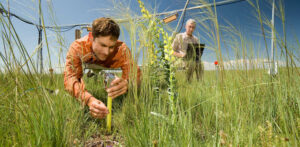
Two people conducting research in a field

Weed Science Webinar Series Schedule

April 5
ARS Weed Science: Past, Present, and Future: Steve Duke, Principal Scientist at the National Center for Natural Products Research at the University of Mississippi, Steve Young, National Program Leader – Weeds and Invasive Pests, WSSA Representatives and ARS Administrators

Meeting Information:

Zoom Meeting Link

Webinar ID: 831 3320 1055

Passcode: 825921

Please download and import the following iCalendar (.ics) files to your calendar system.

Theme I: Tactics

April 12
Integrated Weed Management in Cropping Systems: Marty Williams, Ecologist at the Global Change and Photosynthesis Research Unit in Urbana, IL

April 19
Non-Crop Systems: Advancements in Weed Biocontrol Tools: Melissa Smith, Research Ecologist at the Invasive Plant Research Laboratory in Fort Lauderdale, FL

April 26
New Technology for Weed Identification and Control: Steven Mirsky, Research Ecologist at the Sustainable Agricultural Systems Laboratory in Beltsville, MD

Theme II: Mechanisms

May 3
Role of Plant Physiology in Weed-Crop Competition: Dave Horvath, Research Plant Physiologist at the Sunflower and Plant Biology Research Unit in Fargo, ND

May 10
Molecular Basis for Controlling Invasive Plants: Matt Tancos, Research Plant Pathologist at the Foreign Disease-Weed Science Research Unit in Fort Detrick, MD

May 17
Addressing Herbicide Resistance with Alternative Chemistries: Scott Baerson, Molecular Biologist at the Natural Products Utilization Research Unit in Oxford, MS

Theme III: Impacts

May 24
Spread and Distribution of Invasive Plants: John Madsen, Research Biologist at the Invasive Species and Pollinator Health Unit in Albany, CA

May 31
Climate Change Effects on Weeds and Management: Dana Blumenthal, Ecologist at the Rangeland Resources & Systems Research Unit in Fort Collins, CO

June 7
Restoration for Managing Invasive Plants: Roger Sheley, Ecologist at the Range and Meadow Forage Management Research Unit in Burns, OR

Weather Effects on Plants & Insect-Mite Pests

The old saying that “everyone talks about the weather” is certainly true when it involves landscape plant managers. Professional landscapers/arborists and their clients are always discussing how various weather factors are affecting plants. The New Jersey weather trends can often be variable from one growing season to the next. How do rain, wind and temperature changes impact plants and their corresponding insect/mite pests?

The chart below lists four weather conditions & categorizes how these conditions positively or negatively influence some of the key landscape insect/mite pests.


TABLE: PESTS AFFECTED BY SPECIFIC CONDITIONS (Source: David Shetlar, Ohio State Cooperative Extension)

 “A” Hot-Dry Weather Pests  “B” Cool Weather Pests  “C” Pests Damaged by Excessive Rains   “D” Pests Attracted to Stressed Plants

 -Lace Bugs

 -Scales

 -Leaf Beetles

-Caterpillars

-Warm Season Mites


-Aphids (some)

-Adelgids

-Root Weevils

-Cool Season Mites

-Eriophyid Mites (some)


-Lace Bugs (fungus)

-Aphids/Mites (impact)

-Scale Crawlers (impact/wind)

-Caterpillars (fungus)

-Black Vine Weevils fungus)

-Aphids (some)

-Scales (some)

-Whiteflies

-Caterpillars (some)

-BORERS!!

[Read more…]

Identifying Clearwing Moth Borers in Pheromone Traps

Clearwing moth borers comprise one of the most damaging groups of insect pests that attack shade trees and shrubs. Controls must be accurately timed, since larvae tunnel under the bark most of the year, where they are unreachable by most insecticides. Artificial pheromones of many of the clearwing moths found in the landscape are available. These pheromones are a synthetic of the sex attractant emitted by many insects & are commercially available and recommended for the IPM manager.

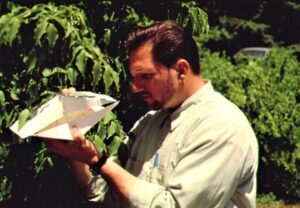
Plant manager viewing contents of clearwing moths captured in pheromone-baited wing-trap. (Photo Credit: Steven K. Rettke, Rutgers Coop. Ext.)
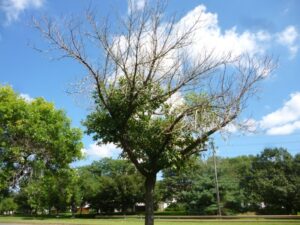
This green ash tree is showing severe symptoms from banded ash clearwing moths. Too late for pheromone traps to be of value. (Photo Credit: Steven K. Rettke, Rutgers Coop. Ext.)
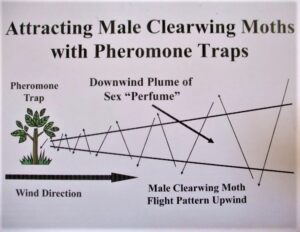


Adult male clearwing moths are attracted to the pheromone-baited sticky trap that helps determine: 1) if the borers are present in an area; and 2) when to apply insecticide sprays. Pheromone traps enable landscape managers to accurately determine when the first emergence of the egg laying borers are expected so that insecticides can be timed & applied effectively to susceptible tree/shrub hosts. Spraying the bark of the tree to be protected with a long residual insecticide (i.e., such as pyrethroids) should effectively kill the young borer larvae as they hatch from eggs & attempt to tunnel into the stems or branches.

Hypothesized flight path of an adult male clearwing moth towards the pheromone trap. (Diagram: Steven K. Rettke, Rutgers Coop. Ext.)

[Read more…]

Pest Scouting Update – 25 to 150 GDDs Plus Printable resources!

Additional resource: SLF EGG MASS GUIDE – USE FOR TRAINING (click here to download)

We have compiled the GDD resources into one single document – please download and print multiple copies of this for yourself and employees in efforts to best scout for these insect pests. These guides do not dictate when to spray, rather they inform scouting ranges for insect pests, vulnerable life-stages, and overlapping timeframes for multiple troublesome pests.

Please Download these resources:

Nursery and Landscape Pest Scouting Guide 2022 PDF (note this contains conifer pests as well)

Conifer Pest Scouting Guide 2022 PDF

Refer to this post “Obtaining your local growing degree-days” for additional information 

We will be making regular announcements throughout the season, however we wanted you to have this beta-version of the compiled growing-degree day information. This will be updated and modified throughout the season – PLEASE let me know what difference you are seeing in the field so we can continue to make this resource better for all of us.   

Contact: twaller@njaes.rutgers.edu (or call the Cumberland County Extension Office – 856-451-2800)

Growing degree-days as of writing this 3/22/22 (using USPEST.org weather station codes):

  • Southern (NJ50): 74
  • Central (NJ10): 72
  • Northeastern (Greater NYC Metro area (D6302): 41
  • Northwestern (NJ59): 21
  • Crop type Common Name Scientific Name GDD Min (50F) GDD Max (95F) Reference Developmental / Target Stage
    Conifer Zimmerman pine moth Dioryctria zimmermani 25 100 3 1st larvae
    Conifer Cooley spruce gall adelgid Adelges cooleyi 25 120 3 Spring control of overwintering stage
    Conifer Eastern spruce gall adelgid Adelges abietis 25 100 3 Spring control of overwintering stage
    Conifer Northern pine weevil Pissodes approximatus 25 100 4 1st adults active
    Conifer Zimmerman pine moth Dioryctria zimmermani 25 100 3 1st larvae active
    Conifer Cooley spruce gall adelgid Adelges cooleyi 25 120 3 Spring control of overwintering stage
    Conifer White pine weevil Pissodes strobi 25 220 4 1st adults active
    Shade trees European fruit lecanium Parthenolecanium corni 35 145 2 Spring control of overwintering stage
    Many, evergreen Euonymus scale Unaspis euonymi 35 120 2 Spring control of overwintering stage
    Conifer European pine sawfly Neodiprion sertifer 35 145 1 Hatched larvae
    Conifer Fletcher scale Parthenolecanium fletcheri 35 148 2 Spring control of overwintering stage
    Conifer European pine shoot moth / borer Rhyacionia buoiana 50 220 4 1st larvae active
    Maples Maple bladdergall mite Vasates quadripedes 58 148 2 Spring control of overwintering stage
    Honeylocust Honeylocust plant bug Diaphnocoris chlorionis 58 246 2 Nympths / adults active
    Conifer Pine tortoise scale Toumeyela parvicornis 58 148 2 Cralwer activity
    Conifer Pine bark adelgid Pineus strobi 58 618 2 Spring control of overwintering stage
    Conifer Balsam twig aphid Mindarus abietinus 60 100 4 Egg hatch
    Many Southern red mite Oligonychus ilicis 69 157 RU Spring hatch
    Conifer Eastern pine shoot borer Eucosma gloriola 75 200 4 1st adults active
    Malus, Prunus, many Eastern tent caterpillar Malacosoma americanum 90 190 2 Larvae treatment before tents apparent
    Many Gypsy moth Lymantria dispar 90 448 RU Larvae treatment (early instars)
    Conifer Cooley spruce gall adelgid Adelges cooleyi 90 180 4 1st adults active – Douglas fir
    Malus, Prunus, many Eastern tent caterpillar Malacosoma americanum 90 190 2 Larvae treatment before tents apparent (near 150-GDD50)
    Malus, Prunus, many Eastern tent caterpillar Malacosoma americanum 90 190 2 Larvae treatment before tents apparent (near 150-GDD50)
    Conifer Balsam twig aphid Mindarus abietinus 100 150 4 Stem mothers present (control target)
    Conifer Pine engraver (Ips bark beetle) Ips spp. 100 150 4 1st adults active
    Conifer European pine sawfly Neodiprion sertifer 100 195 4 1st larvae active
    Pieris Andromeda lace bug Stephanitis takeyai 115 279 RU Nymphs (1st generation)
    Azalea Azalea lace bug Stephanitis pyrioides 118 372 RU Nymphs (1st generation)
    Conifer Larch casebearer Coleophora laricella 120 150 4 Egg hatch
    Elm, Service berry Woolly elm aphid Eriosoma americana 121 246 2 (6) Control target
    Elm, Service berry Woolly elm aphid Eriosoma americana 121 246 2 (6) Control target
    Birch Birch leafminer Fenusa pusilla 123 290 RU Adults – egg laying
    Many Gypsy moth Lymantria dispar 145 200 4 Egg hatch, 1st larvae
    Holly Holly leaf miner Phytomyza ilicis 147 265 RU Adults – egg laying
    Many Cankerworms, inch-worms, loopers (many) 148 290 2 Larvae treatment
    Lilac, ash, privet, many Lilac / Ash Borer Podosesia syringae 148 299 2 Adult flight
    Yews, Rhododendrons, many Black Vine Weevil Otiorhynchus sulcatus 148 400 2 Pupation / Adult emergence
    Dogwood, many Dogwood Borer Synanthedon scitula 148 700 2 Adult activity
    Conifer Spruce spider mite Oligonychus ununguis 150 175 4 1st egg hatch
    Conifer Spruce needleminer Endothenia albolineana 150 200 4 1st larvae active
    Conifer Balsam gall midge Paradiplosis tumifex 150 300 4 Adults laying eggs
    Conifer Hemlock woolly adelgid Adelges tsugae 150 150 RU Eggs and 10% hatch
    Conifer Spruce spider mite Oligonychus ununguis 150 175 4 1st egg hatch
    Conifer Spruce needleminer Endothenia albolineana 150 200 4 1st larvae active
    Conifer Balsam gall midge Paradiplosis tumifex 150 300 4 Adults laying eggs
    Conifer Hemlock woolly adelgid Adelges tsugae 150 150 RU Eggs and 10% hatch
    Conifer Spruce spider mite Oligonychus ununguis 150 175 4 1st egg hatch
    Conifer Spruce needleminer Endothenia albolineana 150 200 4 1st larvae active
    Conifer Balsam gall midge Paradiplosis tumifex 150 300 4 Adults laying eggs

References:

RU Rutgers Cooperative Extension – Landscape IPM Notes
2 http://ccetompkins.org/resources/using-growing-degree-days-for-insect-management
3 https://extension.psu.edu/ipm-basics-for-christmas-trees#section-2
4 https://www.canr.msu.edu/ipm/agriculture/christmas_trees/gdd_of_conifer_insects
5 https://www.agriculture.nh.gov/publications-forms/documents/landscape-pests.pdf
6 https://extension.umd.edu/ipm/pest-predictive-calendar-landscapenursery
7 https://www.canr.msu.edu/ipm/agriculture/christmas_trees/gdd_of_landscape_insects
Unv. Del. Coorespondance with Dr. Kunkel (University of Delaware)-evolving GDD ranges
Compiled by – Timothy J. Waller, Ph.D. – Rutgers Cooperative Extension, Cumberland County Nursery Crops – twaller@njaes.rutgers.edu


Action required NOW to safeguard Nursery shipping – SLF egg mass guide, additional resources, permitting

EXTREMELY  IMPORTANT – PLUS EGG MASS VISUAL GUIDE

Crippling load-by-load phytosanitary requirements are a very REAL concern for the nursery industry this spring.

WE as an industry are in this together, in order to safeguard our industry please do the following:

  1. SLF Training Permits for hang-tags (click here) are required for each company driver who delivers your plants out-of-state. This training is relatively simple and you can also obtain Training materials to educate your employees (click here)
  2. Scout every plant for ANY SLF life stages – from dead adults to egg masses. REMOVE any egg masses prior to shipment and train employees to know the various appearances of SLF egg masses.
  3. Use this guide – SLF EGG MASS GUIDE – USE FOR TRAINING (click here to download) (print and hang up / distribute to personnel)
  4. Refer to this great resource from Penn State: Spotted Lanternfly Management Guide (click here)
    1. An excerpt pertaining to the use of Dormant/Hort oils to suffocate egg masses (note this is not enough for plants about to be shipped (scraping required!), rather this may be considered for plants with SLF that are not being shipped this spring)Ovicides to Kill Egg Masses
      Experiments have shown that some insecticide sprays can kill SLF eggs. So far, all experiments were done between February and April using egg masses that had intact protective coverings. The most effective insecticides tested that are registered for use on ornamentals were horticultural and dormant oils. When oils were applied directly to the egg masses at a concentration of at least 3 percent, they were effective in killing up to 75 percent of treated eggs. Labels must be followed to prevent plant damage, and not all plants should be sprayed due to phytotoxic damage potential.These experiments suggest that registered insecticidal oils may provide some control of eggs if they are applied between February and April in high enough volumes to get excellent coverage. Oils offer a lower-toxicity option and may provide some control of egg masses that are not accessible for scraping or smashing. However, for egg masses that are within a reachable area, scraping or smashing will provide greater efficacy than currently available ovicides. We are actively researching other ovicides that could provide increased control, and we encourage you to stay up to date on our progress.

Please be diligent in this matter. Early season sprays to target nymphs will be discussed soon, but for now remove ANY and ALL signs of SLF in ANY SHIPMENTS! 

Use this guide – SLF EGG MASS GUIDE – USE FOR TRAINING (click here to download)


The following is an alert and reminder from NJDA and NJNLA, and Nick Polanin’s prior post…

Grower Alert: Don’t Let Spotted Lanternfly Impact Spring Shipping

The spring shipping season is upon us, and Spotted Lanternfly (SLF) should be one of your top concerns. You are probably well aware of the shipping disruptions that could occur if any life stage of Spotted Lanternfly is found on outbound deliveries from NJ growers.

No doubt many of you heeded the NJ Dept. of Agriculture’s recommendations last fall and implemented control measures to prevent the spread of neighboring infestations into your nursery or greenhouse facility. To the extent that those efforts might have come up short, you would be well advised to begin scouting and removing any egg masses (and adult carcasses) from your crops – especially as items are being loaded for shipment. Otherwise, you run the risk of contaminated shipments being fully rejected by the vigorous inspections that are planned at out-of-state retail and landscape destinations this season.

Even though you may disagree with these measures, be advised that it remains within the discretion of any state to impose crippling load-by-load phytosanitary requirements on future deliveries.

Load-rejections that occurred last fall underscore the seriousness of the Spotted Lanternfly situation and the far-reaching impact it might have on your business and the NJ industry at large.

Additionally, Spotted Lanternfly training permits are required for each company driver who delivers your plants out-of-state. This training is relatively simple and available online by clicking HERE.

Should you have any questions, please feel free to reach out to NJNLA (609-291-7070) or the NJ Department of Agriculture Plant Diagnostic Lab (609-406-6939).

Joseph Zoltowski, NJDA; Ed Overdevest and Lori Jenssen, NJNLA