Spring (and Summer) Leaf Spot Diseases in Lawns and Sports Turf.

Spring and early summer bring leaf spot diseases to cool-season grasses in home lawns, parks and grounds, on sports fields, and occasionally on golf courses. These diseases are caused by several fungi in the genera Curvularia, Bipolaris and Drechslera. Every cool-season turfgrass species has at least one leaf spot disease associated with it, but the most common and well researched of the spring leaf spot diseases is Leaf Spot and Melting Out of Kentucky Bluegrass, so it gets the most attention here.

Symptoms and Signs

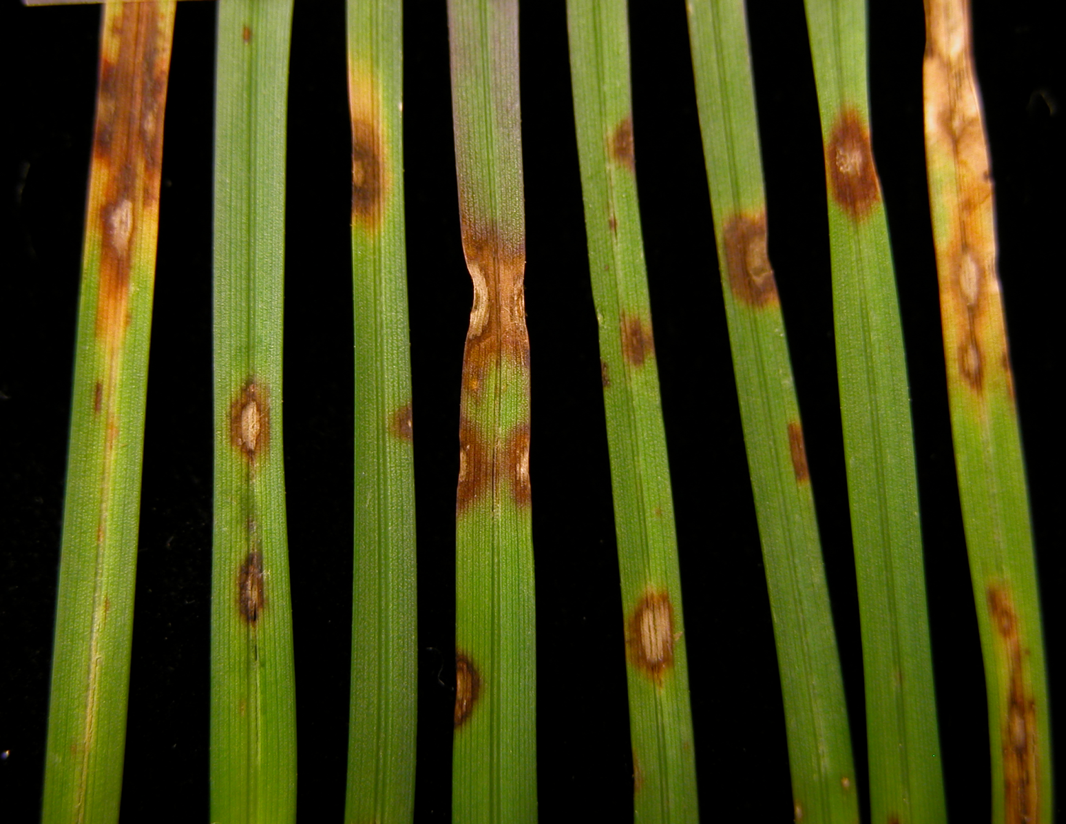
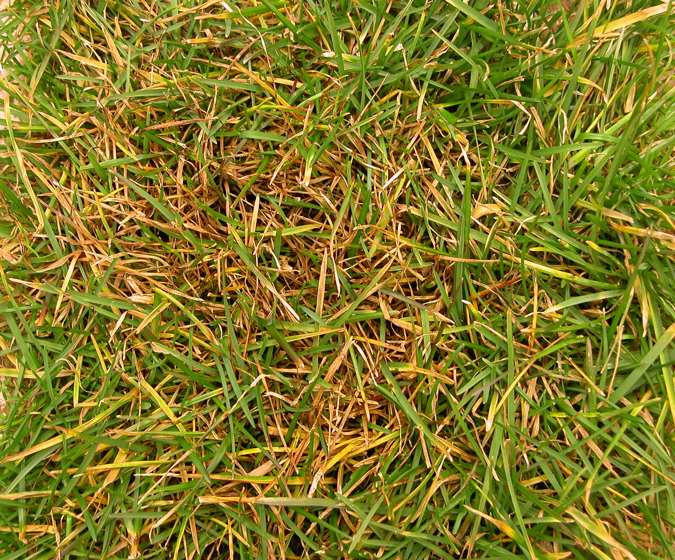
The causal fungi initially penetrate and infect leaf tissues producing small brown spots. These spots on infected leaves expand and develop dark purplish or reddish-brown oval borders with tan centers. The spots are often described as “football” shaped (Photo 1). Infected leaves yellow as the disease progresses and senesce prematurely. This process can thin turf stands, but most modern turfgrass varieties can tolerate minor infections and the loss of a few leaves, so the thinning is generally minimal (Photo 2).

Photo 1: “Football” shaped leaf lesions on Kentucky bluegrass caused by Drechslera poae. Photo: Sabrina Tirpak, Rutgers PDL

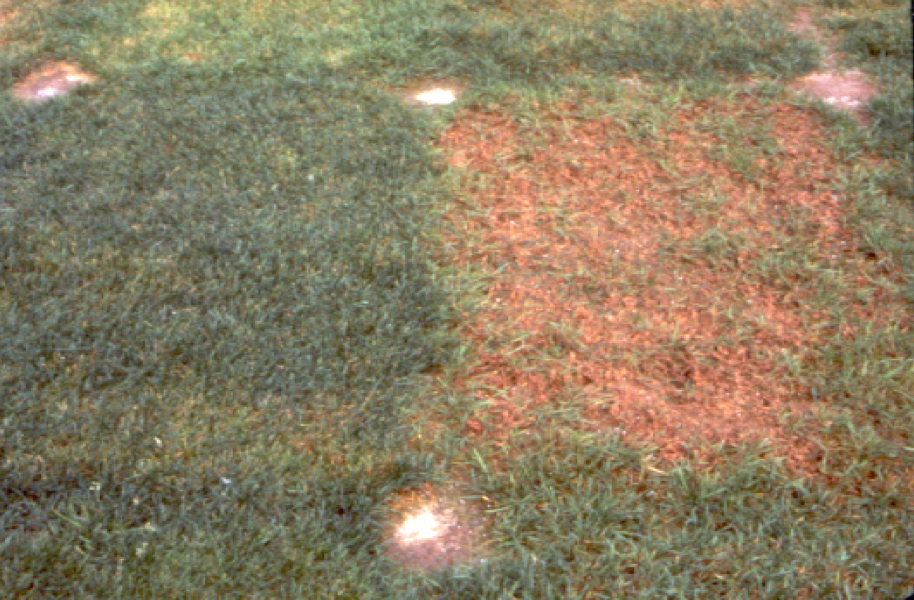
Under ideal conditions for disease development, or with very susceptible cultivars, the crowns and roots of infected plants also become diseased, which results in a brown or black rot of the crown tissue. Once the crown becomes dysfunctional, individual plants begin to fail as temperatures rise and the evapotranspiration demand on the grass increases into the summer months. This usually results in severe thinning of the turf stand and is known as the “melting-out” phase of the disease (Photo 4).

Photo 2: Yellowing and thinning Kentucky bluegrass by Drechslera poae. Photo: Richard J. Buckley, Rutgers PDL

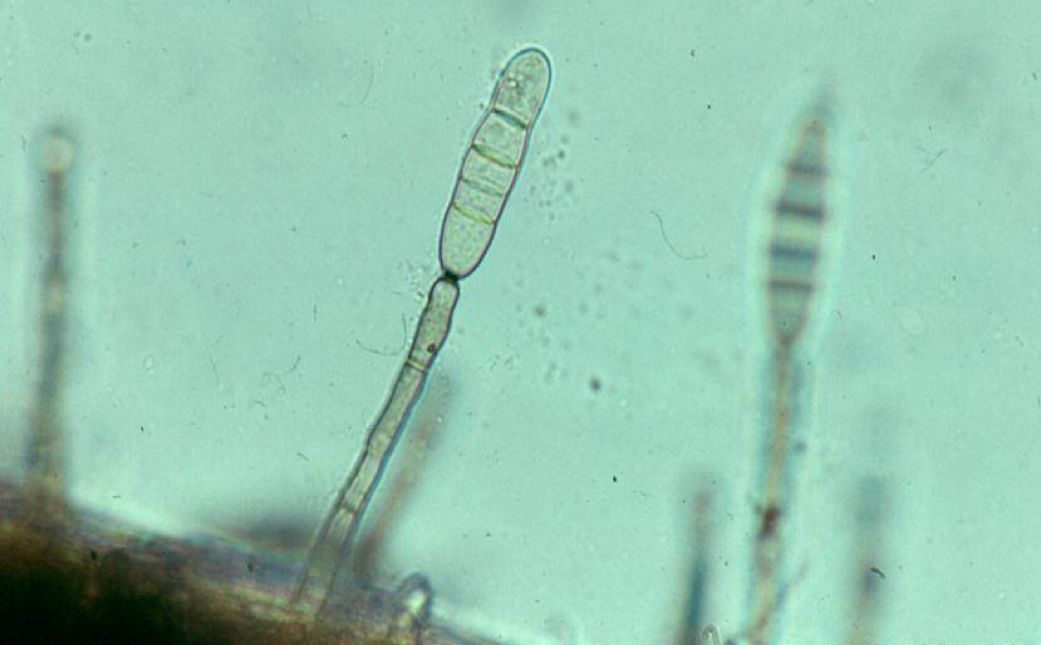
Conidia (asexual spores) produced by the these fungi grow on stalks (conidiophores), are olivaceous (dark), and are shaped like cigars (Photo 3). They are only visible with the aid of a microscope or a high-magnification hand-lens. Trained diagnosticians can determine the genus and species of each leaf spot fungus based on spore germination characteristics as well as the size and shape of the spores.

Photo 3: Conidia of Drechslera siccans on a conidiophore. Photo: Richard J. Buckley, Rutgers PDL

Disease Cycle

The causal fungus of Leaf Spot and Melting Out of Kentucky Bluegrass, Drechslera poae, survives the winter in crowns and roots of infected turfgrass plants and/or on turf debris (thatch). This fungus begins to grow and reproduce during cool, wet weather in late-winter and early-spring beginning in March. Conidia produced by the fungus are splashed by rain or irrigation water to newly emerging grass leaves causing leaf spots. Successive generations of spores and leaf spot symptoms are produced during mid-to-late spring with the highest concentrations of conidia found on leaf litter during May at temperatures between 50 and 65oF. Research suggests that conidial production ceases at temperatures over 68oF. If conditions are favorable for disease development in late-spring, infections of the crowns result in the melting-out phase of the disease by summer. Melting-out causes large areas of previously thinning turfgrass to fail.

Be aware that not all of these closely related pathogens follow the same disease-cycle. Differences among the various causal fungi are generally related to host and the temperature range necessary for disease activity. Table 1. outlines the group.

Disease Typical Host Pathogen Environment
Leaf Spot and Melting Out Kentucky bluegrass Drechslera poae Cool, wet weather in spring
Net Blotch Fescues Drechslera dictyoides Cool, wet weather of late-spring
Brown Blight Perennial ryegrass Drechlsera siccans Cool, wet weather of spring and fall
Red Leaf Spot Bentgrass Drechslera erythrospila Warm, wet weather of summer
Melting Out All cool-season grass Bipolaris sorokiniana Warm, wet weather of summer
Fading Out All cool-season grass Curvularia spp. Warm, wet weather of summer

Cultural Conditions that Favor Disease

Cultural conditions favoring leaf spot disease include: mowing at low cutting heights, light and frequent irrigation cycles, and excessive nitrogen fertilizer applications in early spring. These diseases can also be severe on turfgrasses with nitrogen deficiencies. There is evidence that turf stands (KBG) with excessive thatch accumulations can have more severe disease outcomes. Although many improved cultivars of Kentucky bluegrass and perennial ryegrass have a high degree of leaf spot resistance, other older cultivars—often found in inexpensive seed mixtures or as components in tall fescue sod—are susceptible (Photo 4). These cultivars can sustain severe damage and will suffer recurring disease outbreaks in a single season and over multiple years.

Management

Genetics is everything with leaf spot diseases. The single, most effective cultural practice for preventing severe damage is to plant leaf spot-resistant turfgrass cultivars whenever possible. Lists of leaf spot-resistant grasses can be found on the National Turfgrass Evaluation Program website (NTEP.org). Another important cultural practice is to apply only moderate amounts of nitrogen fertilizer at a time (0.5 lb. nitrogen/1,000 sq. ft.), particularly in the early spring. If higher rates are necessary, using products that are formulated with at least 50% of the available nitrogen in a slow release form are desired to avoid succulent and over-stimulated foliage. Mowing lawns at cutting heights above 2.5 inches during spring may help to reduce the severity of leaf spot and melting-out. If irrigation is required, watering inputs should be made to prevent drought stress and sustain growth, without creating an overly wet canopy. Thatch accumulations should be mechanically removed.

Photo 4: Melting out of Kentucky bluegrass due to Drechslera poae. Note the damage to the older cultivar compared to the improved cultivar. Photo: unknown

Chemical Control

Many fungicides are labeled and efficacious for the control of leaf spot diseases. Timing matters for disease outcomes and preventative fungicide applications provide the best results. Make applications to susceptible grasses in April at the first evidence of leaf infection. Products containing iprodione, chlorothalonil, mancozeb, fluazinam, fludioxonil, azoxystrobin, or penthiopyrad have demonstrated good control of leaf spot diseases in University Trials. Be aware that some research trials have shown enhanced leaf spot disease activity with thiophanate-methyl products, even though they are labeled for leaf spot control. For a complete list of labeled materials and their efficacy, see University of Kentucky’s information bulletin:

Chemical Control of Turfgrass Diseases 2020. Bruce B. Clarke, Department of Plant Biology, Rutgers University; Paul Vincelli, Department of Plant Pathology, University of Kentucky; Paul Koch, Department of Plant Pathology, University of Wisconsin-Madison; Gregg Munshaw, Department of Plant and Soil Sciences, University of Kentucky.

Pest Counts & Action Thresholds in the Greenhouse

Scouting Methods & Options:

There are essentially three options available when scouting your greenhouse crops for insect/mite pests. 1- No scouting performed with pesticides being applied on a calendar timetable. 2- Simply scouting for pest existence  with pesticides applied when presence is observed. 3- Scouting crop and making pesticide application decisions based on pest counts and action thresholds. The third option is part of an integrated pest management (IPM) approach that has been promoted throughout the green industry the past few decades.

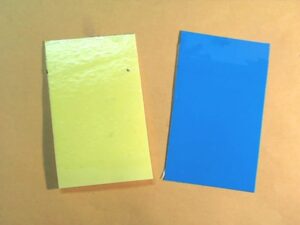
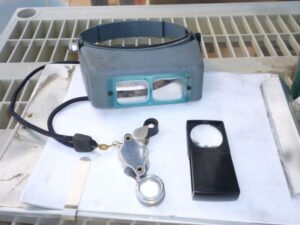
Greenhouse pest populations are measured by trapping or direct plant inspection, and both involve determining pest numbers. Counting pests and using action thresholds requires time and knowledge, but results in less pesticide use, reduced potential for insect resistance, and can improve plant quality. It is important to remember that trapping (e.g., yellow, or blue sticky cards) improves the efficiency when scouting your greenhouse but does not replace the actual inspection of individual crop plants (Fig. 1 & Fig. 2). This is particularly the case when scouting for aphids and mites.

Fig.1. Yellow or blue colored sticky traps are used to capture flying insect pests in the greenhouse. The blue traps attract the western flower thrips more effectively. (Photo Credit: Steven K. Rettke, Rutgers Coop. Ext.)
Fig. 2. The optivisor (3x) at top of photo works best when counting or viewing the insects captured on sticky traps. The other magnifiers shown (5x, 16x, 20x) are used to more closely view pests on crop plants. (Photo Credit: Steven K. Rettke, Rutgers Coop. Ext.)


[Read more…]

Weed Science Webinar Series

Weed Science Webinar Series

USDA – ARS and the Weed Science Society of America (WSSA) are co-hosting 10 webinars on weed science and research. Beginning April 5, presentations will be given by ARS weed science research experts.

The webinars will occur every Tuesday from 2-3p.m. Eastern Time (ET) and include an interactive Q&A session.

Register Here Today!

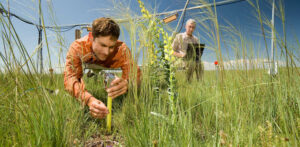
Two people conducting research in a field

Weed Science Webinar Series Schedule

April 5
ARS Weed Science: Past, Present, and Future: Steve Duke, Principal Scientist at the National Center for Natural Products Research at the University of Mississippi, Steve Young, National Program Leader – Weeds and Invasive Pests, WSSA Representatives and ARS Administrators

Meeting Information:

Zoom Meeting Link

Webinar ID: 831 3320 1055

Passcode: 825921

Please download and import the following iCalendar (.ics) files to your calendar system.

Theme I: Tactics

April 12
Integrated Weed Management in Cropping Systems: Marty Williams, Ecologist at the Global Change and Photosynthesis Research Unit in Urbana, IL

April 19
Non-Crop Systems: Advancements in Weed Biocontrol Tools: Melissa Smith, Research Ecologist at the Invasive Plant Research Laboratory in Fort Lauderdale, FL

April 26
New Technology for Weed Identification and Control: Steven Mirsky, Research Ecologist at the Sustainable Agricultural Systems Laboratory in Beltsville, MD

Theme II: Mechanisms

May 3
Role of Plant Physiology in Weed-Crop Competition: Dave Horvath, Research Plant Physiologist at the Sunflower and Plant Biology Research Unit in Fargo, ND

May 10
Molecular Basis for Controlling Invasive Plants: Matt Tancos, Research Plant Pathologist at the Foreign Disease-Weed Science Research Unit in Fort Detrick, MD

May 17
Addressing Herbicide Resistance with Alternative Chemistries: Scott Baerson, Molecular Biologist at the Natural Products Utilization Research Unit in Oxford, MS

Theme III: Impacts

May 24
Spread and Distribution of Invasive Plants: John Madsen, Research Biologist at the Invasive Species and Pollinator Health Unit in Albany, CA

May 31
Climate Change Effects on Weeds and Management: Dana Blumenthal, Ecologist at the Rangeland Resources & Systems Research Unit in Fort Collins, CO

June 7
Restoration for Managing Invasive Plants: Roger Sheley, Ecologist at the Range and Meadow Forage Management Research Unit in Burns, OR

Weather Effects on Plants & Insect-Mite Pests

The old saying that “everyone talks about the weather” is certainly true when it involves landscape plant managers. Professional landscapers/arborists and their clients are always discussing how various weather factors are affecting plants. The New Jersey weather trends can often be variable from one growing season to the next. How do rain, wind and temperature changes impact plants and their corresponding insect/mite pests?

The chart below lists four weather conditions & categorizes how these conditions positively or negatively influence some of the key landscape insect/mite pests.


TABLE: PESTS AFFECTED BY SPECIFIC CONDITIONS (Source: David Shetlar, Ohio State Cooperative Extension)

 “A” Hot-Dry Weather Pests  “B” Cool Weather Pests  “C” Pests Damaged by Excessive Rains   “D” Pests Attracted to Stressed Plants

 -Lace Bugs

 -Scales

 -Leaf Beetles

-Caterpillars

-Warm Season Mites


-Aphids (some)

-Adelgids

-Root Weevils

-Cool Season Mites

-Eriophyid Mites (some)


-Lace Bugs (fungus)

-Aphids/Mites (impact)

-Scale Crawlers (impact/wind)

-Caterpillars (fungus)

-Black Vine Weevils fungus)

-Aphids (some)

-Scales (some)

-Whiteflies

-Caterpillars (some)

-BORERS!!

[Read more…]

Identifying Clearwing Moth Borers in Pheromone Traps

Clearwing moth borers comprise one of the most damaging groups of insect pests that attack shade trees and shrubs. Controls must be accurately timed, since larvae tunnel under the bark most of the year, where they are unreachable by most insecticides. Artificial pheromones of many of the clearwing moths found in the landscape are available. These pheromones are a synthetic of the sex attractant emitted by many insects & are commercially available and recommended for the IPM manager.

Plant manager viewing contents of clearwing moths captured in pheromone-baited wing-trap. (Photo Credit: Steven K. Rettke, Rutgers Coop. Ext.)
This green ash tree is showing severe symptoms from banded ash clearwing moths. Too late for pheromone traps to be of value. (Photo Credit: Steven K. Rettke, Rutgers Coop. Ext.)


Adult male clearwing moths are attracted to the pheromone-baited sticky trap that helps determine: 1) if the borers are present in an area; and 2) when to apply insecticide sprays. Pheromone traps enable landscape managers to accurately determine when the first emergence of the egg laying borers are expected so that insecticides can be timed & applied effectively to susceptible tree/shrub hosts. Spraying the bark of the tree to be protected with a long residual insecticide (i.e., such as pyrethroids) should effectively kill the young borer larvae as they hatch from eggs & attempt to tunnel into the stems or branches.

Hypothesized flight path of an adult male clearwing moth towards the pheromone trap. (Diagram: Steven K. Rettke, Rutgers Coop. Ext.)

[Read more…]

Pest Scouting Update – 25 to 150 GDDs Plus Printable resources!

Additional resource: SLF EGG MASS GUIDE – USE FOR TRAINING (click here to download)

We have compiled the GDD resources into one single document – please download and print multiple copies of this for yourself and employees in efforts to best scout for these insect pests. These guides do not dictate when to spray, rather they inform scouting ranges for insect pests, vulnerable life-stages, and overlapping timeframes for multiple troublesome pests.

Please Download these resources:

Nursery and Landscape Pest Scouting Guide 2022 PDF (note this contains conifer pests as well)

Conifer Pest Scouting Guide 2022 PDF

Refer to this post “Obtaining your local growing degree-days” for additional information 

We will be making regular announcements throughout the season, however we wanted you to have this beta-version of the compiled growing-degree day information. This will be updated and modified throughout the season – PLEASE let me know what difference you are seeing in the field so we can continue to make this resource better for all of us.   

Contact: twaller@njaes.rutgers.edu (or call the Cumberland County Extension Office – 856-451-2800)

Growing degree-days as of writing this 3/22/22 (using USPEST.org weather station codes):

  • Southern (NJ50): 74
  • Central (NJ10): 72
  • Northeastern (Greater NYC Metro area (D6302): 41
  • Northwestern (NJ59): 21
  • Crop type Common Name Scientific Name GDD Min (50F) GDD Max (95F) Reference Developmental / Target Stage
    Conifer Zimmerman pine moth Dioryctria zimmermani 25 100 3 1st larvae
    Conifer Cooley spruce gall adelgid Adelges cooleyi 25 120 3 Spring control of overwintering stage
    Conifer Eastern spruce gall adelgid Adelges abietis 25 100 3 Spring control of overwintering stage
    Conifer Northern pine weevil Pissodes approximatus 25 100 4 1st adults active
    Conifer Zimmerman pine moth Dioryctria zimmermani 25 100 3 1st larvae active
    Conifer Cooley spruce gall adelgid Adelges cooleyi 25 120 3 Spring control of overwintering stage
    Conifer White pine weevil Pissodes strobi 25 220 4 1st adults active
    Shade trees European fruit lecanium Parthenolecanium corni 35 145 2 Spring control of overwintering stage
    Many, evergreen Euonymus scale Unaspis euonymi 35 120 2 Spring control of overwintering stage
    Conifer European pine sawfly Neodiprion sertifer 35 145 1 Hatched larvae
    Conifer Fletcher scale Parthenolecanium fletcheri 35 148 2 Spring control of overwintering stage
    Conifer European pine shoot moth / borer Rhyacionia buoiana 50 220 4 1st larvae active
    Maples Maple bladdergall mite Vasates quadripedes 58 148 2 Spring control of overwintering stage
    Honeylocust Honeylocust plant bug Diaphnocoris chlorionis 58 246 2 Nympths / adults active
    Conifer Pine tortoise scale Toumeyela parvicornis 58 148 2 Cralwer activity
    Conifer Pine bark adelgid Pineus strobi 58 618 2 Spring control of overwintering stage
    Conifer Balsam twig aphid Mindarus abietinus 60 100 4 Egg hatch
    Many Southern red mite Oligonychus ilicis 69 157 RU Spring hatch
    Conifer Eastern pine shoot borer Eucosma gloriola 75 200 4 1st adults active
    Malus, Prunus, many Eastern tent caterpillar Malacosoma americanum 90 190 2 Larvae treatment before tents apparent
    Many Gypsy moth Lymantria dispar 90 448 RU Larvae treatment (early instars)
    Conifer Cooley spruce gall adelgid Adelges cooleyi 90 180 4 1st adults active – Douglas fir
    Malus, Prunus, many Eastern tent caterpillar Malacosoma americanum 90 190 2 Larvae treatment before tents apparent (near 150-GDD50)
    Malus, Prunus, many Eastern tent caterpillar Malacosoma americanum 90 190 2 Larvae treatment before tents apparent (near 150-GDD50)
    Conifer Balsam twig aphid Mindarus abietinus 100 150 4 Stem mothers present (control target)
    Conifer Pine engraver (Ips bark beetle) Ips spp. 100 150 4 1st adults active
    Conifer European pine sawfly Neodiprion sertifer 100 195 4 1st larvae active
    Pieris Andromeda lace bug Stephanitis takeyai 115 279 RU Nymphs (1st generation)
    Azalea Azalea lace bug Stephanitis pyrioides 118 372 RU Nymphs (1st generation)
    Conifer Larch casebearer Coleophora laricella 120 150 4 Egg hatch
    Elm, Service berry Woolly elm aphid Eriosoma americana 121 246 2 (6) Control target
    Elm, Service berry Woolly elm aphid Eriosoma americana 121 246 2 (6) Control target
    Birch Birch leafminer Fenusa pusilla 123 290 RU Adults – egg laying
    Many Gypsy moth Lymantria dispar 145 200 4 Egg hatch, 1st larvae
    Holly Holly leaf miner Phytomyza ilicis 147 265 RU Adults – egg laying
    Many Cankerworms, inch-worms, loopers (many) 148 290 2 Larvae treatment
    Lilac, ash, privet, many Lilac / Ash Borer Podosesia syringae 148 299 2 Adult flight
    Yews, Rhododendrons, many Black Vine Weevil Otiorhynchus sulcatus 148 400 2 Pupation / Adult emergence
    Dogwood, many Dogwood Borer Synanthedon scitula 148 700 2 Adult activity
    Conifer Spruce spider mite Oligonychus ununguis 150 175 4 1st egg hatch
    Conifer Spruce needleminer Endothenia albolineana 150 200 4 1st larvae active
    Conifer Balsam gall midge Paradiplosis tumifex 150 300 4 Adults laying eggs
    Conifer Hemlock woolly adelgid Adelges tsugae 150 150 RU Eggs and 10% hatch
    Conifer Spruce spider mite Oligonychus ununguis 150 175 4 1st egg hatch
    Conifer Spruce needleminer Endothenia albolineana 150 200 4 1st larvae active
    Conifer Balsam gall midge Paradiplosis tumifex 150 300 4 Adults laying eggs
    Conifer Hemlock woolly adelgid Adelges tsugae 150 150 RU Eggs and 10% hatch
    Conifer Spruce spider mite Oligonychus ununguis 150 175 4 1st egg hatch
    Conifer Spruce needleminer Endothenia albolineana 150 200 4 1st larvae active
    Conifer Balsam gall midge Paradiplosis tumifex 150 300 4 Adults laying eggs

References:

RU Rutgers Cooperative Extension – Landscape IPM Notes
2 http://ccetompkins.org/resources/using-growing-degree-days-for-insect-management
3 https://extension.psu.edu/ipm-basics-for-christmas-trees#section-2
4 https://www.canr.msu.edu/ipm/agriculture/christmas_trees/gdd_of_conifer_insects
5 https://www.agriculture.nh.gov/publications-forms/documents/landscape-pests.pdf
6 https://extension.umd.edu/ipm/pest-predictive-calendar-landscapenursery
7 https://www.canr.msu.edu/ipm/agriculture/christmas_trees/gdd_of_landscape_insects
Unv. Del. Coorespondance with Dr. Kunkel (University of Delaware)-evolving GDD ranges
Compiled by – Timothy J. Waller, Ph.D. – Rutgers Cooperative Extension, Cumberland County Nursery Crops – twaller@njaes.rutgers.edu