Fruit Crops Edition - Wine Grape Section

Seasonal updates on diseases, insects, weeds impacting small fruit (blueberry, cranberry, and wine grape). Fruit Pest Alerts are also available via this category feed.
 
Subscription is through the general Fruit feed available via EMAIL and RSS.

Tree Fruit IPM Report for 06/09/23

Peach:

Bacterial Spot: Fruit symptoms from this set of infections have begun to appear in southern counties. So far fruit symptoms are very low and only in highly susceptible varieties. One of the few benefits of a dry spring dry spell is lower disease incidence. Peaches are close to pit hardening and at that point fruit will develop some resistance to bacterial spot. Infection s can still occur but will be less unsightly and may still make grade. Growers should continue to manage using Oxytetracyclene and lower rates of copper, especially around rainy periods and severe weather.

Oriental Fruit Moth: A biofix point for OFM was set on 4/10 in both northern and southern counties.  All timings for first generation OFM have past.

OFM 2nd Generation Timing
Insecticide Type
County/Region Degree Days by  6/9 base 45 Conventional

1150-1200

Diamide

1075-1150

Gloucester – Southern 888 1st –6/21-6/23

2nd – too far off

1st –6/17-6/19

2nd – too far off

Middlesex – Northern 862 1st –6/22-24

2nd – too far off

1st –6/18-6/20

2nd – too far off

Plum Curculio; Tarnished Plant Bugs; and Other Catfacing Insects: Plum Curculio start to move into orchards at about 88-100 degree days base 50 after January 1. Applications for PC should be initiated once all petals are off, with a second application made with ovicidal materials at 379-402 DD. Additional applications with effective materials may be made between 520 and 730 DD base 50. Currently we have accumulated about 702 DD base 50 in southern counties, and 630 DD base 50 in northern counties. Growers can monitor degree day development at their site by finding the nearest weather station and using the degree day development tool at NEWA. Catfacing insects are active, and activity is increasing with fry weather and summer temperatures. Very little recent fruit feeding has been observed.

Scale Insects: White peach scale crawlers should be at peak crawler emergence in southern counties. San jose scale crawlers began emergence about 5/31. SJS crawlers typically peak in mid-June and continue emergence for up to 6 weeks. Control options during crawler emergence include Neonicitiniods (suppression only), and the IGR’s Esteem and Centaur. See the NJ Commercial Tree Fruit Production Guide and the product labels for more information.

Thrips: If the current dry spell continues Flower Thrips may become an issue in highly colored ripening fruit, especially in poorly managed ground covers that contain clover or other flowering weeds. Thrips damage appears as “silvering” and usually appears on fruit close to harvest.
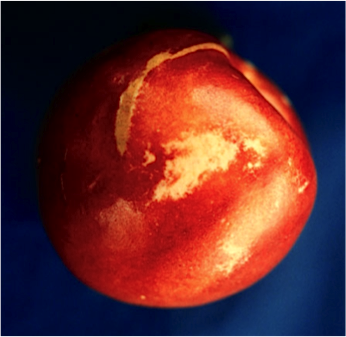
Early Season Thrip Injury on Nectarine

Fig. 1. Early Season Thrips “silvering” on Nectarine.

If populations are high damage can be extensive. Presence of thrips may be scouted for using a beating tray to detect the presence of adults and nymphs in the tree. Flowering weeeds and shrubs on orchard edges may also be scouted by shaking flowers onto a beating tray or a sheet of paper. Delegate or Entrust at the highest labeled rate are the usual recommended materials for thrips in stone fruit. Lannate may be effective in some orchards but has not worked well in recent years. These materials all have short PHI’s and may be applied close to harvest when damage typically appears. Thrips have also been observed to mark cherries. Damage is different than peach and appears as a dark streak in a similar pattern as silvering. See the NJ Commercial Tree Fruit Production Guide for more information.

Apples and Pears:

Diseases: Now that primary scab has ended, the focus turns toward summer diseases such as fruit rots (esp. Bitter rot), and sooty blotch and fly speck. Bitter rot control has been difficult at best in recent years even where management programs have been rigorous. Research has suggested products such as Merivon, Luna Sensation and Inspire Super may be effective, and longtime reliable broad spectrum fungicides such as captan and ziram should provide control. Experience has suggested that the addition of phosphorous acid products such as Prophyt or Rampart to captan sprays may improve control. Observations are that these products improve control of other summer diseases such as sooty blotch and flyspeck, and may help suppress scab infections where present.

Fire Blight: Fire Blight symptoms began appearing in southern county apple and pear orchards the week of 5/1. Typically it is recommended to cut out infected limbs however this is a practical decision that must be made. This blog post from Michigan State may be helpful to decide whether it is worth cutting out infected tissue. Once the terminal buds set, typically in July, infected wood should be removed to prevent colonization by the bitter rot pathogen.

Codling Moth (CM): The first codling moth flight has started.  A biofix was set for CM on April 17th in both northern and southern counties. Trap captures began increasing again in southern counties this week. Timings are updated below.

Codling Moth Degree Day Timing
Application and Insecticide Type
County Area Biofix Rimon:

75-100DD + 14-17 days later


Intrepid

150 + 450 DD

Diamides – Altacor, Voliam mixes: (150-200 DD)

Cyd-X, Carpovirusine

250 DD + every 7-9 days during brood hatch (later if first spray is an IGR)

Standard Insecticides –  Delegate, Avaunt, OP’s, carbamates, pyrethroids

250 DD + 550 DD


DD 75 100 150 450 250 250 550
Southern April 17 past past past 6/7 past past 6/11
Northern  April 17  past  past  past 6/8 past past 6/13

Tufted Apple Budmoth (TABM): A biofix for TABM was set in southern county orchards on 5/8. Nothing needs to be done for TABM at this point. The first alternate middle applications for TABM will be on or about 6/12 in southern counties. This has been considered a minor pest in recent years. Many materials used for Codling Moth will also control TABM.

Pear:  Second generation pear psylla began hatching about 5/15. Options for control include spynosyn products such as Delegate and Entrust, and the neocitinoids (IRAC group 4A). The addition of 0.25-1 gal of summer oil may improve control. Other options include Movento, the IGR’s Esteem and Centaur, and products containing abamectin. Be sure to read and follow the label instructions regarding the addition of penetrants for abamectin products. Pear Psylla are still actively laying eggs and nymphs continue to hatch.

Grape: Early blooming native grapes were at 50% bloom on 5/24, therefore we have set the the Grape Berry Moth biofix at 5/24 for southern counties. Typically we would use the bloom date for V. riparia to set the biofix date, however the usual locations we have used in the past did not have viable vines to look at, and it is difficult to scout new locations for V. riparia this year. Since V. riparia typically blooms with early natives we used Concord and Ives to set the biofix. The model works best when growers record their own bloom dates and use the Grape Berry Moth model at NEWA. Applications for GBM using Intrepid or Diamides should be made at 810 DD base 47. Other effective materials can be applied a few days later. Currently we are at 167 DD in southern counties. Applications have been historically made around the end of June in southern counties.

Tree Fruit Trap Captures – Southern Counties

STLM TABM-A CM BMSB OFM-A DWB OFM-P TABM-P LPTB PTB
4/15/2023 433 20 1
4/23/2023 423 1 13 8 4
4/30/2023 417 7 15 4 1 0
5/06/2023 9 2 3 1 0 0
5/13/2023 18 2 7 2 3 0 6 6
5/20/2023 5 18 6 0 51 0 13 67
5/27/2023 1 11 4 0 17 0 11 49
6/03/23 3 8 2 1 24 0 13 65

Tree Fruit Trap Captures – Northern Counties

STLM TABM-A CM BMSB OFM-A DWB OFM-P TABM-P LPTB PTB
4/8/2023 10
4/15/2023 20 3
4/30/2023 28 11 6
5/06/2023 22 2 19 9
5/13/2023 34 1 3 2 5 0
5/20/2023 31 6 7 1 6 0
5/27/23 16 18 4 1 17 3 11
6/03/23 12 26 2 0 17 2 12

Phenology Table: Based on annual observations made in Gloucester County.

Pest Event or Growth Stage Approximate Date 2023 Observed Date
 Bud Swell (Redhaven)  March 23 +/- 15 Days March 7
1/4″ Green Tip Red Delicious March 31 +/- 13 Days March 27
Pink Peach (Redhaven) April 4 +/- 15 Days March 24
Tight Cluster Red Delicious April 9 +/- 13 Days April 7
Full Bloom Peach (Redhaven) April 9 +/- 14 Days April 4
Pink Apple (Red Delicious) April 14 +/- 12 Days April 11
Full Bloom Apple (Red Delicious) April 22 +/- 11 Days April 16
Petal Fall (Redhaven) April 22 +/- 10 Days April 15
Petal Fall (Red Delicious) April 27 +/- 13 Days  May 3
Shuck Split (Redhaven) April 30 +/- 11 Days April 21
Pit Hardening June 15 +/- 9 Days


2023 Spotted Lanternfly Tracking Survey

Rutgers NJAES Wine Grape Extension, in association with Penn State Extension Grape and Wine Team, is calling on those who own, operate, or manage a farm or vineyard in the New Jersey region to participate in a survey that aims to track the spread and severity of nymph and adult spotted lanternfly populations during the 2023 season. The data collected will provide insights into the distribution patterns of both nymph and adult SLF within and outside vineyards, enabling growers and researchers to better understand this invasive pest’s potential impact on agriculture in the Mid-Atlantic region. [Read more…]

Tree Fruit IPM Report for 6/3/2023

Peach:

Bacterial Spot: Generally we recommend starting at 0.5 ozs metallic copper and gradually lowering the rate as the season progresses. The rate applied will depend on the formulation. Dr. Lalancette published a chart listing common copper formulations and rates for peach and nectarine applications. Avoid combining copper with captan especially if it has been overcast for several days. Also avoid acidic spray solutions when applying copper. Dr. Lalancette has published a handy guide for copper applications in early covers. Antibiotics such as Mycoshield or Fireline may also be used and may offer slightly more residual activity during long wetting periods. Bacterial Spot leaf symptoms began appearing in southern county orchard during the week of 5/8. These infections probably occurred mostly during the heavy rains that occurred on 4/30-5/1. Fruit symptoms from this set of infections have begun to appear in southern counties. So far fruit symptoms are very low and only in highly susceptible varieties.

Oriental Fruit Moth: A biofix point for OFM was set on 4/10 in both northern and southern counties.  All timings for first generation OFM have past.

OFM 2nd Generation Timing
Insecticide Type
County/Region Degree Days by  6/2 base 45 Conventional

1450-1500

Diamide

1300-1400

Gloucester – Southern 769 1st –too far off

2nd – too far off

1st –too far off

2nd – too far off

Middlesex – Northern 742 1st –too far off

2nd – too far off

1st –too far off

2nd – too far off

Plum Curculio; Tarnished Plant Bugs; and Other Catfacing Insects: Plum Curculio start to move into orchards at about 88-100 degree days base 50 after January 1. Applications for PC should be initiated once all petals are off, with a second application made with ovicidal materials at 379-402 DD. Additional applications with effective materials may be made between 520 and 730 DD base 50. Currently we have accumulated about 619 DD base 50 in southern counties, and 546 DD base 50 in northern counties. Growers can monitor degree day development at their site by finding the nearest weather station and using the degree day development tool at NEWA. Catfacing insects are active, and activity is increasing with dry weather and summer temperatures. Very little recent fruit feeding has been observed.

Scale Insects: White peach scale crawlers should be at peak crawler emergence in southern counties. San jose scale crawlers have begun emergence this past week. SJS typically begin emergence about late May or Early June and continue emergence for up to 6 weeks. Control options during crawler emergence include Neonicitiniods (suppression only), and the IGR’s Esteem and Centaur. See the NJ Commercial Tree Fruit Production Guide and the product labels for more information.

Apples and Pears:

Diseases: Now that primary scab has ended, the focus turns toward summer diseases such as fruit rots (esp. Bitter rot), and sooty blotch and fly speck. Bitter rot control has been difficult at best in recent years even where management programs have been rigorous. Research has suggested Products such as Merivon, Luna Sensation and Inspire Super may be effective, and longtime reliable broad spectrum fungicides such as captan and ziram should provide control. Experience has suggested that the addition of phosphorous acid products such as Prophyt or Rampart to captan sprays may improve control. Observations are that these products improve control of other summer diseases such as sooty blotch and flyspeck, and may help suppress scab infections where present.

Fire Blight: Fire Blight symptoms began appearing in southern county apple and pear orchards the week of 5/1. Typically it is recommended to cut out infected limbs however this is a practical decision that must be made. This blog post from Michigan State may be helpful to decide whether it is worth cutting out infected tissue. Once the terminal buds set, typically in July, infected wood should be removed to prevent colonization by the bitter rot pathogen.

Codling Moth (CM): The first codling moth flight has started. A biofix was set for CM on April 17th in both northern and southern counties.

Codling Moth Degree Day Timing
Application and Insecticide Type
County Area Biofix Rimon:

75-100DD + 14-17 days later


Intrepid

150 + 450 DD

Diamides – Altacor, Voliam mixes: (150-200 DD)

Cyd-X, Carpovirusine

250 DD + every 7-9 days during brood hatch (later if first spray is an IGR)

Standard Insecticides –  Delegate, Avaunt, OP’s, carbamates, pyrethroids

250 DD + 550 DD


DD 75 100 150 450 250 250 550
Southern April 17 past past past 6/7 past 5/21 6/13
Northern  past  past  past 6/7 past 5/23 6/14

Tufted Apple Budmoth (TABM): A biofix for TABM was set in southern county orchards on 5/8. Nothing needs to be done for TABM at this point. The first alternate middle applications for TABM will be on or about 6/12 in southern counties. This has been considered a minor pest in recent years. Many materials used for Codling Moth will also control TABM.

Pear:  Second generation pear psylla began hatching about 5/15. Options for control include spynosyn products such as Delegate and Entrust, and the neocitinoids (IRAC group 4A). The addition of 0.25-1 gal of summer oil may improve control. Other options include Movento, the IGR’s Esteem and Centaur, and products containing abamectin. Be sure to read and follow the label instructions regarding the addition of penetrants for abamectin products. Pear Psylla are still actively laying eggs and nymphs continue to hatch.

Grape: Early blooming native grapes were at 50% bloom on 5/24, therefore we have set the the Grape Berry Moth biofix at 5/24 for southern counties. Typically we would use the bloom date for V. riparia to set the biofix date, however the usual locations we have used in the past did not have viable vines to look at, and it is difficult to scout new locations for V. riparia this year. Since V. riparia typically blooms with early natives we used Concord and Ives to set the biofix. The model works best when growers record their own bloom dates and use the Grape Berry Moth model at NEWA. Applications for GBM using Intrepid or Diamides should be made at 810 DD base 47. Other effective materials can be applied a few days later. Currently we are at 167 DD in southern counties. Applications have been historically made around the end of June in southern counties.

Tree Fruit Trap Captures – Southern Counties

STLM TABM-A CM BMSB OFM-A DWB OFM-P TABM-P LPTB PTB
4/15/2023 433 20 1
4/23/2023 423 1 13 8 4
4/30/2023 417 7 15 4 1 0
5/06/2023 9 2 3 1 0 0
5/13/2023 18 2 7 2 3 0 6 6
5/20/2023 5 18 6 0 51 0 13 67
5/27/2023 1 11 4 0 17 0 11 49

Tree Fruit Trap Captures – Northern Counties

STLM TABM-A CM BMSB OFM-A DWB OFM-P TABM-P LPTB PTB
4/8/2023 10
4/15/2023 20 3
4/30/2023 28 11 6
5/06/2023 22 2 19 9
5/13/2023 34 1 3 2 5 0
5/20/2023 31 6 7 1 6 0

Phenology Table: Based on annual observations made in Gloucester County.

Pest Event or Growth Stage Approximate Date 2023 Observed Date
 Bud Swell (Redhaven)  March 23 +/- 15 Days March 7
1/4″ Green Tip Red Delicious March 31 +/- 13 Days March 27
Pink Peach (Redhaven) April 4 +/- 15 Days March 24
Tight Cluster Red Delicious April 9 +/- 13 Days April 7
Full Bloom Peach (Redhaven) April 9 +/- 14 Days April 4
Pink Apple (Red Delicious) April 14 +/- 12 Days April 11
Full Bloom Apple (Red Delicious) April 22 +/- 11 Days April 16
Petal Fall (Redhaven) April 22 +/- 10 Days April 15
Petal Fall (Red Delicious) April 27 +/- 13 Days  May 3
Shuck Split (Redhaven) April 30 +/- 11 Days April 21
Pit Hardening June 15 +/- 9 Days


South Jersey Tree Fruit Twilight Meeting – II

May 31st @ 5 – 7 pm
Summit City Orchards: 500 University Blvd. Glassboro, NJ 08028

Pesticide credits applied Category: 1A, PP2, 10 

4:45 pm  Gather at the Parking lot of the Summit City Winery (above address)

5:00 pm Peach Fruit Thinning - Physiology and Methods
Daniel Ward, Extension Specialist, Pomology, Rutgers NJAES.

Demonstration of the Peach Fruit Thinning Using the Machine
Richard Bannister and Eli Bannister, Richard’s Station.

Field Observations from the IPM Program
Dave Schmitt, Fruit IPM Program Associate, Rutgers NJAES

Summer Disease Control Measures in Orchards
Norman Lalancette, Extension Specialist, Tree Fruit Pathology, Rutgers NJAES

7:00 pm  Pesticide re-certification credits application and Adjourn

Light fare will be provided. Please call Joan Medany jmedany@co.gloucester.nj.us or call 856-224-8030 if you are 
planning to attend. If an additional assistance is needed, please contact Hemant Gohil at 856-224-8029 prior to 
the meeting.

Application for Cost-Share Grant Funding for Installation of Deer Fencing on UNPRESERVED Farmland – Out NOW

“The NJDA Deer Fencing Program makes cost-sharing funding available for the installation of deer fencing on unpreserved farms. The program is conducted in accordance with N.J.S.A 4:40-6.1.”

Please click here for the full application, eligibility, and other important information

Timing is important if considering this program. NJDA began accepting applications on 5/15/23.


Tree Fruit IPM Report for May 10, 2023

Peach:

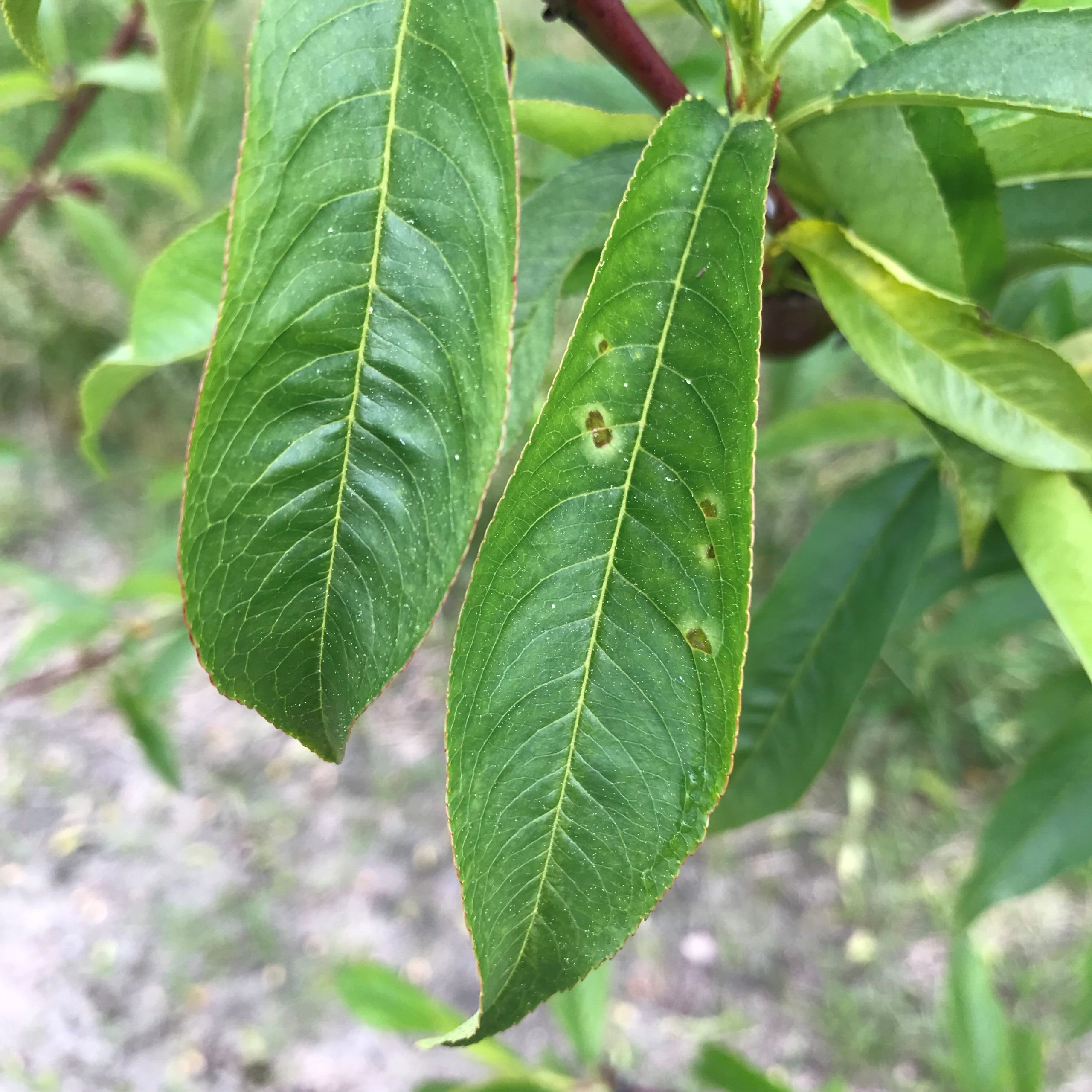
Bacterial Spot leaf symptoms about 2 weeks old.

Fig. 1 Bacterial Spot leaf symptoms about 2 weeks old.

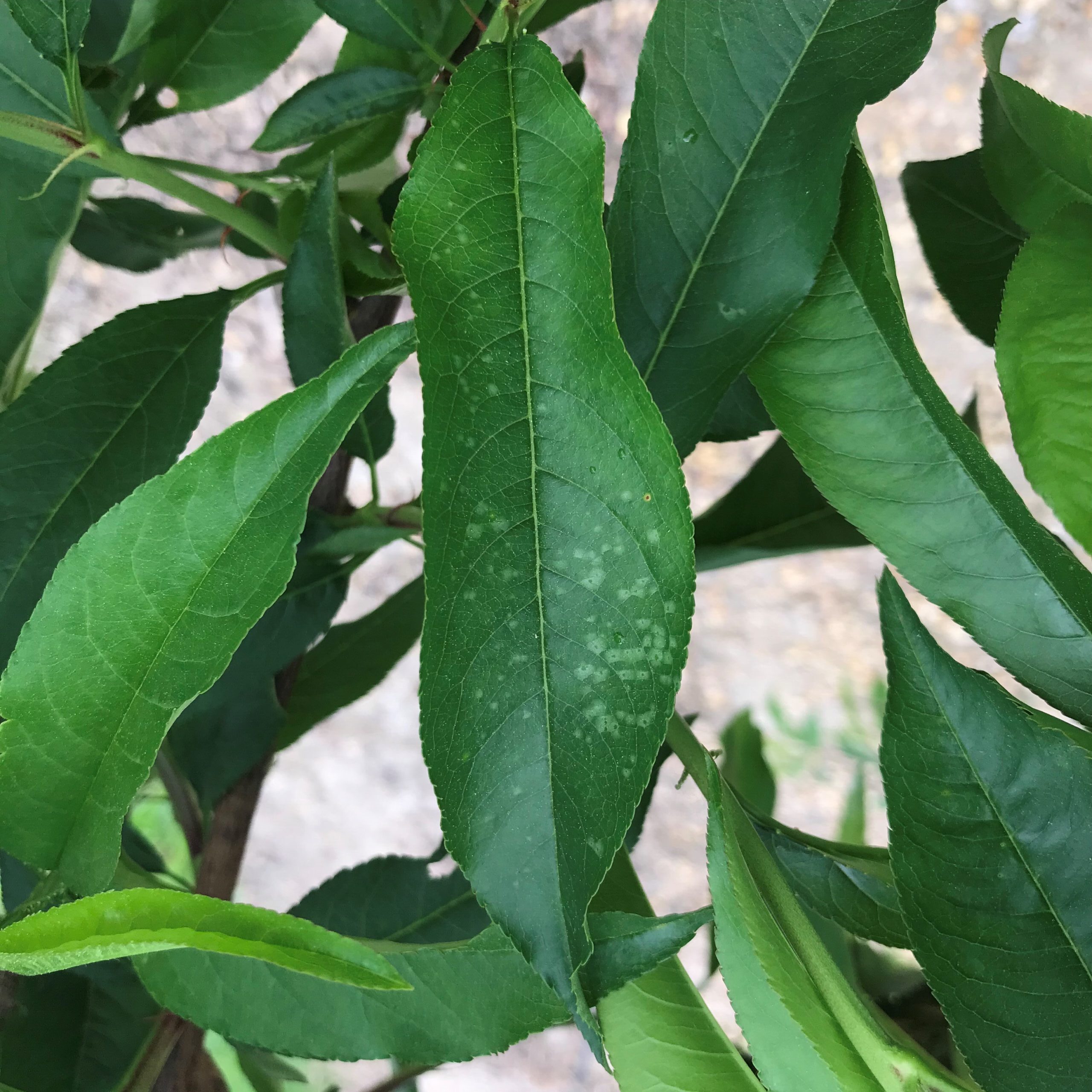
Bacterial Spot leaf symptoms about a week old.

Fig. 2 Bacterial Spot leaf symptoms about a week old.

Bacterial Spot: Generally we recommend starting at 0.5 ozs metallic copper and gradually lowering the rate as the season progresses. The rate applied will depend on the formulation. Dr. Lalancette published a chart listing common copper formulations and rates for peach and nectarine applications. Avoid combining copper with captan especially if it has been overcast for several days. Also avoid acidic spray solutions when applying copper. Dr. Lalancette has published a handy guide for copper applications in early covers. Antibiotics such as Mycoshield or Fireline may also be used and may offer slightly more residual activity during long wetting periods. Bacterial Spot leaf symptoms have begun appearing in southern county orchards. These infections probably occurred mostly during the heavy rains that occurred on 4/30-5/1. There is a small amount of older symptoms which probably occurred the previous weekend of 4/27-4/28 (Figs. 1&2.).

Oriental Fruit Moth: A biofix point for OFM was set on 4/10 in both northern and southern counties.  The first of two insecticide timings for first generation Oriental Fruit Moth control fall at 170-200 degree days base 45 after biofix. This timing generally coincides with 100% petal fall in peaches. Timings are updated below. Do not apply insecticides until all bloom is off. No Insecticides for OFM are needed where Mating Disruption is implemented.

OFM 1st Generation Timing
Insecticide Type
County/Region Degree Days by  5/8 base 45 Conventional

170-200, 350-375

Diamide

100-150, 300-350

Gloucester – Southern 345 1st –past

2nd –5/8-5/10

1st –past

2nd –past

Middlesex – Northern 327 1st –past

2nd –5/10-5/11

1st –past

2nd –5/7-5/10

Green Peach Aphid: GPA colonies begin forming sometime during bloom. Examine trees for the presence of colonies from pink to shuck split. Count the number of colonies on ten trees and use a treatment threshold of 2 colonies/tree at petal fall for peach, and 1 colony/tree for nectarine. The best way to scout for aphids during bloom is with a beating tray. Blossoms may also be collected, opened, and examined for the presence of aphids using a hand lens. This is particularly important for nectarine blocks. Check 10 trees per block with the beating tray. Collect 50 blossoms per block and examine for the presence of aphids. If more than 1 colony of aphids are found in nectarines, or 2-3 colonies are found in peaches, an insecticide for aphids will be needed when all petals are off. See the NJ Commercial Tree Fruit Production Guide for recommended materials and rates. Aphid colonies are now visible in southern county orchards.

Plum Curculio; Tarnished Plant Bugs; and Other Catfacing Insects: Plum Curculio start to move into orchards at about 88-100 degree days base 50 after January 1. Applications for PC should be initiated once all petals are off, with a second application made with ovicidal materials at 379-402 DD. Currently we have accumulated about 320 DD base 50 in southern counties, and 264 DD base 50 in northern counties. Growers can monitor degree day development at their site by finding the nearest weather station and using the degree day development tool at NEWA. Catfacing insects are starting activity, but will become more of an issue as temperatures warm and mowing and other ground cover activities become more common. Small amounts of catfacing injury are present statewide.

Scale Insects: White peach scale crawlers have not yet emerged but usually begin emergence about the third week of May and continue emergence until about the middle of June. San jose scale crawlers typically begin emergence about late May or Early June and continue emergence for up to 6 weeks. Control options during crawler emergence include the neonicitiniods Actara and Belay (suppression only), and the IGR’s Esteem and Centaur. See the NJ Commercial Tree Fruit Production Guide and the product labels for more information.

Lesser and Greater Peach Tree Borers: Growers using mating disruption for borer control can begin placing dispensers around the end of April and should have them in place by mid-May.

Apples and Pears:

Diseases: Apple Scab, Rust diseases, and Powdery Mildew are the main targets at this stage. The NEWA apple scab model is estimating about 100% ascospore maturity in southern NJ with 100% of cumulative ascospores discharged as of April 15. Northern counties were at Green tip on or about 4/3. The model estimates about 100% ascosppsore maturity for Northern Counties with 100% ascospores released as of April 30. Between tight cluster and first cover include products effective for powdery mildew and cedar apple rust.

Fire Blight: Infections can still occur post bloom so covers with antibiotics when infection events are forecast using the NEWA fire blight model may be beneficial. Remember to rotate streptomycin and oxytetracycline products. Fire Blight symptoms began appearing in southern county apple and pear orchards this week. Typically it is recommended to cut out infected limbs however this is a practical decision that must be made. This blog post from Michigan State may be helpful to decide whether it is worth cutting out infected tissue.

Rust Diseases: The two most common rust diseases that affect pome fruit are Quince Rust and Cedar Apple Rust. In some years these diseases can be troublesome in commercial orchards. Most disease control programs for scab will also control rust. In organically managed blocks in the east options are limited for approved materials that are effective for rust. Potassium Bicarbonate products have shown good efficacy for rust diseases in trials performed in Virginia. Organic growers should seek out and plant rust resistant cultivars. Cultural controls are not practicable due to the widespread presence of alternate host Junipers both wild and cultivated. Rust disease development on junipers should now be producing large spore releases during wetting periods. See this link for pictures of rust on pome fruit and juniper.

Dogwood Borer: Growers who plan to use mating disruption for Dogwood Borer should have ties in place by the end of May. See the Product label and the NJ Commercial Tree Fruit Production Guide for more Information.

Codling Moth (CM): The first codling moth flight has started. A biofix was set for CM on April 17th in both northern and southern counties.

Codling Moth Degree Day Timing
Application and Insecticide Type
County Area Biofix Rimon:

75-100DD + 14-17 days later


Intrepid

150 + 450 DD

Diamides – Altacor, Voliam mixes: (150-200 DD)

Cyd-X, Carpovirusine

250 DD + every 7-9 days during brood hatch (later if first spray is an IGR)

Standard Insecticides –  Delegate, Avaunt, OP’s, carbamates, pyrethroids

250 DD + 550 DD


DD 75 100 150 450 250 250 550
Southern April 17 past 5/7 5/11 Too far off 5/17 5/17 Too far off
Northern  5/7  5/10  5/12 Too far off 5/21 5/21 Too far off

Pear Diseases:  Continue managing for Rust, Fire Blight and Fabrea Leaf Spot through May.

Grapes: The most important diseases to manage at this time are Phomopsis, Black Rot, and Powdery Mildew. More information about early season disease control can be found in this blogpost from Virginia Tech. SLF hatch began in southern counties sometime during the last week of April. There is no need to control SLF at this time.

Tree Fruit Trap Captures – Southern Counties

STLM TABM-A CM BMSB OFM-A DWB OFM-P TABM-P LPTB PTB
4/15/2023 433 20 1
4/23/2023 423 1 13 8 0
4/30/2023 417 7 15 4 1 0
5/06/2023 9 2 3 1 0 0

Tree Fruit Trap Captures – Northern Counties

STLM TABM-A CM BMSB OFM-A DWB OFM-P TABM-P LPTB PTB
4/8/2023 10
4/15/2023 20 3
4/30/2023 28 11 6
5/06/2023 22 2 19 9

Phenology Table: Based on annual observations made in Gloucester County.

Pest Event or Growth Stage Approximate Date 2023 Observed Date
 Bud Swell (Redhaven)  March 23 +/- 15 Days March 7
1/4″ Green Tip Red Delicious March 31 +/- 13 Days March 27
Pink Peach (Redhaven) April 4 +/- 15 Days March 24
Tight Cluster Red Delicious April 9 +/- 13 Days April 7
Full Bloom Peach (Redhaven) April 9 +/- 14 Days April 4
Pink Apple (Red Delicious) April 14 +/- 12 Days April 11
Full Bloom Apple (Red Delicious) April 22 +/- 11 Days April 16
Petal Fall (Redhaven) April 22 +/- 10 Days April 15
Petal Fall (Red Delicious) April 27 +/- 13 Days  May 3
Shuck Split (Redhaven) April 30 +/- 11 Days April 21
Pit Hardening June 15 +/- 9 Days