NE Agriculture Expo and Rutgers Educational Sessions Start Tuesday 1/20/26 to Thursday 1/22/26 in Atlantic City

The NE Agriculture Expo and Rutgers Educational Sessions Start Tuesday 1/20/26 at Harrah’s in Atlantic City, 777 Harrahs Boulevard. The final day of educational sessions and trade show ends on Thursday at 5pm.

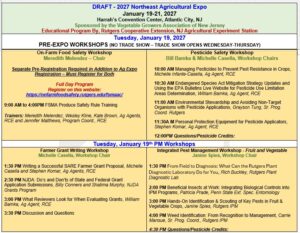
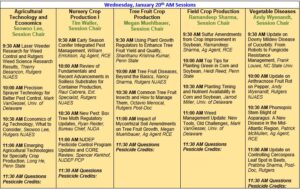
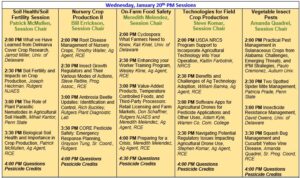
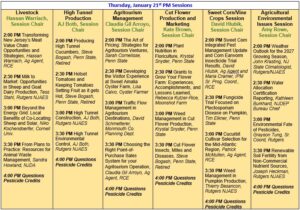
The weather may be cold, but no rain or no snow in the forecast, and warm times inside the conference center to network with others in the industry.  An afternoon Hospitality Room will be available 12-5pm on Wednesday and Thursday to relax and unwind in the trade show area. Come for the social aspects, education and gain pesticide recertification credits. Check out the Rutgers Educational Program to see what topics you would like to learn about. go.rutgers.edu/2026rutgerseduprog

What’s Happening

January 20 (Tuesday)

  • Pre–trade show workshops and sessions

January 21 (Wednesday)

  • Full day of educational sessions for all commodity groups • Year of the Women Farmer Luncheon
  • Packed trade show with vendor booths sold out
  • Live charity auction with FREE food

January 22 (Thursday)

  • More sessions
  • Another day packed trade show with vendor booths sold out
  • Special appearance by Temple Grandin book signing /meet and greet, then her special session (additional cost)

Registration Options On-Site at the Regitration Counter (hallway of conference center) or On-line https://vganj.com/convention-tickets“>https://vganj.com/convention-tickets

✔️ VGANJ Membership – $100

Includes 2 Expo passes

Additional passes just $25 each

✔️ One-Day Pass – $60

Access to sessions + trade show

Register On-Line to

  • Save time at registration
  • Walk in, grab your badge
  • Enjoy FREE breakfast (8am-10am Wednesday and Thursday in Trade Show)
  • Head straight to learning, growing, and catching up with friends

This event under one roof, packed with education and energy, and celebrating New Jersey agriculture at its best.

Plus, buy your tee shirt or hoodie at the registration desk to “Support New Jersey Farmers” and tout “No Farmers No Food” – new this year.


NEED PESTCIDE RECERTIFICATION CREDITS? REGISTER TODAY

4 CORE Credits – Pesticide Safety Workshop

A Tuesday, January 20, 2026 Workshop for Pesticide Applicators to gain CORE Credits towards their license will be held at the NE Agriculture Expo at Harrah’s in Atlantic City to start of this year’s event. This workshop will take place from 10:00AM to 12:00PM. Licensed applicators must accumulate 8 CORE Credits over a 5-year period to maintain their NJDEP Pesticide Applicators License. This workshop will offer 4 CORE Credits. Pre-registration is requested and can be found on the VGANJ website at https://vganj.com“>https://vganj.com. Registration cost is $25 per person and non-refundable. Registration for this workshop is separate from the convention registration and attendees must also register for the expo at https://vganj.com/convention-tickets. The topics include: Pesticide Safety – Personal Protection Equipment for the Pesticide Applicator; Update on US EPA Worker Protection Standards; Storage, Tank Mixing, Tank Cleaning, and Disposal; Pesticide Record Keeping and Notification. For more information contact Bill Bamka (bamka@njaes.rutgers.edu) or Michelle Infante-Casella (minfante@njaes.rutgers.edu).

For the full program (January 20-22nd) of Rutgers Educational Workshops and Sessions that offer more credits and diverse topics, see https://go.rutgers.edu/2026rutgerseduprog

Save the Date – Small Fruit Specialty Crop Production Session

Please mark your calendar and register for the Small Fruit Specialty Crop Production Session at the 2026 Northeast Agriculture Expo.

Location –        The Harrah’s Casino and Resort, Waterfront Conference Center at Atlantic City, Wildwood 10&11
Date & Time – January 21 (Wed), 2026, 2 pm – 4 pm
Registration – Use the link https://vganj.com/convention-tickets

Note: If you plan just to attend the Small Fruit Session, and you are not a member of the Vegetable Growers Association, select NONMEMBER SINGLE DAY CONVENTION TICKET $60.

Hemant Gohil – Chair

2:00 PM: Techniques for Growing and Over-Wintering Japanese Fig variety ‘Espalier’. Craig Boyer, Coastal Fig Co.

2:30 PM: Panel Discussion – Blackberry and Raspberry – Opportunities and Challenges with Pest Management and Production. Growers: Neil Pastore, Reuwai Hanwald, Patti Mood. Panel Moderator – Daniel Ward

3:30 PM: Table Grape Production – Marketing Opportunities and Challenges with Insects, Diseases and Other Production Aspects. Hemant Gohil, Agricultural Agent, RCE of Gloucester County

4:00PM Questions
Pesticide Credits: 1-1A, 1-10, 1-PP2

Late August and Early September Peach Varieties – New and Standard

Cooler temperatures and sunny days during the last 10 days have been ideal for full color and flavor development of late August and Early September peach varieties. Descriptions of fruit and tree characteristics, challenges, and laboratory evaluations of fruit physical and chemical properties (Table 1) of important varieties in this harvest window are described below. Understanding these characteristics is essential for selecting new varieties or replacing existing ones. Note that these varieties were evaluated in southern New Jersey; as a result, the harvest dates could be a few days later for the Central and Northern New Jersey orchards.

SelenaTM is a new yellow, melting flesh peach from the Rutgers Fruit Breeding program. It has an excellent firmness, slightly fibrous flesh around the pit, and ripens during and between ‘Jersey queen’ and ‘Encore’. Very large fruited with an attractive 50-80% mottled red and yellow background. The fruit hangs well on the tree and has an excellent balance of sweet and acidic flavor. This variety exhibits a low susceptibility to bacterial spot. Most importantly, like Gloria, the bloom is delayed and extended, resulting in trees always bearing a crop even during the hard frost years. Fruit maintains firmness after achieving commercial maturity and doesn’t drop fruit, like Encore and Jersey Queen.

TianaTM is a new yellow freestone melting flesh peach, ripening between ‘Cresthaven’ and ‘Encore’, and overlaps with Encore and Selena. It has large fruit with an excellent balance of acidity and high sweetness.  Skin is attractive, 50-75% mottled red-on-yellow background.  This productive variety exhibits low susceptibility to bacterial spot. Like Gloria, the bloom is delayed and extended, resulting in trees always bearing a crop even during the hard frost years. Fruit maintains its firmness on the tree after achieving commercial maturity. It is a good candidate for replacing Encore.

Jerseyqueen is a very large, oblong to ovate, 55-65% scarlet red over a yellow ground color; yellow-fleshed, freestone peach, ripening August 25-28, approximately 31 days after Redhaven. The flesh is firm with a sweet and mildly tangy flavor. The tree is very vigorous and moderately productive. Challenges: It has mild to medium susceptibility to bacterial spot. The variety is not fully productive on many peach sites and tends to produce doubles.

Flamin Fury® PF#27 is an attractive, large to very large, globose to ovate, 60-70% crimson red over a greenish yellow ground color, yellow-fleshed, freestone peach, ripening August 25-28, approximately 31 days after Redhaven. The flesh is firm with very good flavor. Challenges: It has a medium susceptibility to bacterial spot.

Flamin Fury® PF 28-007 is a large to very large, globose to ovate, 50-80% dark crimson red over greenish yellow ground color, yellow-fleshed, freestone ripening August 27-31, approximately 34 days after Redhaven. The flesh is firm to very firm with a sweet and tangy flavor, with some red around the pit. The tree is vigorous and productive with medium leaf susceptibility to bacterial spot. This is an attractive late-season variety with great size and color. Fruit hangs well and has more color than Cresthaven.

Flameprince is a medium-large, firm, attractive 50-70% crimson red over a yellow ground color, yellow/white-fleshed, freestone peach ripening September 2-5, approximately 38 days after Redhaven. The flesh is firm to very firm, sweet, and mildly tangy. The tree is moderately vigorous and productive with medium susceptibility to bacterial spot. Challenge: Note: The fruit color develops early; hence, picking by size is recommended. Three to four pickings may be required to achieve a uniform crop.

AutumnstarTM is a large, globose to slightly ovate, 60-80% crimson red over a yellowish green ground color, yellow-fleshed, freestone peach ripening September 4-7, approximately 41 days after Redhaven. The fruit is attractive for a late-season variety. Fruit size is medium-large.  The flesh is firm with a good balance of sweet and acidic flavor. The tree is vigorous and productive with low susceptibility to bacterial spot. Challenge: Some tree survival problems have been noted. The performance of this variety has varied from year to year. In some years, it’s hard to size to medium-large size.

Flamin Fury PF 36 is a globose, firm, yellow-fleshed free stone peach ripening during the first week of September—one of the best late-season peach varieties. Fruit is large to very large, sweet, mildly tangy, and mostly uniform in size. The tree is vigorous and highly productive with no bacterial spot.

Augustprince is a globose to slightly ovate, 60-90% crimson red over a yellowish red ground color, yellow-fleshed freestone peach ripening August 31 to September 3 or 37 days after Redhaven. The flesh is firm to very firm, melting, stringy, with a very good, slightly acidic flavor. The tree is vigorous, productive, and has low susceptibility to bacterial spot. This sister variety ripens close to Flame Prince but consistently has better size and firmness.

Some of the excellent, yellow-fleshed varieties with few serious challenges

Encore is a firm fleshed variety with decent tolerance to bacterial spot. The tree is productive and cold-hardy, and the fruit has decent eating quality. However, it has a drop tendency. Fruit blush development has been unsatisfactory in some years. Fayette: High susceptibility to bacterial spot. A popular variety. Laurol is firm-fleshed, peach with a very sweet and tangy flavor. It has a high susceptibility to bacterial spots. It can get tiny splits at the stem end, which don’t always open, but water can get in, resulting in black gum around the pit.

White-fleshed Peach

August Rose is an attractive late-season white-fleshed peach harvested 24 days after Redhaven and a few days after the Sugar Giant. It has a longer harvest window because commercially mature fruit retains firmness on the tree. The freestone fruit is very firm and has a delicious flavor and melting texture. 60-90% medium red on cream and sizes 2 ¾ – 3 inches in diameter, somewhat nonuniform in size. It is a very sweet, low-acid fruit that hangs well on the tree after commercial maturity. This tree is tolerant of bacterial leaf spot and constriction canker. It can fill the gap between Sugar Giant and Snow Giant.

Other white-fleshed peaches have serious challenges.

Snow King is challenging to grow in New Jersey due to its high susceptibility to bacterial spots and brown rot. Snowfire has a high susceptibility to bacterial spot. Snowfire has the same problems as Snow King – low productivity and high susceptibility to bacterial spot and brown rot. It ripens earlier than Snow King and has less red skin color. Opale. It is also very susceptible to brown rot. Benedict: The flavor is subacid and very good. The tree is upright, spreading, vigorous, moderately productive, and has medium to high susceptibility to bacterial spots. This peach ripens just after Sugar Giant but is not as attractive.

Articles on Previous Season Peach and Nectarine Varieties:

Updates from EPA for Pesticide Users on How to Navigate Mitigation Measures to Protect Endangered Species

The U.S. Environmental Protection Agency (EPA) has announced the availability of an online tool to help farmers and applicators implement mitigation measures to protect endangered species from pesticides. The mitigation measures were established to reduce exposure from pesticides for nontarget organisms as listed under the Endangered Species Act. Levels of mitigation that are required on pesticide labels can include mitigations for spray drift, runoff, and buffer zones. In April 2025, EPA released a mitigation menu website that includes information on these measures and how to calculate if a pesticide user has incorporated the number of “points” associated with the mitigation measures required by the pesticide labelling. It is the responsibility of the pesticide user to ensure that all pesticide labelling requirements are met, and requirements will vary among labels and products used.

The new tool released by EPA, the Pesticide App for Label Mitigations (PALM) is a mobile application that helps farmers and pesticide users use the EPA’s mitigation menu and stay compliant when applying pesticides for agricultural crop uses. The tool will combine relevant information and calculations needed to help farmers determine whether the necessary level of mitigation has been met before applying a pesticide.

If you are interested in learning more about the mitigation menu and available tools, the EPA will be hosting a public webinar on September 16th at 2 PM Eastern Time. Register here for the webinar.

Spanish Course for Ag Workforce – Registration Open

People shaking hands in a field with the sun setting behind themThe Rutgers Office of Continuing Professional Education will host a course on ‘Spanish for Ag and Horticulture Workforce’ from January 16-March 6, 2026. This is an online, self-paced course with approximately 21 hours of course content designed to help participants study conversational Spanish and gain technical vocabulary specific to those in the agriculture and horticulture workforce.

There is a registration fee of $825 per person. Register by January 9, 2026 for the early bird registration rate of $795.

For more information and to register, visit https://cpe.rutgers.edu/spanish-for-ag-and-horticulture-workforce.