 Gloria: Developed by the Rutgers Tree Fruit Breeding program. A large, globose to slightly ovate, 60-90% scarlet red over yellow ground color, yellow-fleshed, freestone peach ripening from August 16-22. The flesh is very firm with low acid and good, very sweet and sub-acid flavor. The tree is vigorous, spreading, and very productive with low susceptibility to bacterial spot. A unique variety because of its very attractive color, low acidity, and lasting flesh firmness. The bloom is late and extended compared to other varieties; hence, in a frost year, Gloria is more likely to avoid full crop loss. It has a very firm flesh that is slow to soften. Fruit physical and chemical (taste) properties of standard and new peach varieties grown in mid-August are described in Table 1. [Read more…]
Fruit Crops Edition
Seasonal updates on diseases, insects, weeds impacting tree fruit and small fruit (blueberry, cranberry, and wine grape). Fruit Pest Alerts are also available via this category feed.
Subscriptions are available via EMAIL and RSS.
Mid-August Peach and Nectarine Varieties for New Jersey – New and Standard
Pre-Harvest Drop Control and Harvest Management for Apples
For growers interested in using these products on Early/Mid-Season apple varieties, now is the time to consider applying them. Think high value varieties such as early season Honeycrisp.
As apples mature they produce the hormone ethylene. Ethylene induces stem loosening which results in pre-harvest drop of apples. Luckily there are several tools that when applied at optimal times can aid in the management of pre-harvest drop of apples.
*Prior to the application of any product though, remember to read and follow the product label, because the label is the law.
Plant Growth Regulator Options for Apple Harvest Management
Active Ingredient: AVG (aminoethoxyvinylglycine)
ReTain
This product slows starch disappearance, fruit softening, stem loosening and red color development.
Benefits include:
Expansion of the harvest window by minimizing pre-harvest drop and retaining fruit firmness.
Enhancement of fruit size since fruit are given more time to hang onto the tree.
Color enhancement due to exposure to improved weather for fruit coloring (warm sunny days and cool nights).
Application Timing: For maximum efficacy ReTain must be applied 4 weeks prior to harvest.
Single Pick Varieties
For single pick early season varieties, establish the ‘usual’ harvest time for the variety, and if the season is running early adjust the date earlier (accordingly). Once an accurate estimated harvest date is established count back four weeks. This timepoint plus 7 days is the spray window for ReTain for that variety.
Calculate the spray timing for later season, single pick varieties in a similar way. However, later varieties generally do not need harvest date adjustment due to seasonal variation in the same way early season varieties do.
Multiple Pick Varieties i.e. Gala and Honeycrisp
Spray timing for these varieties is 7 to 14 days prior to harvest/first pick. Note that ReTain will not affect the first harvest/pick but will provide stop drop control for later season picks.
Variety Response to ReTain and Rate:
*When applying ReTain be sure to include 100% Organosilicate surfactant @ 12 ounces/100 gallons.
*Ensure there will be 6 hours of drying time after the application.
Active Ingredient: 1-MCP (1-Methylcyclopropene)
Harvista
Much like ReTain this product slows starch disappearance, fruit softening, red color development and pre-harvest drop.
Application Timing: It should be applied within 3 days prior to harvest, much closer to the time of harvest than a ReTain application. This product is a bit more complicated to use in that it must be applied via a proprietary in-line injector system.
Active Ingredient: NAA (naphthaleneacetic acid)
NAA (Multiple Formulations)
This product provides what is considered a rescue treatment for control of fruit drop.
Application Timing: Optimum timing of spray is a couple days prior to harvest, when the first fruit begins to drop.
One application of 10 ppm NAA will provide 7-10 days of drop control.
A two-part spray of 10 ppm, one a couple days prior to harvest and a second 5 days later will provide 10-14 days of drop control.
Keep in mind it takes ~2-3 days for the sprays to take effect.
*Apply with a nonionic or organosilicate surfactant.
*Spray when the temperatures are in the mid 70’s. If the temperature is too hot, fruit ripening can be accelerated.
Table 1. A quick comparison of compounds registered as stop drops.
| Parameter | ReTain | Fruitone, PoMaxa, or Refine | Harvista |
| Active Ingredient | AVG | NAA | 1-MCP |
| What Is Blocked | Ethylene production | Stem loosening | Ethylene action |
| Drop Delay (Approximate) | 10–14 days | 5–7 days | 10–14 days |
| Fruit Ripening | Slowed | Advanced | Slowed |
| Fruit Color | Delayed | No effect | Somewhat delayed |
| Fruit Softening | Delayed | No change or advanced | Delayed |
| Applied (Relative to Drop) | 2-4 weeks before | Just prior to | Just prior to |
| Rescue Option? | No | Yes | Yes |
| Days to Take Effect | >7 | ~2 | ~2 |
| Split Sprays Helpful | Yes | Yes | Not applicable |
| REI | 12 hours | 48 hours | 4 hours |
| PHI | 7 days | 2 days | 3 days |
Cited from 2024-2025 Penn State Tree Fruit Production Guide page 79.
For additional details on utilizing plant growth regulators for harvest management read:
2025/2026 New Jersey Commercial Tree Fruit Production Guide Chapter 10.
https://njaes.rutgers.edu/pubs/publication.php?pid=e002
Don’t Forget Financial Assistance for Food Safety Certification and Training Available
This is the chance for eligible fresh fruit and vegetable growers to recover some of their expenses for implementing food safety practices on their farms.
For 2025:
- Application is due between January 1, 2025 and January 1, 2026
- Eligible expenses must be between January 1, 2025 and December 31, 2025
Eligible specialty crop operations can apply for Food Safety Certification for Specialty Crops (FSCSC) by working directly with the Farm Service Agency offices at your local FSA office for details. Applications will be accepted via mail, fax, hand delivery, or electronic means.
How the Food Safety Certification for Specialty Crops Program Works
The FSCSC program provides financial assistance for specialty crop operations that incur eligible on-farm food safety program expenses related to obtaining or renewing a food safety certification in 2025. This program helps offset costs to comply with regulatory requirements and market-driven food safety certification requirements. FSCSC will cover a percentage of the specialty crop operation’s cost of obtaining or renewing their certification, as well as a percentage of their related expenses.
Program Eligibility
Eligibility requirements for FSCSC applicants are outlined below. We recommend you review these requirements before initiating your FSCSC application.
To be eligible for FSCSC, an applicant must:
- Have obtained or renewed: 2025 food safety certification issued during the calendar year.
- Be a specialty crop operation (growing fresh fruits and vegetables); and meet the definition of a small business or medium size business.
- A small (farm) business means an applicant that had an average annual monetary value of specialty crops the applicant sold during the 3-year period preceding the program year of not more than $500,000.
- A medium (farm) business means an applicant that had an average annual monetary value of specialty crops the applicant sold during the 3-year period preceding the program year of at least $500,001 but no more than $1,000,000.
| Category of Eligible Expenses | Payment Amount of Eligible Costs |
| Developing a Food Safety Plan for First Time Certification | 75% (no maximum) |
| Maintaining or Updating a Food Safety Plan | 75% up to $675 |
| Food Safety Certification | 75% up to $2,000 |
| Certification Upload Fees | 75% up to $375 |
| Microbiological Testing of Produce | 75% up to 5 tests |
| Microbiological Testing of Soil Amendments | 75% up to 5 tests |
| Microbiological Testing of Water | 75% up to 5 tests |
| Training Expenses | 100% up to $500 |
FSCSC payments are calculated separately for each category of eligible costs based on the percentages and maximum payment amounts. The FSCSC application and associated forms are available online at farmers.gov/food-safety.
You are encouraged to contact the Farm Service Agency office about FSCSC, program eligibility, or the application process. You may also call 877-508-8364 to speak directly with a USDA employee ready to provide one-on-one assistance.
For food safety resources, information on the Food Safety Modernization Act and third party audits go to Rutgers On-Farm Food Safety
Fruit IPM Report August 12, 2025
Peach:
Oriental Fruit Moth: A biofix point for OFM was set on 4/2 in southern counties, and on 4/17 in northern counties. The third generation timings are over in all regions. Additional treatments should be made if trap captures are over 6 moths per trap.
| Insecticide Type | |||
| County/Region | Degree Days by 8/11 base 45 | Conventional
2000-2100 2350-2450 |
Diamide
2025-2150 2375-2450 |
| Gloucester – Southern | 3086 | 1st –past
2nd –Past |
1st –past
2nd –past |
| Middlesex – Northern | 2885 | 1st –past
2nd –past |
1st –past
2nd –past |
Scale Insects: Scale crawler emergence is past peak and declining. White Peach scale has a third generation in September and San Jose scale may have a third generation in October. Options at this point include Assail, Belay (Group 4A); and the bioinsecticide Venerate. These products may provide some late season suppression where fruit damage is observed. Venerate has a 0-day PHI, making it useful for blocks near or at harvest.
Apples and Pears:
Diseases: Summer scab, rots and sooty blotch and fly speck are the main targets at this time. Captan plus a phosphorous acid like Prophyt can slow scab development as well as provide good summer disease control. Merivon and Luna Sensation are effective materials for summer diseases to use close to harvest.

Figure 1. Brown marmorated stink bug first instar nymphs recently emerged from egg masses. Photo by Kaitlin Quinn.
Brown Marmorated Stink Bugs: Brown Marmorated Stink bugs are present at low to moderate levels in orchards statewide (Figure 1). See the NJ Tree Fruit Production guide for effective materials.
Codling Moth (CM): A biofix was set for CM on April 28th in southern counties, and April 30 in Northern counties. Second generation treatments according to the degree day model are now over. Additional treatments should be made if trap captures are over 5 moths/trap. Some orchards have had continuing trap captures above threshold.
Scale Insects: For San Jose scale see the peach section above.
Phenology Table: Based on annual observations made in Gloucester County.
| Pest Event or Growth Stage | Approximate Date | 2025 Observed Date |
| Bud Swell (Redhaven/PF-17) | March 23 +/- 15 Days | March 30 |
| 1/4″ Green Tip Red Delicious | March 31 +/- 13 Days | March 30 |
| Pink Peach (Redhaven/PF-17) | April 4 +/- 15 Days | April 1 |
| Tight Cluster Red Delicious | April 9 +/- 13 Days | April 5 |
| Full Bloom Peach (Redhaven/PF-17) | April 9 +/- 14 Days | April 10 |
| Pink Apple (Red Delicious) | April 14 +/- 12 Days | April 16 |
| Full Bloom Apple (Red Delicious) | April 22 +/- 11 Days | April 25 |
| Petal Fall (Redhaven) | April 22 +/- 10 Days | April 19 |
| Petal Fall (Red Delicious) | April 27 +/- 13 Days | May 2 |
| Shuck Split (Redhaven) | April 30 +/- 11 Days | April 26 |
| Pit Hardening | June 15 +/- 9 Days | June 15 |
Tree Fruit Trap Captures – Southern Counties
| Week Ending | STLM | TABM-A | CM | BMSB | OFM-A | DWB | OFM-P | TABM-P | LPTB | PTB |
| 4/5/2025 | 0 | 0 | 0 | 0 | 0 | 0 | 0 | 0 | 0 | 0 |
| 4/12/2025 | 0 | 0 | 0 | 0 | 6 | 0 | 0 | 0 | 0 | 0 |
| 4/21/2025 | 0 | 0 | 0 | 0 | 36 | 0 | 1 | 0 | 0 | 0 |
| 4/27/2025 | 25 | 0 | 0 | 0 | 24 | 0 | 5 | 0 | 1 | 0 |
| 5/2/2025 | 517 | 0 | 4 | 0 | 12 | 0 | 6 | 0 | 13 | 0 |
| 5/9/2025 | 159 | 4 | 10 | 0 | 3 | 16 | 5 | 4 | 46 | 0 |
| 5/16/2025 | 91 | 11 | 6 | 0 | 1 | 36 | 2 | 14 | 69 | 0 |
| 5/23/2025 | 299 | 21 | 3 | 0 | 1 | 23 | 1 | 26 | 23 | 0 |
| 5/30/2025 | 399 | 14 | 2 | 0 | 0 | 41 | 1 | 11 | 10 | 3 |
| 6/6/2025 | 733 | 13 | 1 | 0 | 0 | 36 | 2 | 12 | 29 | 1 |
| 6/13/2025 | 684 | 19 | 2 | 1 | 0 | 81 | 2 | 17 | 22 | 8 |
| 6/20/2025 | 724 | 24 | 2 | 0.5 | 1 | 60 | 1 | 23 | 19 | 12 |
| 6/27/2025 | 932 | 5 | 1 | 0.8 | 1 | 40 | 0 | 5 | 24 | 14 |
| 7/4/2025 | 643 | 0 | 0 | 0.75 | 1 | 17 | 0 | 0 | 6 | 16 |
| 7/11/2025 | 194 | 0 | 0 | 0.5 | 0 | 18 | 8 | 0 | 24 | 15 |
| 7/18/2025 | 190 | 0 | 0 | 1 | 0 | 16 | 2 | 1 | 5 | 12 |
| 7/25/2025 | 222 | 2 | 1 | 1.6 | 0 | 16 | 1 | 2 | 12 | 21 |
| 8/1/2025 | 450 | 1 | 0 | 2 | 1 | 24 | 2 | 1 | 21 | 18 |
| 8/8/2025 | 523 | 2 | 1 | 2 | 0 | 35 | 5 | 2 | 30 | 19 |
Tree Fruit Trap Captures – Northern Counties
| Week Ending | STLM | TABM-A | CM | BMSB | OFM-A | DWB | OFM-P | TABM-P | LPTB | PTB | AMBROSIA BEETLE |
| 4/5/2025 | 387 | 0 | 0 | 0 | 0 | 0 | 0 | 0 | 0 | 0 | 0 |
| 4/21/2025 | 435 | 0 | 0 | 0 | 0 | 0 | 1.3 | 0 | 0 | 0 | 0 |
| 4/27/2025 | 26 | 0 | 0 | 0 | 0 | 0 | 25 | 0 | 0 | 0 | 72 |
| 5/2/2025 | 86 | 0 | 0.33 | 0 | 72.5 | 0 | 47.2 | 0 | 0 | 0 | 136 |
| 5/9/2025 | 56 | 0 | 5.3 | 0 | 58.8 | 0 | 22.9 | 0 | 0 | 0 | 145 |
| 5/16/2025 | 13.75 | 2.6 | 7.3 | 0 | 4 | 0 | 5 | 0 | 0 | 0 | 50.5 |
| 5/23/2025 | 4.8 | 10.3 | 10.5 | 0 | 0.6 | 31.25 | 4.2 | 0 | 14.6 | 1 | 22.2 |
| 5/30/2025 | 2.2 | 4.8 | 1.8 | 0 | 0 | 12.4 | 9.6 | 0 | 9.6 | 1.9 | 22.1 |
| 6/6/2025 | 3 | 4.83 | 2.8 | 0.25 | 0 | 20 | 4.1 | 0 | 21.2 | 1.8 | 40.3 |
| 6/13/2025 | 65 | 20 | 11.4 | 0.6 | 0 | 12.3 | 4 | 0 | 10.5 | 1.5 | 59.2 |
| 6/20/2025 | 26 | 26 | 8 | 0.75 | 1 | 13 | 4.5 | 0 | 11 | 0.75 | 52 |
| 6/27/2025 | 145 | 19 | 6 | 1.3 | 6 | 35 | 5.4 | 0 | 16 | 1.6 | 38 |
| 7/4/2025 | 212 | 6 | 3 | 0.6 | 12.5 | 40 | 2 | 0 | 8.4 | 1.1 | 27 |
| 7/11/2025 | 125 | 2.5 | 0.5 | 0.14 | 5 | 41 | 3 | 0 | 20 | 4.5 | 48 |
| 7/18/2025 | 64 | 0.5 | 0.4 | 0.16 | 2 | 42 | 2 | 0 | 8.4 | 1.9 | 64 |
| 7/25/2025 | 110.5 | 0.4 | 2.3 | 0.24 | 7.5 | 44 | 4 | 0 | 6.8 | 12.2 | 69 |
| 8/1/2025 | 132 | 0.5 | 2.8 | 0.4 | 5.7 | 42.5 | 2.9 | 0 | 8 | 6.2 | 71.5 |
| 8/8/2025 | 157 | 1.9 | 0.6 | 0.41 | 6 | 27.8 | 8.3 | 0 | 10.8 | 5.5 | 78 |
Grapes:
Diseases: Grapes are beginning veraison in southern counties. Disease management continues to focus on downy mildew (Figure 2), and also powdery mildew, bunch rot, and black rot. Refer to the NJ Commercial Grape Production Guide for information on control.

Figure 2. Downy mildew on grape.
Grape Berry Moth: The timing for the third generation is past. In some hot summers a fourth generation may occur; however no further treatments should be needed, especially where insecticides are being applied for Spotted lanternfly.
Spotted Lanternfly: Spotted lantern fly adults are now appearing in vineyards. As we move into September adult migration will increase and at that point growers should apply materials with long residual efficacy. More information on biology and control can be found from Penn State.
Spotted-Wing Drosophila: Trap counts continue to remain high in blueberries in southern counties. Monitoring efforts have shifted to grapes as veraison progresses and ripe fruit becomes vulnerable to infestation.
For weekly reports on blueberry pests and recommendations read the Rutgers Blueberry Bulletin.
Early August Peach Varieties for New Jersey – New and Standard
 August is National Peach Month! No wonder many high-quality peach varieties are ripening during this month. Understanding these varieties’ tree and fruit characteristics in New Jersey conditions can help make planting, replanting, and harvest-related decisions. Table 1 describes the physical and chemical properties of some new and standard, early August peach varieties evaluated at RAREC (Rutgers Agricultural Research and Extension Center), Bridgeton. The ripening dates for central and northern New Jersey could be later by a few days.
Coralstar® is a large, globose, 60-80% orange-scarlet red over orange-yellow ground color, yellow-fleshed, freestone peach ripening August 4-7, approximately 9 days after Redhaven. The flesh is firm with a very sweet and mildly tangy flavor, with a pleasant aroma. The tree is moderately vigorous and productive, with low susceptibility to bacterial spot. It is a suitable replacement for Loring. Avoid overthinning, because Coralstar® can have many fruits bigger than 3” even in the first pick. Ideal for canning and sliced peaches.
Challenge: The fruit size is potentially very large with split pit tendencies in light crop years.
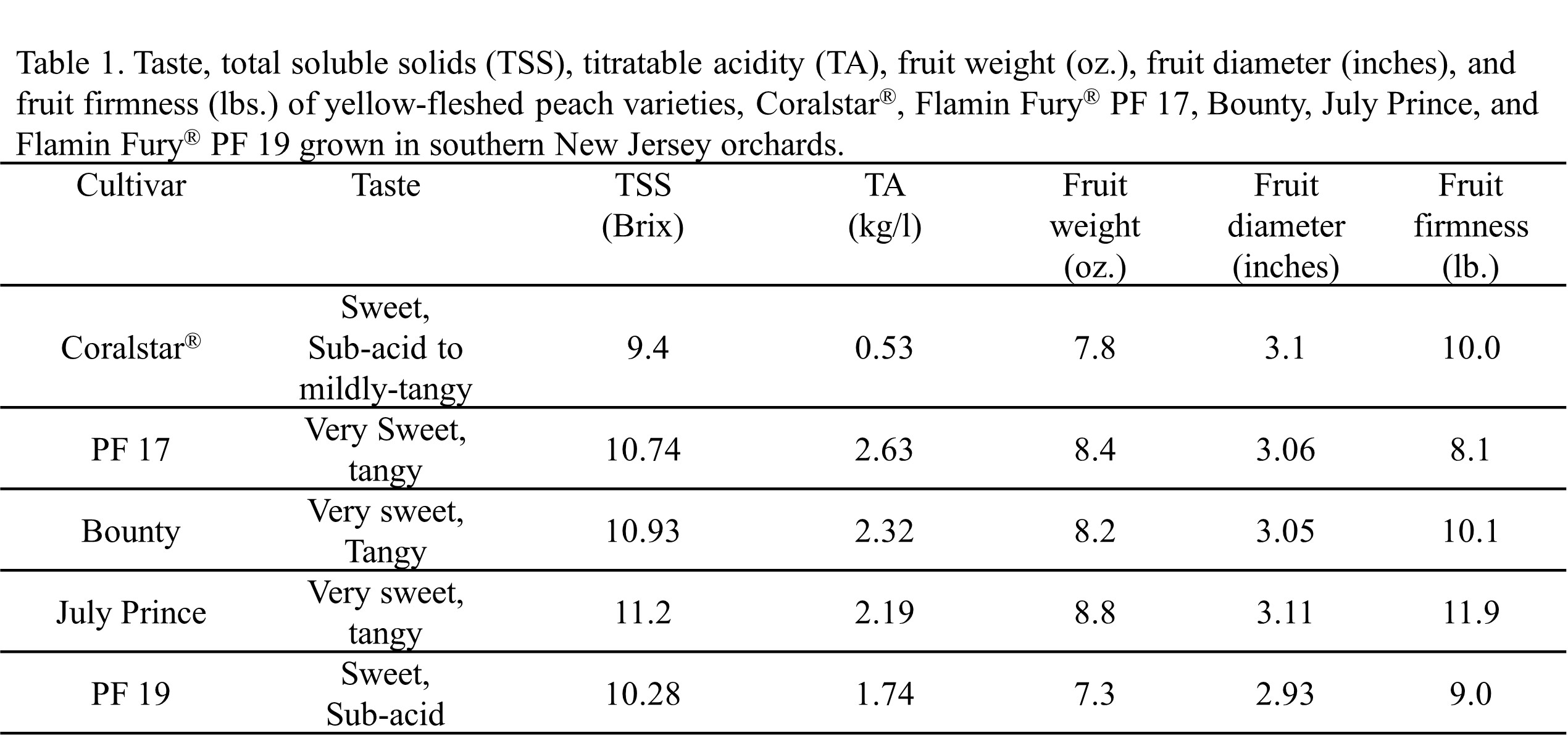 FlavrBurstTM is a large to very large, globose 50-80% scarlet red over a reddish yellow green ground color, yellow-fleshed, freestone peach, ripening August 5-9, approximately 10 days after Redhaven. The coarse-textured, firm, melting, somewhat low-acid flesh has excellent sweet flavor. The tree is upright, spreading, and productive, with medium susceptibility to bacterial spot; however, the fruit has slight susceptibility to it. This high-quality variety has excellent size and flavor.
Challenge: The biggest concern with FlavrBurstTM is that it may get a zipper in some years— a slightly open suture that can create an opening point for the brown rot.
Flamin’ Fury® PF 17 is a medium-large to large, ovate to globose, 55-70% crimson red over yellow-green ground color, yellow-fleshed, freestone peach ripening August 6-9, approximately 12 days after Redhaven. The melting flesh is firm with a very sweet and tangy flavor. The tree is vigorous. It is reliably productive, with low to medium susceptibility to bacterial spot and some fruit drop tendency. The size of the fruit improves as trees age, making it one of the most popular varieties in this season. This is an excellent peach for direct retail.
Challenges: It can have many split pits. In years with cloudy days during ripening, the background color change from green to yellow could be very slow; meanwhile, the fruit has ripened. For PF 17, a day’s delay can result in a lot more softening.


Scarlet Prince is a medium to large, globose, 80-90% scarlet red over greenish yellow ground color, yellow-fleshed, freestone peach ripening August 6-9, approximately 12 days after Redhaven. The flesh has adequate to good firmness with very good flavor. The tree is vigorous and productive with low susceptibility to bacterial spot—an attractive peach with great firmness.
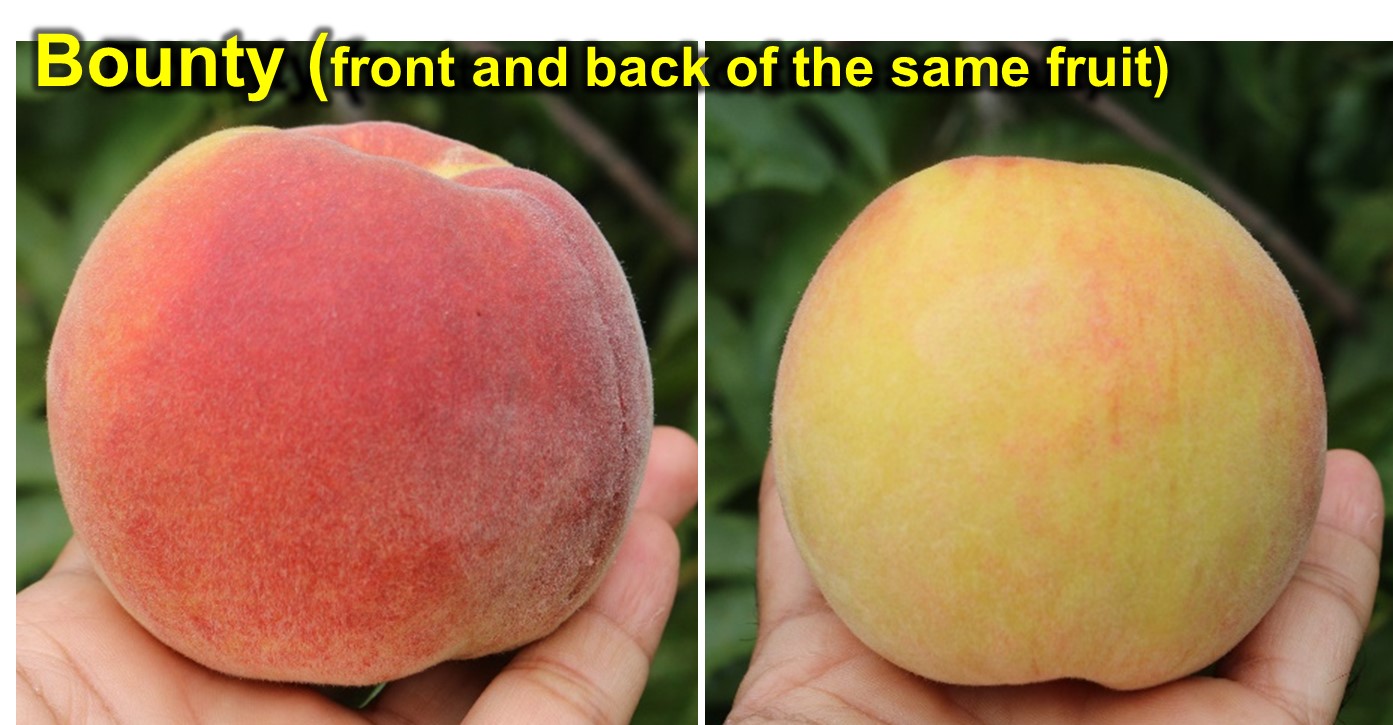 Bounty is a large to very large, globose, 40-70% crimson red over light greenish-yellow ground color, yellow-fleshed, freestone peach, ripening August 6-9, approximately 12 days after Redhaven. The flesh is firm with a very sweet and sub-acid flavor and some split pit tendency. The tree is vigorous, spreading, and productive with medium susceptibility to bacterial spot. Fruits need good light exposure to develop a good red blush. This is the standard in this season because of its size and flavor.
Challenges: Bounty can get soft fast, just like PF-17 and Messina. Look for the under-color, and as soon as it turns yellow from greenish yellow, pick it. If you wait for deep red color development from this point, the fruit will be too soft. Assess for picking every two days.
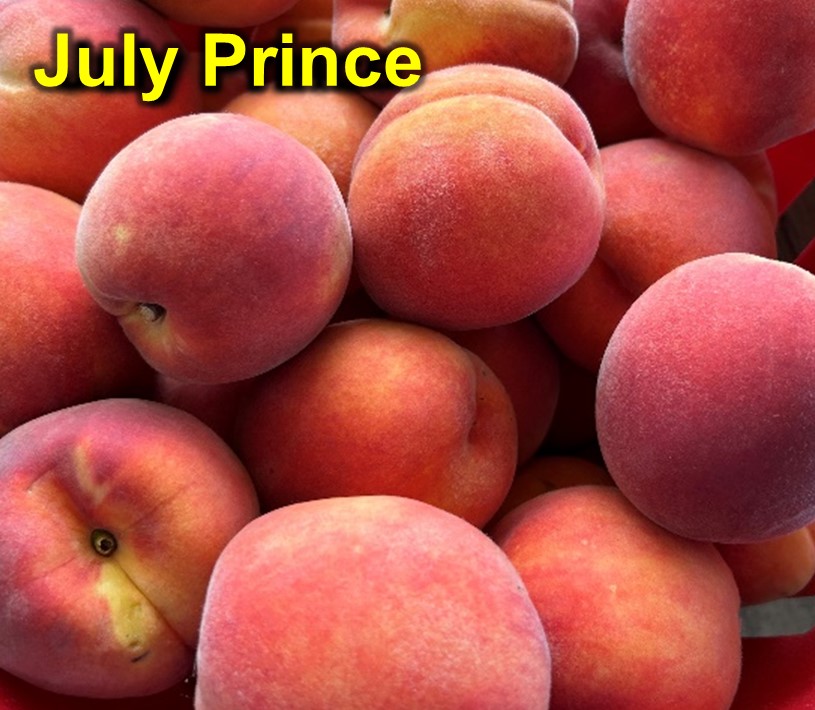
July Prince is a large to very large, globose to ovate, 60-90% attractive scarlet red over a yellow background, yellow melting flesh, freestone peach, ripening August 7-11, approximately 13 days after Redhaven. The flesh is very firm, with a very sweet, acidic, and tangy flavor, slightly fibrous around the pit. The trees are vigorous, upright, spreading, and productive.
Flamin’ Fury® PF 19-007 is a large to very large, slightly ovate to globose, uniformly shaped, 60-90% scarlet red over yellow ground color, yellow-fleshed, freestone peach ripening from August 8-11, approximately 15 days after Redhaven. The flesh is firm with very good flavor, but mealy if overripe. The tree is vigorous and productive with low susceptibility to bacterial spot.
Challenge: Fruit is prone to split pits.

Loring is a large to very large, ovate to globose, 40-60% scarlet red over yellow ground color, yellow-fleshed, freestone peach ripening August 7-10, approximately 13 days after Redhaven. The flesh is firm with very good flavor.
Challenge: Though the tree is very vigorous and moderately productive, it has medium susceptibility to bacterial spot. This variety is more suited for direct marketing because of its relatively short shelf life.
Articles on Previous Season Peach and Nectarine Varieties:
- Late-July Peach Varieties: https://plant-pest-advisory.rutgers.edu/late-july-peach-varieties-for-new-jersey-new-and-standard/
- Late-July Nectarine Varieties: https://plant-pest-advisory.rutgers.edu/late-july-nectarine-varieties-for-new-jersey-new-and-standard/
- Mid-July Nectarine Varieties: https://plant-pest-advisory.rutgers.edu/mid-july-nectarine-varieties-for-nj-silvergem-silverglo-easternglo-and-avalon/
- Mid-July Peach varieties: https://plant-pest-advisory.rutgers.edu/mid-july-peach-varieties-gala-pf-8-ball-summer-serenade-july-rose-and-pf-lucky-13/
- Early July Peach Varieties: https://plant-pest-advisory.rutgers.edu/early-july-peach-varieties-sentry-glenglo-ruby-prince-garnet-beauty-and-sugar-may/
- Late June Peach Varieties: https://plant-pest-advisory.rutgers.edu/late-june-peach-varieties-for-new-jersey-new-and-standard/
Early August Nectarine Varieties for New Jersey – Summer Beaut, Sunglo, and Flavortop.
 Summer Beaut – A medium to medium-large, ovate, 90-100% scarlet-red over yellow ground color, yellow-fleshed, semi-freestone, nectarine ripening from July 29-Aug 1. The flesh is firm with a good acidic flavor. The tree is moderately vigorous, moderately productive, and seems to fruit more heavily when planted near another variety. It has medium susceptibility to bacterial spot. Summer Beaut always has a few split pits. Table 1 summarizes the physical and chemical properties of nectarine varieties – Summer Beaut, Sunglo, and Flavortop.
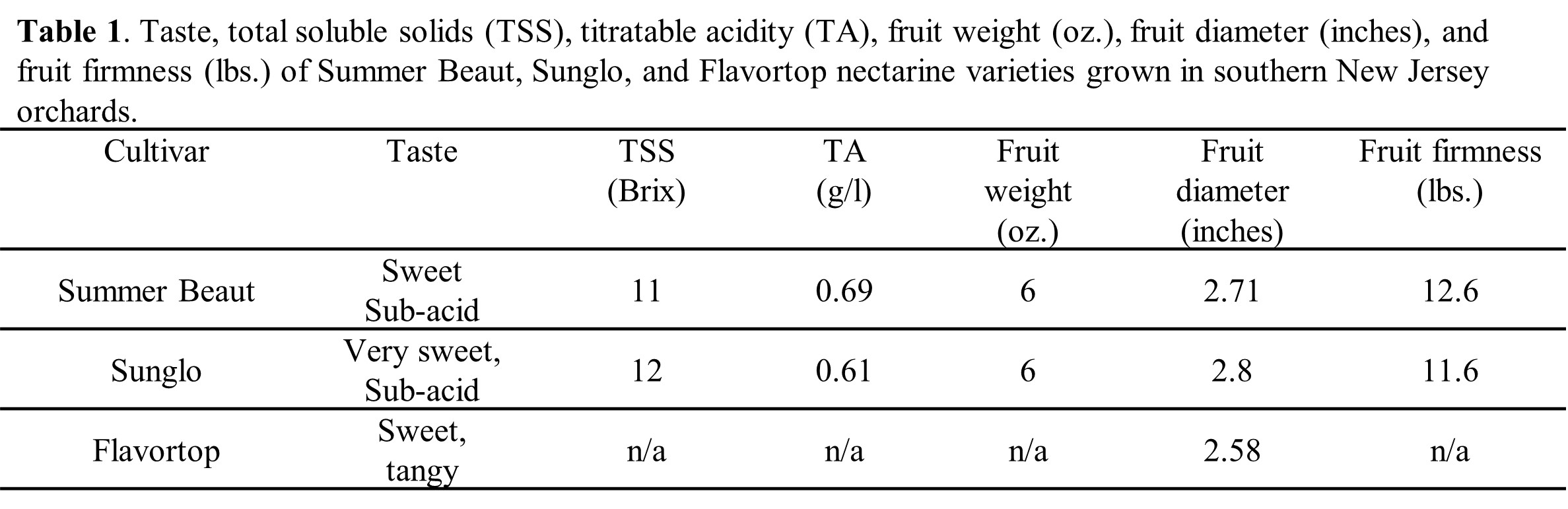
Sunglo – A medium-large to large, globose to slightly ovate, 80-90% orange-scarlet-red, over yellow-orange ground color, yellow-fleshed, freestone nectarine ripening from August 6-9, or approximately 12 days after Redhaven. The flesh is very firm with a very good to excellent acidic flavor. The tree is moderately vigorous and moderately productive, with high susceptibility to bacterial spot.
Flavortop – A medium to large, ovate to globose, 90-100% crimson-red over greenish-yellow ground color, yellow-fleshed, freestone nectarine ripening from August 4-7, or approximately 10 days after Redhaven. The flesh is firm with a very good acidic flavor. The tree is moderately vigorous and productive, with high susceptibility to bacterial spot.


Articles on peach and nectarine varieties in the previous seasons:
- Late-July Peach Varieties: https://plant-pest-advisory.rutgers.edu/late-july-peach-varieties-for-new-jersey-new-and-standard/
- Late-July Nectarine Varieties: https://plant-pest-advisory.rutgers.edu/late-july-nectarine-varieties-for-new-jersey-new-and-standard/
- Mid-July Nectarine Varieties: https://plant-pest-advisory.rutgers.edu/mid-july-nectarine-varieties-for-nj-silvergem-silverglo-easternglo-and-avalon/
- Mid-July Peach varieties: https://plant-pest-advisory.rutgers.edu/mid-july-peach-varieties-gala-pf-8-ball-summer-serenade-july-rose-and-pf-lucky-13/
- Early July Peach Varieties: https://plant-pest-advisory.rutgers.edu/early-july-peach-varieties-sentry-glenglo-ruby-prince-garnet-beauty-and-sugar-may/
- Late June Peach Varieties: https://plant-pest-advisory.rutgers.edu/late-june-peach-varieties-for-new-jersey-new-and-standard/

