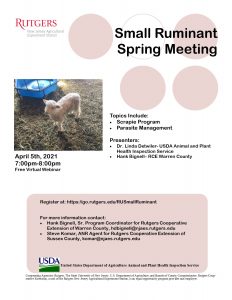
Small Ruminant Spring Meeting 4-5-21
April 5th from 7pm-8pm Virtually on Webex.
Register at https://go.rutgers.edu/RUSmallRuminant
Rutgers Cooperative Extension
Small Ruminant Spring Meeting 4-5-21
April 5th from 7pm-8pm Virtually on Webex.
Register at https://go.rutgers.edu/RUSmallRuminant
Poultry Basics-April 7th at 12pm, Virtually on Webex.
Thinking of acquiring a flock of chickens, or perhaps you already have some but would like of a bit of guidance? Hank Bignell, of Rutgers Cooperative Extension in Warren County will explain all there is to know about beginning and caring for your flock. Are you interested in raising chickens for eggs or meat production?
Topics will include, breeds, animal handling, housing, feed requirements, zoning and health management. Find out if raising poultry is right for you!
Wednesday, April 7th at 12pm-1pm Virtually on Webex
Register online: https://go.rutgers.edu/RUPoultryBasics
Any questions, please reach out to Hank Bignell at hdbignell@njaes.rutgers.
Check out the RCE NJAES Poultry Fact Sheet. FS148: Helpful Hints for Small Flock Management (Rutgers NJAES)
In case you missed one of the RCE Animal Ag, Field and Forage Working Group Webinars this past year, here are the recorded video links to access them in the future.
Basic Pasture Management: https://go.rutgers.edu/sz36rbvt
Horse Pasture Management: https://go.rutgers.edu/239mnwb5
Livestock Pasture Management: https://go.rutgers.edu/uepljvmj
Pasture Renovation: https://go.rutgers.edu/qn74rjj5
Pasture Management: https://go.rutgers.edu/mw0l8wd1
Manure Management: https://go.rutgers.edu/19bim643
Selecting Hay for Horses and Other Livestock Session 1: https://go.rutgers.edu/q9teoewg
Selecting Hay for Horses and Other Livestock Session 2: https://go.rutgers.edu/bfsqi1zv
Every year hundreds of employees are injured or die from preventable hazards while working in grain storage and handling. Stand Up 4 Grain Safety Week, sponsored by the OSHA Alliance Program, is a coordinated industry effort to raise awareness of grain handling hazards and educate industry members to prevent injuries and incidents associated with grain handling.
Stand Up 4 Grain Safety Week 2021 will feature daily educational events which are virtual and free to attend. Be aware that the events begin at 10am CDT (11am EST).
Assert your commitment to grain safety by registering for these educational events via the Grain Handling Safety Coalition EventBrite page. For additional information and resources on grain safety, visit the Stand Up 4 Safety Week website at https://standup4grainsafety.org.
The OSHA Alliance Program includes the Great Plains Chapter of the Grain Elevator and Processing Society (GEAPS), the National Grain and Feed Association (NGFA), and the Grain Handling Safety Council (GHSC).
“On March 17, the U.S. Department of Agriculture’s (USDA) wildlife damage management program, Wildlife Services (WS), posted its annual Program Data Reports (PDR) for fiscal year (FY) 2020. The reports are available on the USDA’s Animal and Plant Health Inspection Service (APHIS) webpage, representing the 25th year that WS has shared this information about its wildlife damage management activities….
…APHIS Wildlife Services’ activities seek to reduce or eliminate more than an estimated $232 million in livestock loss due to predation and $150 million in bird damage to crops caused by native and invasive wildlife annually” – APHIS Stakeholder Registry, March 21, 2021
To read the full report, go to https://www.aphis.usda.gov/aphis/newsroom/stakeholder-info/stakeholder-messages/wildlife-damage-news/ws-post-pdr
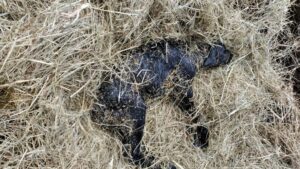
A premature live calf demonstrating the classic signs and pose of selenium deficiency
March 19, 2021
What is a dummy calf? This condition refers to a newborn calf that has no voluntary muscle movement. Legs are stiff and unbendable. The calf is either born dead or presents with labored breathing and dies soon after parturition. This is due to the heart muscle being affected. Calves are often pre-mature in appearance with significantly lower birth weights than expected.
Less deficient calves are able to stand but have low suckle response and difficulty bending legs to nurse. Calves often present with knuckled under forefeet; a distinguishing feature as opposed to a ‘dwarfism’ trait.
