Vaccine Information Resources for Farmers

Anyone who lives or works in NJ is now eligible for a COVID vaccine at any of the vaccine megasites. No appointment needed, see walk-in hours here:
https://covid19.nj.gov/pages/vaccine

Information resources for farmers and farm workers continue to be developed by the CDC and the state of NJ. These resources are easily accessed on the Rutgers On-Farm Food Safety COVID website.  This website will be updated as more resources are developed.  Available now on the website:

  • Documentation from NJDOH stating all are eligible for free COVID vaccinations regardless of immigration status
  • Megasite locations and times for walk-in COVID vaccines for anyone 16 years or older
  • COVID vaccine educational posters in English, Spanish, Haitian Creole, Korean, simplified Chinese, and traditional Chinese
  • CentraState (Freehold) walk-in vaccine clinic information – May 11th and 15th

Farmers or farm workers with questions about locating a vaccine or other vaccine information may use the email address njfarmvax@njaes.rutgers.edu for assistance.

USDA Expands and Renews Conservation Reserve Program (CRP)

In an effort to boost enrollment and address climate change, the USDA will open enrollment in the Conservation Reserve Program (CRP) with higher payment rates, new incentives, and a more targeted focus on the program’s role in climate change mitigation. [Read more…]

Soybeans planted already? Weather and preherbicide considerations

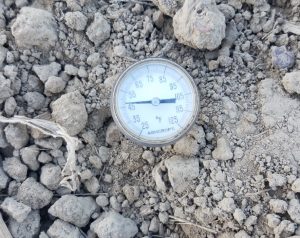
Early morning soil temperature

Soil temperature, Woodstown NJ. April 22

Some producers took advantage of their efforts to fit fields last week and have planted full season beans at the time of this post. Soil temperatures were above 55ºF to 60ºF at planting. Peas and potatoes are also planted.

A cold front last night coupled with gusty winds dropped surface soil temperatures below 50ºF in the Woodstown area.

Should pre-emergences go on at this temperature? Soybeans and other Fabaceae seeds like peas will swell and germinate within twenty-four hours of planting if there is adequate soil moisture. But under cool conditions, twenty degrees below ideal (>70ºF), don’t expect to see plants come out of the ground until soil temperatures warm up. Which is forecasted to gradually occur over the next ten days. That is plenty of time to get preemergent herbicides on before crop and weed seeds germinate. If the weather cooperates. Which at this hour, looks favorable for application Friday and Saturday mornings in Salem County.

The current forecast for the Woodstown, NJ area is for less than an inch of rain Saturday into Sunday morning. Enough to activate preemergent herbicides. But locally heavy downpours are possible.

Herbicide injury is more likely on cold, very wet, coarse sandy soils until soils warm. Cold wet conditions that slow emergence of soybeans ,and after a root and shoot inhibiting herbicide have been applied, can result in herbicide injury. Slower emergence means more time for the herbicide to be absorbed into emerging shoots and roots. What we don’t want is open furrows, on low organic soils as this only increases the likelihood of injury while soils are cold and wet.

Residual, pre-emergent to the weed seed germinating. Some soybean products like sulfentrazone can be applied a month before the crop is planted but warn of significant injury after excessive rainfall or in poorly drained soils. Others specifically state application up to fourteen days prior to planting; or apply after planting. There is somtimes a two-week application restriction between pre-plant incorporated; pre-plant surface timings; and the allowed after planting application on the same label for the same active ingredient for crop safety purposes. Others have no such restrictions. Before spraying, consider the forecast, current and future soil conditions, and read through the herbicide label as this information is not always in the same paragraph.

Why the forecast after planting matters: Heavy rainfall can push pre-emergent root and shoot inhibiting herbicides below the weed seedbank germination zone. Defeating the primary purposes of this application to prevent weed seeds from germinating. For weeds resistant to the post herbicides available (palmar amaranth, common ragweed, marestail) few options remain. Conversely, we need rainfall to activate soil residual products.

No application before weeds germinate is just as concerning. Emerged weeds are not controlled by pre-emergence herbicides. We don’t want soil temperatures to reach the optimum for weed seed germination before application. Common ragweed and common lambsquarters will start germinating after soil temperatures rise above 50ºF. For Palmer Amaranth and other pigweeds, anticipate weed seed bank to flush when soil temperatures are approaching 60ºF degrees; and negligible when day and night time temperatures continue to fluctuate below 50ºF.

Communicating the Value of COVID-19 Vaccines With Your Farm Employees

CDC COVID-19 Vaccine Posters available in multiple languages – “Vaccines (shots) are one of the tools we have to fight the COVID-19 pandemic.”

In an effort to increase participation in the COVID-19 vaccination program among farm workers, the Centers for Disease Control (CDC), through the national Extension Foundation, is working with Cooperative Extension across the country to help spread the word about the importance of getting vaccinated. Rutgers Cooperative Extension Director Brian Schilling has enlisted a team of County Agents and Specialists to answer the call from the CDC to participate in this EXCITE program. Through a variety of communications channels we will be providing informational posters and other educational materials in several appropriate languages that you can hand out or post in locations where your workers can easily read them (like on or near your Worker Protections Standards bulletin boards or in your labor camps).

“Vaccines (shots) are one of the tools we have to fight the COVID-19 pandemic” posters from the CDC are now available on the COVID-19 page of the Rutgers NJAES On-Farm Food Safety website <https://onfarmfoodsafety.rutgers.edu/covid-19-information/> with the direct links to these multiple language editions:

You can also share this Spanish language video <https://wecandothis.hhs.gov/un-rayo-de-esperanza> from the US Dept. of Health and Human Services with your workers to help explain where they can get more information about COVID-19 vaccines. There are several other informational videos available at https://wecandothis.hhs.gov/filter/format/Video, as well as posters/fliers from https://wecandothis.hhs.gov/filter/format/Poster%20%E2%80%93%20Flyer (mostly English), and factsheets at https://wecandothis.hhs.gov/filter/format/Fact%20Sheet.

EXCITE PNG

Tractor Safety – “No Seat, No Rider”

There is no argument that tractors have forever changed agriculture. The use of tractors has long replaced the presence of draft horses on almost every farm in America. It is estimated that cultivation of land with a modern tractor allows 64 acres to be plowed in the time it took to cultivate one acre with a draft horse. The use of tractors also comes with a dark side. As long as farmers have been using tractors they have been injured and killed by them. The Bureau of Labor Statistics reports 274 transportation related deaths, which includes tractor deaths in 2018. In any given year half of all tractor fatalities are from overturns, almost another one-fourth are from runovers. Many have a tradition of allowing extra passengers to ride on tractors. Sometimes trying to transport a worker from one task to the next or possibly saving them from walking back to the barn. Some even allow children to come along for a ride – a very dangerous practice. Whether it be on the tongue, side steps, fender or extra passenger in the cab, remember these places are not designed for riders. As we enter one of the busiest seasons in agriculture remember one of the most important safety rules NO SEAT, NO RIDER!

  • Riders that fall off are immediately in danger of being run over by a tractor wheel
  • On rough or uneven ground, riders are first to bounce off (especially children)
  • Riders distract the driver and can bump controls
  • Rollover Protective Structures are designed to protect drivers, not riders

Do not ever think “it won’t happen to me.” Every farmer can tell a story of an incident that happened to someone they know in the farm community that involves a tractor. Make sure everyone makes it through the harvest – NO SEAT, NO RIDER!

Posted on behalf of Bill Bamka, Agricultural Agent, RCE-Burlington County.

A spray tank’s last check list visual aide for corn and soybean weed management

Back in March, regional weed extension professionals discussed creating a visual aide chart for herbicide selection for the big three problematic weeds (palmer amaranth, common ragweed and marestail) in corn and soybean.

Below are two url links to “A Spray Tank’s Last Checklist in Soybean“; and “A Spray Tank’s Last Checklist in Corn” courtesy of Mark VanGessel, Extension Weed Specialist, University of Delaware Research and Education Center.

Note, these are not meant to replace anything extension has available already, rather to supplement and be coupled with herbicide resistance charts in the Agronomy Guide and the 2021 Mid-Atlantic Field Crop Weed Management Guide noted in this MARCH 5, 2021 post by Thierry Besancon, Rutgers Extension Weed Specialist

These supplemental charts are meant to be used as the spray tank is being filled, to ensure the right products are in the tank – thus the title “Last Check Chart”. These are not meant to be comprehensive for all herbicides and weeds, rather what extension weed experts in our region are recommending for the BIG 3 in corn and soybean. Always refer to the individual product label for weed and crop height and growth stage restrictions.

Ultimately plans are to have a wall-chart that can be distributed next extension season.

Soybean: http://www.udel.edu/008288

Corn: http://www.udel.edu/008287