Resuming In-Person RCE Programming – A Guide for Attendees

Rutgers Cooperative Extension has announced the resumption of in-person programming beginning this month. Extension professionals across all program areas have the option to offer in-person programming, limited at this time to outdoor events with no more than 25 total in attendance. This includes farm and field visits, twilight meetings, and pesticide applicator recertification events. Resuming in-person events doesn’t mean that online or hybrid events will end; both are essential tools for successful RCE programming.

These RCE guidelines and expectations are for all participants to follow to attend these events:

Voluntary Participation – Participation at in-person RCE activities is completely voluntary – there is no requirement for attendance.

Health Screening Form – Attendees will be required to bring a completed RCE Health Screening Form, which can be be accessed at https://go.rutgers.edu/RCE.healthform. Once completed, please take a screenshot of the big green checkmark or print out a copy to show when you arrive before being allowed to attend.

Face Masks – Every participant will be required to wear a face mask / covering over their mouth and nose at all times. Arrive wearing your mask, and make sure to keep it in place during the entire event.

Physical Distancing – Everyone will be required to practice physical distancing, staying at least 6 feet apart.

Hygiene & Sanitation – Everyone who attends is expected to practice good hygiene habits. Participants should wash or sanitize their hands when they arrive and before they leave, and as needed throughout the activity. You are encouraged to bring your own hand sanitizer to limit shared surfaces.

What to Bring With You – Food will not be provided and sharing food is not permitted. Make sure to bring your own refreshments, filled water bottle, tools/equipment, notebook and writing tool, camp chair, etc. depending on the event you’re attending.

All participants are expected to follow these rules and procedures to help make every RCE in-person event safe and enjoyable for everyone. Please be sure to check the NJAES Calendar of Events and the RCE office in your county for upcoming events.
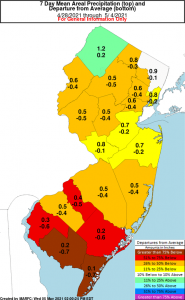
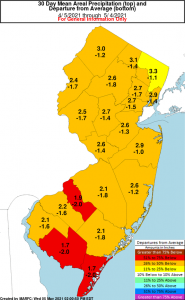
Precipitation departure from normal for South Jersey counties

As planting season progresses, producers in south Jersey are keeping an eye on soil moisture. While year to date precipitation in inches is near normal for most of the state, thirty day and seven day departure from normals require closer attention. As do feed budgets for those who purchase corn, wheat, and soybean meal due to the large portion of the grain belt that is experiencing significant drought at the beginning of the growing season.

For more information and to follow trends, please visit https://www.weather.gov/marfc/NJPrecipitation30Day and associated tabs or the Office of the State Climatologist website at https://climate.rutgers.edu/stateclim/


7-day Mean Precipitation

National Weather Service generated map

30-day Mean Precipitation

National Weather Service generated map

Vaccine Information Resources for Farmers

Anyone who lives or works in NJ is now eligible for a COVID vaccine at any of the vaccine megasites. No appointment needed, see walk-in hours here:
https://covid19.nj.gov/pages/vaccine

Information resources for farmers and farm workers continue to be developed by the CDC and the state of NJ. These resources are easily accessed on the Rutgers On-Farm Food Safety COVID website.  This website will be updated as more resources are developed.  Available now on the website:

  • Documentation from NJDOH stating all are eligible for free COVID vaccinations regardless of immigration status
  • Megasite locations and times for walk-in COVID vaccines for anyone 16 years or older
  • COVID vaccine educational posters in English, Spanish, Haitian Creole, Korean, simplified Chinese, and traditional Chinese
  • CentraState (Freehold) walk-in vaccine clinic information – May 11th and 15th

Farmers or farm workers with questions about locating a vaccine or other vaccine information may use the email address njfarmvax@njaes.rutgers.edu for assistance.

USDA Expands and Renews Conservation Reserve Program (CRP)

In an effort to boost enrollment and address climate change, the USDA will open enrollment in the Conservation Reserve Program (CRP) with higher payment rates, new incentives, and a more targeted focus on the program’s role in climate change mitigation. [Read more…]

Soybeans planted already? Weather and preherbicide considerations

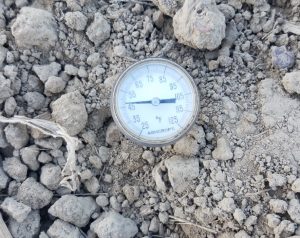
Early morning soil temperature

Soil temperature, Woodstown NJ. April 22

Some producers took advantage of their efforts to fit fields last week and have planted full season beans at the time of this post. Soil temperatures were above 55ºF to 60ºF at planting. Peas and potatoes are also planted.

A cold front last night coupled with gusty winds dropped surface soil temperatures below 50ºF in the Woodstown area.

Should pre-emergences go on at this temperature? Soybeans and other Fabaceae seeds like peas will swell and germinate within twenty-four hours of planting if there is adequate soil moisture. But under cool conditions, twenty degrees below ideal (>70ºF), don’t expect to see plants come out of the ground until soil temperatures warm up. Which is forecasted to gradually occur over the next ten days. That is plenty of time to get preemergent herbicides on before crop and weed seeds germinate. If the weather cooperates. Which at this hour, looks favorable for application Friday and Saturday mornings in Salem County.

The current forecast for the Woodstown, NJ area is for less than an inch of rain Saturday into Sunday morning. Enough to activate preemergent herbicides. But locally heavy downpours are possible.

Herbicide injury is more likely on cold, very wet, coarse sandy soils until soils warm. Cold wet conditions that slow emergence of soybeans ,and after a root and shoot inhibiting herbicide have been applied, can result in herbicide injury. Slower emergence means more time for the herbicide to be absorbed into emerging shoots and roots. What we don’t want is open furrows, on low organic soils as this only increases the likelihood of injury while soils are cold and wet.

Residual, pre-emergent to the weed seed germinating. Some soybean products like sulfentrazone can be applied a month before the crop is planted but warn of significant injury after excessive rainfall or in poorly drained soils. Others specifically state application up to fourteen days prior to planting; or apply after planting. There is somtimes a two-week application restriction between pre-plant incorporated; pre-plant surface timings; and the allowed after planting application on the same label for the same active ingredient for crop safety purposes. Others have no such restrictions. Before spraying, consider the forecast, current and future soil conditions, and read through the herbicide label as this information is not always in the same paragraph.

Why the forecast after planting matters: Heavy rainfall can push pre-emergent root and shoot inhibiting herbicides below the weed seedbank germination zone. Defeating the primary purposes of this application to prevent weed seeds from germinating. For weeds resistant to the post herbicides available (palmar amaranth, common ragweed, marestail) few options remain. Conversely, we need rainfall to activate soil residual products.

No application before weeds germinate is just as concerning. Emerged weeds are not controlled by pre-emergence herbicides. We don’t want soil temperatures to reach the optimum for weed seed germination before application. Common ragweed and common lambsquarters will start germinating after soil temperatures rise above 50ºF. For Palmer Amaranth and other pigweeds, anticipate weed seed bank to flush when soil temperatures are approaching 60ºF degrees; and negligible when day and night time temperatures continue to fluctuate below 50ºF.

Communicating the Value of COVID-19 Vaccines With Your Farm Employees

CDC COVID-19 Vaccine Posters available in multiple languages – “Vaccines (shots) are one of the tools we have to fight the COVID-19 pandemic.”

In an effort to increase participation in the COVID-19 vaccination program among farm workers, the Centers for Disease Control (CDC), through the national Extension Foundation, is working with Cooperative Extension across the country to help spread the word about the importance of getting vaccinated. Rutgers Cooperative Extension Director Brian Schilling has enlisted a team of County Agents and Specialists to answer the call from the CDC to participate in this EXCITE program. Through a variety of communications channels we will be providing informational posters and other educational materials in several appropriate languages that you can hand out or post in locations where your workers can easily read them (like on or near your Worker Protections Standards bulletin boards or in your labor camps).

“Vaccines (shots) are one of the tools we have to fight the COVID-19 pandemic” posters from the CDC are now available on the COVID-19 page of the Rutgers NJAES On-Farm Food Safety website <https://onfarmfoodsafety.rutgers.edu/covid-19-information/> with the direct links to these multiple language editions:

You can also share this Spanish language video <https://wecandothis.hhs.gov/un-rayo-de-esperanza> from the US Dept. of Health and Human Services with your workers to help explain where they can get more information about COVID-19 vaccines. There are several other informational videos available at https://wecandothis.hhs.gov/filter/format/Video, as well as posters/fliers from https://wecandothis.hhs.gov/filter/format/Poster%20%E2%80%93%20Flyer (mostly English), and factsheets at https://wecandothis.hhs.gov/filter/format/Fact%20Sheet.

EXCITE PNG