Immediate potential for Boxwood Blight activity: Plus a Nursery and Greenhouse growers’ update


There is a potential for new boxwood blight infections in the next few days according to https://uspest.org/risk/boxwood_app.

Protective fungicide applications should remain in effect or be initiated immediately for Boxwood Blight. The disease may be sporulating and spreading amongst plantings if present (or may come into your nursery via shipments) within the next few days. According to https://uspest.org/risk/boxwood_app, this is the first legitimate potential for boxwood blight spread and new infections in 2020 for southern NJ. Please continue preventative/protectant fungicide applications utilizing; chlorothalonil (FRAC Group M05), mancozeb (FRAC Group M03), and QoI-fungicides (FRAC Group 11) in a rotation. Please contact Tim Waller at twaller@njaes.rutgers.edu for more information or questions.

UPDATES: 

Growing Degree-days as of 6/4/20 using NEWA

GDD50 = Growing Degree-Day with min. temp. set to 50F

Upper Deerfield = 548.5 GDD50 ; Howell = 407.5 GDD50 ; Pequest = 335.0 GDD50

How to use growing degree-day resources: https://plant-pest-advisory.rutgers.edu/using-growing-degree-day-calculators-nursery-pest-and-pathogen-updates-important-resource-links/

Pests: The number of accumulated growing degree-days has been rapidly increasing with higher and higher temperatures (approaching normalcy). Throughout New Jersey various adult borers will be emerging, these include; Lilac, Emerald Ash, Banded Ash Clearwing, and Peach Tree borers. Additionally, Ambrosia beetles (multiple species) will be in-flight and actively seeking egg-laying locations. Pyrethroids should be used as preventative sprays but should be targeted to the bases of susceptible hosts such as Magnolias, Yellow bud, Red bud, Japanese maples, Styrax, and Hybrid chestnuts. These Targeted applications are geared towards protecting beneficial insect populations. The eggs of many scale insects are hatching now, leaving their ‘crawler’ stage vulnerable to pesticide applications. Scale insect species to be mindful of; Maskell, Oystershell, Taxus, Euonymus, Prunicola, Oak lecanium, Japanese maple, Cottony maple, Calico, Golden oak, and Juniper scale. Aphids, especially on roses, and mites will be increasing their populations with the warmer weather and should be minded when in high density. Management should utilize an appropriate pesticide rotation when necessary, as these pests are prone to developing pesticide resistance quickly. Four lined plant bugs, basswood lacebug, and multiple leaf and plant hoppers have been reported south of NJ and should be monitored and treated for as appropriate through the coming weeks as many of these insects are capable of vectoring plant viruses. Lilac leafminer, Juniper tip-midge, and Pin oak sawfly may also be an issue in some locations. Red-headed flea beetle will be hatching between 250-480 GDD50, with adults emerging between 500-1000 GDD50. A second generation of larva will then be active between 1,570 to 1860 GDD50, emerging later 1,878 to 2,318 GDD50. Reminder, keep an eye out for the Box tree moth that has been identified approaching the border of US and Canada. This pest has prompted APHIS importation amendments for Boxwood, Euonymus, and Illex. Gypsy moths, Bagworms, Mimosa webworm will be hatching or emerging in many parts of the state very soon, (in some locations they may already have).

Please visit https://njaes.rutgers.edu/pubs/publication.php?pid=E334 for more specific information.

Understanding and approaching plant diseases: The weather as of late has been conducive to plant disease for much of NJ. Higher humidity, increasing temperatures, and prolonged periods of leaf wetness (particularly at night) are considered the factors associated with the ‘sweet spot’ of disease development. Regularly scheduled protectant fungicide applications should be continued if a pathogen or history-thereof is suspected. Compounds should be rotated to guard against pesticide resistance to any one compound (rotating high/medium-risk with low-risk materials). Also, any steps geared towards increasing airflow, reducing wet-feet, limiting mechanical injury, and reducing leaf wetness duration or excessive overhead irrigation during this warm and humid period will benefit disease management efforts.

Please visit: https://njaes.rutgers.edu/pubs/publication.php?pid=E036 for more specific information on individual plant and pathogen species.

Other timely diseases to note: Many needle cast diseases of conifers should be well into a fungicide application schedule, utilizing chlorothalonil, azoxystrobin, basic sulfate coppers, mancozeb, and T-methyl in a rotation of materials. Many of these compounds will also control Pine needle rust that may become prevalent in some locations, especially those locations with high levels of goldenrod or aster weeds. Botrytis and powdery mildew are still a concern in many parts of the state, especially those that are experiencing cooler nighttime temperatures. What fungicide used is dependent on the specific host species in many cases. Please refer to the link above for specific information. Fungal and bacterial leaf spots are very common and often only intensively treated if those plants are to enter the market the next season. However, in areas prone to disease or severe cases (defoliation occurs), treatments should be preventative and conducted throughout the season. Sooty mold grows on the honeydew produced by large populations of sap-sucking insect pests (aphids, scales, leaf/plant hoppers). Controlling the insect pests is our best option to reduce this unsightly disease. In severe casts of sooty mold, plants can be washed free of this fungal growth using mild detergents. Phytophthora diseases are ever present at the nursery, however cultural practices such as sterilized potting media, cleaning tools and machinery regularly, efforts to reduce wet-feet or overwatering, and sterilization or treatment of recycled water can have profound impacts on the expression or spread of Phytophthora diseases. When fungicide applications are required, materials like phosphorus acids, fosetyl-Al (Aliette), mefenoxam (Ridomil), and etridiazole + T-methyl (Banrot) are commonly used. Rotation of these compounds and proper disease identification are incredibly important as many root-rotting pathogens have a strong propensity towards developing pesticide resistance.

Please consider the Rutgers Plant Diagnostics Laboratory for pest/pathogen identification concerns: https://njaes.rutgers.edu/plant-diagnostic-lab/


Online discussions and credit events

NJNLA pesticide credit webinar/course: Invasive Forest Pests: New Threats and Their Management (6/10/20): https://www.njnla.org/events/EventDetails.aspx?id=1383945

Webinar – June 10th, 2020 – 7:00pm to 8:30pm. Invasive Forest Pests: New Threats and Their Management. You must include your email address when registering. Information to join Webinar will be sent just prior to the start. Cost: $35/Member, $50/Non-Member. NJ Pest Credits: 3A (Ornamentals) – 3, PP2 (Private Applicator Category) – 3, 2 (Forest) – 3, 8C (Campgrounds) – 3, 9 (Regulatory) – 3,. CNLP: Environment – 1.5, LTE/LTCO: 1 CEU, NJUCF: 1 CEU and ISA is still pending. 

EPA information pertaining to online credits for licenses expiring in 2020: https://pestmanagement.rutgers.edu/increased-online-ceus-for-licenses-expiring-2020-act-now/

Ask the Agent (every Wednesday @ 7:00pm): https://go.rutgers.edu/t7wjkit1 . A new online forum has been created where anyone can log-on and speak with Rutgers Cooperative Extension agents (multiple agents from multiple counties)

NJNLA- Wine Down Wednesdays (every first and third Wednesday @ 7:00pm-8:00pm). Email: Lori Jenssen @ njnla.director@gmail.com. This is a great opportunity to speak with other green-industry businesses.


Rutgers nursery survey, advisory, and other resources:

Please take the 2020 Nursery Industry Survey: https://forms.gle/dUjLxaiu6qDQYYsRA

The new nursery agents have prepared a preliminary survey aimed at understanding the needs of our growers and clientele, i.e. you. Please take a moment to complete the survey, as this type of information really helps the agents secure grant funding to deal with the problems you actually have. Thank you!

Subscribe to the NJAES YouTube webpage: https://www.youtube.com/user/RutgersNJAES/

RU Sustainable Nursery Production website: https://njaes.rutgers.edu/nursery/

March meeting PDF: https://njaes.rutgers.edu/nursery/documents/2020%20SJ%20Nursery%20Meeting%20Proceedings.pdf
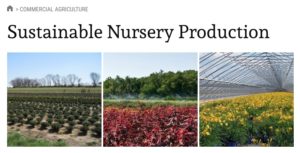
Using Growing Degree-day calculators, nursery pest and pathogen updates, important resource links

Announcements:

NJ Department of Agriculture Issues Burn Permit for Frost Protection –May 7 thru May 11

New Jersey Department of Agriculture has issued a notice concerning open burning due to colder spring overnight temperatures presently forecasted for areas of New Jersey from Thursday, May 7 through Monday, May 11, 2020, which could adversely affect fruit, vegetable, and floriculture crops in bloom or near bloom around the state. For more information: https://plant-pest-advisory.rutgers.edu/nj-department-of-agriculture-issues-burn-permit-for-frost-protection-thru-may-11/

Sourcing PPE for your workers:

If you need PPE for you and your workers, please do not wait to obtain more supplies! When our region re-opens to the masses there will be another wave of high-demand for masks and PPE. https://plant-pest-advisory.rutgers.edu/sourcing-personal-protective-equipment-ppe-for-your-farm-employees/

Recent financial Plant and Pest Advisory Posts:

US Small Business Admin Opens Economic Injury Disaster Loan (EIDL) Programs to Agriculture: https://plant-pest-advisory.rutgers.edu/us-small-business-admin-opens-economic-injury-disaster-loan-eidl-programs-to-agriculture/

SBA resumed accepting Paycheck Protection Program applications: https://plant-pest-advisory.rutgers.edu/sba-resumed-accepting-paycheck-protection-program-applications/


Utilizing Growing Degree-day calculators and resources:

(As of 5/7/20 using NEWA, Upper Deerfield = 213.5GDD50 ; Howell = 153.5 GDD50 ; Pequest = 88.0 GDD50) (GDD50 = Growing Degree-Day with min. temp. set to 50F)

Using Growing Degree Day models to plan pest management timing is a proven method for understanding when a pest or pathogen will rear its ugly head. These models utilize temperature min. and max. throughout the day to generate “growing degree day” units that accumulate throughout the year (typically starting on Jan. 1st, with a minimum temperature set to 50F (base-50)). Correlations between degree-day accumulation and vulnerable life stage events, such as egg hatch or adult emergence, allow pest management to be conducted, or scouted for, more efficiently. These models can track or predict insect, mite, weed, and plant pathogen lifecycles as well as those of beneficial insects, allowing us to protect that arm of Integrated Pest Management (IPM).

Within these models the user can set multiple parameters, allowing hyper-localized information for most of the country. Simple models are also available. The temperature min/max, can be manipulated for specific pests, however a minimum temperature of 50F (aka base-50) is most often cited in growing degree-day pest lists. These models are general in nature, as biology occurs over some span of time or set of conditions, and should therefor be ground-truthed at each location if at all possible. Many other types of pest or disease predictive models are available within the resources listed below, and the agents can help you understand what information you need for those calculations.

Note: The nursery agents are working to develop a local, Rutgers centralized, growing degree-day calculator that will provide information on key pests as well as nursery and greenhouse BMPs thereof. Armed with this information, we will be generating charts and other visual aids that target multiple pests per application, thus increasing labor efficiency.

Degree Day Calculators (select a local weather station within the website):

NEWA (Cornell): http://newa.cornell.edu/index.php?page=growing-degree-days

–        Very easy to use

Integrated Plant Protection Center (Oregon State): http://uspest.org/

–        More complicated but has many different modeling options

–        ***Boxwood blight specific risk model: https://uspest.org/risk/boxwood_app  , also available as an iOS or Android app ***

Typically the procedure is as follows: select a close by weather station, select degree-day calculator, select the min. temperature (50F or “base-50”), select max. temperature (arbitrarily high- 110F), click graph or calculate or get report, then locate the date(s) of interest on the computed table. The accumulated growing degree-days of those dates can then be compared to the target GDD50 on the pest lists below. *Tim Waller will help you set up a local degree-day calculation, or understand how to use this information if needed (twaller@njaes.rutgers.edu)

Pest lists with GDD50 targets:

Ohio State: http://cues.cfans.umn.edu/old/Web/049DegreeDays.pdf

University of California: http://ipm.ucanr.edu/MODELS/index.html

University of Maryland: https://extension.umd.edu/node/11155

University of New Hampshire: http://ccetompkins.org/resources/using-growing-degree-days-for-insect-management

*Some discrepancies between degree-day targets; go with what you have observed locally*


Pests and diseases to be on the lookout for:

(Upper Deerfield = 213.5GDD50 ; Howell = 153.5 GDD50 ; Pequest = 88.0 GDD50)

Pests: Looking towards our southern neighbor states, several pests are either currently present or will become evident in the near future including: Boxwood leafminer, Allium Leaf miner, Lilac borer, Ambrosia beetles (multiple species), Red-headed flea beetle, Hemlock woolly adelgid, Pine Bark adelgid, Roseslug sawflies, Spruce spider mites, Wooly elm aphids, Spirea aphid, Andromeda lace bug, Azalea lace bug, and Pine needle scale. The warm weather jump-started pest development only to be slowed by the current cool days and cooler nights, providing more wiggle room for protective or systemic pesticide applications. Utilize growing degree-day (GDD50) models to apply protectant applications as well as systemic soil drenches when applicable or allowable for pollinator protection.

Red-headed flea beetle larva will be hatching between 250-480 GDD50, with adults emerging between 500-1000 GDD50. A second generation of larva will then be active between 1,570 to 1860 GDD50, emerging later 1,878 to 2,318 GDD50. Brian Kunkel, entomologist at the University of Delaware, has determined that up to three, overlapping, generations can be present in container grown ornamentals. Ambrosia beetles, particularly Xylosandrus crassiusculus (granulate ambrosia beetle), and Xylosandrus germanus (black stem borer), should begin flights soon, or have already done so to some degree. These small beetles begin flight when temperatures hover around 60-70F and are attracted to alcohol produced by woody ornamentals in the spring. The cooler nighttime temperatures and daily averages have kept much of this activity low but scouting should be vigilant during this time. Another invasive pest, the Box tree moth, has been identified approaching the border of US and Canada. This pest has prompted APHIS importation amendments for Boxwood, Euonymus, and Illex. (https://content.govdelivery.com/accounts/USDAAPHIS/bulletins/27f467d)

Diseases: The current temperatures coupled with long wetness-periods, provide optimal pathogen conditions for diseases such as Botrytis, Sclerotinia sclerotiorum, Black spot on roses, multiple Needle cast diseases of conifers, root rots, and bacterial diseases. Once temperatures begin to increase again, pathogen numbers could explode. Efforts towards protectant applications are critical, especially in situations where plants are being held longer than previously anticipated due to COVID-19 related disruptions. Any steps geared towards increasing airflow, reducing wet-feet, and limiting mechanical injury during this wet and cool period will benefit disease management approaches. Please consult your agents for specific disease control recommendations.

Beach Leaf Disease, caused by an exotic nematode, is affecting beeches in the Great Lakes region  and into Pennsylvania. Little is known about the disease, other than the nematodes distort beech leaves by forming sunken lesions, which eventually turn the leaf yellow and drop off. Please contact your local agent if you suspect this disease to be anywhere in New Jersey (forest, farm, etc.). https://www.state.nj.us/dep/parksandforests/forest/docs/Pest_Alert-Beech_Leaf_Disease.pdf .USDA-ARS (more info on the nematode): https://tellus.ars.usda.gov/stories/articles/what-s-killing-beech-trees/

Please advise what pests/pathogens you are seeing in the field so we can be better informed on their management!


Online events and resources:

Ask the Agent (every Wednesday @ 7:00pm): https://go.rutgers.edu/t7wjkit1

A new online forum has been created where anyone can log-on and speak with Rutgers Cooperative Extension agents (multiple agents from multiple counties).

NJAES YouTube webpage: https://www.youtube.com/user/RutgersNJAES/

Our Rutgers Nursery Working group will be uploading many more instructional videos to the NJAES YouTube page in the near future. This webpage has numerous pest/pathogen/ID educational videos, especially from the Plant Diagnostics Lab here at Rutgers.

Tim Waller has posted an introduction video to the newly created “Commercial Nursery and Greenhouse Production” playlist https://youtu.be/RQbXmc5Uug8.

(Please email twaller@njaes.rutgers.edu or william.errickson@njaes.rutgers.edu with ideas for videos!)

 2020 Nursery Industry Survey: https://forms.gle/dUjLxaiu6qDQYYsRA

The new nursery agents have prepared a preliminary survey aimed at understanding the needs of our growers and clientele, i.e. you. Please take a moment to complete the survey, as this type of information really helps the agents secure grant funding to deal with the problems you actually have. Thank you! Please share with other growers that may not have access.

RU Sustainable Nursery Production website: https://njaes.rutgers.edu/nursery/

March meeting PDF: https://njaes.rutgers.edu/nursery/documents/2020%20SJ%20Nursery%20Meeting%20Proceedings.pdf
 

Thank you.

Contact information for the new nursery agents:

 Timothy J. Waller

County Agent
Specialty areas: Commercial nursery production, plant health, and phytopathology
   

Rutgers Cooperative Extension of Cumberland County
291 Morton Ave. Millville, NJ 08332
856-451-2800
twaller@njaes.rutgers.edu

Bill Errickson

County Agent
Specialty areas: Nursery and turfgrass production, agricultural innovation, and soil fertility

Rutgers Cooperative Extension of Monmouth Count
4000 Kozloski Rd., P.O. Box 5033. Freehold, NJ 07728
732-431-7260, ext. 7273
william.errickson@njaes.rutgers.edu

Sustainable Nursery Production Website Updates / Join Our Nursery Grower Email List

Fields of flowers

Please visit (click on links) the Rutgers Sustainable Nursery Production website for the following:

Join our Nursery Growers email list: please email Brandi Williams at brandiwi@co.cumberland.nj.us to stay connected during this time of COVID-19 social distancing and beyond. We will only email you important nursery industry related materials.

Voice your needs: please complete the 2020 Nursery Industry Survey to help the new nursery agents align their programmatic efforts to the needs of our communities.

Get information: view or download the missed 2020 South Jersey Nursery Meeting presentations (PDF).

Watch: visit the Rutgers NJAES video channel for educational content.

We need your input as this website is for you! Please feel free to contact us with ideas, suggestions, discrepancies, and thoughts on website improvements.


Please note: The Sustainable Nursery Production website will be rapidly expanding with new instructional videos, recorded webinar sessions, and commercial nursery production resources, serving as a key resource to our New Jersey grower communities. Additional sections such as commonly used forms will also be updated soon.

The new RCE nursery agents: Bill Errickson (Monmouth) and Timothy Waller (Cumberland) are focused on bringing new and updated Rutgers branded educational materials (fact-sheets, recommendations, videos, etc) to the forefront in an effort to better serve our growers.

Thank you for participating!


Contact Us:

Timothy J. Waller (website improvements)
County Agent
Rutgers Cooperative Extension of Cumberland County
291 Morton Ave.
Millville, NJ 08332
856-451-2800
twaller@njaes.rutgers.edu

Brandi Williams (Nursery Growers email-list)
Agriculture and Natural Resources Secretary
Rutgers Cooperative Extension of Cumberland County
291 Morton Ave.
Millville, NJ 08332
856-451-2800
brandiwi@co.cumberland.nj.us


COVID-19 Resources for Nursery, Greenhouse, Landscape, Garden Centers, etc.

Please contact Cumberland County Extension Agent Tim Waller if you would like to have an association added to the “Green Industry COVID links PDF”. twaller@njaes.rutgers.edu


Defining Essential Businesses

Closing of non-essential retail businesses following New Jersey Executive Orders 107 and 108 have had many NJ green-industries wondering, “what does this mean for my business”.

Many NJ Green-Industries are now considered Essential Businesses (as of 3/24/20, list subject to change).

  • Nurseries
  • Greenhouses
  • Landscaping
  • Garden Centers
  • Farms
  • Farm equipment suppliers
  • Farmer-markets
  • Farms that sell directly to customers
  • Grocery stores
  • Hardware and home improvement stores
  • Livestock feed stores

These businesses can remain open as long as they adhere to the safety guidelines outlined in Executive Order 107 and the CDC recommendations (links in PDF attachment).

The included attachment (PDF) with web-links: has a number of important resources concerning COVID-19 at state and federal levels (click or copy links). East and west coast states have been included, as many nurseries will be shipping throughout those regions. Additionally, web-links to nursery and landscape associations of each state, have been included to serve as a point of reference when shipping in to or out of that state. Contact the local associations for additional clarification if needed. The list is in no way exhaustive as many states have numerous green-industry associations.

Links pertaining to international land border agreements between the USA, and Canada, and Mexico have also been listed.


(PDF): Green Industry COVID links PDF 3 30  (Click link. Copy web-address if not working)


Quick links to New Jersey Associations:

New Jersey Landscape Contractors Association: https://www.njlca.org/

New Jersey Nursery and Landscape Association: https://www.njnla.org/

New Jersey Green Industry Council: http://njgic.org/

New Jersey Turfgrass Association: https://njta.wildapricot.org/

New Jersey Christmas Tree Growers Association: https://njchristmastrees.org/

New Jersey Farm Bureau: https://njfb.org/


BUSINESSES WILL NEED TO FOLLOW SOCIAL DISTANCING PRACTICES.

Business social distancing:

Social distancing for customers will include but limited to, signage for customers to remain 6 feet apart from one another as well as a concerted effort by owners/employees to sanitize frequently used carts, doors, loading equipment, etc.

  • Commonly touched hard surfaces should be routinely disinfected while wearing disposable gloves with 70% alcohol, or other common EPA-registered household disinfectants (diluted bleach instructions below). Soft/porous surfaces should be cleaned with EPA-approved spray/aerosol sanitizers. Any fabric that can be laundered (uniforms, table cloths, etc.) should be done so separately from household laundry. The use of non-clothing linens should be discouraged. For example the use of tablecloths under cash registers is discouraged.

Employee social distancing:

These same efforts must be applied for social distancing amongst employees, including but not limited to, prohibit sharing of vehicles between different work crews or tightly packing single vehicles, routinely sanitizing commonly used tools and equipment, prohibiting congregations around break/lunch areas, etc.

  • Travelers per vehicle should be limited to maximize physical distance between employees/occupants. If possible 1 crew per vehicle for the duration of COVID-19 concerns should be implemented. While conducting business, employee sanitation efforts should be constantly minded. This would include cleaning hard vehicle interiors with disinfectant solutions (70% alcohol, and most common EPA-registered household disinfectants) as well as soft interior surfaces with EPA-approved spray/aerosol sanitizers while wearing disposable gloves. Any fabric that can be laundered (seat covers, work uniform, bibs, etc.) should be done so separately from household laundry.

Diluted household bleach solutions can be used if appropriate for the surface. Follow manufacturer’s instructions for application and proper ventilation. Check to ensure the product is not past its expiration date. Never mix household bleach with ammonia or any other cleanser. Unexpired household bleach will be effective against coronaviruses when properly diluted.

Prepare a bleach solution by mixing:

  • 5 tablespoons (1/3rd cup) bleach per gallon of water or
  • 4 teaspoons bleach per quart of water

Detailed disinfection instructions can be found at the CDC website: https://www.cdc.gov/coronavirus/2019-ncov/prepare/cleaning-disinfection.html


Businesses are encouraged to give each employee a letter indicating that the employee works in an industry permitted to continue operations.

Employees reporting to work are permitted to travel to and from their place of business. This would also apply when nursery deliveries or landscapers services are being performed.


Ideas to generate more business during COVID-19:

  • Increase social media marketing, targeting local audiences
  • Offer delivery services or order online-pick up at store
  • Generate ‘kits’, of easy to grow plants for a new wave of horticulture enthusiasts
  • Offer online demonstrations or classes, branding your business as top-notch
  • Promote different horticulture techniques that should spur purchases
  • Promote unique plants that the average person has not seen and may take interest


In the case of economic disaster:

The Small Business Administration (SBA) has been approved for Economic Injury Disaster Loans, which includes businesses, agricultural cooperatives, and non-profits. Application filing deadline is 12/18/2020.

Applicants may apply online, receive additional disaster assistance information, and download applications at https://disasterloan.sba.gov/ela

Applicants may also call SBA’s Customer Service Center for more information on SBA disaster assistance.

phone: (800) 659-2955

email: disastercustomerservice@sba.gov


OTHER IMPORTANT QUICK LINKS:

CDC COVID page: https://www.cdc.gov/coronavirus/2019-ncov/index.html

NJ COVID page: https://covid19.nj.gov/

Inventory or donations of PPE (Executive Order No. 109): https://covid19.nj.gov/ppereport

All current and archived executive orders: https://nj.gov/infobank/eo/056murphy/approved/eo_archive.html


Stay healthy. Exercise caution on- and off-the-clock!  


2020 South Jersey Nursery Meeting Registration Deadline is This Thursday, March 5th

2020 South Jersey Nursery Meeting

What:
2020 South Jersey Nursery Meeting

When:
March 12, 2020 8:30 A.M – 4:00 P.M. (registration deadline is this Thursday, March 5th)

Cost:
$25 per person. Registration fee covers morning coffee/tea, donuts, and lunch.

Where:
Rutgers Cooperative Extension of Cumberland County
291 Morton Ave. Millville, NJ 08332
Phone: 856-451-2800 ext 1
Fax: 856-451-4206

Pesticide Credits: CORE (1); PP2 (5); 1A (5); 9 (1)

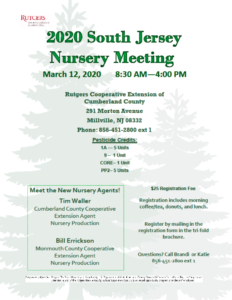
This year’s meeting will be an introduction of Tim Waller and Bill Errickson to the nursery industry here in South Jersey. The educational programming will include weed and pest updates, irrigation management, pesticide use /safety, and soil fertility presentations.

The deadline for registration is this Thursday, March 5th. Please register by mailing in the registration form in the attached tri-fold brochure or call Brandi or Katie (ext 1) for assistance. Due to the proximity of the meeting please call and let us know if you will be attending. 


Meeting flyer: Flyer 2020 Nursery Meeting
