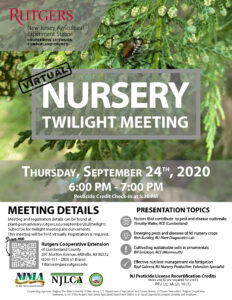
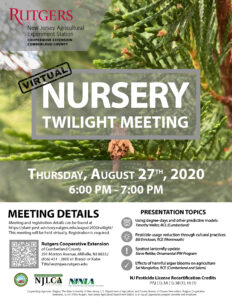
Register for the August Nursery Twilight Meeting (credit-bearing online webinar)

 Thursday, August 27, 2020

6:00-7:00 pm

Click here to register for the twilight meeting

Registration password: nursery20

Please join us for presentations on pest management topics from our two nursery agents Tim Waller and Bill Errickson, Spotted Lanternfly updates from Steve Rettke, and water related updates from Sal Mangiafico. Given the current state of in-person meetings we are aiming to make this as educational and painless as possible. We would like everyone to feel comfortable with this online format for future meetings. We plan to have a longer meeting in late September (+2hr) to hear from more nursery specialists and provide another opportunity to obtain pesticide credits.

August 27th Agenda

(5:30pm)   Webinar platform opens to registrants; Photo ID Check, Welcome Remarks

__(recording begins)__

(6:00pmEffective IPM approaches Using Degree-days and Other Predictive Models– Timothy Waller, RCE (Cumberland)

(6:15pmReduction of Pesticide Usage Through Cultural Practices- Bill Errickson, RCE (Monmouth)

(6:30pmSpotted Lanternfly Update & Review of Current Information Concerning This Invasive Insect- Steve Rettke, Ornamental IPM Program

(6:45pmHarmful Algae Blooms in NJ Lakes and Ponds and Their Effects on Agriculture- Sal Mangiafico, RCE (Cumberland & Salem)

__(recording ends)__

(7:00pmAdditional questions; Photo ID Check, Adjourn

NJ Pesticide License Recertification credits obtained: PP2 (1); 3A (1); 3B (1); 10 (1)

In cooperation with the NJNLA, NJLCA, and NJCTGA


Instructions:

  • Register for event at the above link
  • Include your pesticide license number if you would like recertification credits
  • After registration you will receive a confirmation email with a link to the actual twilight meeting.
  • Registered guests will receive a reminder 1 week prior to the event with more specific instructions.
  • Day-of: click the link in the registration confirmation email and select “join by browser-New” (if you do not currently have a WebEx app on your computer or video-enabled smartphone.
  • Day-of: Have your photo ID ready if you wish to obtain credits

Additional requirements for those seeking credits:

  • Licensed applicators with a recertification period expiring October 31, 2020 will be given an exemption from the NJDEP online credit cap of 25% and are eligible for all credits, otherwise this exemption does not apply.
  • Government issued photo ID is required and will be verified prior or immediately after the  meeting (i.e. will not be video recorded)
  • Attendees must be visible throughout the entire session (with live video on) and must stay to the end.
  • Polls will be randomly scheduled, & attendance will be visually monitored by a moderator.
  • Call-ins (audio only) are not eligible for pesticide recertification credits as of now; you need a computer/phone/tablet with *live* video capability.


We are here to help you connect, please contact Tim Waller (twaller@njaes.rutgers.edu) with any questions or concerns. Thank you very much for your willingness to cooperate within our online space!


Rutgers is dedicated to protecting your privacy and keeping your personal information safe. Your information will be kept strictly confidential; used solely to meet NJDEP ID verification protocol for recertification credit. Any information will be deleted after 60 days.
 

Early August Nursery Update (2nd generation scale hatch and boxwood blight considerations)

This PPA has four updates:

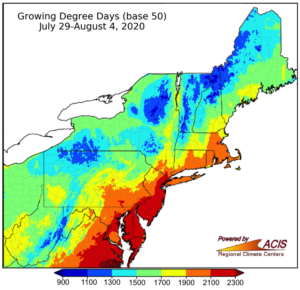
  1. Growing Degree-day Update GDD50
  2. 2nd generation scale insect hatch / crawler growing degree-day targets
  3. Tuliptree and Magnolia scale insect activity and notes on treatment
  4. Late summer boxwood blight considerations

(1) Growing Degree-days as of 8/5/2020

(Weather station selected for each location. Ex: NJ50 = Upper Deerfield)

Upper Deerfield (NJ50)= 2242 GDD50 Howell/Freehold (NJ10) = 1946 GDD50 Pequest (NJ58) = 1901 GDD50

Growth by date

Cornell ForeCast Map

If you need help getting your Growing Degree-day models set up, please contact (twaller@njaes.rutgers.edu) 

(2) 2nd generation scale insect hatch / crawler GDD50 targets

A second generation of scale insects will be hatching soon. Scout for crawlers and treat as needed.

format: scale insect species – (growing degree day GDD50 targets)

  • Maskell scale – (2035)
  • Euonymus scale – (2235)
  • Japanese maple scale – (2508)

Please refer to Tim Waller’s summer scale insect treatments PPA for additional information.

(3) Tuliptree and Magnolia scale egg hatch and crawler activity

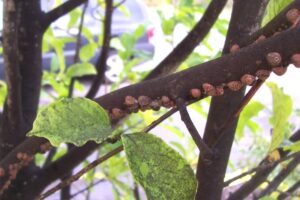
Magnolia Scale

Magnolia Scale & Maturing Females Photo- Steven Rettke of RCE

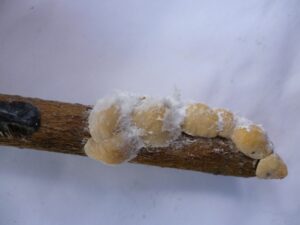
Tuliptree Scale

Tuliptree Scale With Honeydew & Sooty Mold Photo- Steven Rettke of RCE

Tuliptree scale and Magnolia scale insects begin hatching around ~2000 GDD50 but continue to emerge through the month of September (+6 week period). Therefor scouting for 1st and 2nd instar nymphs (crawlers) is critical to controlling these pests. Treatments will be ineffective if made too early in the season, as many of the un-hatched eggs will still be viable and lead to infestation and damages later.

Given this wide window of emergence, three treatment strategies can be deployed

  1. Delay pesticide applications for these pests until mid-October as the females will be dead and not harming the trees, all of the eggs will have hatched, and all of the crawlers will be vulnerable to appropriate materials (best approach)
  2. Apply multiple suppressive sprays at the first sign of emergence (time consuming, labor intensive, costly)
  3. Root or trunk applied systemic insecticides (often for very large trees)

Please refer to Steve Rettke’s Magnolia and Tuliptree scale insect PPA for additional information.

(4) Late summer boxwood blight considerations

As we enter into a period of cooler nighttime temperatures (< 77F) and frequent rain events, boxwood blight preventative sprays should be considered if you have not been making regularly scheduled applications. Boxwood blight is typically not as active during the heat of the summer, however, when cooler temperatures are coupled with prolonged periods of leaf-wetness the pathogen can infect.

Please refer to Tim Waller’s boxwood blight post for additional information and links to many other resources including numerous post from Rich Buckley of the Plant Diagnostic Lab.


Please take the 2020 Nursery Industry Survey: https://forms.gle/dUjLxaiu6qDQYYsRA

Participants Wanted for a Redheaded Flea Beetle Survey

The Southern Nursery Flea Beetle Working-Group has put out a survey under the auspices of University of Georgia. The Universities of Maryland and Delaware recently joined forces with that working group with the goal of gathering information aimed at suppressing this continually destructive pest. If you have seen redheaded flea beetle in your containerized nursery stock please take this short survey. Ultimately the goal is to gather as much information as possible about this pest in an effort to come up with better recommendations for all of us in the industry.

Click here to take the survey

Please contact Tim Waller (twaller@njaes.rutgers.edu) with any questions, severely damaged plant varieties, or personal observations pertaining to pest control and biology.

Thank you

Prevailing landscape disease; Entomosporium Leaf Spot on woody ornamentals

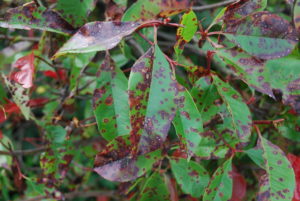
Entomosporium Leaf Spot

Photo: Rich Buckley

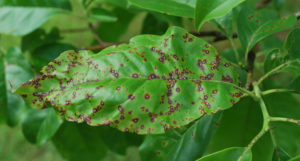
It was brought to my attention this morning that many landscapers and plant professionals are concerned by a reddening and spotting discoloration condition on Photinia foliage. Most often this is caused by the fungal pathogen Entomosporium maculatum, a widespread and destructive foliar disease of woody ornamentals in the rose family (including Photinia, Indian Hawthorn, Loquat, flowering and fruiting Pear, Firethorn, Hawthorn, Juneberry, and Quince). This pathogen discolors foliage to an unsightly red, orange, and black spotting that ultimately leads to premature defoliation. The spots will eventually turn necrotic and fungal structures will be visible within those areas (little black dots).


Entomosporium Leaf Spot

Photo: Rich Buckley

The pathogen can be active from late winter to late fall, favoring conditions that promote humidity and reduced airflow. The pathogen survives on infected leaves (attached or dropped). Typically it takes approximately 2 weeks for symptom development to occur post infection. Therefor the heavy discoloration we are seeing right now is the culmination of multiple infection events, where protectant fungicides were not used or were used correctly.

This means that another round of infections will occur again soon in severely infected locations as the spots will give rise to a new generation of spores.


Disease management (fungicides): Ideally, protectant fungicide applications would have been initiated every 7-14 days post bud break until all leaves had matured. However, in the current situation many people will be playing catch up. Fungicide applications initiated now will not make the symptoms go away or ‘cure’ the plant, but they are required now to protect foliage from the next wave of fungal infections and reduce the overall population. In severely infected plantings, fungicide applications should be continued every 10-14 (depending on fungicide label) days throughout the remainder of the season, especially in high value plantings or in specimen blocks. If winter conditions are unseasonably warm and humid, then applications should continue accordingly. Systemic fungicides should also be considered in addition to protective and cultural control mechanisms in severe cases.

Fungicides: 

ROTATE between Fungicide Resistance Action Committee (FRAC codes)

Format: [FRAC code]: Chemical name (Trade names)

  • [M05]: Chlorothalonil (Daconil WS)
  • [M05 + 1] Chlorothalonil + Thiophanate methyl (Spectro 90WDG)
  • [1] Thiophanate methyl (Clearys 3336)
  • [11] Azxystrobin (Heritage 50W)
  • [3] Myclobutanil (Eagle 40W)
  • [3] Propiconazole (Banner Maxx)
  • [3] Triadimefon (Bayleton 50, Strike 50WDG)
  • [1 + M03] Thiophanate methyl + Mancozeb (Duosan 79W)
  • [M03] Mancozeb
  • [M01] Copper Oxychloride + Copper Hydroxide (Badge SC, many)

IT IS CRITICAL TO ROTATE BETWEEN FRAC CODES DUE TO THE NUMBER OF POTENTIAL APPLICATIONS

Always refer to the label for allowable host crops, use-restrictions, application rates, reapplication intervals, re-entry intervals (REI), and mix compatibility information.

DISCLAIMER: Production and pesticide information on this site are for commercial operators and landscape professionals only and are NOT for home gardener use. Provided materials represent examples and do not cover all possible control scenarios. Please contact your local agent or chemical sales representative for more information.

Click here for a list of materials available to both homeowners and licensed pesticide applicators

Cultural prevention and mitigation:

  • Remove leaf-litter prior to bud break. During the season remove leaf litter only when dry. Infected leaves serve as inoculum for the next season. In severely infected plantings remove and replace mulch as fungal material can be deposited within the litter. Do not use leaf blowers to remove leaf-litter (all that does is spread around the spores).
  • Avoid overhead irrigation. Water moving through the canopy represents at least two dangerous plant pathogen situations; increased leaf wetness that lets pathogens infect successfully, and movement of spores (from sporulating leaves and young growth).
  • Increase airflow. Like all plant diseases, any situation that increases airflow, will decrease leaf wetness. This could include pruning, decreasing the density of plants, greater spacing, and planting/rearing site selection.
  • Pruning in heavily infected plants. In addition to promoting increased air flow, heavy pruning may be required to remove overwintering inoculum from the plants. This should only be done during dry conditions, preferably during plant dormancy periods.


For sample identification please contact the Plant Diagnostic Lab here at Rutgers.

Plant diagnostic lab

Photo: Rich Buckley

For more information and tips please visit:

Controlling Entomosporium Leaf Spot on Woody Ornamentals

Photinia Leaf Spot – Prevention And Treatment Of Common Photinia Bush Diseases

My Photinia Leaf Has Spots?

Entomosporium Leaf spot of Photinia and Indian Hawthorn

LSU: Entomosporium Leaf spot

Entomosporium Leaf Spot Diagnostic Guide


Timothy J. Waller, Ph.D. (twaller@njaes.rutgers.edu)

Boxwood blight update for 6/22-6/26/20

There are consistently high infection potentials this week for boxwood blight.

Protective fungicide applications should remain in effect or be initiated immediately. 

Boxwood Blight Risk Model
Date Upper Deerfield (NJ50) Howell (NJ10) Pequest (NJ58)
6/20/20 S Low risk Very low risk Infection potential
6/21/20 Sun Low risk Infection potential Infection potential
6/22/20 M Infection potential Infection potential Infection potential
6/23/20 T Infection potential Infection potential High Inf. potential
6/24/20 W High Inf. potential High Inf. potential High Inf. potential
6/25/20 Th Infection potential Infection potential Low risk
6/26/20 F Very low risk Very low risk Low risk
^Risk of infection^
adapted from: uspest.org/risk/boxwood_app 

The weather: Don’t let these beautiful early summer days fool you, we all know that violent thunderstorms can appear out of nowhere, bringing with them high winds and rain (wind driven rain) causing high persistent humidity. I.e. the perfect storm for fungal pathogens to spread and successfully infect. Accordingly, many other fungal pathogens are equally active under these conditions and should be managed accordingly. Prevention is always easier than a cure. 

These advisories are general in nature so someone from your business should be using this risk model if boxwood is important to your financial stability. In 30 seconds you can have a better idea of boxwood blight (and other pathogen) activity in your immediate area!


Boxwood blight information:

The disease may be sporulating and spreading amongst plantings if present (or may come into your nursery or landscapes via shipments) within the next few days. The pathogen, Calonectria pseudonaviculata, (aka Cylindrocladium buxicola) can also infect other hosts within the boxwood family (Buxaceae). These include common landscape plants such as Pachysandra and Sweetbox, so treatments should be directed towards these hosts as well. Leaf-litter suspected of boxwood blight should only be removed carefully under dry conditions (i.e. do not use a leaf blower to remove leaf-litter in Pachysandra or Boxwood plantings this week!). Additionally, please refrain from touching the plants at all during wet conditions as boxwood blight spores are sticky and can be transferred from plant-to-plant or site-to-site. Please follow proper sanitization and sterilization practices in addition to a preventative spray program. Tools, clothing, and transportation equipment should be routinely cleaned with alcohol or bleach to prevent the spread of this disease. Additionally, this pathogen forms small (yet bomb-proof) survival structures (Microsclerotia) that can remain as a source of infections for 7-10 years within the soil and leaf-litter (part of why you do not want to use a leaf blower to clean out leaf-litter!).

See the following for what to do in multiple boxwood blight scenarios. 

Boxwood blight key symptoms:

  • Straw-yellow to bronzing leaves that have a characteristic halo of lighter brown and yellow around the infection point.
  • LEAVES FALL OFF, TYPICALLY STARTING AT THE BOTTOM. These leaves then act as a source for new infections.
  • Twigs will have long brown lesions

Look-a-likes: NOT ALL FOLIAR DISEASES are Boxwood blight:

  • Volutella Blight (straw-yellow or golden leaves with pink spores, branches have loose bark).
  • Macrophoma leaf spot (straw-yellow leaves with black fungal structures (black spots))


Fungicides; 

ROTATE between Fungicide Resistance Action Committee (FRAC codes)

Format: [FRAC code]: Chemical name (Trade names)

  • [M05]: Chlorothalonil (Daconil WS)
  • [M05 + 1] Chlorothalonil + Thiophanate methyl (Spectro 90WDG)
  • [11] Trifloxystrobin + [7] Fluopyram  (Broadform)
  • [11] Trifloxystrobin + [3] Triadimefon (Armada 50WDG)
  • [M03] Mancozeb
  • [12] Fludioxonil (Medallion WDG)
  • [3] Tebuconazole (Torque)


Always refer to the label for allowable host crops, use-restrictions, application rates, reapplication intervals, re-entry intervals (REI), and mix compatibility information.

DISCLAIMER: Production and pesticide information on this site are for commercial operators only and are NOT for home gardener use. Provided materials represent examples and do not cover all possible control scenarios. Please contact your local agent or chemical sales representative for more information.   


Previous Boxwood Blight Plant and Pest Advisory Posts;

Additional resources on boxwood blight;

Contact: Timothy J. Waller, Ph.D.  (twaller@njaes.rutgers.edu)


Nursery update; focus on warm season spider mites

This advisory provides; (1) warm season spider mite biology and control options, (2) current growing degree-day information, and (3) a boxwood blight risk update.

Note: Previous spider mite advisories

Steve Rettke, Rutgers IPM, wrote two very good advisory posts pertaining to the different seasonal mites, in addition to symptomology and images of the different mites. He is a wealth of information and has contributed photos and will be assisting in future fact-sheets pertaining to common pests and their control. In light of these advisory posts (below) this current advisory will only cover the basics as it applies to pest control. Contact: rettke@njaes.rutgers.edu

Please review his very informative advisories:

Cool season mites: https://plant-pest-advisory.rutgers.edu/cool-season-mites-wax-as-the-warm-season-mites-wane/

Warm season mites: https://plant-pest-advisory.rutgers.edu/cool-season-mites-have-faded-but-warm-season-mites-now-surge/

Spider mite damaged tree

Cool season: Spruce spider mite damage on an Aberta Dwarf Spruce. Photo: Steven Rettke, RCE.

Plant covered in webs

Warm season: Two spotted spider mite webbing and damage. Photo: Steven Rettke, RCE.

(2) Basic spider mite biology and control options

Cool season mites: The mites affecting horticulture crop production can be broken into two functional groups; cool season and warm season. Cool season mites feed and lay eggs, as the name suggests, in cooler times of the year (late winter-early spring and then again fall-early winter depending on the year). The two most common cool season mites are the Spruce and Southern red spider mites that feed on conifers and broadleaf evergreens, respectively. In many cases the damages caused by these mites are not noticed until well into the growing season. Meaning that if damages are observed mid-season you would be better off waiting until the fall to control cool season mites, i.e. targeting late season egg hatches and developing mites.

Warm season mites: As the season progresses towards summer, the warm season mites including Two-spotted, Maple, Oak, Honey locust, European, and other host specific spider mites become active (typically June – September). The Two-spotted spider mite is known as a “cosmopolitan” pest because of its ability to colonize, and damage, a wide variety of horticulture crops (but are rarely observed on conifers). Sentinel plants would include rose, euonymus, and forsythia, as they are favorites of these mites. In contrast to the cool season mites, warm season mite damages are often visible while the pest is actively feeding and multiplying, as up to 10-15 generations per growing season can impact your crop. Warm season mites evade suffocation by dormant oil sprays and other miticide applications by leaving their feeding locations on plants once temperatures begin to drop, and overwinter in the soil horizon or leaf litter under the host plant. As warm season mites are preparing to go into dormancy they begin to change their color to an orange hue, meaning they are not feeding as readily and will not be as affected by miticides because of this.

Two spotted spider mites

Multiple life stages of Two spotted spider mites. Photo: Steven Rettke, RCE.

Two spotted spider mites

Two spotted spider mite females going into dormancy (orange coloration). Photo: Steven Rettke, RCE.

Conditions favoring spider mites: Full sun and dry, dusty conditions are often associated with increasing mite populations as low relative humidity often stimulates mite reproduction. Additionally, during periods of rain (and resulting leaf wetness-periods), certain fungi are able to attack and reduce mite populations (called entomopathogenic fungi). Meaning in frequently wet seasons mite numbers, damage, and miticide applications should be lowered due to increased fungal activity. However, this situation can certainly lead to increased plant pathogenic fungi activity as well, therefor a balance between the two is most desirable. Excessive nitrogen fertilizer has also been linked to explosive mite populations; therefor a well-planned nutritional regiment should be strictly followed.

IPM is important when suppressing spider mite populations!

Beneficials: In addition to entomopathogenic fungi (like Beauveria bassiana), numerous beneficial organisms can also manage mite populations including predacious mites (Phytoseiidae family), spider mite destroyer (Stethorus punctillim), ladybug larvae, midge larvae (Feltiella acarisuga), and minute pirate bugs. Given this complex, and many times free, natural defense system, applications of certain insecticides can actually cause mite populations to resurge by killing the mite-feeding beneficials (see note below). Therefor, all applications should be thoughtfully considered with economic (or cosmetic) thresholds in mind.

Compounds that can cause spider mite resurgence:

  • Carbaryl (Sevin)
  • Cyfluthrin containing compounds (Tempo, Decathalon, Scimitar)
  • Permethrin (Astro)
  • Imdacloprid (Merit, Marathon)

Warm season spider mite treatment options:

ROTATE between Insecticide Resistance Action Committee (IRAC #)

Format: [IRAC Group #]: Chemical name (Trade names)

  • [3A]: Pyrethrins (Tersus)
  • [5]: Spinosad (Conserve, Entrust)
  • [6]: Abamectin (Avid, Lucid, Aracinate TM)
  • [20D]: Bifenazate (Floramite SC)
  • [10A]: Hexythiazox (Hexygon)
  • [21A]: Pyridaben (Sanmite, Sanmite SC)
  • [21A]: Fenazaquin (Magus)
  • [23]: Spiromesifen (Forbid 4F, Judo)

“Softer” spider mite materials

  • Agitator (forces mites out of hiding): Captiva
  • Azadirachtin from the Neem plant: (Azatrol EC)
  • Beauveria bassiana: (Naturalis-L)
  • Horticulture oil: (@ 1-2% vol:vol summer applications)
  • Insecticidal soaps: (M-Pede)

Always refer to the label for allowable host crops, use-restrictions, application rates, reapplication intervals, REI times, and mix compatibility information.

NOTE: Production and pesticide information on this site are for commercial operators only and are NOT for home gardener use. Provided materials represent examples and do not cover all possible control scenarios. Please contact your local agent or chemical sales representative for more information.   

(2) Growing Degree-days as of 6/16/2020 (if you need help please contact me at twaller@njaes.rutgers.edu)

Upper Deerfield (NJ50)= 809 GDD50 Howell/Freehold (NJ10) = 628 GDD50 Pequest (NJ58) = 525 GDD50

Growing degree day map for our area: (courtesy of Cornell University; Fore Cast)

Growing degree-day map for Northeastern US

Growing degree-day map for our area. Cornell, Fore Cast.

(3) Boxwood blight risk update

Boxwood Blight Risk Model
Date Upper Deerfield (NJ50) Howell (NJ10) Pequest (NJ58)
6/14/20 Sun Very low risk Very low risk Very low risk
6/15/20 M Very low risk Very low risk Very low risk
6/16/20 T Very low risk Very low risk Very low risk
6/17/20 W Very low risk Very low risk Very low risk
6/18/20 Th Low risk Low risk Low risk
6/19/20 F Infection potential Infection potential Low risk
6/20/20 S Low risk Infection potential Low risk
6/21/20 Sun Very low risk Low risk Very low risk
Risk of infection
adapted from: https://uspest.org/risk/boxwood_app

Please visit this website (there is a mobile app as well): https://uspest.org/risk/boxwood_app

Protective fungicide applications should remain in effect or be initiated immediately for Boxwood Blight. The disease may be sporulating and spreading amongst plantings if present (or may come into your nursery via shipments) within the next few days. Please continue preventative/protectant fungicide applications utilizing; chlorothalonil (FRAC Group M05), mancozeb (FRAC Group M03), and QoI-fungicides (FRAC Group 11) in a rotation (other materials available as well).

NJAES; Plant Diagnostic Lab https://njaes.rutgers.edu/plant-diagnostic-lab/


*Additional links and resources*

Please take the 2020 Nursery Industry Survey: https://forms.gle/dUjLxaiu6qDQYYsRA

Ask the Agent (every Wednesday @ 7:00pm): : https://go.rutgers.edu/t7wjkit1

NJNLA- Wine Down Wednesdays (every first and third Wednesday @ 7:00pm-8:00pm).

Email: Lori Jenssen @ njnla.director@gmail.com

Subscribe to the NJAES YouTube webpage: https://www.youtube.com/user/RutgersNJAES/

RU Sustainable Nursery Production website: https://njaes.rutgers.edu/nursery/

March meeting PDF: https://njaes.rutgers.edu/nursery/documents/2020%20SJ%20Nursery%20Meeting%20Proceedings.pdf

How to use growing degree-day resources: https://plant-pest-advisory.rutgers.edu/using-growing-degree-day-calculators-nursery-pest-and-pathogen-updates-important-resource-links/

2017 Southeastern U.S. Pest Control Guide for Nursery Crops and Landscape Plantings: https://content.ces.ncsu.edu/southeastern-us-pest-control-guide-for-nursery-crops-and-landscape-plantings 

Rutgers Insect Control Recs. for Shade Trees and Commercial Nursery Crops: https://njaes.rutgers.edu/pubs/publication.php?pid=E334

NJAES; Soil Testing Lab: https://njaes.rutgers.edu/soil-testing-lab/


Thank you,
Cumberland County Extension: Timothy J. Waller, Ph.D. @ twaller@njaes.rutgers.edu