New Jersey Department of Agriculture (NJDA), Division of Agricultural and Natural Resources is offering the following grant opportunity:
Nutrient Management Assistance Grants
Available Funding: Up to $25,000
Application Deadline: June 16, 2025
Funding Period: Three Years
The New Jersey Department of Agriculture (NJDA), Division of Agricultural and Natural Resources is pleased to announce a funding opportunity to support manure spreader purchase and maintenance, and to establish a community use program for the manure spreader. This grant aims to advance nutrient management Best Management Practices (BMPs) across New Jersey farms by enabling the shared use of properly maintained equipment.
Eligible Applicants:
• New Jersey-based individuals
• Agricultural businesses
• Cooperatives
• Not-for-profit organizations (NFPs)
• Government agencies
Applicants should demonstrate a strong working relationship with local agricultural producers and must be committed to supporting nutrient management in their communities.
Program Highlights:
• Purchase and maintain a manure spreader
• Establish a community use program for the manure spreader with a minimum of five farms
• Support the implementation of Animal Waste Management Plans (AWMPs) with Nutrient Management Plans or nutrient budgets where the manure spreader will be used
• Implement all funded activities over a three-year period
For application materials and additional information, please visit: https://www.nj.gov/agriculture/grants/njdanutrientmanagementgrants.html
Need a Manure Spreader? Nutrient Management Assistance Grants – Deadline 6/16/25
South Jersey Spring Vegetable Growers Meeting
DATE: Thursday, March 27, 2025
TIME: 6:00 p.m. – 9:00 p.m.
LOCATION: Rutgers Cooperative Extension of Gloucester County
Shady Lane Complex, 254 County House Rd, Clarksboro, NJ 08020
(Please enter through the far-right side of the building up the first ramp)
CO- SPONSORED BY THE VEGETABLE GROWERS ASSOCIATION OF NEW JERSEY
NO REGISTRATION NEEDED
6:00 -6:30PM Sign in and Light Dinner
6:30-7:00PM Rutgers Vegetable Integrated Pest Management Update
Amanda Quadrel, Sr. Program Coordinator, Vegetable IPM, RCE
7:00-7:30PM Update on the Water Requirements for the Produce Safety Rule
Wes Kline, Ag Agent, RCE Cumberland County
7:30-8:00PM Update on Disease Control in Vegetable Crops
Andy Wyenandt, Rutgers NJAES Vegetable Pathologist
8:00-8:30PM Labor and Regulatory Updates from NJ Farm Bureau
Ben Casella, NJFB
8:30-9:00PM USEPA/NJDEP Worker Protection Standards Overview for Pesticide Safety
Michelle Infante-Casella, Ag Agent, RCE Gloucester County
9:00PM Pesticide Recertification credits – CREDITS INCLUDE: 1-CORE, 3-PP2, 3-Cat. 1A, 2-Cat. 10
Contact the RCE of Gloucester County Office for more information 856-224-8040 ext. 1 or email Michelle Infante-Casella at minfante@njaes.rutgers.edu
Pesticide Recertification Credits have been requested from NJDEP for this meeting – TBD.
REGISTER TODAY – NJ Ag Convention Coming Soon
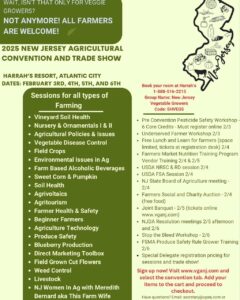
We are only days away from the start of the 2025 NJ Agricultural Convention and Trade Show at Harrah’s in Atlantic City starting on February 3rd to February 6th. The convention has evolved over the years to include much more than vegetable topics. See the graphic below or the VGANJ website convention program for a list of expanded topics.
Nursery growers – we have a full day for you. Do you raise livestock? We have a new session for you. Want to learn about agricultural policies? Come to the session on Tuesday morning hosted by Rutgers Cooperative Extension Director, Brian Schilling and colleagues from the State Agricultural Development Committee. Need to learn about Food Safety Regulations, we have both a session and a workshop for you. USDA will be hosting sessions on Tuesday to promote programs for farmers. There are too many more topics to put into text so please check out the program on the VGANJ website.
Need pesticide recertification credits? This year the workshops and sessions will help you fulfill the obligation to obtain those credits. Monday afternoon hosts a 6-CORE credit workshop that requires a separate special registration. Check out the program and how to register on the VGANJ website.
Have you registered for your hotel rooms yet? If not please use the room block and register online at https://book.passkey.com/GO/SHVEG5 or call to make Room Reservations on the phone at 1-888-516-2215 (8:00am-2:00am EST, 7 days a week), Group Name: New Jersey Vegetable Growers. Group Code: SHVEG5. There are plenty of rooms left in the room block, but the pre-registration ends soon, so reserve your rooms today. Please reserve your rooms through the group block to help us meet our obligations for the convention contract.
Don’t miss the great Tuesday events. There is a FREE “Lunch and Learn” on Tuesday (sign up for tickets at registration on Tuesday, limited to 100 participants) in the back area of the trade show hall with time to meet with vendors and also discussion with the new NJ Secretary of Agriculture, Ed Wengryn. Tuesday night hosts a charity auction and if you attended last year, you know how great this event is with food, drink, and time to catch up with old friends and make new friends in farming. Thanks to VGANJ Secretary, Darcy Perehinys the Tuesday events will once again have amazing food! Lots of prizes from our sponsors will be available for bid at the Charity Auction. If you haven’t attended this event in the past, don’t miss it this year as it is much improved from years past. Tuesday is a big day and with the Lunch and Learn and Charity Auction Happy Hour – if you attend both these events you can eat for free!!!!
One more event you won’t want to miss is the annual awards banquet on Wednesday night. Tickets can now be purchased online on the VGANJ website. This year’s NJ Vegetable Grower of the Year award goes to Brian Porch, of Porch Farms in Salem County, NJ. The award will be presented by VGANJ President, Jim Abma. Come help us celebrate Brian and all the other award winners who will be honored by the NJ Department of Agriculture.
Register Before December 31 for Bonuses at the 2025 NJ Ag Convention

Have you signed up for the 2025 New Jersey Agricultural Convention and Trade Show yet?
Visit the VGANJ Convention Website and register today!
It’s incredibly simple! Here’s a pro tip: Become a member of the Vegetable Growers Association to enjoy all the benefits, even if you don’t grow vegetables, and save on convention registration fees by becoming a member. Everyone must register to enter the trade show and participate in educational sessions and other events sponsored by the VGANJ.
Make sure to register by December 31st to receive two complimentary drink tickets (per registered individual) for use at the trade show bars after 2 PM on Tuesday and Wednesday. Plus, you’ll be entered to win a $100 gift card for meals during your time in Atlantic City!
Don’t forget to check the VGANJ website for the exciting new educational sessions for 2025.
Also, on Tuesday there will be a special free “Lunch and Learn” program to engage with vendors and participate in a Q&A session with the new Secretary of Agriculture, Ed Wengryn.
*FREE lunch tickets only for the first 100 farmers Tuesday who sign up for the “Lunch and Learn” at the registration desk on Tuesday morning. Lunch starts at 12:00.
On Wednesday, February 5th the VGANJ will be honoring the NJ Vegetable Grower of the Year. For 2025 the honoree is Brian Porch from Salem County, NJ. Come help us celebrate our awardee and the NJDA awardees at the banquet. Tickets are now available online through VGANJ. See the VGANJ Convention Website to sign up for the banquet and other special events.
Hurry – Apply for the Marketing Assistance for Specialty Crops (MASC) Program– Applications Due January 8, 2025 – Contact Your Local FSA Office Now
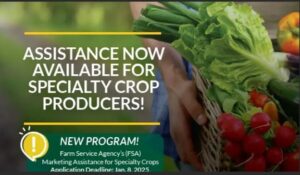 The MASC program, administered by the Farm Service Agency (FSA) using Commodity Credit Corporation (CCC) funds, provides eligible specialty crop producers with marketing assistance payments to help them engage in activities that aid in expanding domestic specialty crop markets or in developing new markets for their specialty crops in 2025.
SPECIALTY CROPS ELIGIBLE – Fruits (fresh, dried) Nursery crops, Christmas trees, and floriculture, Vegetables (including dry edible beans and peas, mushrooms, and vegetable seed) Culinary and medicinal herbs and spices, Tree nuts, Honey, hops, maple sap, tea, turfgrass, and grass seed. Payments are capped at $125,000 per producer, and if demand exceeds the allocated $2 billion, payments may be prorated. Final payment factors will be determined after the application period closes.
To be eligible for payments, persons or legal entities must:
• Be in the business of producing a specialty crop at the time of application and be entitled to an ownership share and share in the risk of producing a specialty crop that will be sold in calendar year 2025;
• Be a U.S. citizen, resident alien, partnership, corporation, limited liability company, or other organizational structure organized under State law, Indian Tribe or Tribal Organization, or a foreign person or foreign entity who meets certain eligibility requirements;
• Comply with the provisions of the “Highly Erodible Land and Wetland Conservation” regulations, often called the conservation compliance provisions;
• Not have a controlled substance violation;
• Submit a complete MASC application form (FSA-1140) and provide all required documentation as specified in the documents section below.
To be eligible for payments, a person or legal entity must have an average adjusted gross income (AGI) of less than $900,000 for tax years 2021, 2022, and 2023, unless the person or legal entity’s average adjusted gross farm income is at least 75 percent of their average AGI.
Eligible producers can apply by completing the FSA-1140, Marketing Assistance for Specialty Crops (MASC) Application, and submitting it to any FSA county office by January 8, 2025.
FSA-1141, Marketing Assistance For Specialty Crops (MASC) New Producer Expected Sales Worksheet (New producers only)
New producers must complete and sign the new producer expected sales worksheet and provide along with their FSA-1140 to any Farm Service Agency county office nationwide.
See link for more information: https://www.fsa.usda.gov/tools/informational/fact-sheets/marketing-assistance-specialty-crops-program
Get Ready for the 2025 NJ Ag Convention – February 3-6
It is that time of year again to sign up for the annual NJ Agricultural Convention, co-sponsored by the Vegetable Growers Association of New Jersey, Rutgers Cooperative Extension, and the New Jersey Department of Agriculture. Visit the VGANJ website at https://vganj.com/convention-tickets to register.
For 2025 there are new and exciting opportunities to learn about all aspects of the agricultural industry at the educational sessions and from vendors at the trade show. If you came last year, you also saw many new improvements to the convention – more vendors, more educational sessions, a complimentary lunch (limited free tickets) on Tuesday highlighting “what’s new from industry”, a complimentary hot buffet at the Tuesday happy hour/charity auction, youth programs for FFA, and co-convention events with the NJ Department of Agriculture. These offerings and more are coming for 2025. New events like Monday afternoon workshops, a livestock session, an agricultural policy session, an environmental session, and others are confirmed for this coming year. Licensed pesticide applicators will see an increase in recertification credits on the program for 2025.
To check out the educational programming and NJDEP recertification credits for pesticide applicators see https://go.rutgers.edu/ConvProgram2025 – this is a draft program. Also, note that some events need special sign-up so read the program carefully to see what events need pre-registration.
NJ State Board of Agriculture information for the convention is coming soon. Check out their website at Department of Agriculture | Conventions.
If you have any questions about the VGANJ registration, go to https://vganj.com/#contact. If you need more information about the educational programs please contact the Rutgers Co-Chairs for the convention – bamka@njaes.rutgers.edu Bill Bamka, Agricultural Agent in Burlington County, or minfante@njaes.rutgers.edu Michelle Infante-Casella, Agricultural Agent in Gloucester County.
