Archives for May 2024

Controlling Phytophthora blight in eggplant

Phytophthora blight, caused by Phytophthora capsici, can cause crown and fruit rot in eggplant. Unfortunately, most of New Jersey has been plagued by heavy rains and pop-up thunderstorms these past few weeks making conditions ideal for pathogens such as Phytophthora blight on pepper, eggplant, tomato, and cucurbit crops.

Control of Phytophthora blight is extremely difficult (even with the use of fungicides) in the very hot, wet weather conditions that most of New Jersey has been through during the month of July. In the past few years a number of new fungicides, with new active ingredients, have become commercially-available for use on multiple crops. Mefenoxam and metalaxyl, both once widely-used to effectively control Phytophthora blight have been hit by resistance issues around much of Southern New Jersey. Growers with a known history of mefenoxam-insensitivity on their farm should use Presidio or Ranman plus a Phosphite fungicide in rotation in their drip application programs for the control of the crown rot phase of Phytophthora blight. Importantly, if mefenoxam has not been used in particular fields on any crop for a number of years (more than 5+) the fungus may revert back to being mefenoxam-sensitive and control with these products may return. Mefenoxam, metalaxyl, and the phosphite fungicides are the most systemic of the group and should readily be taken up the by plant via application through the drip. Orondis Gold (OXTP + mefenoxam) is also systemic. Presidio is locally systemic, and Ranman has protectant activity and can also be applied via drip.
[Read more…]
ALERT – Control window approaching for Cryptomeria and Elongate Hemlock Scale

Cryptomeria Scale, Elongate Hemlock Scale, and Bagworms in Conifers – Control Window Approaching!

Projected GDD50 accumulation as of 5/23/2024 (for June – July)
CODE Location 23-May 1-Jun 15-Jun 1-Jul 15-Jul
NJ50 Upper Deerfield (South) 501 678 977 1383 1786
D2738 Mays Landing (South) 500 667 943 1327 1711
NJ10 Howell (Central) 407 568 833 1203 1577
NJ36 Parsippany (Central) 389 548 795 1141 1491
E7133 Belvidere (North) 432 592 836 1178 1523
N59 High Point (North) 345 486 706 1020 1338
USPEST.ORG – Model: simple average/growing degree-day, Min: 50F – Max: 95F, NMME forecast
Forecast:  7-month NMME based seasonal climate forecast (USPEST.ORG) – Subject to change regularly = Check Often


Cryptomeria Scale – Click here for full Cryptomeria Scale write-up (with pictures)

(Adapted from Steve Rettke – RCE post above)

Crawlers Generation 1: 600-800 GDDs (first few weeks of June in NJ)

  • Similar to many other armored scale species, the Cryptomeria scale has more than one generation of crawlers during the growing season. In New Jersey, this scale has two crawler generations per year, Crawlers are lemon yellow in color & because of the color contrast can typically be easy to observe on needles, even without a hand lens. Unfortunately, the crawler emergence periods of both generations of the Cryptomeria scale are not restricted to only a week or two. Their more prolonged crawler periods can extend for 4 weeks or even longer, although a large percentage of crawlers will occur during the first 2 weeks after emergence begins.

Crawlers Generation 2: 1750-2130 GDDs (end of July early August in NJ)

Control options: When applying control materials with short residuals (e.g., horticultural oils), the use of multiple applications will probably be required to achieve a more complete crawler suppression. If a single application is desired, then oils plus synthetic pyrethroids can provide a 3-week residual. Examine infested trees closely to determine if significant predators or parasitoids are presently active. When numerous, these beneficials can be extremely valuable to help with suppression. Therefore, the use of horticultural oil applications alone will help conserve the beneficials & still control crawlers when coverage is adequate. The use of most of the neonicotinoid insecticides (e.g., Merit) will not achieve satisfactory controls (maybe only 30-40% efficacy). However, the usage of dinotefuran (Safari) as a soil drench or bark spray has been shown to give excellent results against armored scales, with some studies showing 90% efficacy. The extremely high-water solubility of Safari allows this material to penetrate the plant cells where the scales are feeding.

Elongate Hemlock Scale – Click here for more information (with pictures)

(Adapted from Steve Rettke – RCE post above)

First crawler emergence: 360-700 GDDs (Late May – June in NJ)

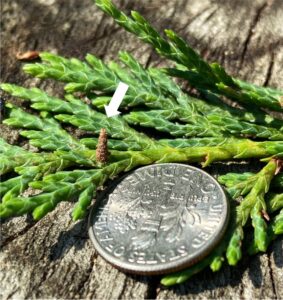
  • Female covers are oval, flat, tan/translucent; males are whitish. There may be six or more scales per needle. Yellow spots appear on needles under light feeding and foliage appears thin; in heavy infestations, needle drop occurs, and trees may be killed. Adult females have an exceptionally long egg-laying period (lasting throughout the summer) with two overlapping generations. Crawlers (immatures) are noticeable in late May, in conjunction with new growth. Although there are only two generations per year, crawlers can emerge over an extended period. Look for the tiny crawlers using a 10-15x hand-lens.

Control options: Pyriproxyfen (Distance) is an insect growth regulator & can provide good suppression. It is classified as a “reduced risk” material by the EPA. Dinotefuran (Safari) is a neonicotinoid that has been a product of choice to control armored scales for more than a decade. Imidacloprid (Merit) is highly effective controlling the hemlock woolly adelgid but will not provide satisfactory control of elongate hemlock scales. Acephate (Orthene) has translaminar properties within foliage & can provide some suppression.


Bagworms 

Days old bagworm size

Days-old bagworm = critical management target – T. Waller – RCE

Bagworms should begin hatching NOW through – 4 weeks in NJ, beginning in the southern regions. Now is an optimal time to get this pest on your radar and prepare materials or approaches to attack first/second instar caterpillars. The control window for this pest is typically between 600-900 GDD50  when they begin to hatch and become airborne, i.e. the “ballooning” phase. It is important to check for egg-hatch prior to applications for greatest chemical efficacy, and to continue scouting as they often hatch and develop at asynchronous rates.

It is critical to target these insects EARLY!

Bagworm management – mechanical: If eggs have not hatched: hand-remove sacs/bags. Typically female/egg filled sacs are higher in the canopy so keep that in mind while scouting. This removes the problem from the field or landscape.

Treatment options for Lepidoptera (caterpillars) to have at the ready – containing: B.t. (Bacillus thuringiensis), spinosad , bifenthrin ), cyfluthrin, carbaryl, chlorantraniliprole, cyclaniliprole, cyclaniliprole + flonicamid, Lambda-cyhalothrin, cyantraniliprole, Indoxacarb.  NOTE – Lethal pesticide doses are important, as sub-lethal doses can trigger early pupation, making the pest all but invincible to chemical or biological treatments. Follow label exactly.

IT IS CRITICAL TO ROTATE MATERIALS (Rotate between IRAC groups) 

DISCLAIMER: The label is the law, always refer to it for allowable host crops, use-restrictions, application rates, reapplication intervals, re-entry intervals (REI), and mix compatibility information. Production and pesticide information on this site are for private/commercial pesticide applicators and landscape professionals only, and are NOT for home gardener use. Provided materials represent examples and do not cover all possible control scenarios. Please contact your local agent or chemical sales representative for more information or to discuss additional pest management options.

BAGWORMS (600-900 GDD) (Bagworm hatch prediction as of 5/20/24)
Crop type Common Name Scientific Name GDD Min (50F) GDD Max (95F) Reference Developmental / Target Stage
Conifer mostly, many minor hosts Bagworm Thyridopteryx ephemeraeformis 600 900 RU Larvae (early instars) – ONLY CONTROL WINDOW
Region Location Station Date (600 GDD) Date (900 GDD) *Treatment window  *Bagworm Hatch – Predictions only, SCOUTING is critical! Treat as soon as larvae detected.     

Remove any ‘bags’ prior to hatch if possible

South Upper Deerfield NJ50 29-May 12-June 13 days
Central Howell / Freehold NJ10 4-June 19-June 15 days
North High Point NJ59 11-June 26-June 15 days 


Please download and print the Rutgers Nursery and Landscape Pest Scouting Guide  or  Conifer and Christmas Tree Pest Scouting Guide and refer to this post “Obtaining your local growing degree-days (GDD)” for additional information.  (See pest scouting guides for complete list of references) 

Please SHARE what you SEE!! If you see a pest, disease, otherwise interesting or troublesome issue please report it to the Working Group by following the QR Code on the front of the Pest Scouting Guides or by filling out this reporting form.

Grape and Wine Science Certificate Program

Grape and Wine Science Certificate Program will be offered July 22-Aug 16, 2024. This program will provide foundational knowledge in three major areas of grape and wine science – grape growing, wine making, and business operations – following the path of grapes from the field to the winery to the glass. Students will gain competency in all three areas to prepare them for positions in the industry. The program will feature 4 weeks of classroom instruction, complemented by hands-on workshops. Then students will complete a 4-week winery internship where they can put their new knowledge and skills into practice. [Read more…]

Phytophthora and Pythium control during wet weather

Most of New Jersey has been wet making current conditions ideal for pathogens such as Phytophthora and Pythium. Unfortunately, Pythium cottony leak and Phytophthora blight can be found on most farms in the southern part of the state. Poor crop rotations with susceptible hosts only make matters worse. The Phytophthora pathogen has an increasing host range that now includes snap and lima beans; and all crops, other than a few resistant bell pepper cultivars, lack any resistance to the pathogen. Under ideal conditions (hot, humid, and wet) Pythium cottony leak can develop on infected fruit.

[Read more…]

Vegetable IPM Update 5/22/24

Sweet Corn

A few scattered European corn borer (ECB) moths have been captured in central and northern counties, and this insect is certainly active in southern parts of the state.  Numbers are very low, which is consistent with the last few seasons.   Whorl corn is the primary target for egg laying, but as yet, scouts have reported no signs of feeding injury in the few plantings that are of suitable maturity.  In northern and central counties, corn plantings that were started on/under plastic have reached a size that will support ECB larvae.  We expect to encounter some level of feeding over the next 2-3 weeks, although the majority of plantings have not required insecticide treatments for ECB prior to full tassel in the past several years.

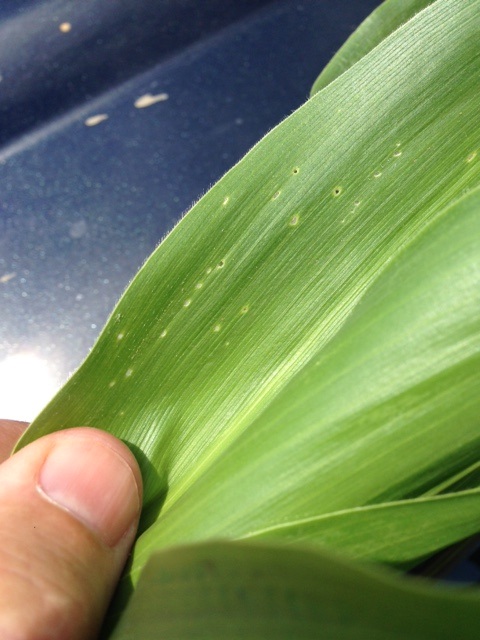
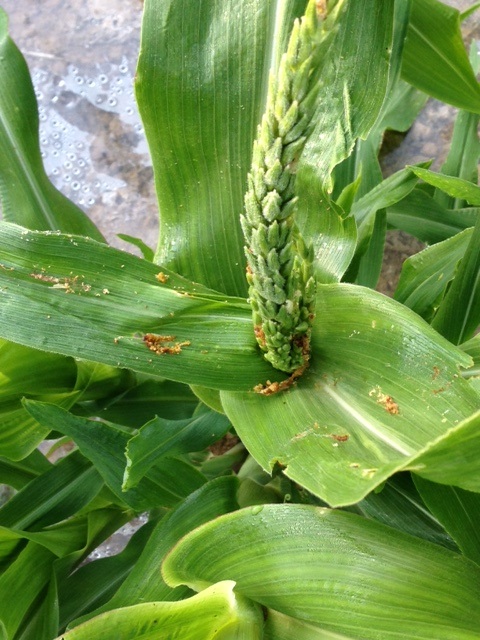
European corn borerLook for the characteristic “shot-hole” type of feeding (photo below at right) and consider treating when infested plants exceed 12% in a 50 plant sample.  As plantings proceed to the pre-tassel stage, ECB larvae may be found in emerging tassels (see photo at left).  It is a good idea to treat individual plantings as they move into the full tassel/first silk stage one time.  This eliminates any ECB larvae that have emerged with the tassels as they begin to move down the stalk to re-enter near developing ears.

Useful insecticides for this particular application include synthetic damaged leafpyrethroids (IRAC Grp 3), spinosyns (including OMRI approved Entrust) IRAC Grp 5), and diamides such as Coragen or Vantacor (IRAC Grp 28) or materials such as Besiege which include the active ingredient in Coragen.  Synthetic pyrethroids alone should NOT be used for corn earworm (CEW) protection on silking corn.  Control with these materials is very inconsistent.

The highest nightly trap catches* of ECB for the week ending 5/22/24 are as follows:

Asbury   1 Georgetown   1
Califon   1 Sergeantsville   1
Farmingdale   1 South Branch   1

*  No blacklight traps are in operation south of the Columbus (Burlington Co.) area this season.

[Read more…]

Preventing Heat Stress in Agriculture – Factsheet Updated

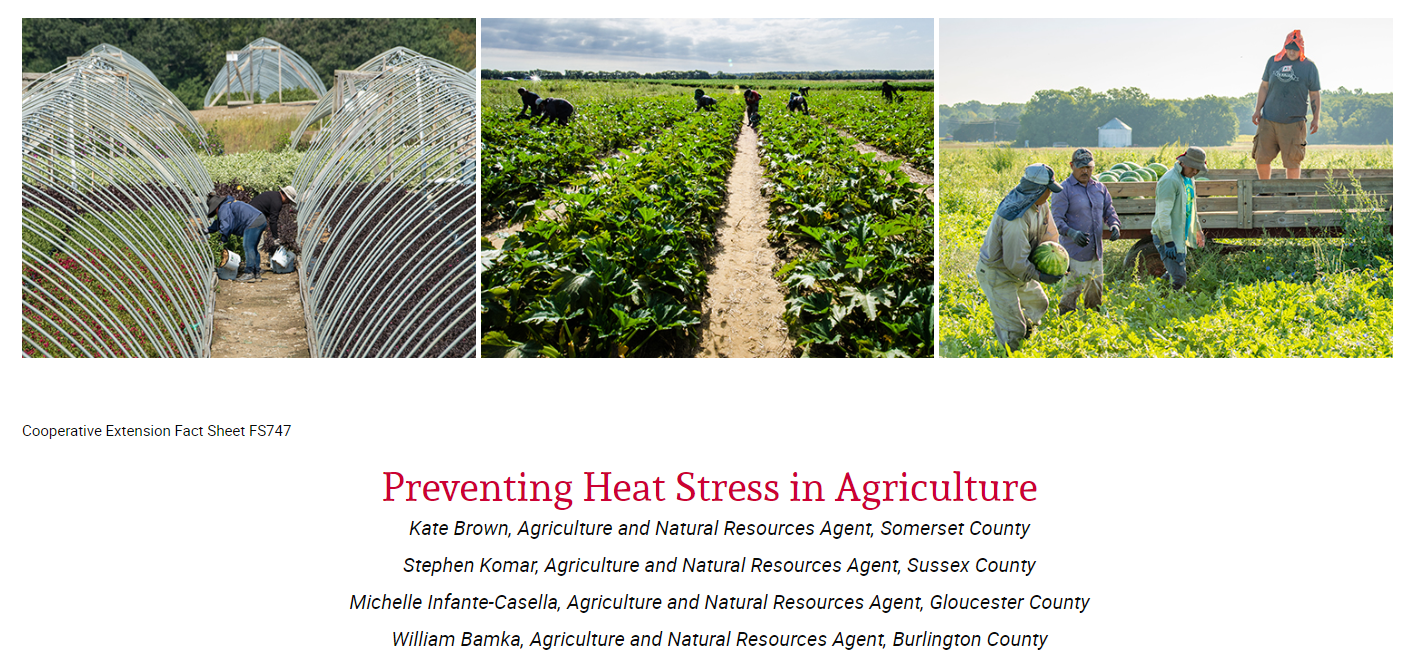
The Rutgers NJAES factsheet on “Preventing Heat Stress in Agriculture” has been updated and is now available at https://njaes.rutgers.edu/FS747/. The factsheet provides basic knowledge about heat stress, first-aid treatment, and preventative measures that are important to both agricultural employers and workers. As the temperatures warm up, it’s time to get prepared for working in the heat!

Screenshot of the heading of a factsheet titled Preventing Heat Stress in Agriculture