Archives for May 2020

COVID-19 Guidance For Farmworkers & Employers

An Important Message from Secretary Fisher (May 6, 2020)

“As mentioned during the Governor’s press conference this afternoon by Health Commissioner Judith Persichilli, a group led by the Department of Health, working in coordination with the Departments of Agriculture and Labor, is finalizing a Guidance Document, “COVID-19 Guidance for Migrant and Seasonal Farmworkers, Their Employers and Housing Providers.” As stated by the Health Commissioner today, this document is expected to be rolled out at the end of this week, with further communication about it coming next week.”

Details will be shared as soon as this guidance document is available.
Frost Protection in Orchards – What Should You Monitor?

By Hemant Gohil and Megan Muehlbauer

The weather forecast for the next few days indicate subfreezing temperature in several parts of New Jersey. In fruit crops, such events during the flower bud development, can cause crop loss which could vary from minor loss of quality and quantity to a total crop loss. Recently, frost events seem to be occurring more frequently. These events have been driven by warmer spring temperatures pushing bud growth earlier, making blossoms more vulnerable to frost damage.

What to monitor before active frost protection?

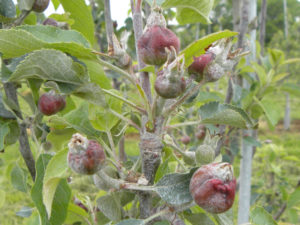
Frost damage occurs when plant tissues are exposed to subfreezing temperatures (Figure 1). However, it is the co-occurrence of other factors that determines the extent of the damage. All these factors should be monitored, and will assist in determining which frost protection method to employ and its duration.

Frost damage in apple

Figure 1. Frost damage in apple following the freeze event in 2010 in Pennsylvania (Photo by R. Crassweller).

Bud Stage: Regular monitoring of the bud development stage beginning at bud swell will help in determining the actual threat of frost damage. Critical temperatures have been researched and calculated for each bud development stage. For example, in an apple orchard, at 24°F, one can expect up to 90% crop loss at ‘first pink’ stage, but only marginal to zero percent loss at green tip stage at the same temperature. An example of the critical temperature for some of the most common pome and stone fruit crops In New Jersey is available at https://www.canr.msu.edu/news/critical_spring_temperatures_for_tree_fruit_bud_stages  Note that the critical temperature for damage at a particular bud stage may vary by 4 or 5⁰F depending on temperatures during the previous few days before the cold event.

Type of frost event: There are two types of frost:  Advective and Radiative frost.  Advective frost occurs when a large mass of cold dry air moves in from another region and replaces warmer air such as during a polar vortex. The rapid movement of air aids this, and there is generally an absence of an inversion layer, creating the potential for a prolonged event. Frost protection will generally be not effective during an advective frost.  Conversely, radiative or radiational frost occurs when there is a rapid loss of heat from the ground, usually with a cloudless open sky, dry air, little wind and the likely formation of an inversion layer. This frost is relatively manageable with frost protection methods.

Inversion Layer: A strong inversion layer can be a source of warmer air, and could have a substantial difference in temperature than that closer to the ground.  For this reason, inversions need to be closely monitored.

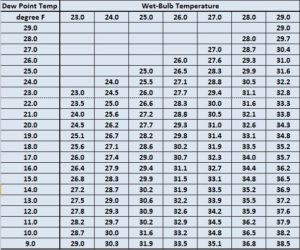
Table of wet bulb temp

Table 1. An example of determining wet bulb temp using ambient temp and dew point. Courtesy, Don Smith, Penn State University

Air Temperature: Frost can occur when the ambient temperature dips below freezing (32°F). The hourly rate of falling temperatures and the lowest forecasted temperature should also be monitored. However, temperature experienced by trees will not necessarily be the same as the reported ambient temperature.  To measure the temperature of the flower buds, farmers must take into account the cooling effect of evaporation of the moisture on the trees which is referred to as the wet-bulb temperature. Generally, the wet bulb temperature will be a few degrees lower than the dry bulb temperature except at the 100% RH. Table 1 provides an example of determining wet bulb temperature using the ambient temperature and the dew point. Hand-held and digital psychrometers can be used in the field to determine the wet bulb temperature.

Recently, Knox et al. (2017) at the University of Georgia showed that wet bulb temperature can be simply derived by ‘subtracting one third the difference between ambient temperature and dew point, from the ambient temperature.’ Modern frost alarms measure wet bulb temperature, which can directly transmit real time data to the user’s mobile phone or computer.

Dew point: Dew point is commonly reported as the atmospheric temperature below which water droplets begin to condense, forming dew. At low temperatures, the moisture in the air transitions from a gas to a liquid, as air temperature reaches the dew point. A higher dew point is associated with relatively slow drops in temperature, and vice versa. A lower dew point also generally means surface moisture will evaporate quicker.

Cloud coverage:  Clear skies normally result in lower low temperatures than when there is cloud cover trapping radiant energy from the ground.

Wind Speed: Wind will determine the rate of loss of thermal energy. Almost all Frost Protection methods will have reduced efficiency at wind speeds above 10 mph, and are therefore not recommended when winds are above 10 mph.

Effective Frost Protection requires weather stations and sensors for each of the fields you are seeking to monitor and protect.  Data from a nearby weather stations may not always be reliable.  On-farm weather stations are the most accurate source of weather data, and should be linked with a frost alarm.

Literature Cited:

Knox JA, Nevius DS, and Knox PN. 2017. Two Simple and Accurate Approximations for Wet-bulb Temperature in Moist Conditions with Forecasting Applications. Bulletin of American Meteorological Society. Sept Issue: 1897-1906. https://journals.ametsoc.org/doi/pdf/10.1175/BAMS-D-16-0246.1

Take home message: 

  • Monitor both your temperature and relative humidity to determine the wet bulb temperature. Remember nighttime temperatures often dip BELOW predicted temperatures, do not GAMBLE.
  • Determine what bud stage your tree fruit are at.
  • If you suspect you are at risk of a nighttime frost event, monitor the weather report for the likelihood of an inversion layer.
  • hink you have a potential for a frost event in your orchard, utilize appropriate frost protection measures.

IPM Update 5/06/20

Sweet Corn

IPM Program personnel are currently finishing deployment of the black light trap network in New Jersey.  At present, we are approximately 70% operational and have begun to monitor traps.  With below normal temperatures, no corn earworm (CEW) or  European corn borer (ECB) moths have been captured.  As numbers increase, look for population maps of ECB, CEW, brown marmorated stink bug (BMSB) and CEW catches from pheromone traps in this weekly publication.  The resulting full-state maps will include interpretive information.

[Read more…]

Printable Signage to Inform Customers of COVID-19 Policies

Communicating your policies to customers is critical during this season, especially about your COVID-19 policies.  Printable signs have been developed for use on New Jersey farms.  Click on the images below for a direct link to the letter-size paper printable of each sign. Visit the Rutgers On-Farm Food Safety COVID-19 website for more resources.

Cloth face coverings and gloves must be made available to employees by the business.  Employees must wear a cloth face covering and gloves but may supply their own if they prefer.  Customers must wear a cloth face covering while on the property of essential retail businesses.  If a customer cannot or is not willing to wear a face-covering you must consider alternative methods of selling your food to them.  An order can be taken over the phone, or in a parking lot.  Options include phone ahead orders or parking lot orders where staff select the items for the customer.

Face coverings required to shop inside


Essential retail businesses must maintain social distancing in retail areas, and whenever possible in other areas.

Maintain social distancing


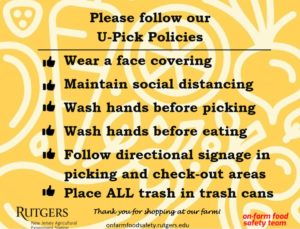
Pick your own operations to need to enforce face-covering use and social distancing in both indoor and outdoor areas of the farm.  Executive Order 122 requires the wearing of face coverings by staff and customers at essential retail businesses.  Prominent signage with your farm policies will help convey the message and ample posting on your social media sites.  You can create your own or use the one below.

Please follow our U-Pick Policy

Manage your transplant watering schedule

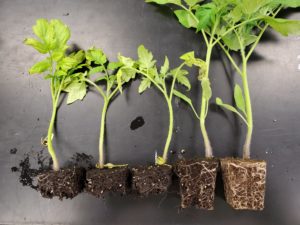
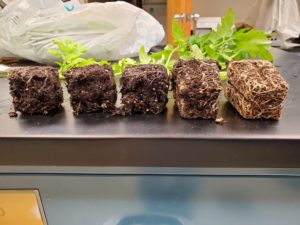
The weather this spring has been anything but normal with the up and downs in the temperature as well as the on and off again sunny days followed by many days of cloudy weather. These types of weather patterns can cause problems in transplant production in the greenhouse, especially when it comes time for watering. Hot days may require more than one watering, and cloudy days may require no water. In either case, growers need to anticipate their transplant water needs without over or under estimating watering. Of course, other factors include the growing media and the plant itself. Lets focus on media, for example, growers using a lighter soilless media, these will dry out much quicker than a heavier media and will require more daily watering (e.g., once in AM, afternoon, and evening). Growers using a heavier media may only have to water once a day, or early in the AM and maybe once more in the PM. Either type of media works fine as long as the weather doesn’t change and it fits the growers needs. Proper transplant watering is all about adjustment. If you have stuck to the same daily watering schedule this spring its very likely you have grossly over or under watered your transplants at some point. And, in all likelihood, grossly over or under watered trying to correct the situation. Uniformity is also key when it comes to proper transplant watering. If you find yourself spot watering out of schedule because some flats dry out quicker than others then most likely your uniformity is off. This is easily done when watering is done by hand with a wand. Poor uniformity can also be the result of transplant flats being set on uneven benches or uneven floors. Much like a field, low spots tend to collect the most water. All of this can lead to uneven transplant growth as well as disease and pest pressure, such as fungus gnat problems. If you are experiencing uneven transplant growth, then most likely your watering is uneven. For transplant growth to remain even, flats need to be watered each time to maximum water holding capacity, where each cell in the flat holds the maximum amount of water. An easy way to see this is to watch for water dripping out the bottom of the flat. As important, flats should also uniformly dry out. Below is an example of tomato transplants that have been pulled from the same flat. You can see the differences in plant height as well as root system formation as a result of uneven watering in a “heavy” soilless media. Cells that have remained on the wet side show poor growth and poor root system development because of a waterlogged cell; whereas cells that have been receiving the appropriate amount of water have much better growth and a nice root ball. The weight test. When was the last time you picked up a transplant tray? Picking up a transplant flat every once in a while will give you an idea of how well your watering schedule and uniformity is! Everyone has picked up a tray that has felt like it has the weight of a rock or the tray breaks apart because of the weight, or when you pick it up and it feels as light as a feather. Doing this is a good way to determine if your soilless media is “heavy” – holds more water than you think or if you have been overwatering on days you shouldn’t be or if you have not watered enough. Consistency is key when watering. Going from an extremely wet to an extremely dry transplant tray is not what you want for the transplant production season. You want consistent soil moisture as much as possible, thus proper transplant watering is all about the proper adjustments and knowing your media.

Difference in soil temperature

Differences in soil moisture across a single flat of tomato transplants.

Difference in soil temperature in plant roots

Roots of tomato transplants in a flat that has irregular soil moisture.

Tree Fruit IPM Report for May 5, 2020


Tree Fruit Phenology: Tree Fruit Phenology remains advanced, but development is slowing. In southern counties peach orchards are at Shuck Split to Shuck Off. Pears are past Petal Fall. Red Delicious was about Full Bloom on 4/25 and is late bloom/Petal Fall on May 4. Other varieties still have considerable bloom. Cherries are just past full Bloom. [Read more…]