Apple Scab Update

Apple Scab Update  

Apple scab models are currently forecasting potential infection periods from March 31st-April 2nd. This is based on a green tip date of March 22nd which was observed across the state aside from the most northern counties. Conditions may be optimal for further scab infection events on April 5th-6th. Model outputs are most accurate within 48-72 hours of the date in question,which should be kept in mind when making management decisions. It will be critical for growers to keep an eye on the models to make timely management decisions for optimal disease control. If you have recently applied copper, you will be covered for this infection period. Other effective options include Manzate at 3 lb/A + Syllit at 1.5 pt/A or Manzate at 3 lb/A + Vangardat 3-5 oz/A.  

NEWA   

The Network for Environment and Weather Applications (NEWA) offers forecasting models for numerous disease and insect pests on a variety of crops including apple scab. This model allows you to select your own weather station or one closest to your farm to get real time information on when apple scab infections may occur. This allows you to make informed management decisions and apply effective fungicides prior to an infection event, which is the ideal timing for optimal disease control. Once you have selected your weather station, you can enter the date you noted green tip on your earliest variety (this will be 3/22 for the majority of NJ this year).  

First, you will see the ‘Ascospore Maturity Summary’ chart. This will give you information on ascospore maturity, daily ascospore discharge, and cumulative ascospore discharge. Right now, the most important number to pay attention to is the daily ascospore discharge. The higher the daily ascospore discharge, the more severe the infection event will be. If the daily ascospore discharge is greater than 10%, there will be a significant scab infection event and fungicides should be applied prior to this event for management. If the daily discharge is above 20%, there will be an extreme infection event, and the most efficacious fungicides (DMI + Manzate) should be applied before the infection for control.   

The next chart will be the ‘Infection Events Summary’. This will tell you if the weather conditions are optimal for apple scab infection. It includes weather data and tells you if there will be an infection event with the readouts ‘Yes’, ‘Combined’, or ‘No’. This information should be compared with the daily ascospore discharge to determine what efficacy of fungicide should be used for a given infection period.  


Apple Scab Management Considerations 

  • If you have not applied copper yet, it should be applied before this upcoming potential infection period March 31st-April 2nd  
  • Copper applied after ½” green can cause phytotoxicity and fruit finish concerns  
  • If you have already applied copper, since this is a low-risk infection period, Manzate at 3 lb/A + Syllit at 1.5 pt/A or Manzate at 3 lb/A plus Vangard at 3-5 oz/A would be sufficient management options  
  • Keep in mind, powdery mildew control begins at tight cluster and cedar apple rust control begins at pink 
  • The DMI fungicides should be saved for tight cluster and later timings since they are some of the best options for powdery mildew and cedar apple rust 

Fruit IPM Updates Week of 3/23/26

Tree Fruit Phenology Update

Tree fruit phenology is progressing across New Jersey, with development in southern counties remaining slightly advanced and northern regions beginning to catch up. Overall, the 2026 season is showing a more compressed phenology window than typical. Cooler weather this weekend should help slow development.

In apples, green tip for Pink Lady was observed around March 22 across both southern and some northern regions, with Honeycrisp following around March 26. In pears, swollen buds were observed around March 11, with green clusters reaching by March 26 in southern New Jersey. Peach varieties in southern New Jersey were observed at the swollen bud stage this week.

Apples
Green Tip Dates by County
County Green Tip Date (earliest varieties) 
Cumberland 3/22
Gloucester 3/22
Burlington 3/22
Mercer 3/22
Middlesex 3/22
Monmouth 3/22
Hunterdon 3/22
Morris TBD
Warren TBD
Sussex TBD
Bergen TBD
Apple Scab
Models

Apple scab models are available through NEWA and RIMpro. Apply fungicides before infection events when discharge exceeds thresholds (10–20%).

Current Update
  • ~2% ascospore maturity (March 25)
  • ~7% by March 31
  • ~10% by April 1
  • Low cumulative discharge (~1–4%)
Management Considerations

Copper can be applied now but avoid after ½” green.

  • Manzate + single-site fungicide
  • DMI (FRAC 3) for high pressure
  • Vangard (FRAC 9)
  • FRAC 7 (save Aprovia)
  • Axios (save for later)
  • Syllit (avoid if resistance)
  • FRAC 11 (save for summer)
  • Topsin (limited uses)

As we move toward tight cluster:

  • Rapid ascospore increase
  • Higher infection risk with rain

Monitor:

  • NEWA models
  • Weather/wetting events
  • Phenology

Early control is critical to avoid season-long pressure.

Scouting Calendar

Use as a scouting guide only (not for spray timing).

  • Green tip: March 22–26
  • Ascospore maturity: 2–7% increasing
Key Points
  • Minimal difference between North and South Jersey
  • Green tip ~March 22
  • Prepare for scab infection events
  • Build fungicide rotation now

Pears
Pear Phenology Update

Pear phenology is progressing, with swollen buds observed around March 11 and green clusters observed on March 26 in southern New Jersey.

Pear Psylla

Pear psylla activity has begun in southern New Jersey, with variability across counties:

  • Salem County: adults and eggs observed
  • Gloucester County: eggs observed
  • Burlington County: no activity observed to date

These observations indicate that egg laying is underway in the southernmost regions and will likely progress north with warming temperatures. Reports from surrounding regions also suggest psylla activity is increasing.

At this stage:

  • Continue monitoring for eggs and early nymphs
  • Use beating trays to assess adult activity
  • Examine buds and developing shoots for egg presence

Dormant oil applications should be applied where possible to deter psylla egg laying and suppress early populations. Timely applications are especially important in areas where activity has already been observed.

At green cluster:

  • Oil is often combined with an insecticide to target migrating adults
  • In lieu of oil, particle films such as Surround may be used starting at swollen bud and continuing through bloom

Materials such as Esteem, Centaur, and Sivanto Prime may also be incorporated, depending on timing and pressure.

Adult pear psylla laying eggs.

Figure 1. Adult pear psylla laying eggs at swollen bud. Photo by Janine Spies.

Pear Diseases
Fire Blight and Early Season Management

Dormant copper applications should be applied for fire blight and pear scab suppression, but no later than green tip if fruit russet is a concern. Where copper has already been applied, early-season risk is likely reduced.

As bloom approaches:

  • Begin planning for antibiotic applications
  • Kasumin may be used at bloom and petal fall
  • Other options include streptomycin and oxytetracycline for post-bloom use

Rotating chemistries is important for resistance management.

Pear Scab

RIMpro modeling for pear scab in Upper Deerfield indicates low infection risk at this time, with infection values remaining below threshold levels. Despite recent wetting events, limited ascospore maturity is restricting infection potential.

Growers who have applied dormant copper are likely adequately protected under current conditions. Protective fungicide programs should begin at the cluster bud stage, particularly as we approach tighter cluster and bloom, when risk will increase.

Materials such as Ziram or EBDC formulations provide effective protection. At white bud, include materials effective against pear scab, rust diseases, and Fabraea leaf spot. Particular attention should be paid to rust on Asian pear varieties.

Dormant urea applications may also be used, where appropriate, to help reduce overwintering inoculum.

Summary
  • Pear psylla activity has begun in southern New Jersey, with adults and eggs observed in Salem County and eggs in Gloucester County
  • Dormant oil applications should be applied to suppress egg laying and early populations
  • Copper applications should be completed by green tip where russet is a concern
  • Pear scab risk is currently low based on RIMpro modeling
  • Fungicide programs for pear scab should begin at cluster bud as risk increases
  • Dormant urea may be used to reduce overwintering inoculum

Continued scouting will be important over the next 1–2 weeks as both insect and disease pressure increase with advancing phenology.

Peaches

Peach Phenology

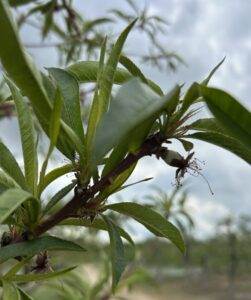
Peach varieties in southern New Jersey were observed at the swollen bud stage this week. Development is progressing steadily and will advance with warming temperatures.

Peach Swollen Bud

Figure 2. Peach Swollen Bud. Photo by Janine Spies.

Brown Rot

Blossom infections from the brown rot fungus can occur whenever pistils are exposed and favorable environmental conditions are present.

Infections can occur during any wetting period when temperatures are between 41 and 86°F. Optimum conditions occur with wetting and temperatures in the mid-70s. During extended wetting periods (several days or more), blossoms can be infected regardless of temperature. Infections under suboptimal conditions are generally less severe.

Blossoms and fruitlets remain susceptible until the pistil desiccates, which occurs sometime between petal fall and shuck split.

Initiate coverage for blossom blight starting at pink for short-petaled varieties and at 5–10% bloom for showy flowers. Refer to the NJ Commercial Tree Fruit Production Guide for recommended materials and rates.

Scale Insects

Oil applications may be safely applied up to pink on peach.

Oil can be applied alone or in combination with insecticides including Centaur, Sivanto Prime, and Esteem.

Early Season Tree Fruit Pest Control in 2026

Dormant Oil Sprays: In recent growing seasons, San Jose scale and white peach scale populations have been causing increasing amounts of damage. These pests create a superficial spotted injury caused by crawler stage feeding on the skin of apples and peaches, making the fruit unmarketable. In severe infestations, heavy crawler populations feeding on the sap of tree limbs can cause severe dieback. Scale overwinter on the limbs of trees asimmature crawlers under their protective waxy covering. In the spring when temperatures begin to rise, they respire through this covering. Dormant oil sprays are your first line of defense as they work to coat the protective covering of the scale and prevent respiration. Dr. Anne Nielsen’s lab found that another effective option at the delayed dormant timing is Centaur at 34.5 oz/A.

European red mite is another pest of concern that can be targeted at this stage. These mites feed on the foliage of tree fruit causing a bronzing symptom. Feeding from this pest can reduce fruit quality and tree vigor. European red mites overwinter in orchards as eggs. These eggs begin to hatch just prior to pink through bloom in apples. Dormant oil efficacy improves the closer you are to egg hatch for this pest so an application should be timed for green tip-half inch green in apple.  

Pear psylla typically become active and begin laying eggs in NJ in mid-late March. Nymph stage pear psylla feed on the sap of pear trees and excrete honeydew which causes black sooty mold on fruit making it unmarketable. This pest also injects a toxin into the leaves as it feeds causing the leaves to blacken and eventually leads to defoliation. Dormant oil works to deter pear psylla from laying eggs and acts as a first line of defense against this pest.  

Proper coverage with dormant oil is essential for it to work properly. Due to this, dormant oil should be applied as a full block spray instead of alternate row middle. It is important to ensure your sprayer is properly calibrated and that you are using a sufficient spray volume. Dr. Brett Blaauw from the University of Georgia found that 100 gal/A is a sufficient volume for coverage IF the trees are properly pruned prior to the dormant oil application (see University of Georgia factsheet). It is possible to achieve almost 100% coverage by making multiple dormant oil applications. This strategy is optimal because it also allows you to target both scale and mites at their optimal timings. One application can be made early on when temperatures first begin to rise above 51°F to target scale and a second application can be made between green tip and ½” green to target mites and continue controlling scale. An oil application at ½” green combined with Esteem at 4-5 oz/A will also provide control of aphids including wooly apple aphid. Wooly apple aphid populations have been becoming more prevalent in NJ apple orchards in recent years, likely due to dry end of summer conditions and pyrethroid use flaring populations. The first place this pest will begin to pop up will be pruning cuts so be sure to keep an eye out as the season progresses since early action is critical for effective control.  

Dormant oil application rates depend on the phenological stage and the crop you are spraying. Typically, oil is recommended at a 2% rate or 2 gallons of dormant oil per 100 gallons of spray mix. You can perform concentrated sprays of 6 gallons of dormant oil per 100 gallons of spray mix in pome fruit based on the dilute volume of 300 gallons per acre (amount generally considered to cover a mature semi dwarf apple to the point of drip). In stone fruit, a concentrated spray would include 4 gallons of dormant oil per 100 gallons of spray mix based on the dilute volume of 200 gallons per acre (amount generally considered to cover a mature peach tree to the point of drip). Oil can safely be applied up to the pink stage of tree fruit, but the rate should be dropped the closer you get to this stage. For example, in pome fruit a full rate can be applied up to ½” green, this rate should be halved up to tight cluster and then halved again up to pink.   

When applying dormant oil, it is important that you do not make an application within 2 days of the temperature dropping below 32°F. Another important consideration is that oil should not be applied within 2 weeks of Captan due to phytotoxicity concerns. There are other insecticides that can be mixed with dormant oils to target these pests; however, results are variable on whether the addition of these insecticides improves efficacy over oil alone. 

Dormant Season Copper Sprays: Fire blight can be targeted at the dormant stage using copper as your first line of defense. The copper targets cankers caused by fire blight and reduces the amount of bacterial inoculum present in the field. Early season copper sprays can also be effective against apple scab if some green tissue is present in the bud. Copper should not be applied after ½” green due to concerns with phytotoxicity and fruit russeting. If tank mixing copper with dormant oil, extra precaution should be taken to ensure there is no risk of freezing temperatures since this can exacerbate issues with phytotoxicity and injure the tree.  

The bacteria causing fire blight can only survive inside of living tree tissue. The winter is an optimal time to remove infected branches since the sap is not flowing, this reduces the risk of spreading the inoculum to your next cut. Removing the cankers caused by this disease where most of the bacteria are surviving will reduce your inoculum levels and make this disease easier to manage during the spring. It is a good practice to flag limbs that were infected with fire blight in the previous season to make the cankers easier to find when it comes time to prune. Pruning crews should be trained to look for sunken, dark, cracked areas on the tree bark that may be cankers. A knife can be used to peel away the tree bark to confirm the presence of the canker. If it is in fact a canker, the sapwood will be brown. You can continue peeling the bark away until you find the margin of the canker where the sapwood is still healthy and green. The pruning cut should be made at least 8 inches below the canker to ensure no inoculum is left behind in the tree. All canker prunings should be removed from the orchard since they can still act as a source of inoculum if left behind on the orchard floor.  

If peach leaf curl was not targeted in the late fall at leaf drop, a fungicide application is also effective in the late winter prior to bud swell. Copper, Ziram, and Bravo (Chlorothalonil) are the most effective options at this timing.  

Dormant Season Urea Sprays: Dormant season urea sprays are an extremely effective tool to reduce inoculum in orchards with high apple scab pressure. These sprays help to break down the leaf litter more quickly, which isessential for orchard sanitation and reduction of foliar disease inoculum. Urea applications are most effective if applied after leaf drop in the fall, but if you didn’t have a chance to make the application, it is not too late! Urea can be applied to leaf litter in the late winter or early spring using an airblast sprayer with nozzles pointed towards the ground or a boom sprayer at a rate of 40 lb/A in 100 gallons of water. A flail mower can also be used to chop leaf litter,which allows it to decompose more quickly. By using these methods, you can reduce your apple scab inoculum by 80% or more, which will make management easier and more effective during primary scab infection. 

South Jersey Commercial Fruit Growers Meeting

Pesticide Credits Approved – #CORE(1); #10(6); #PP2(7); #1A(7)

Date:                    March 4, 2025 (Tuesday)
Location:            Gloucester County Govt. Services Building #A, 1200 N. Delsea Dr., Clayton, NJ 08312
Registration:      $20.00 (Checks only, made out to Rutgers University, can be paid at the door but pre-registration required).  Lunch, Coffee, and Pastries Included. Required by March 3.  Contact: (856) 224 – 8030 or Email: jmedany@co.gloucester.nj.us

PROGRAM

8:30 am           Registration, Coffee and pastries
8:50 am           Welcome and Opening Remarks
Hemant Gohil, County Agent II, RCE of Gloucester County, Rutgers NJAES

9:00 am           Multi Pest Management in the Orchard
Anne Nielsen, Extension Specialist, Fruit Entomology, Rutgers NJAES

9:30 am           Bacterial Spot Management in the Peach Orchard.
Kari Peter, Extension Specialist, Tree Fruit Pathology, Penn State University.

10:00 am         Understanding how irrigation water can be a source for soilborne diseases in the orchard
Kari Peter, Extension Specialist in Tree Fruit Pathology, Penn State University.

10:30 am         Coffee Break
10:45 am         Industry and USDA Updates

11:00 am         An update on the Fruit IPM Program and summary of the 2024 season.
Janine Spies, Statewide Program Leader in Fruit IPM, Rutgers NJAES

11:30 am         What can the Rutgers Plant Diagnostic Lab do for you?
Sabrina Tirpak, Laboratory Researcher, Plant Diagnostic Lab, Rutgers NJAES

Noon             Lunch

1:00 pm           Pesticide Handling and 2025 updates
George Hamilton, Extension Specialist in Pest Management, Rutgers NJAES

1:30 pm           Peach Flower Thinning using ACC (Accede)
Shantanu Krishna Kumar, Assistant Professor of Tree Fruit, Penn State University.

2:00 pm           Plant Nutrition and Causes of Bitter Pit Disease in Apple
Joseph Heckman, Extension Specialist in Soil Fertility, Rutgers NJAES.

2:30 pm           2024 Field Observations – peach varieties, overhead irrigation frost protection, hydro-cooling, post-harvest inking.
Hemant Gohil, County Agent II, RCE of Gloucester County, Rutgers NJAES.
Daniel Ward, Extension Specialist, Pomology, Rutgers NJAES.

3:00 pm           Pesticide recertification credits and Adjourn

For questions, please get in touch with Hemant Gohil at 856-418-6538 or email at gohil@njaes.rutgers.edu
Send Check to Hemant Gohil, Rutgers Coop Extension, 254 County House Rd., Clarksboro, NJ 08020

2024 Tree Fruit IPM Post Season Summary

Observation Overview: The IPM observations for 2024 come from the North and South Jersey Tree Fruit IPM Programs. There are 29 farms that participate in the North Jersey program and 13 farms in the South Jersey Program. The program includes approximately 600 acres of apples and 1,650 acres of peaches. Each farm has traps for the pests included in the trap data and are scouted once a week. The data for the charts below comes from the NEWA model, using Snyder Farm in Pittstown as the weather station. The trap data comes from each of the farms in the program and excludes farms using mating disruption. This is because the mating disruption proved to be very effective this year and I had no or very low trap catches in orchards utilizing this method of control. 

2024 Weather: Using the weather data from our Snyder research farm in Pittstown, New Jersey (Hunterdon County), the weather (highs, lows and precipitation), was average for the 2024 growing season. There were no notable statewide frost events in the spring however, in our most northern counties we experienced temperatures of 27°F on 4/8/2024 (during tight cluster) and again on 4/22/2024 (during bloom) which affected some of the blossoms but overall, did not affect crop load. However, the high temperatures were sustained above 80 °F for much of June through August. Precipitation was above the 20-year normal until May and then dropped to about half of normal from June-July, then seemingly increased in August but that was largely due to a very large squall that occurred at the Pittstown research station at the beginning of August. There was a hailstorm that occurred in Sussex and Warren counties on 7/16 which resulted in significant crop loss for some growers.  

  March  April  May  June  July   August  September  October 
Hunterdon, NJ: 30 year normal precipitation  4.05  3.92  4.18  4.55  5.04  4.61  4.53  4.36 
Hunterdon NJ: 2024 precipitation  6.89  4.97  4.16  2.21  3.28  6.83  .99  .02 

Datasources: 

https://climate.rutgers.edu/stateclim_v1/nclimdiv/# 
https://www.njweather.org/data/daily 


Fireblight: Fireblight presented an issue during the blossom blight phase for growers in both North and South Jersey. As you can see from the chart below, which pulls data from the NEWA fireblight model using the weather station in Pittstown, New Jersey, there were at least two infection periods during bloom where the EIP value was over 100. One of these periods persisted over the course of 5 days which required two applications of an antibiotic, 3 days apart from each other for optimal control. 


Apple Scab: Compared to last year, we experienced more scab infection periods during the primary scab phase. Most of these infection periods spanned over a couple days with the longest period lasting 5 days. Most growers were able to avoid primary scab by applying effective fungicides prior to NEWA predicted infection periods. There were a few orchards with heavy scab pressure that experienced major scab outbreaks with over 20% infected fruit found in post-harvest assessments. If growers experienced heavy scab pressure this year, it is recommended to apply urea and mow the leaves once they have fallen from trees to reduce the inoculum moving into the next season.  


Rots: Bitter Rot remains the most challenging to control throughout all New Jersey orchards. Incidence of this disease occurred in almost all farms in our Tree Fruit IPM Program and appeared most devastating in the Honeycrisp, Empire, Ambrosia and Evercrisp varieties. It may be beneficial to remove infected apples from the trees at the end of this season to reduce inoculum moving into the next season. Some of the most effective fungicides to include in cover sprays are Captan, Aprovia, Omega, Merivon, Luna Sensation and Topsin. These all work best when applied before a wetting event. In South Jersey, White Rot was also prevalent this season, we did not experience this in our North Jersey counties.   

Cedar Apple Rust and Quince Rust: In Southern New Jersey these diseases, particularly Quince Rust, are becoming more prevalent, especially in Asian Pear. In North Jersey, we also saw a higher incidence of these diseases compared to last season. It is important to begin applying effective materials from pink through first cover.  

Nectria Canker: This disease has not presented a major issue in New Jersey in previous years and when it has shown up, it has typically been on varieties that are known to be susceptible. This year one grower experienced this disease on the MAIA variety, Ludacrisp. Almost every tree in the row was infected with multiple cankers per tree.  

Bacterial Spot: In South Jersey control of this disease was very good. In North Jersey there was more incidence of this disease than last year with 4 farms having minor outbreaks. Growers should begin including effective materials for this disease as soon as green leaf tissue is present. For resistance management growers should rotate between copper and oxytetracycline (Fireline or Mycoshield). It is important to remember that combining copper and captan will can cause phytotoxicity to the leaves which may be exacerbated in slow drying conditions.  

Peach Scab: Control of this disease remains very good in commercial orchards across both North and South Jersey.  

Brown Rot: This disease did not present a major issue in North or South Jersey this season. In North Jersey, most growers had less than 2% crop loss caused by brown rot.  

Codling Moth: In South Jersey, a biofix was set for this pest on 4/22 which is 3 days later than last year. A biofix was set for this pest on 5/1 for five North Jersey counties (Middlesex, Mercer, Hunterdon, Warren, and Sussex counties) and on 5/6 for one North Jersey county (Morris County) which is 3-4 days earlier than last year. Across the state, trap captures were lower than average, but this pest was more damaging than last year. This season, all 3 generations of this pest caused damage in orchards which are known to have high pest pressure. Mating disruption remained effective in most blocks, but small amounts of damage were found at one farm which had irregularly shaped blocks. In Southern New Jersey, over the last 3 seasons there has been incidence of another internal feeder which is believed to be lesser apple worm. In North Jersey damage of this pest was noted in one orchard on 10/15. 

Brown Marmorated Stinkbug: In both North and South Jersey, trap counts for this pest were higher than the past few seasons. There was also a higher incidence of damage found in post-harvest assessments of Pome fruit. In North Jersey, there was also a higher incidence of damage to Stone fruit compared to last season. 

Ambrosia Beetle: In North Jersey, we began a monitoring program for this pest this year utilizing clear sticky traps baited with Trece’s ethanol lures and wood dowel traps. We had significant trap captures, and this pest attacked the wood dowel traps at all 29 farms in our program. This pest only attacked apples at 4 of the 29 farms, 3 of which were previously known infestation sites. The one farm which had not previously experienced crop loss to this pest experienced 43.3% loss of the trees they had topworked at the beginning of the season. In South Jersey, tree loss continued at normal levels in known infestation sites. The best management practice for control of this pest is reducing tree stress through cultural techniques.  

Scale: In South Jersey, incidence of San Jose Scale infestation increased over the last season. Early season controls suppressed crawler populations, however, damage in August was notable in many orchards. In North Jersey, this pest did not cause notable damage except in known problem areas. White Peach Scale was observed at slightly increased levels in orchards across the state. The late generation of this pest continues to cause damage to later ripening peach varieties in North Jersey. Dormant oil sprays at the beginning of next season will help manage this pest. Ensuring proper coverage of these sprays is essential for control.  

Oriental Fruit Moth: A biofix for this pest was set on 4/10 in South Jersey and 4/12 in North Jersey. This pest did not present a major issue to growers across the state this season. Only a few growers had a small incidence of damage to their peaches found in post-harvest assessments.  

Plum Curculio: Plum curculio damage was above average in stone fruit. This pest also caused significant damage to pome fruit due to the long bloom period which made control difficult.  


Early Season Tree Fruit Pest Control for 2024

  • Dormant season oil sprays
  • Dormant season copper sprays
  • Dormant season urea sprays

[Read more…]