Pepper Anthracnose
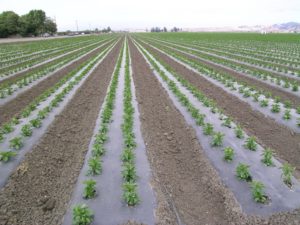
In recent years, pepper anthracnose caused by Colletotrichum spp. has become a significant problem on some farms in southern New Jersey.
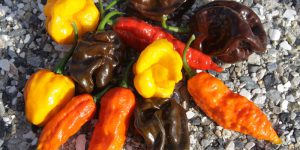
Unlike in tomato, where symptoms are only present in mature (red) fruit, pepper anthracnose can infect pepper fruit at any growth stage. Currently, there are no commercially-available bell or non-bell peppers with known resistance to anthracnose. [Read more…]
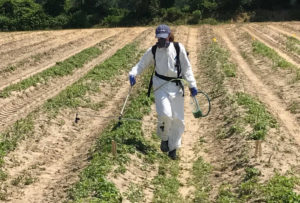 Paraquat is an herbicide labeled on various crops species for row middles applications. However, with new paraquat use restrictions in place, vegetable growers may be interested by other herbicide options available for controlling emerged weed seedlings. Paraquat controls numerous annual grasses and broadleaf weeds seedlings by inhibiting plant photosynthesis. Its acts quickly by contact when absorbed by plant foliage and has no soil activity due to complete soil adsorption. Because of poor translocation, it is essential to have complete foliar coverage to achieve good weed control. Hence, the need for a non-ionic surfactant and the importance of making sure that weeds are not taller than 6” when direct-spraying paraquat in row middles. Paraquat offers relatively good crop safety because it does not translocate and will control a wide range of annual weeds at the seedling stage, which makes it the herbicide of choice for postemergence row middles weed control in labeled crops.