Immediate potential for boxwood blight in many parts of NJ over the next 4 days

Breaking- Due to the potential for rainfall and high humidity levels, there is an immediate risk of boxwood blight infections in many parts of New Jersey. Be mindful that even though we have had very little precipitation in the state as of late, we are well within the boxwood blight growth range and prior cover-sprays may have been washed off by irrigation or the interval to reapply has come due.

Preventative spray programs should continue or be initiated for high value crops or installations.  

Boxwood Blight Risk Assessment as of 5/26/2021
Region Location CODE 26-May 27-May 28-May 29-May 30-May 31-May
Southern Upper Deerfield NJ50 Infection Risk Infection Risk Very Low  Low  Very Low  Very Low 
Central Howell / Freehold NJ10 Low Infection Risk Very Low  Low  Very Low  Very Low 
Northern High Point NJ59 Very Low  Very Low  Very Low  Very Low  Very Low  Very Low 
Please check your local boxwood blight risk here (click here and type in your area code – select closest station)


These advisories are general in nature and change rapidly so someone from your business should be using this risk model (CLICK HERE) daily if boxwood is important to your financial stability – In 30 seconds you can have a better idea of boxwood blight (and other pathogen) activity in your immediate area!

  • (click on the link – input area code – select closest weather station – check 7-14 prediction – click on graph / table) 

Fungicide options; 

  1. You very well may have these materials already applied as ‘cover-sprays’ – But – be mindful that protectant fungicides lose efficacy the more rain/irrigation they are subjected to, and reapplication may be warranted especially if the reapplication interval has come due.
  2. ROTATE between Fungicide Resistance Action Committee (FRAC codes) whenever possible

Format: [FRAC code]: Chemical name (Trade names)

  • [M05]: Chlorothalonil (Daconil WS)
  • [M05 + 1] Chlorothalonil + Thiophanate methyl (Spectro 90WDG)
  • [11] Trifloxystrobin + [7] Fluopyram  (Broadform)
  • [11] Trifloxystrobin + [3] Triadimefon (Armada 50WDG)
  • [M03] Mancozeb
  • [12] Fludioxonil (Medallion WDG)
  • [3] Tebuconazole (Torque)
DISCLAIMER: The label is the law, always refer to it for allowable host crops, use-restrictions, application rates, reapplication intervals, re-entry intervals (REI), and mix compatibility information. Production and pesticide information on this site are for private/commercial pesticide applicators and landscape professionals only, and are NOT for home gardener use. Provided materials represent examples and do not cover all possible control scenarios. Trade-names listed do not imply endorsement and are used as examples only. Please contact your local agent or chemical sales representative for more information or to discuss additional pest management options.

Nursery and Landscape Pest Scouting Guide: 150-250 Growing Degree-days and Boxwood Blight Risk ( currently = low risk )

Nursery and Landscape Pest Scouting Guide 150-250 GDD50:

Please print or download these resources (click on them)

Remember:

  • To determine your local growing degree-days, please review this postObtaining your local growing degree-day information”
  • The information provided in the downloads gives scouting GDD50 ranges (in growing degree days, base 50F) for specific insect pests harming nursery crop production and maintenance. It is important to note that these GDD50 are not exact, rather provide a range of GDD and subsequent calendar dates that can be used to scout for, and treat for, insect pests.
  • This document supports scouting, it does not replace it. Keeping good notes on pest development will help dial in scouting and treatment efforts at your local level.
  • Forecasting predictions (GDD50 accumulation) for calendar dates of multiple regions of New Jersey (S,N,C) are provided.
  • If you need more information, OR you are regularly seeing specific pest development stages at growing degree-days different than those listed here, please contact Tim Waller at twaller@njaes.rutgers.edu

GREAT RESOURCE from Steve Rettke:Landscape Pest Notes: Some Early Spring Insects/Mites”


Projected GDD50 accumulation as of 4/15/2021
Region Location 4/15/21 1-Apr 1-May 1-Jun 1-Jul Aug. 1st
Southern Upper Deerfield (NJ50) 141 75 230 636 1314 2156
Central Howell / Freehold (NJ10) 94 67 165 513 1135 1929
Northern High Point (NJ59) 50 21 56 268 721 1327
Forecast: NOAA NCEP Coupled Forecast System model version 2 (CFSv2) forecast system (3.5 months) (USPEST.ORG)


Pest Scouting – Growing Degree-day Ranges (150-250 GDD50)
CROP TYPE Common Name Scientific Name GDD Min (50F) GDD Max (95F) Reference Developmental / Target Stage
Malus, Prunus, many Eastern tent caterpillar Malacosoma americanum 90 190 2 Larvae treatment before tents apparent (near 150-GDD50)
Elm, Service berry Woolly elm aphid Eriosoma americana 121 246 2 (6) Control target
Conifer Hemlock woolly adelgid Adelges tsugae 150 150 RU Eggs and 10% hatch
Conifer Spruce spider mite Oligonychus ununguis 150 175 4 1st egg hatch
Conifer Spruce needleminer Endothenia albolineana 150 200 4 1st larvae active
Conifer Balsam gall midge Paradiplosis tumifex 150 300 4 Adults laying eggs
Witchhazel, River birch Spiny witchhazel gall aphid Hamamelistes spinosus 171 6 Control target
Birch Birch leafminer Fenusa pusilla  190 290 RU Larvae (1st generation)
Conifer Spruce spider mite Oligonychus ununguis 190 363 RU Immatures/Adults
Honeylocust Honeylocust pod gall midge Dasineura gleditchiae 192 229 RU Larvae
Holly Holly leafminer Phytomyza ilicis 192 290 RU Egg hatch
Holly *Native holly leafminer Phytomyza ilicicola 192 298 2 Egg hatch
Rhododendron Rhododendron borer Synanthedon rhododendri 192 298 2 Typical treatment window
Larch Larch sawfly Pristophora erichsonii 192 299 2 Typical treatment window
Andromeda Andromeda lacebug Stephanitis takeyai 192 303 RU Adults
Rhododendron Rhododendron gall midge Clinodiplosis rhododendri 192 363 RU Larvae
Willows, Cottonwood, Poplar Imported willow leaf beetle Plagiodera versicolora 192 448 RU Larvae/Adults
Privet Privet thrips Dendrothrips ornatus 192 618 2 Typical treatment window
Lilac, ash, privet, many Lilac / Ash Borer Podosesia syringae 200 299 RU Adults – 1st Treatment
Spruce Spruce budworm Choristoneura fumiferana 200 300 5 Larvae
Elm Elm leafminer Fenusa ulmi 215 240 5 Adult emergence
Wild and cultivated roses Roseslug sawfly Endelomyia aethiops 230 6 Egg hatch / early instars
Deciduous, many Hawthorn lacebug Corythucha cydoniae 239 363 RU Nymphs/Adults
Conifer Arborvitae leafminer Argyresthia thuiella 245 360 RU Larvae Treatments
Prunus American plum borer Euzophera semifuneralis 245 440 5 Adult flight, egg laying
Boxwood Boxwood mites Eurytetranychus buxi 245 600 RU All Stages
Lilac Lilac leafminer Caloptilia syringella 246 363 5 Larvae Treatments
Holly Holly leafminer Phytomyza ilicis 246 448 RU Larvae Treatment
Yew Taxus mealybug Dysmicoccus wistariae 246 618 RU Adults/Crawlers
Conifer Pine sawflies (Red-headed) Neodiprion lecontei 246 1388 RU Larvae (1st generation)
Boxwood Boxwood leafminer Monarthropalpusi flavus 249 6 Adult emergence
Conifer Eastern spruce gall adelgid Adelges abietis 250 310 5 egg hatch, galls begin forming (not a control target)
References RU Rutgers Cooperative Extension – IPM Notes
2 http://ccetompkins.org/resources/using-growing-degree-days-for-insect-management
3 https://extension.psu.edu/ipm-basics-for-christmas-trees#section-2
4 https://www.canr.msu.edu/ipm/agriculture/christmas_trees/gdd_of_conifer_insects
5 https://www.agriculture.nh.gov/publications-forms/documents/landscape-pests.pdf
6 https://extension.umd.edu/ipm/pest-predictive-calendar-landscapenursery
7 https://www.canr.msu.edu/ipm/agriculture/christmas_trees/gdd_of_landscape_insects


Boxwood Blight risk-model information, considerations, and links:

Boxwood Blight Risk Assessment as of 4/15/2021
Region Location CODE 15-April 16-April 17- April 18-April 19-April
Southern Upper Deerfield NJ50 Low  Very Low  Very Low  Very Low  Very Low 
Central Howell / Freehold NJ10 Low  Very Low  Very Low  Very Low  Very Low 
Northern High Point NJ59 Very Low  Very Low  Very Low  Very Low  Very Low 
Please check your local boxwood blight risk at (https://uspest.org/risk/boxwood_app)


Considerations:

Become a Boxwood Blight Advocate to receive quarterly updates (through the Horticultural Research Institution)

Managing Heat Stress in Nursery and Landscape Plants

With temperatures approaching or exceeding 95oF for many areas of the state, there is potential for heat stress to negatively impact nursery and landscape plants both in the ground and in containers. Most trees and shrubs in our area can begin to experience some degree of heat stress when temperatures exceed 85oF. Several factors can influence the extent of heat stress injury, including the severity and duration of high temperatures, relative humidity, wind, soil moisture status, the age and condition of the plant, and how well the particular species of plant is adapted to dealing with these conditions.

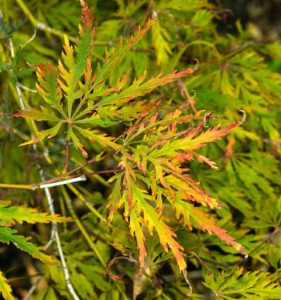
Japanese Maple

Leaf Scorch on Japanese Maple caused by heat stress. Photo Credit.

Heat stress can cause damage to the leaves, resulting in dried or curled edges, as well as reddish or pale coloration as the green chlorophyll pigment begins to break down. This damage may only be superficial, but in some cases it could cause serious injury and death of the leaf tissue. One factor that greatly affects the severity of tissue damage caused by heat stress is the hydration status of the plant before the onset of extreme temperatures.

Plants will naturally dissipate heat through the process of transpiration, provided there is adequate moisture in the soil to support this function. During periods of extreme temperatures, the roots will struggle to draw enough water from the soil to keep up with the rate of water vapor that is exiting the leaves through transpiration. This leads to symptoms such as leaf scorch, curled leaves, discoloration, defoliation, die-back, and temporary wilting. Because the plant is experiencing stress and a disruption in its normal physiological functions, it becomes more susceptible to insect and disease problems.

There are several preventative measures that can be taken to reduce the impacts of heat stress in nursery and landscape plants.

  1. Thoroughly water plants either in the evening or in the early morning before extreme temperatures occur. Water the plants deeply and use irrigation methods that minimize leaf wetness to reduce the potential for foliar diseases.
  2. Properly mulch plants to conserve water in the soil and help lower soil temperatures. Bark mulch, leaf mulch, straw, and other organic mulches will help to lower the temperature in the root zone, while gravel mulches can actually increase root zone temperatures. Be sure to provide additional water to newly mulched plants to prevent dry mulch from taking moisture away from the roots.
  3. Avoid fertilization during periods of heat stress because this can absorb moisture in the root zone and further contribute to dehydration of the plant.
  4. Avoid applying herbicides that can volatilize in high temperatures and drift, causing damage to non-target species.
  5. Pay special attention to plantings that are located next to driveways, concrete patios, or other structures that can absorb and radiate additional heat to the plants. These areas will likely require additional irrigation.


Additional Resources:

How to Protect Trees and Other Landscape Plants from Heat Stress

Reducing Heat Stress to Container Grown Plants

Natter’s Notes: Heat Stress

Hot Weather Takes a Toll on Georgia Landscapes

COVID-19 Resources for Nursery, Greenhouse, Landscape, Garden Centers, etc.

Please contact Cumberland County Extension Agent Tim Waller if you would like to have an association added to the “Green Industry COVID links PDF”. twaller@njaes.rutgers.edu


Defining Essential Businesses

Closing of non-essential retail businesses following New Jersey Executive Orders 107 and 108 have had many NJ green-industries wondering, “what does this mean for my business”.

Many NJ Green-Industries are now considered Essential Businesses (as of 3/24/20, list subject to change).

  • Nurseries
  • Greenhouses
  • Landscaping
  • Garden Centers
  • Farms
  • Farm equipment suppliers
  • Farmer-markets
  • Farms that sell directly to customers
  • Grocery stores
  • Hardware and home improvement stores
  • Livestock feed stores

These businesses can remain open as long as they adhere to the safety guidelines outlined in Executive Order 107 and the CDC recommendations (links in PDF attachment).

The included attachment (PDF) with web-links: has a number of important resources concerning COVID-19 at state and federal levels (click or copy links). East and west coast states have been included, as many nurseries will be shipping throughout those regions. Additionally, web-links to nursery and landscape associations of each state, have been included to serve as a point of reference when shipping in to or out of that state. Contact the local associations for additional clarification if needed. The list is in no way exhaustive as many states have numerous green-industry associations.

Links pertaining to international land border agreements between the USA, and Canada, and Mexico have also been listed.


(PDF): Green Industry COVID links PDF 3 30  (Click link. Copy web-address if not working)


Quick links to New Jersey Associations:

New Jersey Landscape Contractors Association: https://www.njlca.org/

New Jersey Nursery and Landscape Association: https://www.njnla.org/

New Jersey Green Industry Council: http://njgic.org/

New Jersey Turfgrass Association: https://njta.wildapricot.org/

New Jersey Christmas Tree Growers Association: https://njchristmastrees.org/

New Jersey Farm Bureau: https://njfb.org/


BUSINESSES WILL NEED TO FOLLOW SOCIAL DISTANCING PRACTICES.

Business social distancing:

Social distancing for customers will include but limited to, signage for customers to remain 6 feet apart from one another as well as a concerted effort by owners/employees to sanitize frequently used carts, doors, loading equipment, etc.

  • Commonly touched hard surfaces should be routinely disinfected while wearing disposable gloves with 70% alcohol, or other common EPA-registered household disinfectants (diluted bleach instructions below). Soft/porous surfaces should be cleaned with EPA-approved spray/aerosol sanitizers. Any fabric that can be laundered (uniforms, table cloths, etc.) should be done so separately from household laundry. The use of non-clothing linens should be discouraged. For example the use of tablecloths under cash registers is discouraged.

Employee social distancing:

These same efforts must be applied for social distancing amongst employees, including but not limited to, prohibit sharing of vehicles between different work crews or tightly packing single vehicles, routinely sanitizing commonly used tools and equipment, prohibiting congregations around break/lunch areas, etc.

  • Travelers per vehicle should be limited to maximize physical distance between employees/occupants. If possible 1 crew per vehicle for the duration of COVID-19 concerns should be implemented. While conducting business, employee sanitation efforts should be constantly minded. This would include cleaning hard vehicle interiors with disinfectant solutions (70% alcohol, and most common EPA-registered household disinfectants) as well as soft interior surfaces with EPA-approved spray/aerosol sanitizers while wearing disposable gloves. Any fabric that can be laundered (seat covers, work uniform, bibs, etc.) should be done so separately from household laundry.

Diluted household bleach solutions can be used if appropriate for the surface. Follow manufacturer’s instructions for application and proper ventilation. Check to ensure the product is not past its expiration date. Never mix household bleach with ammonia or any other cleanser. Unexpired household bleach will be effective against coronaviruses when properly diluted.

Prepare a bleach solution by mixing:

  • 5 tablespoons (1/3rd cup) bleach per gallon of water or
  • 4 teaspoons bleach per quart of water

Detailed disinfection instructions can be found at the CDC website: https://www.cdc.gov/coronavirus/2019-ncov/prepare/cleaning-disinfection.html


Businesses are encouraged to give each employee a letter indicating that the employee works in an industry permitted to continue operations.

Employees reporting to work are permitted to travel to and from their place of business. This would also apply when nursery deliveries or landscapers services are being performed.


Ideas to generate more business during COVID-19:

  • Increase social media marketing, targeting local audiences
  • Offer delivery services or order online-pick up at store
  • Generate ‘kits’, of easy to grow plants for a new wave of horticulture enthusiasts
  • Offer online demonstrations or classes, branding your business as top-notch
  • Promote different horticulture techniques that should spur purchases
  • Promote unique plants that the average person has not seen and may take interest


In the case of economic disaster:

The Small Business Administration (SBA) has been approved for Economic Injury Disaster Loans, which includes businesses, agricultural cooperatives, and non-profits. Application filing deadline is 12/18/2020.

Applicants may apply online, receive additional disaster assistance information, and download applications at https://disasterloan.sba.gov/ela

Applicants may also call SBA’s Customer Service Center for more information on SBA disaster assistance.

phone: (800) 659-2955

email: disastercustomerservice@sba.gov


OTHER IMPORTANT QUICK LINKS:

CDC COVID page: https://www.cdc.gov/coronavirus/2019-ncov/index.html

NJ COVID page: https://covid19.nj.gov/

Inventory or donations of PPE (Executive Order No. 109): https://covid19.nj.gov/ppereport

All current and archived executive orders: https://nj.gov/infobank/eo/056murphy/approved/eo_archive.html


Stay healthy. Exercise caution on- and off-the-clock!