Fruit IPM Report for Week of 5/11/2026


Apples
Disease Management Considerations
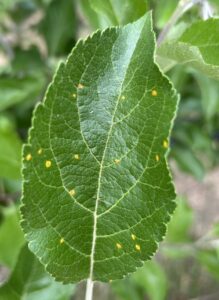
  • Apple scab symptoms are now appearing in some orchards as secondary infections (Figure 1).

    Early onset of scab symptoms on apple leaves. Photo by Kaitlin Quinn.

    Figure 1. Early onset of scab symptoms on apple leaves. Photo by Kaitlin Quinn.

  • Primary scab season is coming to an end or has ended.
  • Rust and powdery mildew infections are also a risk during this time.
  • These diseases need to be managed, even if you have little to no apple crop, to maintain healthy trees and keep inoculum low going into next season. A conservative spray program can focus on broad-spectrum fungicides, such as mancozeb, captan, ziram, and sulfur. Mancozeb is the only broad-spectrum product to control rust, while sulfur is the only broad-spectrum product to control powdery mildew.

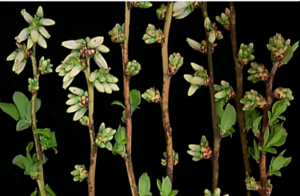
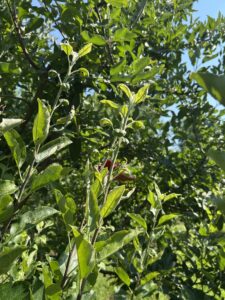
    Fire blight strike in apple. Photo by Karlton Raines-Neidigh.

    Figure 2. Fire blight strike in apple. Photo by Karlton Raines-Neidigh.

  • Marssonina Blotch, Glomerella Leaf Spot, and Frogeye Leaf Spot should be managed, as they will cause defoliation and provide a source of inoculum for black rot and bitter rot next season.  Maintain coverage of captan, manzate, or ziram prior to rain events through the growing season according to the cover spray rule of applications every 2” of rain or 14 days, whichever comes first.
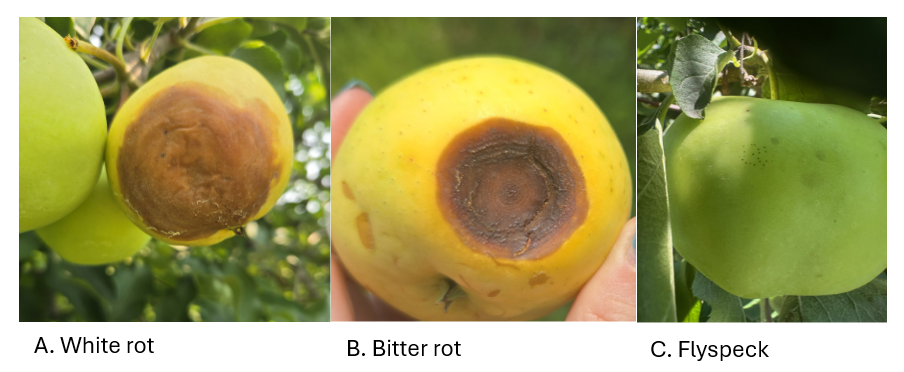
  • For those who have fruit on their trees, there are additional fungicide options to consider, particularly to manage bitter rot, sooty blotch & flyspeck. Products such as Merivon, Luna Sensation, Inspire Super, Omega, and Aprovia are effective and can be combined or rotated with broad-spectrum fungicides such as captan and ziram for sustained control.
  • Fire Blight:
    • Fire blight strikes are developing in orchards statewide (Figure 2).
    • Products such as Apogee or Kudos are highly recommended to help slow the spread of infections. Repeated applications may be necessary to help control shoot blight from previous blossom infections or leftover cankers in the trees.
    • If there is still some bloom, apply antibiotics when infection events are forecasted using the NEWA fire blight model.
    • Remember to rotate streptomycin and oxytetracycline products.
    • If symptoms appear, it is generally recommended to cut out infected limbs and remove them from the orchard when possible; however, this is a practical decision that must be made on a case-by-case basis.
Insect Update

Insect management programs should be adjusted this season to account for reduced crop load in many orchards. In blocks with little to no fruit, many early-season insect pests will not require treatment; however, monitoring should continue, and management should be maintained where pests threaten tree health or next year’s crop.

  • Rosy apple aphid activity has been very low to start this season. RAA can feed extensively on foliage and terminals, causing leaf curling and stunting. This can impact next year’s fruit that will be set this season. Without fruit, the trees may tolerate a higher threshold of these pests, but they should still be managed.
    • Monitor for colonies during bloom and use a treatment threshold of 1 colony/tree at petal fall.
  • Green Apple (Spirea) Aphids (GAA) colonies are being observed in some apple blocks. GAA is generally a pest that can be tolerated because it causes little direct damage.
    • Treatment thresholds for GAA are met if 50% of the shoots are infested with no beneficial insects present.
    • Movento will control GAA and should control scale when applied in mid-May, and suppress scale when applied in late May or early June.
  • Ambrosia Beetle
    • Trap captures have decreased across NJ, indicating peak flight has ended or is coming to an end.
    • Infested trees should be showing signs of stress or will soon.
    • If you have had a history of this pest in your orchard, you should begin scouting for damage and flag any trees that have been attacked for continued monitoring.
  • Codling Moth (CM)
    • A codling moth biofix was set in Southern counties on 4/20 and in Northern counties on 5/5. See the NJ Commercial Tree Fruit Production Guide for recommended materials and rates. Where Mating Disruption has been employed, supplemental Madex applications should be made at the timings listed below.
    • Codling Moth Degree Day Timing
      Application and Insecticide Type
      County Area Biofix Rimon:

      75-100DD + 14-17 days later


      Intrepid

      150 + 450 DD

      Diamides – Altacor, Voliam mixes: (150-200 DD)

      Madex

      250 DD + 7-10 days during brood hatch (later if first spray is an IGR)

      Standard Insecticides –  Delegate, Avaunt, OP’s, carbamates, pyrethroids

      250 DD + 550 DD


      DD 75 100 150 450 250 250 550
      Southern April 20 Past Past Past 6/1 5/18 5/18 Too far off
      Northern  May 5 5/12 5/14 5/17 Too far off 5/21 5/21 Too far off
  • Plum curculio, tarnished plant bug, stink bugs, BMSB, TABM, and OBLR:
    • In most blocks, treatment is not necessary where little to no fruit is present
    • The timing to treat plum curculio has passed.
  • Mites:
    • Continue to use standard thresholds through June
    • Maintaining healthy foliage is important for return bloom next season
Traps

Average Trap Captures in Apple – Southern Counties

  Week STLM TABM CM OFM DWB AMBROSIA BEETLE
5/11/2026 18  11  6 3   25   2


Average Trap Captures in Apple – Northern Counties

  Week STLM TABM CM DWB AMBROSIA BEETLE
5/11/2026 13.7  1.5  1.8   12.8   1.1

Pears
Disease Management
  • Fire blight remains a concern during warm and wet periods. Continue to protect actively growing shoots, particularly during warm, wet, or stormy conditions. In high-risk situations, oxytetracycline (e.g., Mycoshield, FireLine) may be used post-bloom to suppress shoot blight.
  • Maintain protectant fungicides (e.g., Mancozeb, Ziram) to control rust, scab, and Fabraea leaf spot, protecting foliage.
    • Use FRAC 3 and 7, and premix fungicides (e.g., Inspire Super, Merivon, Luna products) as needed for foliar disease control.
    • In blocks with little to no fruit, fungicide programs can often be reduced and focused on maintaining healthy foliage rather than fruit protection.
Insect Update
  • Second generation pear psylla adults and eggs have been observed in southern counties. Options for control include Actara, Assail, and Belay (IRAC group 4A); Sivanto Prime (IRAC group 4D); Delegate (IRAC Group 5); and products containing abamectin (IRAC group 6). Other options include Movento (IRAC Group 23). The addition of 0.25-1 gal of summer oil may improve control. Be sure to read and follow the label instructions for adding penetrants to these products.

Peaches
Disease Management

Given the widespread crop loss in many orchards, disease management programs should be adjusted accordingly. With little to no fruit present in most blocks, emphasis should

Bacterial leaf spot on peach

Figure 3. Bacterial leaf spot on peach

shift away from fruit protection and toward maintaining tree health and reducing inoculum for next season.

  • Peach scab:
    • In orchards without a history of high disease pressure, scab is generally not a concern in the absence of fruit
    • In blocks with a history of scab, lesions can still develop on current-season shoots and serve as inoculum for next year
    • In these situations, a reduced program may be warranted, with Captan applications timed ahead of significant rainfall events (e.g., ~2.5 lb/A)
  • Bacterial spot:
    • Leaf symptoms are showing in orchards (Figure 3).
    • Maintain low-rate copper programs to protect foliage and reduce inoculum for future seasons
    • Particularly important in blocks with a history of bacterial spot or under warm, wet conditions
    • Avoid combining copper with captan, especially following extended cloudy or slow-drying conditions
  • Rusty spot and brown rot:
    • Not a concern in blocks with little to no fruit
    • Fungicide applications targeting these diseases can be eliminated in most orchards this season unless there is a crop to protect.
Insect Update

Insect management programs for peaches and nectarines should be adjusted this season due to reduced crop load. In blocks with little to no fruit, many fruit-feeding pests will not require treatment; however, monitoring should continue, and management should focus on pests that impact tree health or future production.

Terminal flagging due to Oriental fruit moth.

Figure 4. Terminal flagging due to Oriental fruit moth.

Oriental Fruit Moth (OFM)

    • A biofix point for OFM was set on 4/7 for southern counties and 4/15 in northern counties.
    • The second insecticide timings for the first generation Oriental Fruit Moth have passed.
    • No insecticides are needed for OFM when mating disruption is implemented.
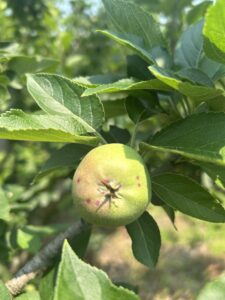
    • We have seen very few flagging in new leaf tissue where OFM larvae have bored into (Figure 4).
    OFM 1st Generation Timing
    Insecticide Type
    County/Region Degree Days by 5/18 base 45 Conventional

    170-200, 350-375

    Diamide

    100-150, 300-350

    Gloucester – Southern 556 1st –past

    2nd – past

    1st –past

    2nd –past

    Middlesex – Northern 456 1st –past

    2nd –5/13-5/15

     1st – past

    2nd –5/10-5/13

Scale

  • Beneficial insects may help suppress populations in many blocks
  • In orchards with a history of infestation, plan to target the crawler stage starting the third week of May and continue emergence until about the middle of June
  • Control options include materials such as Esteem or Centaur
  • Where scale is a recurring problem, Movento should be applied between petal fall and shuck split. A penetrant must be included with Movento as per the product label. Applications should be made at optimal temperature conditions. Movento will also control green peach aphid when used at this time.
  • Continue monitoring historically infested blocks and plan crawler management for later in the season if populations persist.

Green Peach Aphid

Plum Curculio

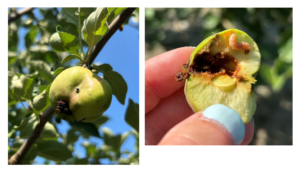
  • Injury to fruit has been observed on developing peaches and apples in southern counties.
  • Management in NJ typically requires weekly sprays for 3-4 weeks, beginning at petal-fall and continuing through approximately 300 DD50 after petal-fall.
  • Materials that cover PC and other key pests encountered at this time include Asana, Avaunt, Imidan, and Voliam Flexi.

Tarnished plant bugs and other catfacing insects

  • Activity has been low and is considered a low priority for management, where fruit is not present. If you plan to retain a crop, you must continue to manage insect pests intensively as you would in a normal season.

Lesser and Greater Peach Tree Borers

  • Growers using mating disruption for borer control should have them in place by mid-May.
  • Even in orchards with little fruit, borers will need to be managed to maintain healthy tree stands for the next season. If this has been a historical pest in your orchard, mating disruption is recommended.
  • Continue monitoring and managing as usual in problem blocks
Traps

Average Trap Captures in Peach – Southern Counties

  Week OFM TABM LPTB PTB
5/11/2026 5 10


Average Trap Captures in Peach – Northern Counties

  Week OFM LPTB PTB
5/11/2026 4.4 24 0

Blueberries
Blueberry Phenology

Early varieties are in the green fruit stage – the flowers have been pollinated, the petals are off, and the tiny green fruit are expanding.

Insect Update

Scouting activities were conducted last week across 139 commercial blueberry fields in Burlington and Atlantic Counties. Field evaluations focused on monitoring pest activity and crop development, including assessments of leafrollers, spongy moth, plum curculio, and thrips using beating tray samples, as well as fruit inspections for pest injury and developmental progress. All target pests were detected during scouting activities (Table 1).

Plum curculio numbers of adults on bushes has decreased over the past week, but some adults are still present. The average count was 0.117 per bush with a high of 3.5 adults per bush.

Thrips numbers increased from previous weeks. The main concern comes from the potential for thrips injury to flowers and developing fruit. After bloom, thrips can feed on young blueberry foliage causing curling of leaves; however, the risk of injury to developing leaves and fruit from thrips is low at this point.

In addition, monitoring of developing fruit indicated increasing feeding and/or oviposition activity by these pests (Table 2).

Table 1. Beating Tray Sampling Data

Leafrollers Spongy Moth Plum Curculio Thrips
Avg High Avg High Avg High Avg High
4/17 0.0649 2 0.0001 0.1 0.0686 2.5 0.5547 9
4/25 0.0801 0.8 0.0001 0.1 0.1156 3 1.0383 26
5/1 0.1 0.8 0.0007 0.1 0.15 3 2.38 39
5/9 0.08 0.7 0 0 0.245 4.5 1.89 37
5/16 0.04 0.7 0.0007 0.1 0.117 3.5 5.02 99

Table 2. Fruit Sampling Data

% Leafroller Berry Infestation % Plum Curculio Berry Infestation
Avg High Avg High
5/9 0.125 1 0.235 2.6
5/16 0.22 1.5 0.67 6.5

Trap Monitoring

Scale traps targeting Putnam and terrapin scale were monitored last week and captured very low numbers; therefore, no treatment is recommended at this time.

Cranberry and cherry fruitworm traps were also checked last week. No cranberry fruitworm activity was detected; however, captures of cherry fruitworm increased, indicating that adults are actively flying and mating (Table 3).

Table 3. Trap Sampling Data

Cranberry  Fruitworm (AC) Cherry Fruitworm (AC) Cranberry Fruitworm (BC) Cherry Fruitworm (BC)
Avg High Avg High Avg High Avg High
5/1 0 0 2.5 5 0 0 3.5 7
5/9 0 0 4.4 6 0 0 6.25 10
5/16 0 0 7.7 11 0 0 9 15
AC: Atlantic County, BC: Burlington County

Management recommendations can be found on the current Blueberry Bulletin and Commercial Blueberry Pest Control Recommendations for New Jersey.

Grapes
Grape Phenology

Grape development across New Jersey has progressed, with most vineyards in southern counties moving through to pre-bloom. In many areas, shoots are now between 1–6 inches, depending on variety and site conditions.

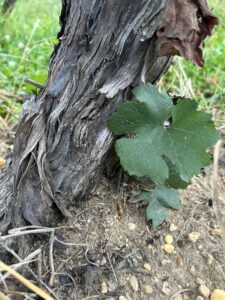
Damage is most apparent in low-lying or frost-prone sites, where primary shoots may have been injured or killed. In these situations, secondary buds are beginning to push (Figure 5) and may help compensate for some crop loss, though overall yield may still be reduced depending on the extent of primary bud injury.

At this stage, vineyards should be assessed for primary and secondary bud viability and uniformity of growth. Blocks with uneven development may require adjustments in management timing over the coming weeks.

Grapevines with secondary bud break.

Figure 5. Grapevines with secondary bud break.

Diseases
  • The most important diseases to manage at this time are Phomopsis, black rot, and powdery mildew.
  • More information on early-season disease control can be found in this blog post by Dr. Mizuho Nita at Virginia Tech.
Insect Update
  • Insect pests to monitor are the grape flea beetle and the climbing cutworms. Controls for these insects are rarely needed.
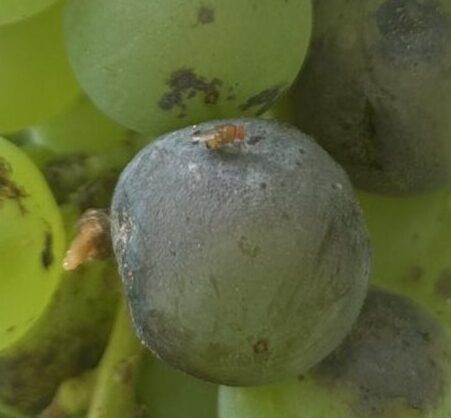
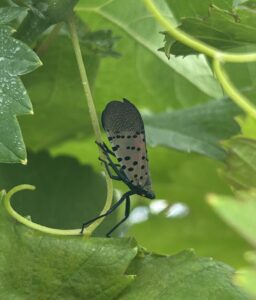
  • Spotted lanternfly nymphs are emerging in southern counties and will continue to hatch over the next few weeks (Figure 6).
    • Insecticide applications are generally not recommended to control SLF nymphs. Due to the April freeze, the vines are under stress; therefore, a well-timed insecticide application to manage other key pests can knock down nymph populations.

      Spotted lanternfly nymphs on grapevines.

      Figure 6. Spotted lanternfly nymphs on grapevines.

  • Grape berry moth adults continue to be trapped in pheromone traps in vineyards where there is surrounding pressure from wild grapes.

Fruit IPM Report 5/11/2026


Apples

Disease Management Considerations

Primary scab season is coming to an end or has ended. While the majority of mature ascospores have been released, there is still a risk of infection. An apple scab infection period occurred over the weekend (5/9-5/11), and currently the forecast indicates an apple scab infection period for May 13-14. Rust infection is also a risk during this time. These diseases need to be managed even if you have little to no apple crop in order to maintain healthy trees and keep inoculum low going into next season. A conservative spray program can focus on broad-spectrum fungicides, such as mancozeb, captan, ziram, and sulfur. Mancozeb is the only broad-spectrum product to control rust, while sulfur is the only broad-spectrum product to control powdery mildew.

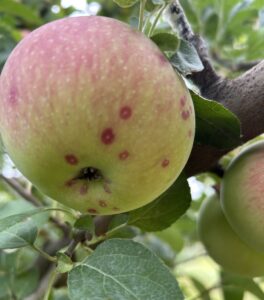
Marssonina Blotch, Glomerella Leaf Spot, and Frogeye Leaf Spot (Figure 1) should be managed as these diseases will cause defoliation and provide a source of inoculum for black rot and bitter rot next season. Maintain coverage of captan, manzate, or ziram prior to rain events through the growing season according to the cover spray rule of applications every 2” of rain or 14 days, whichever comes first.

Frogeye leaf spot on apple.


Figure 1. Frogeye leaf spot on apple.

For those who have fruit on their trees, there are additional fungicide options to consider, particularly to manage bitter rot, sooty blotch & flyspeck. Products such as Merivon, Luna Sensation, Inspire Super, Omega, and Aprovia are effective and can be combined or rotated with broad-spectrum fungicides such as captan and ziram for sustained control.

Fireblight
Infections can still occur post bloom. Products such as Apogee or Kudos, combined with plant defense inducers such as Actigard, should be used to manage shoot blight. If there is still some bloom, apply antibiotics when infection events are forecasted using the NEWA fire blight model. A potential infection period is predicted for May 13-14. Remember to rotate streptomycin and oxytetracycline products. If symptoms appear, it is generally recommended to cut out infected limbs and remove them from the orchard when possible; however, this is a practical decision that must be made on a case-by-case basis. Applications of Prohexadione calcium (Kudos or Apogee) are highly recommended to help slow infections. Repeated applications may be necessary to help control shoot blight from previous blossom infections or leftover cankers in the trees.

Insect Update

Codling Moth: A Codling Moth Biofix was set in Southern counties on 4/20 and in Northern counties on 5/5. See the NJ Commercial Tree Fruit Production Guide for recommended materials and rates. Where Mating Disruption has been employed, supplemental Madex applications should be made at the timings listed below.

Codling Moth Degree Day Timing
Application and Insecticide Type
County Area Biofix Rimon:

75-100DD + 14-17 days later


Intrepid

150 + 450 DD

Diamides – Altacor, Voliam mixes: (150-200 DD)

Madex

250 DD + every 7-9 days during brood hatch (later if first spray is an IGR)

Standard Insecticides –  Delegate, Avaunt, OP’s, carbamates, pyrethroids

250 DD + 550 DD


DD 75 100 150 450 250 250 550
Southern April 20 Past Past 5/9 Too far off 5/19 5/19 Too far off
Northern  May 5 5/12 5/14 5/19 Too far off Too far off Too far off Too far off

Rosy Apple Aphid: Aphid activity has been very low to start this season. RAA can feed extensively on foliage and terminals, causing leaf curling and stunting. This can impact next year’s fruit that will be set this season. Without fruit, the trees may tolerate a higher threshold of these pests, but they should still be managed. Monitor for colonies during bloom and use a treatment threshold of 1 colony/tree at petal fall.

Green Apple (Spirea) Aphids (GAA): GAA colonies are being observed in some apple blocks. GAA is generally a pest that can be tolerated because it causes little direct damage. Treatment thresholds for GAA are met if 50% of the shoots are infested with no beneficial insects present. Movento will also control GAA and should control scale when applied in mid-May, and suppress scale when applied in late May or early June.

Ambrosia Beetle: Trap captures have decreased from previous weeks in South Jersey, indicating peak flight has ended. However, in some of the northernmost New Jersey counties, trap captures are increasing, which indicates we are entering peak flight. Infested trees should be showing signs of stress or will be soon. Once these beetles bore into the trunk, they will form a gallery in the heartwood of the tree to lay their eggs and farm the ambrosia fungus to feed themselves and their larvae. Once the female lays her eggs, it will take about 30 days for the eggs to hatch and the adults to emerge from their host tree to begin the second flight. If you have had a history of this pest in your orchard, you should begin scouting for damage and flag any trees that have been attacked for continued monitoring.

Pears
Pear Diseases

Although the primary bloom infection period is largely over, fire blight remains a concern during warm, wet periods. Continue to protect actively growing shoots, particularly during warm, wet, or stormy conditions. In high-risk situations, oxytetracycline (e.g., Mycoshield, FireLine) may be used post-bloom to suppress shoot blight. Maintain protectant fungicides (e.g., Mancozeb, Ziram) to control rust, scab, and Fabraea leaf spot, protecting foliage. Use FRAC 3 and 7, and premix fungicides (e.g., Inspire Super, Merivon, Luna products) as needed for foliar disease control. In blocks with little to no fruit, fungicide programs can often be reduced and focused on maintaining healthy foliage rather than fruit protection.

Pear Psylla

Second-generation pear psylla adults and eggs have been observed in southern counties. Options for control include Actara, Assail, and Belay (IRAC group 4A); Sivanto Prime (IRAC group 4D); Delegate (IRAC Group 5); and products containing abamectin (IRAC group 6). Other options include Movento (IRAC Group 23). The addition of 0.25-1 gal of summer oil may improve control. Be sure to read and follow the label instructions for adding penetrants to these products.

Peaches
Peach Diseases

Given the widespread crop loss in many orchards, disease management programs should be adjusted accordingly. With little to no fruit present in most blocks, emphasis should shift away from fruit protection and toward maintaining tree health and reducing inoculum for next season.

  • Peach scab:
    • In orchards without a history of high disease pressure, scab is generally not a concern in the absence of fruit
    • In blocks with a history of scab, lesions can still develop on current-season shoots and serve as inoculum for next year
    • In these situations, a reduced program may be warranted, with Captan applications timed ahead of significant rainfall events (e.g., ~2.5 lb/A)
  • Bacterial spot:
    • Maintain low-rate copper programs to protect foliage and reduce inoculum for future seasons
    • Particularly important in blocks with a history of bacterial spot or under warm, wet conditions
    • Avoid combining copper with captan, especially following extended cloudy or slow-drying conditions
    • Antibiotics containing oxytetracycline may also be used and may offer more residual activity during long wetting periods.

      Bacterial leaf spot on peach.

      Figure 2. Bacterial leaf spot on peach.

    • We have observed bacterial leaf spot symptoms in the field starting in early May (Figure 2).
  • Rusty spot and brown rot:
    • Not a concern in blocks with little to no fruit
    • Fungicide applications targeting these diseases can be eliminated in most orchards this season.


Insect Update

Insect management programs for peaches and nectarines should be adjusted this season due to reduced crop load. In blocks with little to no fruit, many fruit-feeding pests will not require treatment; however, monitoring should continue, and management should focus on pests that impact tree health or future production.

Oriental Fruit Moth (OFM)

A biofix point for OFM was set on 4/7 for southern counties and 4/15 in northern counties. The second insecticide timings for first generation Oriental Fruit Moth control fall at 350-375 degree days base 45 after biofix. No Insecticides for OFM are needed where mating disruption is implemented.

OFM 1st Generation Timing
Insecticide Type
County/Region Degree Days by 5/10 base 45 Conventional

170-200, 350-375

Diamide

100-150, 300-350

Gloucester – Southern 434 1st –past

2nd – past

1st –past

2nd –past

Middlesex – Northern 325 1st –past

2nd –5/12-514

 1st – past

2nd –5/9-5/12

Green Peach Aphid: Aphid activity has been very low to start this season. GPA colonies usually begin forming sometime during bloom. Examine trees for the presence of aphids by counting the number of colonies on ten trees and use a treatment threshold of 2 colonies/tree at petal fall for peach, and 1 colony/tree for nectarine. See the NJ Commercial Tree Fruit Production Guide for recommended materials and rates. Aphid colonies curling leaves was noted in southern counties starting the week of 5/4.

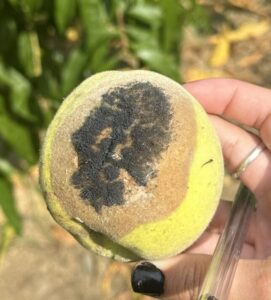
Plum Curculio; Tarnished Plant Bugs; and Other Catfacing Insects: Injury on fruit from plum curculio has been observed on developing peaches and apples in southern counties (Figure 3). Plum curculio start to move into orchards at about 88-100 degree days base 50 after January 1. Applications for PC should be initiated once all petals are off, with a second application made with ovicidal materials at 379-402 DD. We are currently past this treatment window, as southern counties have accumulated about 508 DD base 50, and northern counties have accumulated 457 DD base 50. Growers can monitor degree day development at their site by finding the nearest weather station and using the degree day development tool at NEWA. Tarnished plant bug and catfacing insect activity has been low and is considered a low priority for management where fruit is not present. If you are planning to retain a crop, you must continue to intensively manage insect pests as you would in a normal season.

Plum curculio feeding in apple fruitlets.

Figure 3. Plum curculio feeding in apple fruitlets.

Scale Insects: White peach scale crawlers have not yet emerged, but usually begin emergence about the third week of May and continue emergence until about the middle of June. San Jose scale crawlers typically begin emergence about late May or Early June and continue emergence for up to 6 weeks. Control options during crawler emergence include Esteem and Centaur. See the NJ Commercial Tree Fruit Production Guide and the product labels for more information.

Lesser and Greater Peach Tree Borers: Growers using mating disruption for borer control can begin placing dispensers around the end of April and should have them in place by mid-May.


Blueberries
Insect Update

Scouting activities were conducted across 139 fields in Burlington and Atlantic Counties. Field evaluations focused on the presence of leafrollers, spongy moths, plum curculio, and thrips. Insect activity remains low in beating tray samples and observations on developing fruit of feeding and oviposition injury.

Table 1. Beating Tray Data

Leafrollers Spongy Moth Plum Curculio Thrips
Avg High Avg High Avg High Avg High
4/17 0.0649 2 0.0001 0.1 0.0686 2.5 0.5547 9
4/25 0.0801 0.8 0.0001 0.1 0.1156 3 1.0383 26
5/1 0.1 0.8 0.0007 0.1 0.15 3 2.38 39
5/9 0.08 0.7 0 0 0.245 4.5 1.89 37


Table 2. Fruit Monitoring Data

% Leafroller Berry Infestation % Plum Curculio Berry Infestation
Avg High Avg High
5/9 0.125 1 0.235 2.6


Trap Monitoring: Cranberry and cherry fruitworm traps were deployed and will be monitored on a weekly basis.

Cherry fruitworm activity is increasing, indicating that adults are in flight and mating (Table 3).

Table 3. Trap Data

Cranberry Fruitworm

(AC)

Cherry Fruitworm (AC) Cranberry Fruitworm (BC) Cherry Fruitworm (BC)
Avg High Avg High Avg High Avg High
5/1 0 0 2.5 5 0 0 3.5 7
5/9 0 0 4.4 6 0 0 6.25 10
AC: Atlantic County, BC: Burlington County


Scale traps targeting Putnam and terrapin scale will be set up in the coming week to monitor for first-generation crawler emergence and to assist in optimizing treatment timing.

Grapes
Diseases

We are prebloom in vineyards in southern counties. The most important diseases to manage at this time are Phomopsis and Powdery Mildew. Starting at 3″ growth start managing for Black Rot. More information about early-season disease control can be found in this blog post from Virginia Tech.

Insect Update

We are catching the first generation of grape berry moth in pheromone traps in vineyards; however, a biofix will not be set until early native varieties are at trace bloom. Insecticide timings will target control of later generations of grape berry moth in vineyards infesting developing fruit bunches. Spotted lanternfly nymphs have been observed in southern NJ vineyards (Figure 4). There is no need to control SLF at this time.

Spotted lanternfly nymphs on grapevines.

Figure 4. Spotted lanternfly nymphs on grapevines.


Fruit IPM Updates Week of 4/27/2026

Tree Fruit Phenology Update

Tree fruit development across New Jersey continued to progress over the past week, and the impacts of the recent freeze event are now becoming more clearly defined. Across much of the state, significant injury to blossoms and young fruit has been confirmed, with many orchards reporting substantial crop loss. The extent of damage remains highly variable by location, elevation, variety, and phenological stage at the time of the freeze, with the most severe injury observed in low-lying areas and blocks that were at full bloom or petal fall.

At this stage, surviving fruitlets are becoming easier to identify, although some additional drop is still expected over the coming week. Growers are encouraged to continue evaluating blocks carefully before making final management decisions, as crop potential may continue to change.

In apples, early varieties such as ‘Pink Lady’ sustained significant injury in many locations. However, some later-developing blooms appear to have escaped the freeze, and limited fruit set is being observed from these later flowers. While this provides some promise in select blocks, overall yield potential remains extremely low across most orchards. Variability remains high even within individual blocks.

In pears, most varieties across the state were at or just past bloom during the freeze, and widespread crop loss has now been confirmed. In many orchards, little to no viable fruit remains, though isolated pockets of surviving fruit may still be present depending on site conditions.

Peach and nectarine varieties in southern counties, which were at petal fall to early shuck split during the freeze, experienced extensive crop loss in many orchards. In northern counties, where bloom was still ongoing at the time of the freeze, damage remains variable but is often substantial in more exposed locations.

Despite reduced crop potential, continued monitoring and management remain important, particularly in blocks with surviving fruit or where maintaining tree health and supporting return bloom for the 2027 season are priorities.

Apples
Apple Phenology Update

Apple phenology continued to progress across New Jersey over the past week, with most blocks now moving through bloom into petal fall. The impacts of the recent freeze event are now becoming more apparent, with significant injury observed in many orchards statewide. Early varieties in southern counties, such as ‘Pink Lady,’ sustained substantial damage where they were at full bloom during the freeze.

Later varieties and more northern regions show variable levels of injury depending on bloom stage and site conditions. In some blocks, later-developing blooms appear to have escaped damage and are setting limited fruit. Surviving fruitlets are becoming easier to identify, although some additional drop may still occur over the coming week.

As development continues into petal fall and early fruit set, this remains a critical period for disease management, particularly for fire blight, apple scab, powdery mildew, and cedar apple rust. Even in blocks with reduced crop, maintaining protection of foliage and any surviving fruit is essential for overall tree health and to support return bloom next season. Monitoring for early-season insect pests should also continue, with management decisions adjusted based on crop presence and block-specific conditions.

Phenology Dates by County (earliest varieties)

County Green Tip Tight Cluster Pink Bud Bloom Petal Fall
Cumberland 3/22 3/28 4/3 4/8 4/17
Gloucester 3/22 3/28 4/3 4/8 4/17
Burlington 3/22 3/28 4/2 4/13 4/22
Mercer 3/22 3/28 4/2 4/13 4/22
Middlesex 3/22 4/1 4/4 4/14 4/22
Monmouth 3/22 4/1 4/4 4/14 4/22
Hunterdon 3/22 4/1 4/10 4/17 4/24
Morris 3/26 4/4 4/11 4/17 4/24
Warren 3/30 4/4 4/13 4/17 4/24
Sussex 3/31 4/10 4/14 4/18 4/24
Bergen 3/22 4/1 4/4 4/14 4/24
Apple Scab
Apple scab season is approaching the end of primary ascospore release, with most ascospores now matured and a large proportion already discharged. We are transitioning out of peak primary infection risk; however, recent infection events and any established lesions can continue to drive secondary spread if not controlled.Recent wetting events earlier this week resulted in infection periods, but the upcoming forecast is relatively dry, which should limit additional infection risk in the short term. Growers should continue to monitor conditions closely and maintain coverage, particularly where primary infections may have already occurred. Models are available through NEWA and RIMpro
Current Update using the Upper Deerfield Station
  • ~91–94% ascospore maturity as of April 29–May 1
  • ~62–63% cumulative ascospore discharge to date
  • Forecasted to reach ~95–98% maturity by May 2–6
  • Cumulative ascospore discharge forecasted to increase to ~73% by May 2–6
  • Infection events occurred April 29–30 under sufficient wetting and favorable temperatures
  • Limited infection risk is forecast over the next several days due to dry conditions

While primary scab season is nearing completion, remaining ascospores and recent infection events mean that protection should be maintained until discharge is complete and orchards are scouted for lesions.

Management Considerations

Fungicide programs should be maintained through petal fall and early fruit set, particularly in blocks where infection events occurred this week. However, as primary scab season nears completion and ascospore maturity approaches full discharge, growers should begin planning to wind down intensive scab programs.

One additional well-timed fungicide application over the next week may be sufficient to protect against any remaining ascospore release and recent infection events. Following this, programs can be adjusted based on scouting and the presence or absence of lesions.

Despite widespread freeze injury, protecting foliage remains critical for tree health and return bloom. Programs should continue to prioritize apple scab until primary season is complete, along with powdery mildew and cedar apple rust. Fire blight protection should continue where bloom or trauma blight risk remains.

Recommended Programs

  • Final primary scab spray (next 5–7 days):
    • Mancozeb or Captan + single-site fungicide (use reduced rate when tank mixing)
    • Time this application ahead of any remaining wetting events to protect against final ascospore discharge
  • Primary scab season is nearing completion — begin transitioning out of intensive spray programs
  • One final fungicide application over the next week should be sufficient in most blocks to cover remaining ascospore discharge
  • Recent infection events occurred April 29–30 — ensure coverage was adequate and consider follow-up where needed
  • After this final application, shift to scouting for primary lesions and adjust programs accordingly
  • Do not fully relax programs where foliage health is still a priority, especially in blocks with any remaining crop
  • Powdery mildew remains active under dry conditions
  • Do not tank mix Captan with oil due to phytotoxicity risk

Fireblight

Models

Fire blight risk remains present as we move through the end of bloom and into early post-bloom, particularly in blocks with open blossoms or where freeze injury may have created additional infection sites. Recent conditions included wetting events on April 29–30; however, risk has been relatively low over the past few days.

Forecasts indicate increasing risk heading into early next week, with Cougarblight values rising and infection potential (EIP) expected to increase by May 5–6 under warmer conditions. These conditions may support infection if bloom remains or if trauma events occur.

Given the current outlook, one to two additional bactericide applications may be warranted, particularly in blocks with a history of fire blight, open bloom, or high-value varieties. Applications should be timed ahead of forecasted rain events where possible.

Management Considerations

  • Consider 1–2 additional sprays.
    • Particularly important in blocks with open bloom, recent freeze injury, or known fire blight history
    • Time applications ahead of forecasted wetting events
  • Rotate bactericides.
    • Streptomycin, Kasugamycin, and Oxytetracycline should be rotated to reduce resistance risk
    • Kasumin is labeled through bloom/petal fall only
    • Streptomycin and oxytetracycline may be used post-bloom (FireLine 45 allows only one post-bloom application)
  • Monitor models closely.
    • Use Cougarblight and EIP tools to guide timing
    • Enter your last streptomycin application date to improve model accuracy
  • Be aware of trauma blight risk.
    • Freeze injury, wind, or hail can create entry points for infection even after bloom
  • Plan for aggressive sanitation this season.
    • With reduced crop in many blocks, this is an ideal year to focus on removing infected wood
    • Prune out blighted shoots and cankers during dry conditions to reduce inoculum for future seasons

Monitor:

    • NEWA models
    • Weather/wetting events
    • Phenology
Insect Update

Insect management programs should be adjusted this season based on reduced crop load in many orchards. In blocks with little to no fruit, many early-season insect pests will not require treatment; however, monitoring should continue, and management should be maintained where pests threaten tree health or next year’s crop.

  • Ambrosia Beetle
    • No new significant flight activity has been observed in recent days
    • Peak flight period appears to have passed, though low-level activity may still occur
    • Continue monitoring traps, particularly in stressed, freeze-damaged, declining, or newly planted blocks
    • Freeze-injured trees may remain attractive, so risk is not fully eliminated
    • No additional insecticide applications are needed in most blocks at this time unless activity resumes or trees are under stress
  • Codling Moth (CM)
    • Biofix has been set for southern New Jersey as of April 20, 2026
    • In blocks with little to no crop, CM management programs can often be reduced or delayed, as the risk of economic injury is low; however, monitoring should continue.
    • Mating disruption should remain in place where already deployed; do not remove dispensers, as they will continue to suppress populations
    • Where Mating Disruption has been employed or there is a reduced insecticide program, supplemental Madex applications can be made at the timings listed below if threshold exceeds 5 or more moths per trap per week.
Codling Moth Degree Day Timing
Application and Insecticide Type
County Area Biofix Rimon:

75-100DD + 14-17 days later


Intrepid

150 + 450 DD

Diamides – Altacor, Voliam mixes: (150-200 DD)

Madex

250 DD + every 7-9 days during brood hatch (later if first spray is an IGR)

Standard Insecticides –  Delegate, Avaunt, OP’s, carbamates, pyrethroids

250 DD + 550 DD


DD 75 100 150 450 250 250 550
Southern April 20 5/4 5/5 5/11 Too far off Too far off Too far off Too far off
Northern  NA NA NA NA NA NA NA NA
  • Other Apple Insects
    • In blocks with little to no crop, many early-season fruit-feeding insects will not require treatment at this time. Continue monitoring, and focus management on pests that impact tree health, terminal growth, or future crop potential.
  • Plum curculio, tarnished plant bug, stink bugs, BMSB, TABM, and OBLR:
    • In most blocks, treatment is not necessary where little to no fruit is present
  • Mites:
    • Continue to use standard thresholds through June
    • Maintaining healthy foliage is important for return bloom next season
  •  Rosy apple aphid:
    • Manage only in cases of severe infestation to avoid excessive leaf curling and shoot distortion
  • Dogwood borer:
    • Manage as needed in blocks with a history of infestation
Summary
  • The recent freeze has resulted in widespread blossom and fruit loss across many orchards, with damage now becoming more clearly defined at the block level
  • Some late-developing apple blooms have escaped injury and are setting limited fruit
  • Apple scab season is nearing completion, with most ascospores matured and a large portion already discharged; one final well-timed fungicide application should be sufficient in most blocks
  • Fire blight risk remains in blocks with open bloom or recent injury; 1–2 additional bactericide applications may be warranted based on model predictions and weather conditions
  • Insect management programs can be reduced in many blocks due to low crop, but monitoring should continue and management maintained for pests that impact tree health
  • Maintaining healthy foliage and overall tree vigor remains critical to support return bloom and production for the 2027 season

Pears
Pear Phenology Update

Pear development continued to progress across New Jersey over the past week, and the impacts of the recent freeze event are now becoming more clearly defined. Significant injury to blossoms and young fruit has been confirmed across much of the state, with many orchards reporting substantial crop loss.

Most European pear varieties were at full bloom to early petal fall during the freeze and have sustained widespread damage, particularly in low-lying or frost-prone areas. In many blocks, little to no viable fruit remains, though isolated pockets of surviving fruit may still be present depending on site conditions.

Asian pear varieties, which were generally more advanced at the time of the freeze, appear to have experienced even greater levels of injury in some locations. In northern counties, where bloom was still ongoing, damage remains variable but is often still substantial in exposed sites.

At this stage, surviving fruitlets are becoming easier to identify (Figure 2), although some additional drop may still occur over the coming week. Growers should continue to assess blocks carefully before making final management decisions.

Pear fruitlets cut to assess freeze injury—internal tissue appears viable; however, additional drop may occur. Salem County, NJ.

Figure 1. Pear fruitlets cut to assess freeze injury—internal tissue appears viable; however, additional drop may occur. Salem County, NJ.

Despite reduced crop potential, maintaining disease management and overall tree health remains important, particularly to support return bloom and long-term productivity.

Pear Psylla
  • Pear psylla activity remains low across much of southern New Jersey, with limited observations to date
  • Some variability exists by block, though overall pressure remains light at this time
  • Freeze-damaged orchards may be more susceptible to colonization as stressed trees can favor psylla buildup

Regional Observations:

  • Gloucester County: None observed
  • Salem County: Newly emerged Adults observed
  • Burlington County: No activity observed to date
  • Mercer County: No activity observed to date

As orchards move through petal fall and temperatures warm, psylla populations may increase gradually, particularly in blocks where adults are present. However, given the widespread crop loss this season, economic risk is reduced in many orchards.

Management Considerations

  • In most blocks, immediate treatment is not necessary at this time
  • Continue monitoring for adults, eggs, and early nymphs, especially in historically infested blocks
  • Where management is needed, target newly hatched nymphs, which are the most susceptible stage
  • Focus treatments on blocks with high historical pressure, active populations, or significant freeze stress
  • Even with little to no crop, psylla should be managed where populations build to levels that may impact tree health, vigor, or lead to honeydew and sooty mold accumulation

Recommended Options

  • Movento (IRAC 23) – excellent systemic control of psylla, scale, and aphids (apply with a spreading/penetrating adjuvant for best performance)
  • Actara, Assail, Belay (IRAC 4A) – effective options for psylla control
  • Centaur (IRAC 16) – targets immature stages
  • Sivanto Prime (IRAC 4D) – effective, softer option with good activity
  • Agri-Mek (IRAC 6) – strong option when applied with oil/adjuvant, especially for nymph control

With little to no fruit in many blocks, psylla management should be highly targeted rather than routine. Focus on monitoring and only treat where populations threaten tree health or where there is a history of significant infestation.

Pear Diseases
Fire Blight and Early Season Management

As pear orchards move through petal fall and into early post-bloom, the primary bloom infection period is largely complete. However, fire blight remains a concern, particularly in blocks with freeze injury, where damaged tissue and rapid regrowth increase susceptibility.

The recent freeze has created additional risk for trauma blight, as injured blossoms and developing shoots provide entry points for infection during periods of warm temperatures, wind, or rain. At the same time, widespread crop loss reduces the need for fruit-focused disease programs, shifting management emphasis toward protecting tree health and controlling shoot blight.

At Petal Fall and Post-Bloom:

  • Continue monitoring forecasts using NEWA for fire blight risk, especially following storms or warm periods
  • Discontinue streptomycin after petal fall (not labeled beyond this stage)
  • Kasumin may be used up to petal fall only; do not apply afterward
  • Focus on protecting actively growing shoots, particularly during warm, wet, or stormy conditions
  • In high-risk situations, oxytetracycline (e.g., Mycoshield, FireLine) may be used post-bloom for shoot blight suppression

Management Considerations:

  • Monitor closely for trauma events (hail, wind, heavy rain), which can trigger shoot blight infections
  • Maintain heightened awareness in blocks with a history of fire blight or significant freeze injury
  • Rapid shoot growth under warm conditions increases susceptibility—vigorous orchards are at higher risk
  • With little to no crop in many blocks, focus management on tree health and reducing inoculum for future seasons

Fungicide Considerations (Post-Bloom)

  • Maintain protectant fungicides (e.g., Mancozeb, Ziram) for pear scab and Fabraea leaf spot to protect foliage
  • Use FRAC 3, 7, and premix fungicides (e.g., Inspire Super, Merivon, Luna products) where needed for foliar disease control
  • Rotate FRAC groups to manage resistance and maintain program efficacy
  • In blocks with little to no fruit, fungicide programs can often be reduced and focused on maintaining healthy foliage rather than fruit protection
Summary
  • The recent freeze has resulted in widespread blossom and fruit loss across many New Jersey pear orchards, with damage now more clearly defined at the block level.
  • Most orchards are now at petal fall to early post-bloom in southern counties, while northern counties have largely progressed through bloom with variable levels of injury.
  • Asian pear varieties, which were more advanced at the time of the freeze, experienced greater levels of injury in many locations; in most blocks, little to no viable fruit remains.
  • Pear psylla pressure remains low at this time; while populations may increase with warmer temperatures, most blocks do not require immediate treatment, though monitoring should continue—particularly in freeze-stressed or historically infested orchards.
  • Insecticide applications can be reduced in many blocks due to low crop; where needed, target early nymph stages and focus on blocks with active populations or a history of pressure.
  • Pear scab risk peaked during the April 25–27 infection period; current risk is declining, and one additional fungicide application is likely sufficient in most blocks to cover remaining primary infection.
  • Fire blight risk remains a concern in blocks with freeze injury and actively growing shoots; 1–2 additional bactericide applications may be warranted depending on conditions and model predictions.
  • With little to no crop in many orchards, management should shift toward maintaining healthy foliage, reducing inoculum, and supporting return bloom and productivity for the 2027 season.
  • Continued scouting and monitoring of weather conditions, pest activity, and tree response will remain important over the next 7–10 days.

Peaches
Peach Phenology

Peach and nectarine development continued to progress across New Jersey over the past week, and the impacts of the recent freeze event are now becoming more clearly defined. Significant injury to blossoms and young fruit has been confirmed in many orchards, particularly in southern counties.

Most varieties in southern New Jersey were at shuck split during the freeze, a highly sensitive stage, and have sustained substantial crop loss, especially in low-lying or frost-prone areas. In many blocks, little to no viable fruit remains, though isolated pockets of surviving fruit may still be present depending on site conditions.

In northern counties, where bloom was still ongoing at the time of the freeze, damage remains variable but is often still significant in more exposed locations. Some blocks may retain limited crop depending on bloom stage and site protection.

At this stage, surviving fruitlets are becoming easier to identify, although additional drop may still occur over the coming week. Growers should continue to assess crop viability at the block level before making final management decisions.

Despite reduced crop potential, maintaining disease management and overall tree health remains important to support return bloom and long-term productivity for the 2027 season.

Petal Fall / Early Cover Disease Programs

Given the widespread crop loss in many orchards, disease management programs should be adjusted accordingly. With little to no fruit present in most blocks, emphasis should shift away from fruit protection and toward maintaining tree health and reducing inoculum for next season.

  • Peach scab:
    • In orchards without a history of high disease pressure, scab is generally not a concern in the absence of fruit
    • In blocks with a history of scab, lesions can still develop on current-season shoots and serve as inoculum for next year
    • In these situations, a reduced program may be warranted, with Captan applications timed ahead of significant rainfall events (e.g., ~2.5 lb/A)
  • Bacterial spot:
    • Maintain low-rate copper programs to protect foliage and reduce inoculum for future seasons
    • Particularly important in blocks with a history of bacterial spot or under warm, wet conditions
    • Avoid combining copper with captan, especially following extended cloudy or slow-drying conditions
  • Rusty spot and brown rot:
    • Not a concern in blocks with little to no fruit
    • Fungicide applications targeting these diseases can be eliminated in most orchards this season.
Insect Update

Insect management programs in peaches and nectarines should be adjusted this season based on reduced crop load. In blocks with little to no fruit, many fruit-feeding pests will not require treatment; however, monitoring should continue, and management should focus on pests that impact tree health or future production.

Oriental Fruit Moth (OFM)

  • OFM biofix has been set for April 7 in southern New Jersey and April 15 in northern counties
  • Degree-day accumulations should continue to be tracked from biofix to time first-generation management
  • In blocks with little to no fruit, OFM pressure will have limited economic impact; however, a well-timed application may still be beneficial to reduce populations, particularly in young blocks or orchards with historically high pressure
  • Where treatment is warranted, first-generation control should be timed around 170–200 DD (base 45°F) after biofix
  • A second treatment can be timed 10-14 days after petal fall where traps capture moths above threshold (>10) at 300-350 DD.
  • Mating disruption should remain in place where already deployed; do not remove dispensers
OFM 1st Generation Timing
  Insecticide Type
County/Region Degree Days

by 5/3 base 45

Conventional

170-200, 350-375

Diamide

100-150, 300-350

Gloucester – Southern 288 1st –past

2nd – 5/7-5/9

1st –past

2nd – 5/4-5/7

Middlesex – Northern 206 1st –4/30-5/2

2nd

 1st – past

2nd

Scale

  • Beneficial insects may help suppress populations in many blocks
  • In orchards with a history of infestation, plan to target the crawler stage later in the season
  • In severe infestations, materials such as Esteem or Centaur may be used
  • Where scale is a recurring problem, an application of Centaur at petal fall or Movento between petal fall and shuck split should “clean up” problem blocks. Centaur is recommended at 34.5 ozs./ac and Movento should be applied at 6-9 ozs./ac. A penetrant must be included to Movento as per the product label. Movento will also control green peach aphid when used at this time.
  • Continue monitoring historically infested blocks and planning for crawler management later in the season if populations persist.

Green Peach Aphid

  • Continue scouting as terminals expand and colonies begin to establish
  • Manage populations to prevent leaf curling and shoot distortion
  • Treatment thresholds remain:
    • Nectarines: 1 colony per tree
    • Peaches: 2–3 colonies per tree

Lesser and Greater Peach Tree Borers

  • Growers using mating disruption for borer control can begin placing dispensers around the end of April and should have them in place by mid-May.
  • Even in orchards with little fruit, borers will need to be managed to maintain healthy tree stands for the next season. If this has been a historical pest in your orchard, mating disruption is recommended.
  • Continue monitoring and manage as usual in problem blocks

Other Insects

  • Plum curculio, tarnished plant bug, stink bugs, BMSB, Japanese beetle, TABM, and thrips: In most blocks with little to no fruit, treatment is not necessary

Recommended Options

  • OFM / Leafrollers:
    • Altacor, Asana, Delegate, Besiege, Voliam Flexi
  • Lesser and Greater Peach Tree Borers
    • Asana XL, Pounce 25WG
  • Green Peach Aphid:
    • Assail, Actara, Admire Pro
Summary
  • The recent freeze has resulted in widespread blossom and fruit loss across many peach and nectarine orchards, with damage now clearly defined at the block level
  • Most southern New Jersey orchards have little to no viable fruit remaining, while northern orchards show variable but often significant injury depending on bloom stage and site conditions
  • Surviving fruitlets are becoming easier to identify, though additional drop may still occur over the coming week
  • With minimal crop present, disease management programs can be significantly reduced, with emphasis shifting to maintaining foliage health and reducing inoculum for next season
  • Fruit diseases such as brown rot and rusty spot are not a concern in most blocks this season
  • Insect management programs can also be reduced; most fruit-feeding pests will not require treatment in blocks without crop
  • Oriental fruit moth should still be monitored and may warrant a well-timed application in high-pressure or young blocks to reduce populations
  • Green peach aphid and mites should be managed as needed to protect foliage and support return bloom
  • Maintaining tree health and canopy development remains critical to support productivity for the 2027 season
  • Continued scouting and monitoring of weather, pest activity, and tree response will be important over the next 7–10 days

Blueberries
Blueberry Phenology

Blueberries were observed in bloom throughout Atlantic and Burlington Counties. While the freeze event the week of April 20 had some impact on earlier blooming varieties, later-blooming acreage that did not have significant freeze damage is now hitting peak bloom (Draper, Elliott, etc.).

Insect Update

Scouting activities were conducted across 141 fields in Burlington and Atlantic Counties. Field evaluations focused on the presence of leafrollers, spongy moths, plum curculio, and thrips. There was a minor increase in plum curculio and thrips; however, due to the ongoing pollination period, the application of insecticides is not recommended at this stage.

IPM Data

Leafroller Spongy Moth Plum Curculio Thrips
Avg High Avg High Avg High Avg High
4/17 0.0649 2 0.0001 0.1 0.0686 2.5 0.5547 9
4/25 0.0801 0.8 0.0001 0.1 0.1156 3 1.0383 26


Trap Monitoring: Cranberry and cherry fruitworm traps were deployed and will be monitored on a weekly. Scale traps targeting Putnam and terrapin scale will be set up in the coming week to monitor for first-generation crawler emergence and to assist in optimizing treatment timing.

Grapes
Grape Phenology

Grape development across New Jersey has progressed under recent warm conditions, with most vineyards in southern counties moving through early shoot growth stages. In many areas, shoots are now between 1–6 inches, depending on variety and site conditions.

Damage is most apparent in low-lying or frost-prone sites, where primary shoots may have been injured or killed. In these situations, secondary buds are beginning to push (Figure 2) and may help compensate for some crop loss, though overall yield may still be reduced depending on the extent of primary bud injury.

At this stage, vineyards should be assessed for primary shoot viability and uniformity of growth. Blocks with uneven development may require adjustments in management timing over the coming weeks.

Grapevines with secondary bud break.

Figure 2. Grapevines with secondary bud break.

Diseases
Insect Update
  • Insect pests to monitor are grape flea beetle, and climbing cutworms. Controls for these insects are rarely needed.
  • The first generation flight of grape berry moth (GBM) was completed in April. Management of GBM will focus on controlling later generations when they migrate into fields after bloom.
  • Spotted lanternfly nymphs have been observed in southern NJ vineyards (Figure 3). There is no need to control SLF at this time.
    Spotted lanternfly nymphs on grapevines.

    Figure 3. Spotted lanternfly nymphs on grapevines.

    It’s also not too late to scout for and destroy SLF egg masses on posts and trunks.

Nursery Update 5/20/24 – Red-headed flea beetle and flathead borer ADULT emergence, Boxwood blight, bagworms, more

Please note: The Rutgers Nursery and Green Industry Working Group is working to deliver regular pest and disease updates throughout the season. These will be in addition to important alerts, critical topics, and pesticide credit opportunities. This tool is made for you, the commercial agriculture business, so please let us know if there are particular topics you would like to see included in the regular update.

Email:  twaller@njaes.rutgers.edu Phone: 856-451-2800 Ext. 1.


Projected GDD50 accumulation as of 5/20/2024 (for June – July)
CODE Location 20-May 1-Jun 15-Jun 1-Jul 15-Jul
NJ50 Upper Deerfield (South) 437 658 957 1363 1766
NJ73 Vineland (South) 454 670 961 1360 1755
KMIV Millville Airport (South) 445 655 942 1338 1730
NJ05 Greenwich (South) 453 681 984 1395 1798
NJ10 Howell (Central) 344 545 809 1180 1554
N59 High Point (North) 275 463 683 997 1316
USPEST.ORG – Model: simple average/growing degree-day, Min: 50F – Max: 95F, NMME forecast
Forecast:  7-month NMME based seasonal climate forecast (USPEST.ORG) – Subject to change regularly = Check Often

Please download and print the Rutgers Nursery and Landscape Pest Scouting Guide  or  Conifer and Christmas Tree Pest Scouting Guide and refer to this post “Obtaining your local growing degree-days (GDD)” for additional information.  (See pest scouting guides for complete list of references) 

Please SHARE what you SEE!! If you see a pest, disease, otherwise interesting or troublesome issue please report it to the Working Group by following the QR Code on the front of the Pest Scouting Guides or by filling out this reporting form.

Keep reading for more ALERTS – Red-headed flea beetle and Borer ADULT EMERGENCE, Boxwood Blight, bagworms [Read more…]

Increasing temperatures = scout for insects pests! 2022 Nursery and Conifer Pest Scouting Guides HERE

With the increases in daily temperature averages expected over the next week for the southern and central areas of NJ, pest scouting should commence on commercially important ornamental crops and landscapes. Typically, in our region, growing degree-days (GDD50) are counted beginning March 1st (known as a biofix date), however this year by March first we may see degree-day accumulation approaching 20+. Therefor scouting efforts should be commenced, especially in conifers. 

We have compiled the GDD resources into one single document – please download and print multiple copies of this for yourself and employees in efforts to best scout for these insect pests. These guides do not dictate when to spray, rather they inform scouting ranges for insect pests, vulnerable life-stages, and overlapping timeframes for multiple troublesome pests.

Download here:

Nursery and Landscape Pest Scouting Guide 2022 PDF (note this contains conifer pests as well)

Conifer Pest Scouting Guide 2022 PDF

Refer to this post “Obtaining your local growing degree-days” for additional information 

We will be making regular announcements throughout the season, however we wanted you to have this beta-version of the compiled growing-degree day information. This will be updated and modified throughout the season – PLEASE let me know what difference you are seeing in the field so we can continue to make this resource better for all of us.   

Contact: twaller@njaes.rutgers.edu (or call the Cumberland County Extension Office – 856-451-2800)

Growing degree-days as of writing this (using USPEST.org weather station codes):

  • Southern (NJ50): 13
  • Central (NJ10): 13
  • Northeastern (Greater NYC Metro area (D6302) and Northwestern (NJ59): 0

Crop type

Common Name

Scientific Name

GDD Min (50F)

GDD Max (95F)

Reference

Developmental / Target Stage

Conifer
Conifer rust mites
Eriophyidae
7
22
4
Overwintering eggs hatch
Pomes, Stone fruit
European red mite
Panonychus ulmi
7
58
2
1st adults active
Conifer
White pine weevil
Pissodes strobi
7
58
RU
Overwintering adults become active / prevent egg laying
Deciduous
Oystershell scale
Lepidosaphes ulmi
7
91
2
Spring control of overwintering stage
Deciduous, Yew
Cottony camellia / taxus scale
Pulvinaria floccifera
7
91
5
Spring control of overwintering stage
Many
Southern red mite
Oligonychus ilicis
7
91
5
Overwintering eggs hatch
Conifer
Taxus mealybug
Dysmicoccus wistariae
7
91
2
Spring control of overwintering stage
Oaks
Kermes oak scales
Kermes spp.
7
91
2
Spring control of overwintering stage
Conifer
Elongate hemlock scale
Fiorinia externa
7
120
2
Spring control of overwintering stage
Many
Aphids
Aphidoidea
7
120
2
Spring control of overwintering stage
Conifer
Spruce spider mite
Oligonychus ununguis
7
121
RU
Overwintering eggs hatch
Oaks
Golden oak scale
Asterolecanium variolosum
7
121
5
Spring control of overwintering stage
Conifer
Pales weevil
Hylobius pales
7
121
RU
Overwintering adults become active / prevent egg laying
Magnoliaceae
Tuliptree scale
Toumeyella liriodendri
12
121
2
Spring control of overwintering stage
Rhododendron, Azalea
Azalea lacebug
Stephanitis pyrioides
18
372
RU
Spring control of overwintering stage
White and Scotch Pine
White pine aphid
Cinara strobi
22
91
RU
Spring control of overwintering stage
Conifer
Pine bark adelgid
Pineus strobi
22
58
2
Spring control of overwintering stage
Magnoliaceae
Magnolia scale
Neolecanium cornuparvum
22
91
2
Spring control of overwintering stage
Conifer
Spruce bud scale
Physokermes piceae
22
120
2
Spring control of overwintering stage
Conifer
Juniper scale
Carulaspis juniperi
22
148
2
Spring control of overwintering stage

Tree Fruit IPM Report for 5/11/21

Peach:

Oriental Fruit Moth: First generation timings are updated below: Growers that have utilized mating disruption for OFM can focus on PC; GPA; and catfacing insect pests as described below. If you have not placed mating disruption dispensers yet they can still be deployed for later generations, but this generation must be treated with insecticides at the first generation timings.


OFM 1st Generation Timing
Insecticide Type
County/Region Degree Days by  5/10 base 45 Conventional

170-200, 350-375

Diamide

100-150, 300-350

Gloucester – Southern 384 1st – past

2nd – past

1st – past

2nd – past

Hunterdon – Northern 307 1st – past

2nd – May 14-15

1st – past

2nd – May 9-12


Plum Curculio (PC): PC activity usually peaks about mid-May and may linger into early June. Preferred materials that offer PC control now are Avaunt, and Imidan. If using high rates of a neonicotinoid (i.e. Actara, Belay, Assail), be aware that there is a synergistic effect when used in tank mixes with DMI materials (i.e. Rally) with regard to bee toxicity. Neonicotinoids should not be used if there are any flowering weeds in your orchard. Those flowering weeds will attract bees, which will be killed by the insecticide. The use of most of these products when bees are present is off label and therefore not legal. If pyrethroids are being used, then high rates are advisable, since low rates often do not control PC, especially in hot weather. Where PC is a problem, growers should rotate away from pyrethroid insecticides if possible. Actara and Belay will also control PC (and GPA), but not OFM.

Green Peach Aphids (GPA): Green Peach Aphid: GPA colonies remain at very low levels in southern counties, and are well below treatment thresholds. If aphids are at treatment level, you have and your ground cover is clean of blooming weeds, a good choice that will cover catfacing insects, aphids, and plum curculio is Thiamethoxam (Actara and in VoliamFlexi). Actara will not control OFM. Examine trees for the presence of colonies by standing back and looking at the entire tree. Clusters of curled leaves will define a single colony. Count the number of colonies on ten trees and use a treatment threshold of 2 colonies/tree at petal fall to shuck split for peach, and 1 colony/tree for nectarine. If treating aphids alone then Movento @ 6 oz/A is a good non-neonicotinoid choice. Movento must be combined with a spreader/penetrant spray adjuvant. Used later during late May to early June this will also control scale. Movento will not control PC or catfacing insects. Lannate can also be used, but is not quite as effective and is a weak PC material. To date no aphids have been observed in southern county orchards.

Tarnished Plant Bugs and Other Catfacing Insects:  This is the other key insect complex at this time of year. Stink bugs have been found at low levels in beating tray samples. Tarnished plant bugs will become more of an issue as temperatures warm and mowing and other ground cover activities become more common. General spray timing at this time of year should still be targeted for Oriental Fruit Moth and/or Plum Curculio (PC). Most materials, except the diamides (Altacor, Belt, Tourismo) used for these pests will have some efficacy for plant bugs.

Lesser Peach Tree Borer and Peach Tree Borer: Growers that wish to use mating disruption for borer control should place them in the orchard before the lesser borer flight begins, which should be sometime very soon. 

Bacterial Spot: Maintain tight covers with antibiotics until pit hardening. Typical antibiotics used include various copper and oxytetracyclene formulations. Full covers with at least 100 gpa are recommended around wetting periods or severe weather. No bacterial spot cankers or leaf symptoms have been observed in southern county orchards as of yet.

Peach Scab: In addition to Rusty Spot and Bacterial Spot, peach scab requires protective applications starting at petal fall. Peach scab cankers begin to expand at bloom and by shuck split begin to shed spores during wetting periods. Topsin, Topsin/Captan combinations, Flint Extra, Inspire Super, and especially Quadris Top applied at petal fall are the best materials for blocks that had scab last year. Quadris Top, Flint Extra and Topsin should be used at the high rate to suppress overwintering lesions on the wood. Quadris Top contains azoxystrobin which is phytotoxic to many apple varieties. Phytotoxic residues can remain in the tank for long periods after an application is made, even if a tank cleaner is used. Do not use Quadris Top or Abound in the same sprayer used for apples. Bravo (chlorothalonil) is also a good protectant that may be applied no later than shuck split. Captan is also helpful in cover sprays after shuck split where scab was troublesome last year.

Rusty Spot: Rusty spot infections are ongoing until pit hardening. If you are using Flint Extra, Inspire Super, or Quadris Top for scab, these materials will also control rusty spot. After petal fall, maintain coverage with effective materials such as Rally, Rhyme, or potassium bicarbonate products.

Apple:

Codling Moth (CM): Biofixes for Codling moth have been set. See the chart below. Timings for codling moth treatments by chemistry are listed below.


Codling Moth Degree Day Timing
Application and Insecticide Type
County Area Biofix Rimon:

75-100DD + 14-17 days later


Intrepid

150 + 450 DD

Diamides – Altacor, Voliam mixes: (150-200 DD) + 14-21 days later

Cyd-X, Carpovirusine

250 DD + every 7-9 days during brood hatch (later if first spray is an IGR)

Standard Insecticides –  Delegate, Avaunt, OP’s, carbamates, pyrethroids

250 DD + 550 DD


DD 75 100 150 450 250 250 550
Southern May 2 May 6 May 13 May 16 Too far off Too far off Too far off Too far off
Northern April 28 May 4 May 8 May 17 Too far off Too far off Too far off Too far off

European Apple Sawfly (EAS): This insect is active through bloom and into petal fall and first cover. Adult females lay eggs just under the skin of freshly set fruit, and the young larvae mine just under the skin. Where this insect is active, it is a primary target at petal fall. In orchards of mixed variety plantings, the petal fall spray for the entire planting is prolonged. This enables EAS to start damaging the first varieties where petals fell earlier before a petal fall spray could be applied to the entire block.

Tufted Apple Budmoth (TABM): A biofix was set statewide on May 3. Predictions for insecticides timings are too far out at this time. More on this in later reports.

Diseases: Apple Scab, Powdery Mildew, Cedar Apple Rust, are diseases of concern at this time. The NEWA scab models are predicting about 100% ascospore maturity during this period in southern NJ. Primary apple scab spores are released during any substantial wetting and infection period, and since all ascospores are predicted to be mature primary scab season is nearing the end in southern counties. Growers should continue to manage for primary scab through May since microclimates may affect spore maturity and because it has been dry the next significant wetting may still result in a primary scab infection. Ascopore maturity will be slightly less in northern counties. Cedar apple rust infections can occur anytime between pink and 3rd cover.

Fire Blight: Continue rotations of Streptomycin, Mycoshield or Firewall through 1st cover for shoot blight. If using apogee or Kudos for shoot blight suppression follow label instructions.

Grapes:

Diseases: Grape diseases active at this growth stage are phomopsis, powdery mildew and black rot. Disease infection periods can be monitored using the NEWA models. Choose the weather station closest to your vineyard.

Insects: At this growth stage monitor for climbing cutworms and grape flea beetle. Both of these are considered minor pests. Leafhoppers have been seen in a few spots. This complex is generally not of concern. Potato leafhoppers, which arrive sometime in June, can cause some minor damage.

Scouting Calendar Tree Fruit Southern Counties

The following table is intended as an aid for orchard scouting. I t should not be used to time pesticide applications. Median dates for pest events and crop phenology are displayed. These dates are compiled from observations made since 1995 in Gloucester County. Events in northern New Jersey should occur 7-10 days later.


Pest Event or Growth Stage

Approximate Date 2019 Observed Date
Bud Swell (Redhaven) March 23 +/- 15 Days March 29

1/4″ Green Tip Red Delicious

March 31 +/- 13 Days March 27

Pink Peach (Redhaven)

April 4 +/- 15 Days April 4

Tight Cluster Red Delicious

April 9 +/- 13 Days April 6

Oriental Fruit Moth Biofix

April 9 +/- 13 Days April 8

Full Bloom Peach (Redhaven)

April 9 +/- 14 Days April 10

Pink Apple (Red Delicious)

April 14 +/- 12 Days April 11

Codling Moth Biofix

April 27 +/- 13 Days May 2

Green Peach Aphid Observed

April 16 +/- 16 Days April 26

Full Bloom Apple (Red Delicious)

April 22 +/- 11 Days April 20

Petal Fall (Redhaven)

April 22 +/- 10 Days April 24

Petal Fall (Red Delicious)

April 27 +/- 14 Days May 7

Shuck Split (Redhaven)

April 30+/- 11 Days April 29

First PC Oviposition Scars Observed

May 3 +/- 18 Days April 29

Tufted Apple Bud Moth Biofix

May 4 +/- 10 Days May 3

San Jose Scale Crawlers

June 2 +/- 8 Days Not yet observed

White Peach Scale Crawlers

May 26 +/- 11 days Not yet observed

Pit Hardening Peach

June 16 +/- 8 Days Not yet observed


Tree  Fruit Trap Counts – Southern Counties


Weekending STLM TABM-A CM AM OFM-A DWB OFM-P TABM-P LPTB PTB
4/17/21 7 0 8 1
4/24/21 12 0 34 2
5/1/21 7 0 11 1 0 0