Apples
Disease Management Considerations
Apple scab, cedar apple rust, and powdery mildew: Few apple scab lesions have been found in orchards throughout the state. Cedar apple rust has been reported on leaves and fruit at several orchards throughout the state (Figure 1).
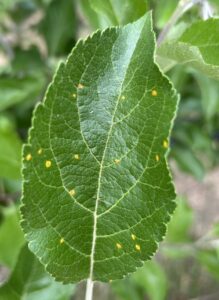
Figure 1. Cedar apple rust lesions forming on apple leaves.
Powdery mildew is present in some orchards and needs to be managed through July (Figure 2). If you see apple scab lesions on your cluster leaves, products such as Merivon, Luna Sensation, Prophyt, or Inspire Super can be applied to burn them out. These products also work well on powdery mildew. In periods of hot days with high humidity and no rain, sulfur (e.g., Microthiol Disperss at 10 lb./A) can be applied.

Figure 2. Powdery mildew on apple leaves.
Fire blight: Where shoot blight symptoms are present, it is appropriate to prune out infected shoots. Do not cut out infections during wet weather, as bacteria can spread through water. The recommendation is to cut back to last year’s growth, at least 12” back into healthy tissue, and to sterilize pruners between cuttings.

Figure 3. Bitter rot on developing fruit.
Rots: Hot, humid weather will increase the risk of fruit rots, including white rot, bitter rot, black rot, sooty blotch & flyspeck. Bitter rot has been observed in southern county orchards (Figure 3).
Broad-spectrum fungicides, such as captan and ziram, are effective, and adding single-site products such as Merivon, Luna Sensation, Pristine, Omega, and Aprovia may improve control. The addition of phosphonate products such as ProPhyt or Rampart to captan sprays can improve control of rots and other summer diseases, including sooty blotch and flyspeck. It may help suppress scab infections when present.
Marssonina Blotch, Glomerella Leaf Spot, and Frogeye Leaf Spot: Maintain coverage of captan, manzate, or ziram before rain events through the growing season according to the cover spray rule of applications every 2” of rain or 14 days, whichever comes first.
Insect Update
Codling Moth (CM): Biofix has been set for southern counties as of April 20 and in northern counties as of May 5. Injury from the first generation has been reported in southern orchards (Figure 4). Second-generation timings are updated below. Consider management if >5 months/trap.
| Codling Moth Degree Day Timing – Second Generation | ||||||||
| Application and Insecticide Type | ||||||||
| County Area | Biofix | Rimon:
75-100DD + 14-17 days later
|
Intrepid
1150 + 1450 DD Diamides – Altacor, Voliam mixes: (150-200 DD) |
Madex
1250 DD + every 7-9 days during brood hatch (later if first spray is an IGR) |
Standard Insecticides – Delegate, Avaunt, OP’s, carbamates, pyrethroids
1250 DD + 1550 DD
|
|||
| DD | 1150 | 1450 | 1250 | 1250 | 1550 | |||
| Southern | April 20 | N/A | N/A | 6/30 | 7/8 | 7/2 | 7/2 | 7/11 |
| Northern | May 5 | N/A | N/A | 7/3 | 7/10 | 7/5 | 7/5 | 7/13 |
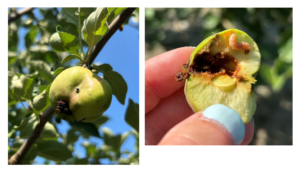
Figure 4. Codling moth injury and larva in developing fruit.
Scale: Crawler emergence continues and has increased in some orchards. Control options during crawler emergence include Neonicotinoids (suppression only), Sivanto, Esteem, and Centaur. See also the scale discussion under the peach section.
Woolly Apple Aphid (WAA); Green Apple (Spirea) Aphids (GAA): Populations continue to build in some orchards statewide, but on average remain below treatment levels. A treatment threshold is set at 50% of the terminals infested with live colonies. Predation by lady beetles and other predators has been observed and can help to maintain pest populations below damaging thresholds. As the terminals stop growing and harden, aphid populations should decrease. Movento will control WAA and GAA and can suppress scale when crawlers are active.
Potato leafhopper (PLH): Adults and nymphs are present and increasing in apple orchards throughout the state. Feeding damage from PLH results in “hopperburn” symptoms, which include browning & necrosis along leaf margins, along with leaf curling and stunting (Figure 5).
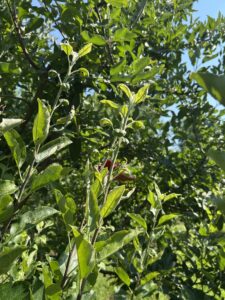
Figure 5. Potato leafhopper injury in new apple shoots.
Consider treatment, particularly on young, non-bearing fruit trees. The preferred materials for leafhopper control include Actara, Admire, Assail, Belay, Endigo, and Voliam Flexi.
Ambrosia Beetle: Trap captures continue to increase in some orchards, while other orchards, particularly in the south, have had a decrease in trap captures. Monitor signs of stress or infested trees with “toothpicks” from boring activity and consider trunk sprays if needed.
Dogwood borer: We continue to capture a high number of males in pheromone traps across orchards statewide. Mating disruption is recommended and effective for this pest and should be considered for next season in blocks with a history of infestation. Assail has demonstrated activity when targeting adults to reduce egg laying. See the 2026 Integrated Orchard Management Guide for Commercial Apples in the Southeast.
Traps
Average Trap Captures in Apple – Southern Counties
| Week | STLM | TABM | CM | OFM | DWB | AMBROSIA BEETLE | BMSB |
| 5/11/2026 | 18 | 11 | 6 | 3 | 25 | 2 | – |
| 5/18/2026 | 16 | 21 | 3 | 10 | 54 | 13 | – |
| 5/25/2026 | 1.3 | 23 | 2 | 2 | 71 | 7 | – |
| 6/1/2026 | 378 | 33 | 3 | 2 | 49 | 6 | 0.4 |
| 6/8/2026 | 258 | 11 | 2 | 1 | 61 | 21 | 1.2 |
| 6/15/2026 | 355 | 4 | 0.6 | 1.5 | 57 | 13 | 0.8 |
| 6/22/2026 | 178 | 5 | 0.6 | 2 | 54 | 8 | 1.2 |
Average Trap Captures in Apple – Northern Counties
| Week | STLM | TABM | CM | DWB | AMBROSIA BEETLE | BMSB |
| 5/11/2026 | 13.7 | 1.5 | 1.8 | 12.8 | 1.1 | – |
| 5/18/2026 | 8.3 | 13.25 | 2.4 | 18.5 | 10.8 | – |
| 5/25/2026 | 2.2 | 13.75 | 1.2 | 24.5 | 5.1 | – |
| 6/1/2026 | 25.1 | 24.3 | 3.4 | 23.8 | 9.4 | 0.3 |
| 6/8/2026 | 94 | 22.3 | 0.3 | 24.6 | 18 | 1.4 |
| 6/15/2026 | 68 | 22.3 | 1 | 22.6 | 14 | 1.1 |
| 6/22/2026 | 105.9 | 35 | 0.7 | 27.2 | 8.2 | 0.5 |
Pears
Disease Management
Foliar diseases should be managed with Mancozeb or Ziram, plus a single-site fungicide, to maintain pressure and inoculum at low levels, protecting fruit and maintaining a healthy orchard going into the next season. See the New Jersey Commercial Tree Fruit Production Guide for more information.
Where fire blight is present, it is appropriate to prune out infected shoots. Prune out strikes on dry, cooler days, cut back 8-12” back into healthy tissue, and sterilize pruners between cuts.
Insect Update
Pear psylla: Where psylla adults are still being found, options for control include Actara, Assail, and Belay (IRAC group 4A); Sivanto Prime (IRAC group 4D); Delegate (IRAC Group 5); and products containing abamectin (IRAC group 6). Other options include Movento (IRAC Group 23). The addition of 0.25-1 gal of summer oil may improve control. Avoid applying oil at high temperatures, and do not mix with captan. Be sure to read and follow the label instructions for adding penetrants to products.
Peaches
Disease Management
Bacterial spot: This disease is still present in some orchards and can be found on developing fruit (Figure 6).
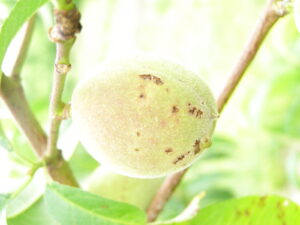
Figure 6. Bacterial spot on developing peach fruit.
Peach scab: Maintain good coverage with captan or other effective fungicides until July in orchards where scab was previously an issue.
Brown Rot: Most growers should rely on a captan-based program for mid-season covers, followed by better materials during the last 3 weeks pre-harvest when fruit is present. See the NJ Commercial Tree Fruit Production Guide for more information.
Insect Update
Oriental Fruit Moth (OFM): A biofix point for OFM was set on 4/7 for southern counties and 4/15 in northern counties. Treatment timings targeting the second generation are shown in the table below.
| OFM 2nd Generation Timing | ||||
| Insecticide Type | ||||
| County/Region | Degree Days by 6/29 base 45 | Conventional
1150-1200 1450-1500 |
Intrepid/Rimon
1050-1150 1300-1400 |
Diamides/Virus
1075-1150 1375-1450 |
| Gloucester – Southern | 1258 | 1st –past
2nd – past |
1st –past
2nd – past |
1st –past
2nd – past |
| Middlesex – Northern | 1363 | 1st – past
2nd – 7/2-7/3 |
1st – past
2nd – 6/27-7/1 |
1st – past
2nd – 6/29-7/2 |
Japanese Beetles: Japanese beetles have been observed feeding in orchards. Products containing imidacloprid (Admire Pro, Leverage 360) are effective and have a short preharvest interval.
Scale: Crawler emergence is active in orchards across the state. If crawlers are present, treatment options include Movento, Esteem, Centaur, Sivanto, and neonicotinoids (for suppression only). Movento, Esteem, and Centaur should be applied at the start of crawler emergence.
Thrips: We continue to observe moderate thrips activity in orchards throughout the state. Delegate or Entrust at the highest labeled rate are the usual recommended materials for thrips present in stone fruit. Lannate also has activity on thrips. These materials all have short PHI’s and may be applied close to harvest where injury is observed.
Tarnished plant bugs and other catfacing insects: Insects are active, but new fruit feeding injury has been minimal.
Lesser and Greater Peach Tree Borers: We continue to trap high numbers of both species. If this has been a historical pest in your orchard, mating disruption is recommended. Continue monitoring and managing as usual in problem blocks with mating disruption or trunk sprays.
Traps
Average Trap Captures in Peach – Southern Counties
| Week | OFM | TABM | LPTB | PTB | BMSB |
| 5/11/2026 | 5 | 10 | – | – | – |
| 5/18/2026 | 4 | 20 | – | – | – |
| 5/25/2026 | 2 | 20 | 31 | 1 | – |
| 6/1/2026 | 4 | 46 | 28 | 3 | 0 |
| 6/8/2026 | 8 | 13 | 25 | 3 | 0.75 |
| 6/15/2026 | 5 | 6 | 13 | 3 | 0.75 |
| 6/22/2026 | 6 | 4 | 23 | 7 | 1 |
Average Trap Captures in Peach – Northern Counties
| Week | OFM | LPTB | PTB |
| 5/11/2026 | 4.4 | 24 | 0 |
| 5/18/2026 | 2.4 | 16.5 | 0.2 |
| 5/25/2026 | 0.7 | 8.75 | 0.1 |
| 6/1/2026 | 1.8 | 11 | 0.5 |
| 6/8/2026 | 0.6 | 8.5 | 0.05 |
| 6/15/2026 | 3.5 | 9.7 | 1.2 |
| 6/22/2026 | 3.4 | 7.4 | 1.6 |
Blueberries
Insect Update
Scouting was conducted last week across 180 commercial and organic blueberry fields in Burlington and Atlantic Counties. Field evaluations focused primarily on inspecting fruit for insect injury and assessing aphid infestations on new vegetative terminals. Aphid populations increased compared with the previous week, although average colony sizes remain low, with approximately 1–5 aphids per infested shoot (Table 1).
Table 1: Aphid Infestation on New Terminals
| Aphids % Terminal Infestation | ||
| Avg | High | |
| 5/23 | 1.5 A | 14 |
| 5/29 | 2.83 A | 38 |
| 6/6 | 2.189 A | 30 |
| 6/12 | 1.9 A | 26 |
| 6/20 | 2.9 A | 54 |
| 6/27 | 3.07 A | 56 |
| Aphid Colony Size: A: 1-5, B: 6-10, C: 11-15, D: >16 | ||
Trap Monitoring
Although spotted-wing drosophila trap captures remain low compared to previous years, SWD remains the primary target for insecticide applications at this time (Table 2). For management recommendations for SWD in blueberry and other berry crops, reference Rutgers Cooperative Extension Factsheet FS1246 and SWD Insecticides for Berries.
Table 2. Spotted-Wing Drosophila and Blueberry Maggot Traps
| Spotted-Wing Drosophila | Blueberry Maggot | |||||||
| Atlantic County | Burlington County | Atlantic County | Burlington County | |||||
| Avg | High | Avg | High | Avg | High | Avg | High | |
| 6/6 | 8.99 | 35 | 2.86 | 7 | 0.03 | 1 | 0 | 0 |
| 6/12 | 9.9 | 46 | 3.7 | 25 | 0 | 0 | 0 | 0 |
| 6/20 | 10.24 | 48 | 8.22 | 35 | 0 | 0 | 0 | 0 |
| 6/27 | 6.96 | 78 | 3.6 | 18 | 0 | 0 | 0 | 0 |
Table 3. Sharp-nosed Leafhopper and Oriental Beetle Traps
| Sharp-nosed Leafhopper | Oriental Beetle | |||||||
| Atlantic County | Burlington County | Atlantic County | Burlington County | |||||
| Avg | High | Avg | High | Avg | High | Avg | High | |
| 6/6 | 1.42 | 16 | 1.25 | 7 | 5.78 | 35 | 2.57 | 14 |
| 6/12 | 0.56 | 12 | 4.8 | 46 | 62 | 340 | 47 | 170 |
| 6/20 | 0.88 | 6 | 1.44 | 12 | 411 | 2025 | 403 | 2025 |
| 6/27 | 0.77 | 9 | 0.37 | 2 | 243 | 2025 | 458 | 2025 |
Scale: We continue to monitor scale crawler activity for both terrapin scale and Putnam scale. We observed a decline in crawler activity (Table 4) and scale infestations on fruit (Table 5).
Table 4. Scale Traps
| Putnam | Terrapin | |||
| Avg | High | Avg | High | |
| 5/23 | 36.85 | 230 | 1.8 | 8 |
| 5/29 | 65.17 | 352 | 21.2 | 41 |
| 6/6 | 136.25 | 402 | 75.25 | 84 |
| 6/12 | 164 | 639 | 96 | 202 |
| 6/20 | 102 | 288 | 85 | 167 |
| 6/27 | 45 | 193 | 32 | 119 |
Table 5. Scale infestation on fruit
| Scale % infestation on fruit | ||
| Avg | High | |
| 6/12 | 0.13 | 2.1 |
| 6/20 | 0.19 | 5.7 |
| 6/27 | 0.06 | 1.5 |
Diseases
The IPM team has observed anthracnose on ‘Duke’ blueberries, as well as mummy berry and Alternaria fruit rot. Alternaria incidence can increase due to injuries from mechanical harvesting, which create entry points for infection.
| % Mummy Berry Infested Fruit | % Anthracnose Infested Fruit | % Alternaria Infested Fruit | ||||
| Avg | High | Avg | High | Avg | High | |
| 6/20 | 0.03 | 0.9 | 0.06 | 2.5 | 0.004 | 0.7 |
| 6/27 | 0.007 | 0.3 | 0.08 | 2.2 | 0.07 | 3 |
For blueberry production and management recommendations, please reference the recently revised 2026 Commercial Blueberry Pest Control Recommendations for New Jersey.
Grapes
Insects
We continue to capture Grape berry moth in pheromone traps, which have slightly increased in number, indicating adults are actively in flight. Applications for GBM using Intrepid or Diamides should be made at 810 DD base 47°F from wild grape or native grape varieties (Concords were at trace bloom on 5/19 in southern counties). Other effective materials can be applied a few days later. We are past the projected treatment window as predicted by the NEWA Grape Berry Moth model; however, you can monitor bunches to determine if further treatment is needed. Check especially on edge rows near the woods. If 5% of clusters show damage, then treatment is justified.
Japanese beetle pressure is increasing in vineyards throughout the state. Vines with well-developed canopies can withstand some Japanese beetle pressure, but where vines are stressed and vigor is reduced, see the NJ Commercial Grape Production Guide for more information on insecticides effective against this pest.

