2021 NJ Ag/VGANJ Convention Virtual Educational Sessions – Tues

Day 1 is in the books. Tomorrow we start again. Please join in via the following links.

Access for all morning sessions begins at 9am Tues Feb 23 here:  https://go.rutgers.edu/iexg7ly5

Like Monday, once you’ve logged in you will be directed to ‘breakout rooms’ for each of the morning sessions. While you’re waiting please listen to a few welcoming remarks from our Interim Executive Dean Dr. Laura Lawson, Director of Rutgers Cooperative Extension Brian Schilling, NJDA Secretary Douglas Fisher, and Vegetable Growers Association president John Banscher, as well as some instructions and housekeeping rules. The program sessions will begin at 9:15am.

All links are also available for every session at vganj.com/schedule or the direct link to the agenda page is https://go.rutgers.edu/yw2aminv. NOTE that the morning sessions are all through the same link, but afternoon sessions each have a unique Zoom link that will be seen directly next to the agenda for that session.

If neither of those options work, here is the agenda and links for Tueday’s sessions:

2021 NJ Ag/VGANJ Virtual Convention – Educational Sessions Agenda
Tues Feb 23, 2021 – 9:15am-11:45am
Access ALL MORNING sessions HERE

https://go.rutgers.edu/iexg7ly5

Organic Production
9:15-9:30am-Welcome & Intro
9:30-10:00am-Soil Health & Organic Sweetpotato Production
10:00-10:30am-Managing Allium Leaf Miner for Organic Onions
10:30-10:45am-What’s New from Industry/Break
10:45-11:15am-Satisfying the Sulfur Needs of Crops
11:15-11:45am-Balancing Safety and Nutrition in Organic Foods

New Orchard Establishment I
9:15-9:30am-Welcome & Intro
9:30-10:00am-Overview of Resources Available to New Tree Fruit Growers in New Jersey
10:00-10:30am-Orchard Site Selection and Pre-Plant Preparation
10:30-10:45am-Web Soil Survey – An Efficient Tool to Understand Native Properties of the Soil
10:45-11:15am-Orchard Integrated Pest Management (IPM) Basics
11:15-11:45am-Orchard Management in the Early Years – Principles & Practices

Hemp
9:15-9:30am-Welcome & Intro
9:30-10:00am-Rutgers First Hemp Trials – Observations & Future Direction
10:00-10:30am-Marketing Considerations for Industrial Hemp Production in NJ
10:30-10:50am-Laboratory Services for the Hemp Industry in New Jersey
10:50-11:15am-Hemp Diseases in NJ – What We Know
11:15-11:45am-Hemp Production in NJ – Challenges & Opportunities (Panel Discussion)

2021 NJ Ag/VGANJ Virtual Convention – Educational Sessions Agenda
Tues Feb 23, 2021 – 12:00pm-1:00pm
Access AFTERNOON sessions individually
Pesticide credit sessions require logging in within 10 minutes of start and remaining through the entire session
to be eligible for credits.
Pesticide Regulatory Review for Pesticide Applicators, Businesses,
and Agricultural Employers

https://go.rutgers.edu/cl0zmui7
(1 hour for 2 CORE credits)
Pat Hastings
A thorough review of regulatory requirements for pesticide applicator certification, recertification, and licensing
in New Jersey, including administrative changes to license renewal processes.

Tues Feb 23, 2021 – 1:00pm-3:45pm

Weed Control
https://go.rutgers.edu/p4yk2e17
(pesticide recertification credits: 4 Cat 1A; 4 Cat 10; 4 PP2)
1:15-1:30pm-Welcome & Intro
1:30-2:00pm-Weed Management Update for Row crops
2:00-2:30pm-Electrical Weeders & Potential Use in Specialty Crops
2:30-2:45pm-What’s New from Industry/Break
2:45-3:15pm-Taking Advantage of Plant Weaknesses for Improved Weed Control
3:15-3:45pm-Weed Management Update for Vine Crops

New Orchard Establishment II
https://go.rutgers.edu/iexg7ly5
1:15-1:30pm-Welcome & Intro
1:30-2:00pm-Panel Discussion-Growers’ Perspectives on Delving into Tree Fruit Production
2:00-2:30pm-Organic Apple Production – Is it Feasible in NJ?
2:30-2:45pm-What’s New from Industry/Break
2:45-3:15pm-Economics of Tree Fruit Production
3:15pm-Q&A/Adjourn

Specialty Crops
https://go.rutgers.edu/rxr924oy
(pesticide recertification credits: 1 CORE)
1:15-1:30pm-Welcome & Intro
1:30-2:00pm-Using Demographic Information to Identify Specialty Crop Markets
2:00-2:30pm-African Marigolds for Fall Markets
2:30-2:45pm-What’s New from Industry/Break
2:45-3:15pm-New Crops – RU Hot Peppers & More
3:15-3:45pm-Pesticide Safety & Regulatory Update for 2021

Tues Feb 23, 2021 – 4:00pm-6:00pm
NJ Dept Health
Training Required for Farmers/Market Managers

https://go.rutgers.edu/am5l29pm

2021 NJ Ag/VGANJ Convention Virtual Educational Sessions – Mon

We’re ready to go! Are you?

Access for all sessions begins at 9am Mon Feb 22 here:  https://go.rutgers.edu/bs9ohbuk

Once you’ve logged in you will be directed to ‘breakout rooms’ for each of the morning sessions, but while you’re waiting hear a few welcoming remarks from our Interim Executive Dean Dr. Laura Lawson, Director of Rutgers Cooperative Extension Brian Schilling, NJDA Secretary Douglas Fisher, and Vegetable Growers Association president John Banscher. The program sessions will begin at 9:15am.

Don’t worry if you miss where to go because you’ll be able to find every link to every session at vganj.com/schedule. Click on the black ‘schedule’ button, then on the session you’d like to join, and it will take you to the page with the Zoom link for that session. NOTE that the morning sessions are all through the same link, so if you don’t see the link next to the session, scroll to the top of the page to find it for that morning. Afternoon sessions will each have a unique Zoom link that will be seen directly next to the agenda for that session.

If you’re new to Zoom meetings, or haven’t been on one for a few months, you might need to download the newest version or update the app on your mobile device. You will be prompted to do so if you try to enter one of the rooms without it, and it should be a simple click or two to complete the update. Easy enough if you wait until you first try to get in, but we strongly recommend that you click on the link above to see if it works now rather than waiting to find out at the last minute Monday morning.

Also, if you’re new to Zoom, our IT support team at Rutgers Continuing Education Center at Atrium recommends checking out one or more of these online tutorials so you can get familiar with using it.

On behalf of the NJAES Extension Vegetable Working Group and colleagues coordinating these sessions, and the VGANJ officers and directors, we hope you will enjoy this virtual conference and look forward to ‘seeing’ you online this coming week. Actually, maybe not ‘seeing’ as video will be turned off for all except speakers/moderators, but that also reminds me — be sure to know how to use the ‘chat’ feature as that will be the primary mode to get questions to speakers.
Here we go!

USDA Announces More Specialty Crops, Nursery Crops, Cut Flowers Eligible for CFAP Payments

The U.S. Department of Agriculture (USDA) announced today that additional specialty crops, including nursery crops and cut flowers, are covered by the Coronavirus Food Assistance Program (CFAP) and that the deadline to apply for the program is extended to September 11th. [Read more…]

Specialty Crops Producers Can Now Apply for Financial Assistance Through USDA’s Coronavirus Food Assistance Program

USDA Agricultural Marketing Service sent this bulletin at 05/26/2020 03:31 PM EDT

Agriculture marketing serviceWASHINGTON, May 26, 2020-–Specialty crops producers can now apply for USDA’s Coronavirus Food Assistance Program (CFAP), which provides direct payments to offset impacts from the coronavirus pandemic. The application and a payment calculator are now available online and USDA’s Farm Service Agency (FSA) staff members are available via phone, fax and online tools to help producers complete applications. The agency set up a call center in order to simplify how they serve new customers across the nation. Applications will be accepted through August 28, 2020.

Through CFAP, USDA is making available $16 billion for vital financial assistance to producers of agricultural commodities who have suffered a five-percent-or-greater price decline due to COVID-19 and face additional significant marketing costs as a result of lower demand, surplus production, and disruptions to shipping patterns and the orderly marketing of commodities.

We also want to remind producers that the program is structured to ensure the availability of funding for all eligible producers who apply. In order to do this, producers will receive 80 percent of their maximum total payment upon approval of the application. The remaining portion of the payment, not to exceed the payment limit, will be paid at a later date nationwide, as funds remain available.

Producers can download the CFAP application and other eligibility forms from farmers.gov/cfap. Also, on that webpage, producers can find a payment calculator to help identify sales and inventory records needed to apply and calculate potential payments.

Additionally, producers in search of one-on-one support with the CFAP application process can call 877-508-8364 to speak directly with a USDA employee ready to offer assistance. This is a good first step before a producer engages the team at the FSA county office at their local USDA Service Center.

Applying for Assistance

Producers of all eligible commodities will apply through their local FSA office. Those who use the online calculator tool will be able to print off a pre-filled CFAP application to sign and submit to your local FSA office either electronically or via hand delivery. Please contact your local office to determine the preferred method. Producers can find contact information for their FSA county office by visiting farmers.gov/CFAP and using the Find Your Local Service Center tool at the bottom of the page.

Documentation to support the producer’s application and certification may be requested after the application is filed. FSA has streamlined the signup process to not require an acreage report at the time of application and a USDA farm number may not be immediately needed.

 Additional Commodities

USDA is also establishing a process for the public to identify additional commodities for potential inclusion in CFAP. Specifically, USDA is looking for data on agricultural commodities, that are not currently eligible for CFAP, that the public believes to have either:

  1. suffered a five percent-or-greater price decline between mid-January and mid-April as a result of the COVID-19 pandemic,
  2. shipped but subsequently spoiled due to loss of marketing channel, or
  3. not left the farm or remained unharvested as mature crops.

More information about this process is available on farmers.gov/cfap.

 More Information

To find the latest information on CFAP, visit farmers.gov/cfap or call 877-508-8364.

USDA Service Centers are open for business by phone appointment only, and field work will continue with appropriate social distancing. While program delivery staff will continue to come into the office, they will be working with producers by phone and using online tools whenever possible. All Service Center visitors wishing to conduct business with the FSA, Natural Resources Conservation Service, or any other Service Center agency are required to call their Service Center to schedule a phone appointment. More information can be found at farmers.gov/coronavirus.

###

JUST RELEASED – INTERIM COVID-19 Guidance For Migrant & Seasonal Farmworkers, Their Employers, & Housing Providers

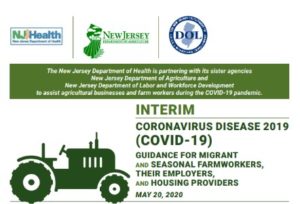
Cover 5-20-2020 NJ DOH Interim Guidance for Migrant-Seasonal Farmworkers

My apologies for not including our nursery growers that may also be impacted by this guidance when originally posted last week.

NJ Dept of Agriculture Secretary Douglas Fisher just announced, “At 3:30 today, we just received final approval to release the attached official guidance on migrant seasonal farmworker housing.”

The New Jersey Department of Health is partnering with its sister agencies New Jersey Department of Agriculture and New Jersey Department of Labor and Workforce Development to assist agricultural businesses and farm workers during the COVID-19 pandemic.

Please review the attached document carefully. This is titled INTERIM CORONAVIRUS DISEASE 2019 (COVID-19) GUIDANCE FOR MIGRANT AND SEASONAL FARMWORKERS, THEIR EMPLOYERS, AND HOUSING PROVIDERS.

Adopt these recommendations carefully for the protection of not only your workforce, but for you, your family and the entire ag community.


JUST RELEASED – INTERIM COVID-19 Guidance For Migrant & Seasonal Farmworkers, Their Employers, & Housing Providers

Cover 5-20-2020 NJ DOH Interim Guidance for Migrant-Seasonal FarmworkersNJ Dept of Agriculture Secretary Douglas Fisher just announced, “At 3:30 today, we just received final approval to release the attached official guidance on migrant seasonal farmworker housing.”

The New Jersey Department of Health is partnering with its sister agencies New Jersey Department of Agriculture and New Jersey Department of Labor and Workforce Development to assist agricultural businesses and farm workers during the COVID-19 pandemic.

Please review the attached document carefully. This is titled INTERIM CORONAVIRUS DISEASE 2019 (COVID-19) GUIDANCE FOR MIGRANT AND SEASONAL FARMWORKERS, THEIR EMPLOYERS, AND HOUSING PROVIDERS.

Adopt these recommendations carefully for the protection of not only your workforce, but for you, your family and the entire ag community.