Vegetable IPM Update 5/08/25

Sweet Corn

We’ve put out corn earworm pheromone traps throughout the state. While silking corn is the main target of CEW activity, we set the traps early to detect overwintering moths, which have become more common with warmer winters. As a reminder, we’re no longer using blacklight traps as of this year, and we’ll be reporting pheromone trap counts in the Plant Pest Advisory as the season progresses.

Cole Crops 

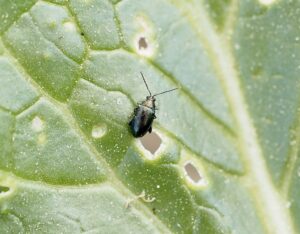
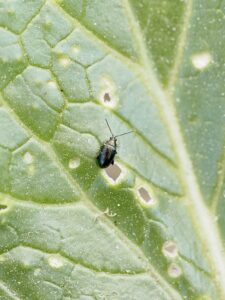
A shiny black beetle with straight antennae stands on a leaf surrounded by circular feeding holes.

Flea beetle surrounded by feeding damage. Picture by Maria Cramer.

Flea beetle are active in various cole crops. This year, they have been especially prevalent in Napa cabbage and bok choy. Young plants are especially vulnerable to attack from flea beetles. The treatment threshold for flea beetles in heading cole crops is 50% infestation.
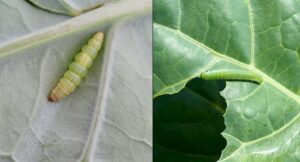
 

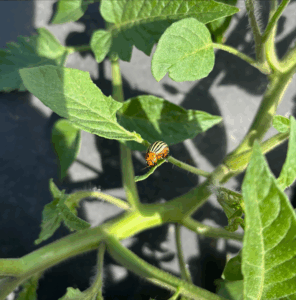
Two picture, the picture on the left shows a smooth caterpillar that tapers at both ends. The picture on the right shows a caterpillar that is fuzzy all over and does not taper at either end.

Left: Diamondback moth caterpillar, showing characteristic tapering at each end. Right: Imported cabbageworm caterpillar showing characteristic fuzziness. Pictures by Maria Cramer.

We’re seeing caterpillar activity (imported cabbageworm and diamondback moth) in cabbage and other cole crops. Treatment thresholds vary between crops and growth stage, but for heading cole crops between early vegetative and cupping, the treatment threshold is 30%. At this stage, sprayable Bt products (IRAC 11A) such as Dipel, Xentari, or Javelin can be effective on young caterpillars. Other materials approved for caterpillar control include Entrust/Radiant (IRAC 5), Proclaim (IRAC 6), Torac (IRAC 21A), and Exirel (IRAC 28). For Bt products and contact insecticides, coverage on the undersides the leaves is essential.


Tomatoes

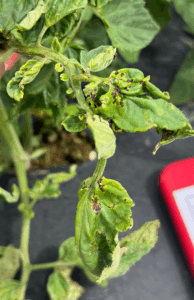
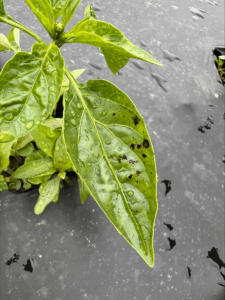
In high tunnel tomatoes, we’re seeing limited aphid, thrips, and spider mite activity. If dealing with primarily aphids, products such as Beleaf (IRAC 29) are recommended, especially if plants have reached the flowering stage. For thrips, Entrust, Radiant (IRAC 5) and Torac (IRAC 21A) can be used. For spider mites, Nealta (IRAC 25) is an effective material that is more friendly to beneficial insects, but Portal (IRAC 21A) and other materials can be used to manage populations.


Please consult the Mid-Atlantic Commercial Vegetable Production Guide for a more comprehensive list of materials that are labeled for specific crops and pests. As always, be sure to follow label rates and application instructions.

Authors: Amanda Quadrel (Northern NJ Veg IPM coordinator) and Maria Cramer (Southern NJ Veg IPM coordinator)
 

REMINDER – Vegetable Research Plot Tour at RAREC Tonight

Wednesday, August 24, 2022, 4:30 pm (meet at the shelter near the parking lot)

Rutgers Agricultural Research & Extension Center

121 Northville Rd., Bridgeton, NJ (Upper Deerfield)

PESTICIDE CREDITS approved for this event:  

1A  (AGRICULTURAL PLANT)                     – 07
10  (DEMONSTRATION & RESEARCH)      – 07
PP2  (PRIVATE APPLICATOR CATEGORY)   – 07

4:30 – Welcome and Intros – Rick VanVranken, Atlantic County Agricultural Agent

5:00 –  8:30 pm Tour of research plots and discussions with Rutgers Extension Specialists

Thierry Besancon, PhD, Extension Weed Specialist for Specialty Crops

  • Cover-Crops for Row Middle Weed Management in Plasticulture Tomato.
  • Cover-Crops for Row Middle Weed Management in Plasticulture Cucumber.
  • Crop Safety of Delayed Preemergence Herbicide Application for Cole Crops (Broccoli and Cabbage)

Andy Wyenandt, PhD,  Specialist in Vegetable Pathology

  • Bacterial Leaf Spot Development in Pepper and Tomato in NJ
  • Copper Resistance Development in Bacterial Leaf Spot
  • Basil Downy Mildew Breeding Program Update
  • Bell and Non-bell Phytophthora Tolerance Trials

Joe Ingerson-Mahar, PhD, Vegetable IPM Coordinator

  • Comparing the response of corn earworm to GMO and non-GMO sweet corn varieties and the resistance to BT corn


2022 Annual Vegetable Twilight Meeting & Research Tour

Wednesday, August 24, 2022, 4:30 pm (meet at the shelter near the parking lot)

Rutgers Agricultural Research & Extension Center

121 Northville Rd., Bridgeton, NJ (Upper Deerfield)

PESTICIDE CREDITS approved for this event:  

1A  (AGRICULTURAL PLANT)                     – 07
10  (DEMONSTRATION & RESEARCH)      – 07
PP2  (PRIVATE APPLICATOR CATEGORY)   – 07

4:30 – Welcome and Intros – Rick VanVranken, Atlantic County Agricultural Agent

5:00 –  8:30 pm Tour of research plots and discussions with Rutgers Extension Specialists

Thierry Besancon, PhD, Extension Weed Specialist for Specialty Crops

  • Cover-Crops for Row Middle Weed Management in Plasticulture Tomato.
  • Cover-Crops for Row Middle Weed Management in Plasticulture Cucumber.
  • Crop Safety of Delayed Preemergence Herbicide Application for Cole Crops (Broccoli and Cabbage)

Andy Wyenandt, PhD,  Specialist in Vegetable Pathology

  • Bacterial Leaf Spot Development in Pepper and Tomato in NJ
  • Copper Resistance Development in Bacterial Leaf Spot
  • Basil Downy Mildew Breeding Program Update
  • Bell and Non-bell Phytophthora Tolerance Trials

Joe Ingerson-Mahar, PhD, Vegetable IPM Coordinator

  • Comparing the response of corn earworm to GMO and non-GMO sweet corn varieties and the resistance to BT corn


Update on Status of Dacthal Herbicide

DCPA (dimethyl tetrachloroterephthalate) is a selective preemergence herbicide used for control of annual grasses (foxtail, crabgrass, barnyardgrass, goosegrass, fall panicum) and some broadleaved weeds (purslane, common lambsquarters, pigweeds) in vegetable crops and ornamental turf. Commercial formulations of DCPA include Dacthal® Flowable herbicide. Dacthal® Flowable is labelled for use on the following vegetable and fruiting crop groups: cole leafy vegetables, seeded melons (cantaloupe, honeydew, watermelon), collards and mustard greens, horseradish and radish, onions, sweet potatoes, tomatoes and eggplants, strawberries.

  • What is happening with DCPA, the technical ingredient in Dacthal® Flowable herbicide from AMVAC?
    On April 27th the U.S. Environmental Protection Agency (EPA) published a notice of intent to suspend (NOITS) DCPA technical registration in the U.S. The basis for this action was that AMVAC had not provided multiple studies required during the registration review.
  • How did AMVAC and key grower stakeholders respond to this action by the EPA?
    According to FIFRA (Federal Insecticide, Fungicide, and Rodenticide Act), AMVAC and impacted stakeholders had the opportunity to
    appeal the NOITS within 30 days, which they did on May 27th. The purpose of the appeal was to obtain a hearing that would allow
    evidence from each side to be presented in front of an Administrative Law Judge (ALJ) appointed by EPA.
  • Did AMVAC and the grower stakeholders have the opportunity for a hearing?
    No. The assigned EPA administrative law judge (ALJ) ruled on Friday July 1st that the NOITS was upheld without requiring a hearing.
  • How will that impact end use formulated products like Dacthal Flowable herbicide?
    This decision does not impact formulated products (i.e., Dacthal Flowable). AMVAC’s customers can continue to sell, distribute, and
    apply Dacthal Flowable.
  • What happens now in this process concerning DCPA?
    The July 1st decision granted EPA the ability to suspend DCPA technical without requiring a hearing to examine AMVAC and
    EPA testimony. AMVAC will appeal this decision to the Environmental Appeals Board.
  • Is the registration of the end-use product Dacthal Flowable herbicide impacted by the NOITS?
    If you have used or plan to use end-use products containing DCPA, there are no consequences from that use or downstream
    consequence for the crop you applied it to, now or in the future, from NOITS activities. Applications of Dacthal Flowable end-use
    products remain legal and the established United States tolerances remain in place.
  • What are the next steps in this process? How will it impact the availability of Dacthal Flowable?
    AMVAC can continue to manufacture, sell, and distribute end-use products until notification of the appeal process has been completed. AMVAC’s customers can continue to sell, distribute, and apply Dacthal Flowable. AMVAC is commitment to continuing to exhaust all options to defend DCPA. Outside of any legal proceedings, AMVAC continues to generate and submit to EPA the data necessary to fulfill the Data Call-In (DCI) Notices required to complete registration review for DCPA, regardless of the suspension status.


ALERT – Alternaria leaf spot active on fall cole crops.

Alternaria leaf spot has been reported on broccoli this week. Weather conditions for the development of both diseases has been ideal. Preventative control  is recommended and growers should scout and apply protectant fungicides on a regular basis. Note, if Downy mildew is present use downy mildew specific fungicides in conjunction with fungicides for Alternaria leaf spot control. For more information on controlling Alternaria and Downy mildew, please see the 2020/2021 Commercial Vegetable Production Recommendations.

Alternaria leaf spot infection

Alternaria leaf spot infection. Note the yellow halo around each spot. Under ideal conditions black concentric rings will develop within each spot. These rings are the conidia which are then spread causing new leaf spots to develop.

Downy mildew

Symptoms of downy mildew on infected chinese cabbage leaf. Note the irregular chlorosis and browning of upper leaf surface. Under ideal conditions the pathogen will produce white spore masses only on the undersides of the leaf.

Residual Weed Control in Cabbage and Other Cole Crops

Good weed control in transplanted and seeded cole crops requires planning and the use of pretransplant or preemergence herbicide applications.

Cabbage treated pretransplant with Goal and never cultivated.

Cabbage treated pretransplant with Goal.  The crop was never cultivated.

Preplant incorporate Treflan HFP at 1 to 1.5 pt/A for seeded and up to 2 pt/A for transplanted, or apply Dacthal 6F at 6 to 14 pt/A or Prefar 4E at 4 to 9 qt/A preemergence or post-transplant to control annual grasses and certain broadleaf weeds. Choose Dacthal or Prefar in early spring when soils are cold and wet when Treflan may cause temporary stunting. Please make sure to check the label before mixing as these herbicides are registered for use only on certain cole crops.

Goal 2XL and GoalTender 4F are labeled for transplanting ONLY!.  Goal 2XL can ONLY be used pretransplant whereas GoalTender 4F can be used pre-transplant or post-emergence with a 24(c) Special Local Needs label on broccoli, cabbage and cauliflower in New Jersey (NJ 24(c) SLN GoalTender 4F). Build beds, spray, and transplant through the herbicide barrier. Use Prefar or Dacthal post-transplant for grass control. Treflan or Dual Magnum applied preplant incorporated may increase the risk Goal injury. Do NOT cultivate unless weeds appear. Incorporation of Goal reduces or eliminates the effectiveness of the product for weed control. Goal and GoalTender are registered for use only on certain transplanted cole crops.

Dual Magnum 7.62E has a 24 (c) Special Local Needs label for use on cabbage in New Jersey. Use Dual Magnum at the rate of 0.5 to 1.33 pt/A  depending on soil type. Use the lower rate on soils that are relatively coarse-textured or low in organic matter; use the higher rate on soils that are relatively fine-textured or high in organic matter. Apply to weed free soil in transplanted cabbage after transplanting, or to direct seeded cabbage when the seedlings have developed 3 to 4 true leaves. The delayed use in directed seeded cabbage reduces the risk of slight temporary stunting of the crop. Dual Magnum controls annual grasses, nightshade species, and galinsoga. Yellow nutsedge will be suppressed or controlled at the rates and use patterns on the Dual Magnum label for cabbage. To obtain a label, an indemnification agreement must be filled out on line agreeing not to hold the manufacturer responsible for crop damage. Obtain a copy of the label and complete the indemnification agreement on the Syngenta website. Register or sign in, select state and product, and submit. You will then be asked to select your crop before accepting or not the waiver of liability and indemnification agreement. You must have a copy of this 24(c) label if you want to use Dual Magnum on cabbage!

Consult the 2020/2001 Mid-Atlantic Commercial Vegetable Production Recommendations for rates and additional information.