Organic Farm Advisory

The Plant & Pest Advisory serves NJ growers by reporting on important pests and recommending responses that are grounded in reproducible trials.

Articles in this section contain information helpful to the NJ commercial organic grower.
Sharing organic practice trial results between land-grant universities is a cost effective way to create a common knowledge base built on the strengths of individual programs. In the sidebar, find institutions with programs in organic agriculture which augment knowledge developed at the Rutgers New Jersey Ag Experiment Station.

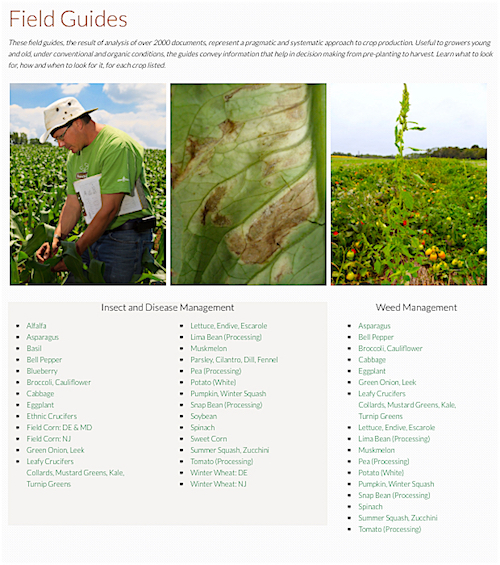
Rutgers Cooperative Extension Field Guides: These concise guides help with decision making from pre-planting to harvest. For each crop listed, learn what pests to proactively look for as the season progresses, how to look for them, and when to take action.

Field Guide List

IPM Update 5/03/23

Sweet Corn

There will be significant changes to insect trapping efforts in the Vegetable IPM Program for this season.  At present, personnel are deploying black light and corn earworm (CEW) pheromone trap networks in central and northern New Jersey counties.  In areas from central Burlington County southward, grower cooperators have been provided with CEW pheromone traps and will be monitoring these traps on their own properties and reporting catch data to IPM personnel.  This is an effort to maintain a statewide reporting program for the most significant economic pest of sweet corn despite a shortage of professional staff this year.  The IPM program thanks these growers in the southern counties for their assistance in maintaining this necessary service.

Black light trap derived maps for European corn borer (ECB), CEW and brown marmorated stink bug (BMSB) will not appear in the Plant and Pest Advisory, as there is no longer a statewide blacklight trap network.  Data from existing black lights in the central and northern counties will appear in table format, with associated information on the relevance of the populations.  Provided that  data from the southern CEW pheromone traps is available on a regular basis, maps will be generated for this pest/trap type.   Limited collections from traps thus far have not contained any target pests.
[Read more…]

Your Input Needed on Preharvest Water use in Produce

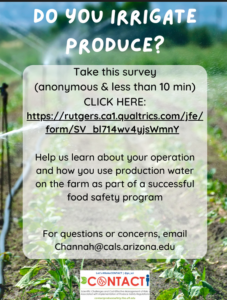
Do you irrigate produce?Survey link
Have questions about Subpart E or agricultural water?

The On-Farm Food Safety Team is involved in a national survey to find out:

  • Does the produce industry understand the rule?
  • What areas of the rule are still unclear to the industry.
  • How preharvest water is used and treated on farms across the U.S.

This survey will help us get a better understanding of what you know and how extension educators can assist the industry. Please take a few minutes and fill out the survey by clicking on the image to the right.

Allium leaf miner update: 04/06/23

Allium Leaf Miner (ALM)

Allium leaf miner feeding and egg laying injury was discovered on chives and garlic near Milford in Hunterdon County on Wednesday.  All weather stations on the NEWA network except for a few in the highest elevation sites in northern New Jersey have surpassed 250 growing degree days (GDD) base 39˚F.  39˚F is close to the lower developmental temperature (38.3˚ F) which our colleagues at Penn State recommend for predicting the first emergence of ALM adults.    In recent years, initial feeding/egg laying scars have been detected within a few days of local weather stations recording the 250 GDD threshold.  Growers who feel they may be impacted by this pest should check the accumulated GDD from local weather stations.   Growers in southern counties may reasonably assume there will be ALM activity in their area soon, if not already happening.  To determine GDD from local weather stations, the NEWA website https://newa.cornell.edu/ is very helpful.  From the NEWA home screen, select the nearest weather station from drop down menu at the center of the page.  Next, scroll down to “Weather Tools” on the right side of the page, and select “DD Calculator”.  Select your start date (1/01/23) and end date as well as Degree Day Type (39 F) from the menu at the left of the page.  The site will automatically generate the accumulated GDD base 39F to the last day of your requested sample, and then offer a forecast of accumulated GDD for the next week.

Deceased tree branch

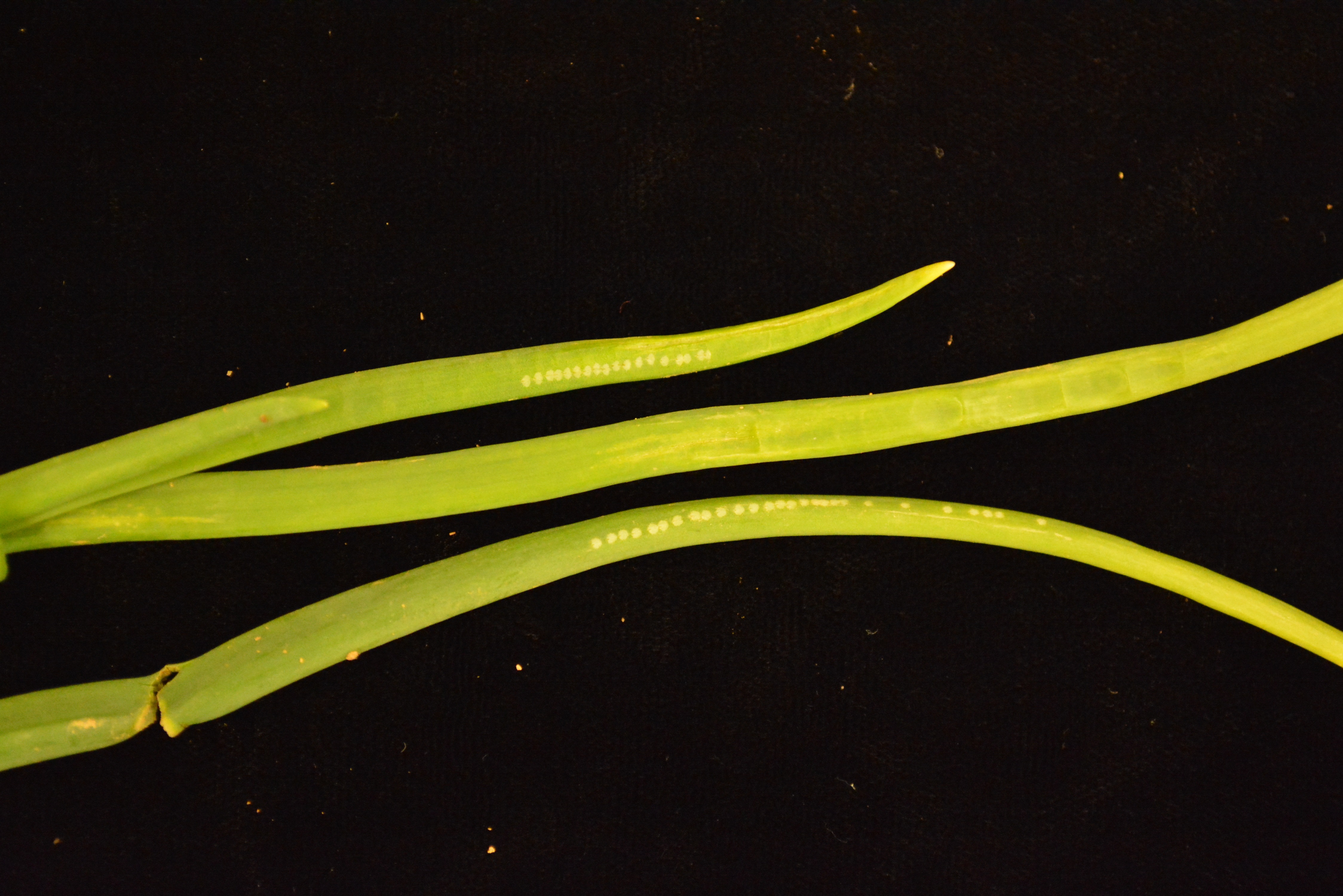
Photo: Sabrina Tirpak. Allium leafminer oviposition scars on onion

Growers should consider initiating the control method of their choice at this time.  Affected crops include chives, scallions, garlic, onions and leeks.  Look for neat rows of white spots descending from the upper tips of allium leaves (see photo at left).  Initial injury often occurs on the tallest leaves.  Under warmer, less breezy conditions, adults may be seen near the tips of leaves (see photo of adult at lower right).  Perennial chive beds are often the first, and most heavily infested alliums of the spring season, so this makes chives an ideal crop to confirm ALM adult activity.  At the Milford site this week, chives had feeding/egg laying scars on nearly 30% of leaves.  The garlic field, which was approximately a half mile away, exhibited only 2% infested plants.  A primary reason for this lower infestation rate in the garlic is that allium crops had not been grown in that field for several years.

Floating row covers, kept on until this flight ends will help minimize access to plants.  Insecticide applications targeting adults may be helpful as well, although frequency of applications is uncertain.  Spinosyn materials (Radiant, Entrust (OMRI approved)), pyrethroids (Mustang Maxx, Spider on leafWarrior), neonicotinoids (Scorpion, Venom), the diamide Exirel (section 2ee recommendation) and the insect growth regulator Trigard are labeled for miner control.

Adult activity and observations of feeding will be reported on in the IPM Update as they occur.


Free Webinar: Marketing Your Farm – Agritourism

Wednesday, March 29, 12-1pm Eastern Time

Rutgers Cooperative Extension is partnering with other New England states to deliver agritourism education. A free webinar will be held to help farmers learn the three essential components of marketing your farm, with a focus on agritourism. Myrna Greenfield is the “Top Egg” at Good Egg Marketing and the author of Marketing Your Farm: A practical guide to attracting loyal customers and increasing sales. Ellen Parlee is the co-owner of Parlee Farms in Tyngsboro, Massachusetts, which offers pick-your-own fruit and flowers, along with a farmstand, bakery, ice cream stand, animal petting area, and a food trailer for lunch. Ryan Wilson is the co-owner of DeMeritt Hill Farm in Lee, New Hampshire, which offers pick-your-own apples/peaches/blueberries/Xmas trees, hayrides, school tours, special events, Cross Country running, and hiking trails and has a full commercial kitchen. The farm plays host to Torey Roderick Performance Horses and every October, the world-famous Haunted Overload. Lisa Chase from University of Vermont Extension will moderate the session.

To register see: https://uvm-edu.zoom.us/webinar/register/WN_e3WWWaq9SoaQSR8nVkotdQ

This webinar is free, but registration is required.

Webinar: Incorporating Classes into Your Agritourism Business

Thursday March 23, 2023 12-1pm Eastern Time

Rutgers Cooperative Extension is partnering on a regional project with other New England Land Grant Universities to offer webinars related to agritourism in the northeast.

Join our speakers for Incorporating Classes into Your Agritourism Business, where they will share their experiences with offering, hosting, and teaching classes. As farm and food business owners, you are experts in your craft and likely face endless questions from customers and the public. Why not use this as an opportunity to offer classes, enabling your customers or the public to learn from your expertise? Classes can be tailored to a variety of topics and activities.

Susan Rigg is the owner of and cheesemaker at Whey River Creamery. Susan offers both introductory and advanced hands-on cheesemaking classes. Michele Capron is the co-owner of Lavender Essentials of Vermont. She offers numerous classes, including lavender wreath creations, cooking with lavender, native tea blending, herb garden, and make it – take it. Deb Hartshorn owns White Picket Farm LLC, offering a variety of class experiences, including soap making, creating terrariums, succulent bowls, and more!

To register go to: https://extension.psu.edu/incorporating-classes-into-your-agritourism-business

This webinar is free, but registration is required. You will need to create an account with Penn State Extension to register for this webinar.

Allium leaf miner update: 03/09/23

Allium Leaf Miner (ALM)

Allium leaf miner feeding and egg laying injury was reported on chives in southern Cape May County on Thursday.  The West Cape May weather station (closest station) has recorded 295 growing degree days (GDD) base 39˚F as of Thursday.  39˚F is close to the lower developmental temperature (38.3˚ F) which our colleagues at Penn State recommend for predicting the first emergence of ALM adults.  295 GDD at this temperature is in excess of the 250 GDD base 38.3˚ F that is the threshold for adult emergence and activity.   In recent years, initial feeding/egg laying scars have been detected within a few days of local weather stations recording the 250 GDD threshold.  Growers who feel they may be impacted by this pest should check the accumulated GDD from local weather stations.   Growers in southern counties may reasonably assume there will be ALM activity in their area soon, if not already happening.  To determine GDD from local weather stations, the NEWA website https://newa.cornell.edu/ is very helpful.  From the NEWA home screen, select the nearest weather station from drop down menu at the center of the page.  Next, scroll down to “Weather Tools” on the right side of the page, and select “DD Calculator”.  Select your start date (1/01/23) and end date as well as Degree Day Type (39 F) from the menu at the left of the page.  The site will automatically generate the accumulated GDD base 39F to the last day of your requested sample, and then offer a forecast of accumulated GDD for the next week.

Plant stem

Photo: Sabrina Tirpak. Allium leafminer oviposition scars on onion

Growers should consider initiating the control method of their choice at this time.  Affected crops include chives, scallions, garlic, onions and leeks.  Look for neat rows of white spots descending from the upper tips of allium leaves (see photo at left).  Initial injury often occurs on the tallest leaves.  Under warmer, less breezy conditions, adults may be seen near the tips of leaves (see photo of adult at lower right).

Floating row covers, kept on until this flight ends will help minimize access to plants.  Insecticide applications targeting adults may be helpful as well, although frequency of applications is uncertain.  Spinosyn materials (Radiant, Entrust (OMRI approved)), pyrethroids (Mustang Maxx, Spider on leafWarrior), neonicotinoids (Scorpion, Venom), the diamide Exirel (section 2ee recommendation) and the insect growth regulator Trigard are labeled for miner control.

Adult activity and observations of feeding will be reported on in the IPM Update as they occur.