Landscape, Ornamentals, Nursery, and Turf Edition
Seasonal updates on ornamental, nursery, and turf pests.
Subscriptions are available via EMAIL and RSS.
Companion Website Links:
 Rutgers Turf Blog - Articles on turfgrass diseases and cultural practices for the commercial turfgrass industry. Subscription available via RSS.
Rutgers Weather Forecasting - Meteorological Information important to commercial agriculture.
June 16, 2025 Andy Wyenandt
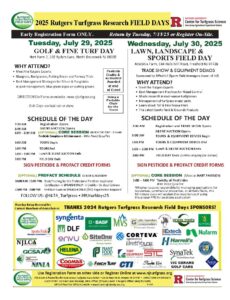
Forest Tree and Plant Identification Program Offered This Summer

Scan QR code or the link below!
Forest Tree & Plant Identification Outdoor Lessons for Land Stewards
Bagworms + PEST ALERTS (SCALE crawlers) + Ornamental IPM 5/27 Recording Upload
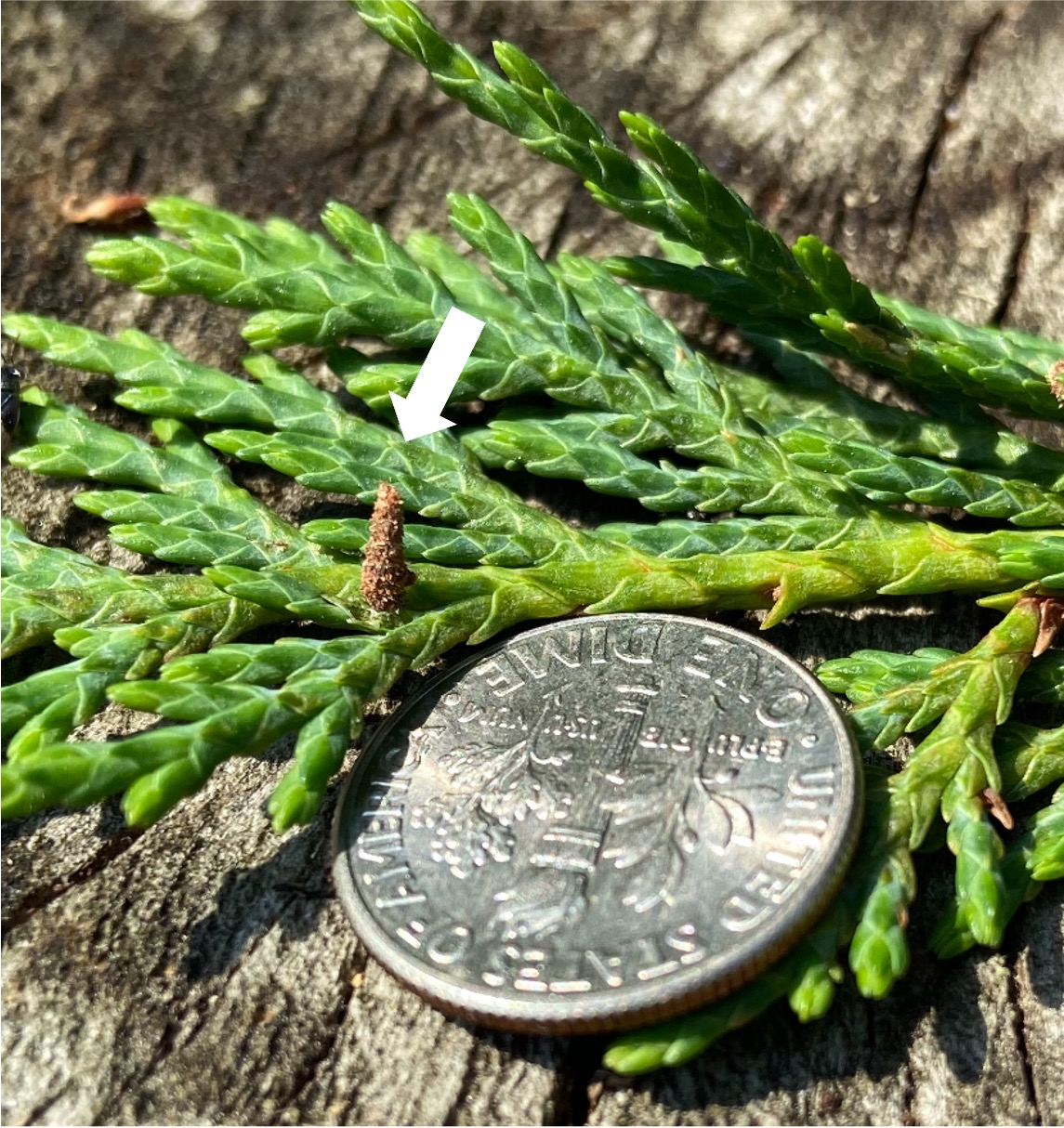
Bagworms should begin hatching NOW through – 4 weeks in NJ, beginning in the southern regions. Now is an optimal time to get this pest on your radar and prepare materials or approaches to attack first/second instar caterpillars. The control window for this pest is typically between 600-900 GDD50 when they begin to hatch and become airborne, i.e. the “ballooning” phase. It is important to check for egg-hatch prior to applications for greatest chemical efficacy, and to continue scouting as they often hatch and develop at asynchronous rates.
It is critical to target these insects EARLY! We need to target when they are as small as shown in the image.
Bagworm management – mechanical: If eggs have not hatched: hand-remove sacs/bags. Typically female/egg filled sacs are higher in the canopy so keep that in mind while scouting. This removes the problem from the field or landscape.
Treatment options for Lepidoptera (caterpillars) to have at the ready – containing: B.t. (Bacillus thuringiensis), spinosad , bifenthrin ), cyfluthrin, carbaryl, chlorantraniliprole, cyclaniliprole, cyclaniliprole + flonicamid, Lambda-cyhalothrin, cyantraniliprole, Indoxacarb. NOTE – Lethal pesticide doses are important, as sub-lethal doses can trigger early pupation, making the pest all but invincible to chemical or biological treatments. Follow label exactly.
Still time to Sign up for the 2025 – Rutgers Ornamental IPM Program
(Join us for the next Session Tuesday 6/10/25)
Note we have clearwing borer lures and wing or delta traps, scale crawler tape, and yellow sticky cards available to commercial grower program members at our Cumberland (twaller@njaes.rutgers.edu) and Monmouth (william.errickson@njaes.rutgers.edu) RCE offices.
ALERTS:
- Scale crawler emergence throughout the state
- Bronze Birch Borer (BBB) and Emerald Ash Borer approaching adult emergence
- Clearwing Borer adult flight – still capturing clearwings
- Red-headed flea beetle (RHFB) egg hatch – adult emergence
- Bagworm reminders – be vigilant
UPLOADS 5/27 SESSION: (contains information on flathead borers (Bronze Birch, Emerald Ash), Armored scales, bagworms, Volutella blight in Boxwoods, Mildews)
Previous webinars:
- Click here for a PDF of May 13, 2025 webinar (contains information on scales and oomycetes) Click here for VIDEO of May 13, 2025 webinar
- Click here for a PDF of April 22, 2025 webinar (contains information on RHFB and early Clearwing borer treatments) Click here for VIDEO of April 22, 2025 webinar
- Click here for a PDF of April 08, 2025 webinar (Contains information on aphids and boxwood leafminer) Click here for VIDEO of April 08, 2025 webinar
(click the ‘Read More’ below for complete dates in S-C-Northern NJ per pest)
High Temperatures Predicted this Coming Week – Ways to Prevent Heat Stress

Heat exposure for agricultural laborers should be a consideration when working outside and even in non-airconditioned buildings. When a person’s ability to adapt to heat stress is exceeded, exposure can lead to reduced productivity, mistakes in job performance, increased workplace incidents, and/or heat-related illnesses. Each person’s heat tolerance varies and several factors including type of physical activity, fitness level, underlying health issues, temperature, sun exposure, air movement (wind), and humidity can dramatically impact the potential for heat stress. To determine the level of heat risk, employers should consider the job, the environment, and the worker.
Evaluate the Risk of Heat Stress:
Monitoring the environmental conditions during work times to make management decisions for workers is an important part of preventing heat-related illnesses. Temperature is not the only factor in implementing heat stress management. Humidity is another important consideration. The heat index is a measure of how hot it feels when the relative humidity is factored in with the actual air temperature.
An environmental heat assessment should account for the following factors: air temperature, humidity, radiant heat from sunlight or other artificial heat sources, and air movement. OSHA recommends the use of wet bulb globe temperature (WBGT) monitor to measure workplace environmental heat. OSHA provides this link to calculate the WBGT for a specific location. There is also a NIOSH/OSHA Heat App for Android and iPhone devices that uses the Heat Index as a screening tool.
Management Suggestions for Enhancing Heat Tolerance:
Acclimatization (to heat) is a process of adaptation that involves a stepwise adjustment to heat over a week or sometimes longer. An acceptable schedule for achieving acclimatization is to limit occupational heat exposure to one-third of the workday during the first and second days, one-half of the workday during the third and fourth days, and two-thirds of the workday during the fifth and sixth days. The acclimatization procedure should be repeated if a person misses workdays after days off due to illness, vacation, or other reasons for missing one week or more of job duties.
Fluid replacement:
Provide adequate drinking water for all employees. Recommend to employees they drink plenty of water before work shifts, during work, and after work. Simply relying on feeling thirsty will not ensure adequate hydration. To replace the four to eight quarts of sweat that may be produced in hot environments, people require one-half to one cup of water every 20 minutes of the workday. Potable drinking water kept at a temperature of 59°F or less is recommended.
Physical Fitness: Physical fitness is extremely important. The rate of acclimatization is a function of the individual’s physical fitness. The unfit worker takes 50 percent longer to acclimate than one who is fit.
Increasing Safe Work Practices:
To find management and guidance tools for determining whether to implement heat stress management plans refer to the CDC documents on Heat Stress and Work/Rest Schedules.
The following list of management options should be considered to prevent heat stress for workers:
- Limit exposure time. Schedule as many physical work activities as practical for the coolest part of the day (early morning or late afternoon). Employ additional help or increase mechanical assistance, if possible, to lighten individual workloads.
- Minimize heat exposure by taking advantage of natural or mechanical ventilation (increased air velocities up to 5 mph increase the rate of evaporation and thus the rate of heat loss from the body) and heat shields/shade when applicable.
- Take rest breaks at frequent, regular intervals, preferably in a cool environment sheltered from direct sunlight. Anyone experiencing extreme heat discomfort should rest immediately and be provided with first aid for heat stress.
- Wear clothing that is permeable to air and loose fitting. Generally, less clothing is desirable in hot environments, except when the air temperature is greater than 95°F or a person is standing next to a radiant heat source. In these cases, covering exposed skin can reduce the risk of heat stress.
- A buddy system may also be helpful. It depends on a fellow worker’s ability to spot the early signs of heat stress, such as irritability, confusion, or clumsiness. A ready means of cooling should be available in work areas where heat illness might occur.
May 22, 2025 Jean Epiphan
Beech Leaf Disease Twilight Meeting June 2nd – Registration OPEN
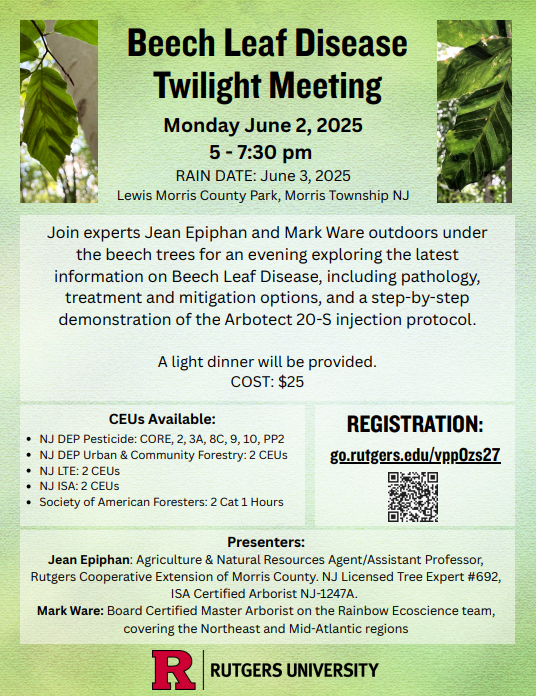
Beech Leaf Disease Twilight Meeting
Click here to Register
- Exact address will be sent after registration
- Beech Leaf Disease Twilight – flyer
Details:
- Monday June 2, 2025
- 5 – 7:30 pm
- RAIN DATE: June 3, 2025
- Lewis Morris County Park, Morris Township NJ
- A light dinner will be provided
- COST: $25
About: Join experts Jean Epiphan and Mark Ware outdoors under the beech trees for an evening exploring the latest information on Beech Leaf Disease, including pathology, treatment and mitigation options, and a step-by-step demonstration of the Arbotect 20-S injection protocol.
Presenters:
- Jean Epiphan: Agriculture & Natural Resources Agent/Assistant Professor,
Rutgers Cooperative Extension of Morris County. NJ Licensed Tree Expert #692,
ISA Certified Arborist NJ-1247A. - Mark Ware: Board Certified Master Arborist on the Rainbow Ecoscience team,
covering the Northeast and Mid-Atlantic regions
CEUs Available:
NJ DEP Pesticide: CORE, 2, 3A, 8C, 9, 10, PP2
NJ DEP Urban & Community Forestry: 2 CEUs
NJ LTE: 2 CEUs
NJ ISA: 2 CEUs
Society of American Foresters: 2 Cat 1 Hours

