Register for the NEW – 2025 Ornamental IPM Program PLUS Boxwood Blight, Pest emergence, Updates

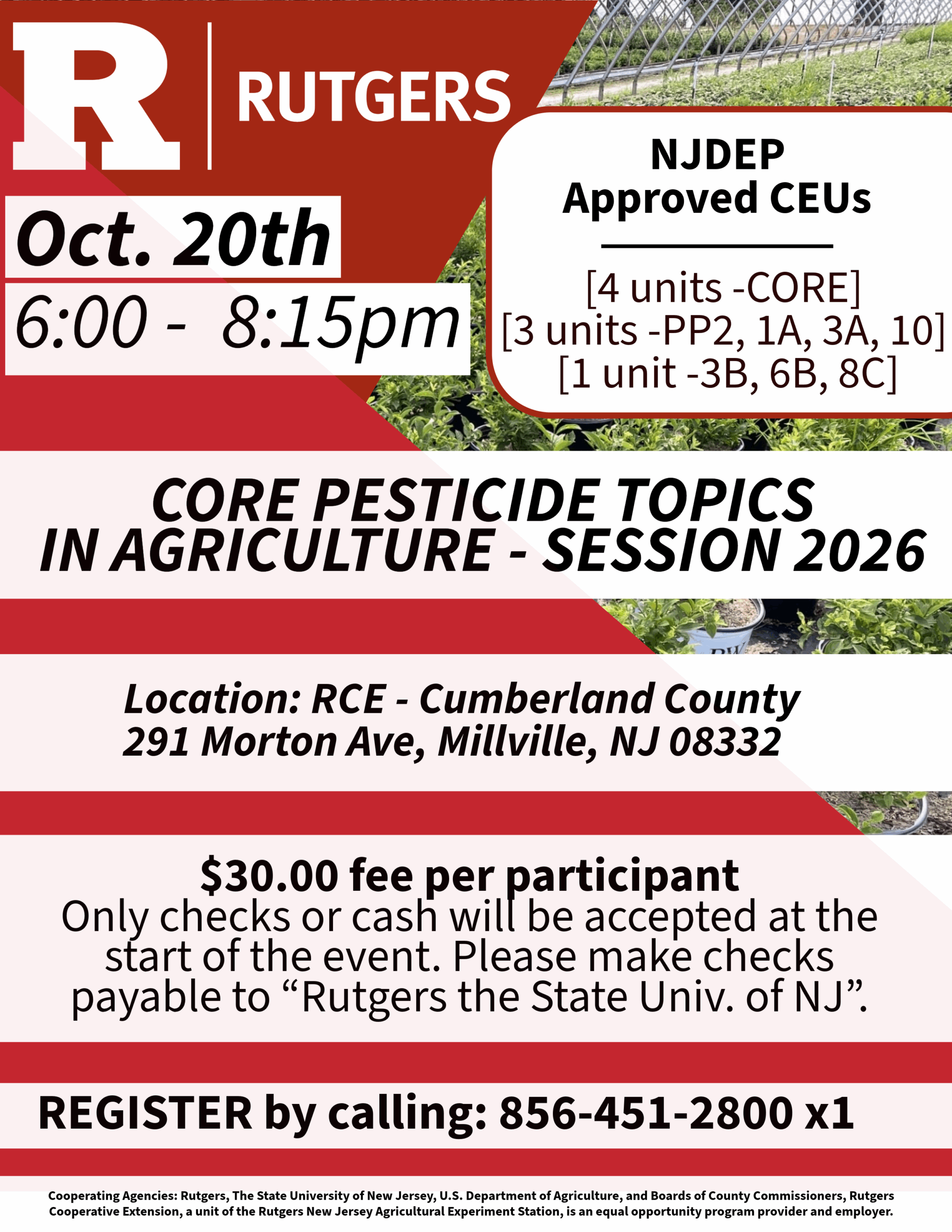
Ornamental IPM 2025 v1 flyer

Please consider signing up for the NEW 2025 – Rutgers Ornamental IPM Program.

The focus of this program is to provide timely updates on pest, disease, and weeds impacting commercial ornamental producers. The webinars will focus on the most important pests for a 2 week interval, will be recorded, and will be shared shortly thereafter with Spanish overdub (spoken word). The trap packages are in an effort to find grower led solutions for monitoring economically important pests throughout the multiple regions of New Jersey. Please consider joining this program for its inaugural year.

Registration includes:

  • Site visit to your ornamental nursery/farm from Rutgers agents
  • Delivered printed IPM resources (Guides, factsheets, bulletins)
  • Free pheromone & sticky trap kit + guidance on setup/monitoring
  • Access to live bi-weekly webinars (Zoom)
  • (First session NEXT TUESDAY 4/8 @ 12PM)
  • Every Second and Fourth, Tuesday, April through September
  • Webinars will be recorded – posted later with Spanish overdub

This program is free, however registration is required.

click here to Register

Boxwood Blight Risk Assessment as of 3/4/2025
Region Location CODE 31-March 1-April 2-April 3-April 4-April 5-April
Southern Upper Deerfield NJ50 Very Low  Very Low  Very Low  Low Minor Risk Very Low 
Central Howell / Freehold NJ10 Minor Risk Very Low  Very Low  Low Minor Risk Very Low 
Northern Wantage NJ79 Low Very Low  Very Low  Low Risk Very Low 
M T W TH F S
 Please check YOUR LOCAL risk (click here)

Please download and print the Rutgers Nursery and Landscape Pest Scouting Guide  or  Conifer and Christmas Tree Pest Scouting Guide and refer to this post “Obtaining your local growing degree-days (GDD)” for additional information.  (See pest scouting guides for complete list of references) 

Please SHARE what you SEE!! If you see a pest, disease, otherwise interesting or troublesome issue please report it to the Working Group by following the QR Code on the front of the Pest Scouting Guides or by filling out this reporting form.

Keep reading for more resources!


[Read more…]

Preparing Orchards Against the Frost – Low Tech Strategies

Frost is common in the northeastern US. However, frost events during bloom, specifically in orchard crops, can be economically devastating. Often, the cause is a few hours below the injury threshold temperature for the developing buds, as cooler nights result in the rapid loss of thermal energy. Several passive or low-tech strategies can help maintain a slightly higher orchard floor temperature and potentially prevent substantial crop loss.

Site selection is the most effective frost protection method. When planning a new orchard, selecting a site with proper cold air drainage is the most valuable decision a grower can make and enjoy the rewards for many years. Cold air drainage is essential, so avoid buying a site or planting trees on the site that accumulate cold air. Also, identify areas where the cold air moves in and out. When possible, plant early blooming varieties in the least frost-prone areas and plant delayed and or extended bloom varieties in frost-prone areas.

Table 1. Relative temperature differences are influenced by orchard floor conditions (Courtesy, Robert Crassweller, PSU).

Do not invite the frost with excess vegetation and ground cover. The management of weeds along the row and sod between the rows will influence orchard temperatures. The bare ground will absorb more heat during the day and release more heat at night than soil covered in vegetation (Table 1). During the day, 45-50% of solar radiation gets reflected or absorbed by the atmosphere, and the earth absorbs the remaining 50-55%. Vegetation reduces this heat transfer to the soil because it reflects light before it can reach the soil surface. Removing tall weeds and windbreaks along the edges of orchards will also help improve airflow and limit the accumulation of cold air pockets in some areas of the orchard. This can be particularly important during spring bloom when just a few more degrees can make the difference between killing the flowers or not!

Extremely low grass cutting: Maintaining sod between the rows at a minimum height by frequently mowing will help with frost protection. Similarly, keeping the rows weed-free by using postemergence herbicides to kill emerged weeds and removing weed residues from the previous season will maximize the warming of the soil by solar energy during the day. Maintaining weed-free rows should also be considered by applying residual herbicides in the fall. Depending on herbicides applied in the fall, this will prevent or reduce weed emergence in early spring and give you more flexibility for applying your residual and postemergence herbicides in spring. 

The cold air drain machine has a fan that pulls cold air from the surrounding ground and pushes it into the sky. This is effective in a lower section of the orchard or the end of the vineyard where the cold air drains due to a slight slope. Placing the machine in the middle of the orchard may prove ineffective as the pulled cold air could settle back into the orchard unless there is a low inversion layer to mix with warmer air. Using the cold air drain machine can enhance the effectiveness of low grass cutting. The machine costs around $15,000, and its operating cost is much less than other active frost protection methods.

Wet soil slows the release of thermal energy on frost night. However, the soil profile must be thoroughly wet. This can be achieved by irrigating the soil to field capacity (maximum water holding capacity of that soil). Also, the temperature must be warmer during the preceding days to pack sufficient heat into the soil. Sandy soils store less energy than loamy soils because there is more air space between soil particles than loamy soils. Heavier soils may require more than 8–10 hours of irrigation to reach field capacity.

Delayed pruning delays bud development, which helps avoid damage from early spring frosts. Years of observation in commercial orchards in the northeast indicate that more buds survive after a frost event, specifically in peaches, if the pruning is delayed. Often, large farm operations begin pruning early in the dormant season due to labor availability and time constraints. In such cases, avoid pruning upper branches until the risk of a late freeze has passed. Also, avoid hard blossom thinning on peaches on lower branches or blossom thinning altogether. Instead, focus only on fruit thinning, which can serve as insurance against crop loss. Remember that any available crop will likely command a good price in frost years.

Combining the above methods can have a cumulative effect on overall frost protection in the orchard. Keeping trees healthy with proper nutrient and pest management is also important. Healthy trees may still lose a crop but are more likely to survive the next season than poor vigor and diseased trees. The success of Frost Protection will also depend on understanding each method’s working principles and the combination of environmental factors necessitating its use. The bulletin https://njaes.rutgers.edu/e363/ explains what to monitor before a frost event and active frost protection methods such as irrigation, heat application, and air mixing.

White Pine Weevil Adults Become Active During the Early Weeks of Spring

Many arborists & landscapers often find it difficult to prevent white pine weevil pests (Pissodes strobi), because they are typically applying fertilizer & dormant oil treatments during the control window. In NJ, the control window against feeding white pine weevil adults occurs in March & April. Adults overwinter in the duff beneath trees. The WPW adults will often crawl or sometimes fly to the top terminal leaders of pine, spruce, or Douglas-fir trees. Eastern white pine & Norway spruce species are the most severely attacked & the death of the terminal leaders of these trees will often occur.

Often by July, an infested terminal will brown & die as the weevil larvae have destroyed the vascular tissues. (Photo Credit: Steven K. Rettke, Rutgers Coop. Ext.)

Treatment timing is critical with this pest, and controlling the adult female before egg laying is necessary. Apply preventative sprays (e.g., pyrethroids) only to the terminal leaders during this time. Before mating & egg laying, adults will feed by chewing holes within the central leader, causing a characteristic pitch flow that becomes white when dry. Then females will lay eggs in new cut-out holes within the top 12 inches of the leader just below the terminal bud.

White pine weevil adults will feed within the upper terminal leaders & cause pitch flow that when dries has a white appearance. This is an early symptom that adults are active & control materials need to be applied. (Photo Credit: Steven K. Rettke, Rutgers Coop. Ext.)

[Read more…]

Black Knot Fungus of Prunus: A Common Landscape Disease

Overview:

Black knot is a cankering fungus disease that infects many trees and shrubs within the genus Prunus. It is caused by the native North American fungal pathogen Apiosporina morbosa. Although black knot fungal galls have been found in a couple of dozen Prunus species, not all species are equally susceptible, and it can be most destructive to certain varieties of cherries and plums (Photo 1).

The following species can be highly susceptible to infections: Japanese plums (Prunus salicina), European and American plums (Prunus domestica & Prunus americana), Sweet cherry (Prunus avium), Mahaleb cherry (Prunus mahaleb), and cultivated species of chokecherries.

This blog reviews the symptoms and signs of Black Knot Disease. It’s management by pruning and fungicide treatments is discussed. Finally, a handful of resistant plum varieties is provided.

Photo 1: This Japanese Plum species is highly susceptible to Black Knot Disease.

Photo 1: This Japanese Plum species is highly susceptible to Black Knot Disease. (Photo Credit: Steven K. Rettke, Rutgers Coop. Ext.)

[Read more…]

Approaching 2025 Boxwood Blight Season

March weather is always unpredictable, however, if we have sustained periods of increased temperatures and spring rains, boxwood blight (BWB) will become an issue quickly.

New – [pictorial tri-fold] Common Boxwood Pests and Diseases (click-here). This includes Box Tree Moth images. Print the PDF out double-sided, then fold. We are working to have a better resolution print of this material very soon.

If you suspect Boxwood Blight and would like to have this verified – please contact the Rutgers Plant Diagnostic Laboratory (click here) for sample submission instructions

Boxwood Blight Risk Assessment as of 3/4/2025
Region Location CODE 3-March 4-March 5-March 6-March 7-March 8-March
Southern Upper Deerfield NJ50 Very Low  Very Low  Low Minor Risk Very Low  Very Low 
Central Howell / Freehold NJ10 Very Low  Very Low  Low Minor Risk Very Low  Very Low 
Northern High Point NJ59 Very Low  Very Low  Very Low  Minor Risk Very Low  Very Low 
M T W TH F S
 Please check YOUR LOCAL risk (click here)

There is a minor potential for boxwood blight infections this Wednesday & Thursday, throughout ALL of NJ. Incoming rains, coupled with warmer temperatures may initiate boxwood blight infections this week.

  • It is time to begin protective fungicide applications in boxwoods throughout the state if you have not already done so. 

  • If BWB is important to your business Use the USPEST – PUSH Alerts – (click here) – to setup weekly email alerts. Create an account, watch the tutorial, and then set up your subscriptions. You select which locations (as many as you like), days you want to receive emails, and what you would like to receive alerts about (BWB and a variety of other pests and diseases). Rutgers is not directly affiliated, however this is an incredible tool. 

[Read more…]

Southern NJ Nursery Round Table : Next Monday & Delaware BTM Updates

Nursery Round Tables – I am hosting these free events at the Cumberland RCE (291 Morton Ave, Millville NJ)

Free RSVP here: https://forms.office.com/r/hJhesNgBxv Or RSVP at: 856-451-2800 ext 1.
February 10th – Hands on Growing Degree-days. We are going to sit down with computers (I have 10+ laptops), our cellphones, and a tablet to see how easy it is to use GDD calculators. We will then compare with the Rutgers Pest Scouting Guides (this is the guide;  https://plant-pest-advisory.rutgers.edu/wp-content/uploads/2023/03/LONT-PSG-DISTRIB-2023.pdf)
  • Like the idea of using growing degree-days, but are unsure how to use the online calculators or other resources – THIS IS FOR YOU. On Monday 2/10 – we will be using laptop computers (I have 12 on-site), tablets, and smart cellphones to access and explore online growing degree-day calculators. We will then use the Rutgers Pest Scouting Guides to line up when to expect these pests and will discuss treatment opportunities with overlapping pest populations.

    -Each person will use all three technology methods to obtain their local growing degree-days. – By the end of the training you will be able to access and utilize this powerful tool anywhere.
February 24th – 2025 Playbook: We will be discussing emerging threats like Box Tree Moth and numerous plant diseases we need to be prepared for. The session will conclude with a 30-minute CORE credit session. 1 unit – CORE obtained-only.
Note you don’t HAVE to be from southern NJ, however I would appreciate you being with a nursery or other commercial ornamental operation. I just want to facilitate thoughtful communication. Registration greatly appreciated.

____________________________________________________

ALL DELAWARE NOW QUARANTINED (DA-2024-47)(as of 12/4/24)

Subject:           APHIS Establishes Box Tree Moth (Cydalima perspectalis) Quarantines in Delaware and Pennsylvania

To:                   State, Tribal, and Territory Agricultural Regulatory Officials

Effective immediately, the Animal and Plant Health Inspection Service (APHIS), in cooperation with the Delaware Department of Agriculture and the Pennsylvania Department of Agriculture (PDA), is adding the entire State of Delaware and Erie County, Pennsylvania to the box tree moth (BTM; Cydalima perspectalis) quarantined area. APHIS is taking this action in response to the confirmed detections of BTM in a residence in Little Creek, Delaware, on July 11 and in Lakeside Cemetery in Erie, Erie County, Pennsylvania, on August 29. PDA has established an intrastate quarantine area for BTM that parallels the Federal quarantine. This Federal Order supersedes Federal Order DA-2024-17.

The attached Federal Order (click here) and additional information about BTM are located on the APHIS box tree moth webpage. For additional information, you may contact:

Matthew Travis
National Policy Manager
580-240-5394
matthew.a.travis@usda.gov

If you see, or think you see this pest, or its damages in New Jersey please contact:

  • RCE -Cumberland Co. Nursery Agent: Tim Waller – twaller@njaes.rutgers.edu
  • Nursery Inspection Program Manager: Sarah Katzenbach –  sarah.katzenbach@ag.nj.gov  (609) 406-6939

Please educate yourself about this in-bound pest here – Resources: