Managing Heat Stress in Nursery and Landscape Plants

With temperatures approaching or exceeding 95oF for many areas of the state, there is potential for heat stress to negatively impact nursery and landscape plants both in the ground and in containers. Most trees and shrubs in our area can begin to experience some degree of heat stress when temperatures exceed 85oF. Several factors can influence the extent of heat stress injury, including the severity and duration of high temperatures, relative humidity, wind, soil moisture status, the age and condition of the plant, and how well the particular species of plant is adapted to dealing with these conditions.
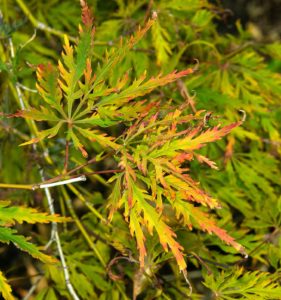
Japanese Maple

Leaf Scorch on Japanese Maple caused by heat stress. Photo Credit.

Heat stress can cause damage to the leaves, resulting in dried or curled edges, as well as reddish or pale coloration as the green chlorophyll pigment begins to break down. This damage may only be superficial, but in some cases it could cause serious injury and death of the leaf tissue. One factor that greatly affects the severity of tissue damage caused by heat stress is the hydration status of the plant before the onset of extreme temperatures.

Plants will naturally dissipate heat through the process of transpiration, provided there is adequate moisture in the soil to support this function. During periods of extreme temperatures, the roots will struggle to draw enough water from the soil to keep up with the rate of water vapor that is exiting the leaves through transpiration. This leads to symptoms such as leaf scorch, curled leaves, discoloration, defoliation, die-back, and temporary wilting. Because the plant is experiencing stress and a disruption in its normal physiological functions, it becomes more susceptible to insect and disease problems.

There are several preventative measures that can be taken to reduce the impacts of heat stress in nursery and landscape plants.

  1. Thoroughly water plants either in the evening or in the early morning before extreme temperatures occur. Water the plants deeply and use irrigation methods that minimize leaf wetness to reduce the potential for foliar diseases.
  2. Properly mulch plants to conserve water in the soil and help lower soil temperatures. Bark mulch, leaf mulch, straw, and other organic mulches will help to lower the temperature in the root zone, while gravel mulches can actually increase root zone temperatures. Be sure to provide additional water to newly mulched plants to prevent dry mulch from taking moisture away from the roots.
  3. Avoid fertilization during periods of heat stress because this can absorb moisture in the root zone and further contribute to dehydration of the plant.
  4. Avoid applying herbicides that can volatilize in high temperatures and drift, causing damage to non-target species.
  5. Pay special attention to plantings that are located next to driveways, concrete patios, or other structures that can absorb and radiate additional heat to the plants. These areas will likely require additional irrigation.


Additional Resources:

How to Protect Trees and Other Landscape Plants from Heat Stress
Reducing Heat Stress to Container Grown Plants

Natter’s Notes: Heat Stress

Hot Weather Takes a Toll on Georgia Landscapes

Make Sure Your Farm or Ranch Counts – And is Counted!

Did you know that according to the 2019 State Agriculture Overview for NJ, 3,900 acres of peaches yielded 5/tons per acre at a value of over $25.6 million dollars? Or that 3,500 acres of peppers were harvested in 2019, with a value of $45.8 million dollars?  Or that 9,300 acres of harvested blueberries were valued at $85.3 million dollars in 2019?  And in 2018, NJ ranked 4th nationwide in cranberry and peach production, and third in bell peppers?

[Read more…]

Participants Wanted for a Redheaded Flea Beetle Survey

The Southern Nursery Flea Beetle Working-Group has put out a survey under the auspices of University of Georgia. The Universities of Maryland and Delaware recently joined forces with that working group with the goal of gathering information aimed at suppressing this continually destructive pest. If you have seen redheaded flea beetle in your containerized nursery stock please take this short survey. Ultimately the goal is to gather as much information as possible about this pest in an effort to come up with better recommendations for all of us in the industry.

Click here to take the survey

Please contact Tim Waller (twaller@njaes.rutgers.edu) with any questions, severely damaged plant varieties, or personal observations pertaining to pest control and biology.

Thank you

NJ Ag & Health Urge Use of Free COVID-19 Testing For Farm Workers

Earlier this week, NJ Secretary of Ag Douglas Fisher released this attached letter, co-signed by Dept of Health Commissioner Judith Persichilli, urging all growers with farm labor to take advantage of opportunities to help protect your employees from COVID-19.

As the letter states,

“One program that is being implemented FREE OF CHARGE for all farms is a COVID-19 testing and education program through Federally Qualified Health Centers (FQHCs) and local health departments. Along with free testing, the program provides education and other related support services. [Read more…]

Azalea Leafminer: A Commonly Unrecognized Azalea Pest Problem

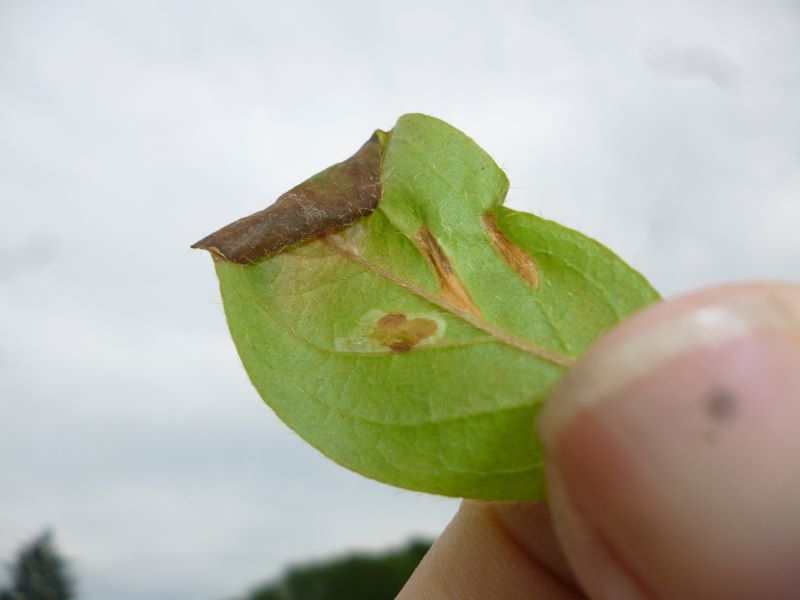
The Azalea Leafminer (Caloptilia azaleella) produces plant symptoms that are typically subtle & can often be overlooked. Symptoms from this caterpillar can also confuse people by having both leafminer & leafroller stages. The early instar stages are leafminers, while the later instar stages are leafrollers or leaftiers. Commercial nurseries generally have more concerns with this pest, while they often receive little attention in the landscape. Although the Azalea Leafminer has 2+ generations per year, the azalea (Rhododendron genus) is the only known host of this native caterpillar having the unique one-two punch.

Symptom of Azalea Leafminers

Azalea Leafminers: Symptom stages from 3 leafmines & a single leafroller (Photo Credit: Steven Rettke of RCE)

[Read more…]

Prevailing landscape disease; Entomosporium Leaf Spot on woody ornamentals

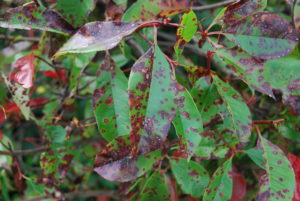
Entomosporium Leaf Spot

Photo: Rich Buckley

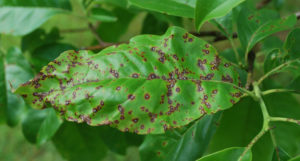
It was brought to my attention this morning that many landscapers and plant professionals are concerned by a reddening and spotting discoloration condition on Photinia foliage. Most often this is caused by the fungal pathogen Entomosporium maculatum, a widespread and destructive foliar disease of woody ornamentals in the rose family (including Photinia, Indian Hawthorn, Loquat, flowering and fruiting Pear, Firethorn, Hawthorn, Juneberry, and Quince). This pathogen discolors foliage to an unsightly red, orange, and black spotting that ultimately leads to premature defoliation. The spots will eventually turn necrotic and fungal structures will be visible within those areas (little black dots).


Entomosporium Leaf Spot

Photo: Rich Buckley

The pathogen can be active from late winter to late fall, favoring conditions that promote humidity and reduced airflow. The pathogen survives on infected leaves (attached or dropped). Typically it takes approximately 2 weeks for symptom development to occur post infection. Therefor the heavy discoloration we are seeing right now is the culmination of multiple infection events, where protectant fungicides were not used or were used correctly.

This means that another round of infections will occur again soon in severely infected locations as the spots will give rise to a new generation of spores.


Disease management (fungicides): Ideally, protectant fungicide applications would have been initiated every 7-14 days post bud break until all leaves had matured. However, in the current situation many people will be playing catch up. Fungicide applications initiated now will not make the symptoms go away or ‘cure’ the plant, but they are required now to protect foliage from the next wave of fungal infections and reduce the overall population. In severely infected plantings, fungicide applications should be continued every 10-14 (depending on fungicide label) days throughout the remainder of the season, especially in high value plantings or in specimen blocks. If winter conditions are unseasonably warm and humid, then applications should continue accordingly. Systemic fungicides should also be considered in addition to protective and cultural control mechanisms in severe cases.

Fungicides: 

ROTATE between Fungicide Resistance Action Committee (FRAC codes)

Format: [FRAC code]: Chemical name (Trade names)

  • [M05]: Chlorothalonil (Daconil WS)
  • [M05 + 1] Chlorothalonil + Thiophanate methyl (Spectro 90WDG)
  • [1] Thiophanate methyl (Clearys 3336)
  • [11] Azxystrobin (Heritage 50W)
  • [3] Myclobutanil (Eagle 40W)
  • [3] Propiconazole (Banner Maxx)
  • [3] Triadimefon (Bayleton 50, Strike 50WDG)
  • [1 + M03] Thiophanate methyl + Mancozeb (Duosan 79W)
  • [M03] Mancozeb
  • [M01] Copper Oxychloride + Copper Hydroxide (Badge SC, many)

IT IS CRITICAL TO ROTATE BETWEEN FRAC CODES DUE TO THE NUMBER OF POTENTIAL APPLICATIONS

Always refer to the label for allowable host crops, use-restrictions, application rates, reapplication intervals, re-entry intervals (REI), and mix compatibility information.

DISCLAIMER: Production and pesticide information on this site are for commercial operators and landscape professionals only and are NOT for home gardener use. Provided materials represent examples and do not cover all possible control scenarios. Please contact your local agent or chemical sales representative for more information.

Click here for a list of materials available to both homeowners and licensed pesticide applicators

Cultural prevention and mitigation:

  • Remove leaf-litter prior to bud break. During the season remove leaf litter only when dry. Infected leaves serve as inoculum for the next season. In severely infected plantings remove and replace mulch as fungal material can be deposited within the litter. Do not use leaf blowers to remove leaf-litter (all that does is spread around the spores).
  • Avoid overhead irrigation. Water moving through the canopy represents at least two dangerous plant pathogen situations; increased leaf wetness that lets pathogens infect successfully, and movement of spores (from sporulating leaves and young growth).
  • Increase airflow. Like all plant diseases, any situation that increases airflow, will decrease leaf wetness. This could include pruning, decreasing the density of plants, greater spacing, and planting/rearing site selection.
  • Pruning in heavily infected plants. In addition to promoting increased air flow, heavy pruning may be required to remove overwintering inoculum from the plants. This should only be done during dry conditions, preferably during plant dormancy periods.


For sample identification please contact the Plant Diagnostic Lab here at Rutgers.

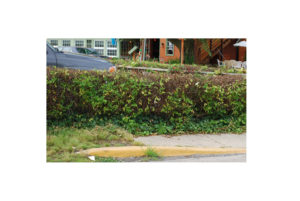
Plant diagnostic lab

Photo: Rich Buckley

For more information and tips please visit:

Controlling Entomosporium Leaf Spot on Woody Ornamentals

Photinia Leaf Spot – Prevention And Treatment Of Common Photinia Bush Diseases

My Photinia Leaf Has Spots?

Entomosporium Leaf spot of Photinia and Indian Hawthorn

LSU: Entomosporium Leaf spot

Entomosporium Leaf Spot Diagnostic Guide


Timothy J. Waller, Ph.D. (twaller@njaes.rutgers.edu)