Fruit Crops Edition

Seasonal updates on diseases, insects, weeds impacting tree fruit and small fruit (blueberry, cranberry, and wine grape). Fruit Pest Alerts are also available via this category feed.
 
Subscriptions are available via EMAIL and RSS.

Activity Periods of Cranberry Insect Pests in New Jersey

This chart illustrates the periods of insect pest activity in cranberries in New Jersey. These are general guidelines based on knowledge on pest biology and field experience. The actual period of activity for any given pest may vary from year to year depending on the time when the spring flood water is removed from bogs, seasonal weather conditions, and other (biotic and abiotic) factors.

Activity of cranberry pests

Seasonal activity of insect pests of cranberries

Tree Fruit IPM Report for March 31, 2021

Tree Fruit Phenology:

Tree fruit phenology is about normal based on historical observations. In southern counties some early blooming varieties are at Pink to about 20% bloom. Redhaven was at bud swell on March 29, about 6 days later than the median observation date. Plums are in bloom and Pears are at Green Cluster. Red Delicious is at 1/2 Green Tip, which is about a week early. So it is time to start applying delayed dormant and blossom protection applications. [Read more…]

Attention Tree Fruit Growers!

Ask the Expert Series Orchard Edition

Please Join us for an Interactive Discussion on Tree Fruit Thinning

QR code

April 7: 9AM-10:15 AM

Zoom Link: https://go.rutgers.edu/tdi8pllm

Meeting ID: 974 2422 2622Password: 808726

Join by Phone: 1 646 558 8656


Expert Panelists
Win Cowgill, Professor Emeritus, Rutgers University and owner Win Enterprises International, LLC a Pomology and Horticultural Consulting firm
and
Jon Clements, Commercial Tree Fruit Extension Educator at The University of Massachusetts

Topics will include Apple fruit thinning with plant growth regulators, crop load management, return bloom, fruit growth model and Cornell Carbohydrate Models as tools for thinning and update on PGR’s Available for 2021

This will be part presentation followed by an INTERACTIVE discussion.

Prior to Wednesday April 7, Please E-mail ALL of your Tree Fruit Thinning Questions to:
Megan Muehlbauer muehlbauer@njaes.rutgers.edu
or
Hemant Gohil gohil@njaes.rutgers.edu
Prepare to have a lively interactive discussion between the experts and your fellow New Jersey tree fruit growers!

On Farm Readiness Reviews (OFRR) Available to Produce Growers

As part of the Food Safety Modernization Act (FSMA) the New Jersey Department of Agriculture in coordination with Rutgers Cooperative Extension are again offering an OFRR to any operation that has taken the Produce Safety Alliance (PSA) Training.  The PSA training is required for fresh produce operations to comply with FSMA with sales over $25,000.  We have been doing OFRRs over the last two years (approximately 100) and want to continue this service during 2021.  So, what is the OFRR?  It is a walkthrough of the farm operation to assess where it may need for make changes to comply with FSMA prior to an inspection.  Generally, two individuals will be on the assessment team one from Extension and one from the New Jersey Department of Agriculture.  These reviews take approximately 2 hours and is scheduled to fit into the grower’s time.  To schedule a review email Charlotte Muetter at charlotte.muetter@ag.nj.gov.  She will then contact the farm operation to schedule the review.

On-Farm Food Safety Talks for the Busy Grower

The Rutgers On-Farm Food Safety Team has developed three video presentations.  Clip on  Three On The Go Webinars For the Busy Grower  to view the three videos listed below.

 Introduction to Food Safety Modernization Act (FSMA) and USDA Audits.  Find out the differences between FSMA inspections and USDA audits. Who do they apply to and who does the inspection or audits?

Building Your One-Way Street: Backflow Prevention and Your Farm.  Learn what backflow is, how to evaluate your operations and how to prevent problems with backflow to protect your packed produce.

How to Use Best Practices for On-Farm Recordkeeping.  Tried and true strategies for organized record keeping that complies with FSMA and will prepare you for USDA audits.

What water test do you need and how often do you need to do it?

FSMA Produce Safety Rule compliance, third party audit standards, and general best practices all include the need for irrigation, harvest, cleaning, sanitation, handwashing, pesticide application, drinking and postharvest water testing.  Not all tests are the same, but all cost money, so make sure what your paying for meets your needs.  
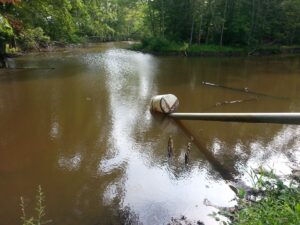
Pond

Here are the questions we commonly get from produce growers and answers that we hope you find helpful:

What water test do I need for a water source that is used only for irrigation of crops and/or pesticide applications?
– This water should be tested for generic E. coli, acceptable results give you a number answer of 126 CFU (colony forming units) or MPN (most probable number) or less. You do not want a presence/absence (P/A) test.  A P/A test would not be sufficient for a third-party audit requirement or the FSMA PSR.
-Most water testing labs on the NJ Water Testing Lab Map (link below) offer the EPA 1603 analysis, which satisfies both the FSMA PSR anticipated requirements and third-party audit requirements.
-Other acceptable analysis methods are described on the
Produce Safety Alliance Water Analysis Method Requirement fact sheet.
-Well water sources used for irrigation should be tested once a year.
-Surface water sources should be tested at least three times during their period of use, ideally when starting irrigation, mid-season, and close to harvest.  Surface water sources include irrigation ponds (spring fed, well fed, or other ponds), streams, rivers, and other bodies of water that are exposed to the surface.
-Municipal water sources used for irrigation should have a copy of the water testing record on file.  These testing records are often found online or are available upon request.  Made sure that generic E. coli is listed on the report.

What water test do I need for a water source that is used during the harvest process? Handwashing water? Cleaning and sanitizing use? Postharvest washing and cooling water? 
[Read more…]