A multistate Cyclospora outbreak linked to fresh imported basil was announced by the FDA late yesterday. For more information on the outbreak visit the FDA outbreak webpage. The New Jersey Department of Agriculture is closely monitoring the situation and will be communicating the latest updates.
Fruit Crops Edition
Seasonal updates on diseases, insects, weeds impacting tree fruit and small fruit (blueberry, cranberry, and wine grape). Fruit Pest Alerts are also available via this category feed.
Subscriptions are available via EMAIL and RSS.
July 25, 2019 Dean Polk, Dave Schmitt, Atanas Atanassov, Carrie Mansue
Fruit IPM for July 26, 2019
Peach:
Oriental Fruit Moth: Treatments for the 3rd generation OFM are timed for now in northern counties. Treatments are done in southern counties. [Read more…]
July 17, 2019 Dean Polk, Dave Schmitt, Atanas Atanassov, Carrie Mansue
Fruit IPM for 7/17/19
Peach:
Oriental Fruit Moth: Treatments for the 3rd generation OFM are timed for now and over the next week, depending on which county you are in. [Read more…]
July 14, 2019 Cesar Rodriguez-Saona
Managing Cranberry Toad Bug
Toad bugs, Phylloscelis atra, are an occasional pest of cranberries in New Jersey that can cause economic injury. This insect feeds only on
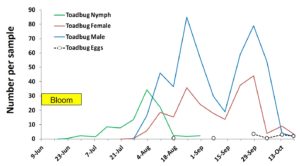
Fig. 1. Seasonal number of toad bug nymphs and adults per sweep net sample
cranberries and has a single generation per year. It overwinters as eggs. The nymphs appear by the end of June through early September, and the adults from end of July through October (harvest) (see Figure 1). Eggs are laid from end of August through October.
Damage. Feeding damage can be noticed in two stages. First stage feeding damage on vines causes closing in (towards the branch) of the leaves on the new growth. Second stage feeding causes changed in color (reddish to brown) of new growth. The damage can be seen from July until harvest. This damage will cause dying of the branch and the berries to shrivel up. Heavy infestation will result in dwarfed berries.
Management. To determine infestation, lightly sweep problematic beds (bugs should be easy to catch in sweep nets as they are very active). Because this is a new pest there is no threshold established yet. Thus, insecticide applications should be based on the relative number of bugs per sweep compared with other sites and previous history of infestation. Currently, growers can use the following control options: Sevin 4F (broad-spectrum carbamate), Diazinon (broad-spectrum organophosphate), or Actara or Assail 30SG (neonicotinoid insecticides, effective against piercing-sucking insects) (see Figure 2). If infestation is high, treatments should be applied when the nymphs are present (i.e., mid- to late-July; see Figure 1).
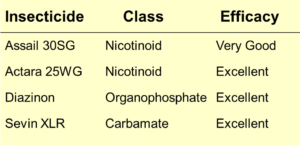
Fig. 2. Chemical control options for toad bugs
For more information, please see “The Cranberry Toad-Bug” by F.A. Sirrine and B.B. Fulton. 1914. New York Agricultural Experiment Station. Bulletin No. 377. Department of Agriculture, Geneva, NY.
July 10, 2019 Dean Polk, Dave Schmitt, Atanas Atanassov, Carrie Mansue
Fruit IPM for 7/10/19
Peach:
Oriental Fruit Moth: During the previous week we were between the 2nd and 3rd OFM flights on most farms, and just starting the third flight this week. Populations on most farms are low, but the timing in southern counties is now if trap captures exceed 6 moths per trap. See timings in the table below: [Read more…]
July 9, 2019 Anna Molinski
Grape Camp 2019
Tuesday, July 30, 2019 (rain date July 31); 4:30-8:00 pm is Grape Camp 2019. This workshop will cover important topics on mid- and late season vineyard management. It will be held at the Rutgers Agricultural Research and Extension Center, 121 Northville Rd, Bridgeton, NJ.
Light fare will be provided. Please call Joan Medany jmedany@co.gloucester.nj.us or call 856-224-8030 if you are planning to attend.
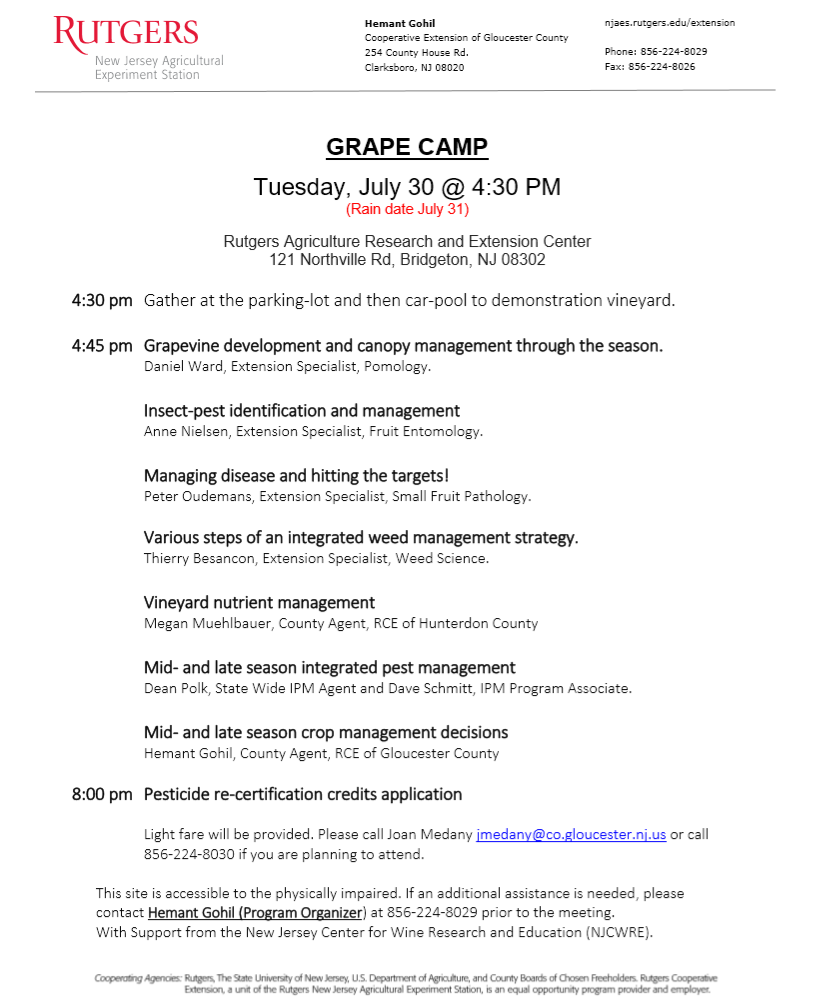
This site is accessible to the physically impaired. If an additional assistance is needed, please contact Hemant Gohil (Program Organizer) at 856-224-8029prior to the meeting.
With Support from the New Jersey Center for Wine Research and Education (NJCWRE).

