Fruit Crops Edition

Seasonal updates on diseases, insects, weeds impacting tree fruit and small fruit (blueberry, cranberry, and wine grape). Fruit Pest Alerts are also available via this category feed.
 
Subscriptions are available via EMAIL and RSS.

Ag Employers Urged to Submit Survey to Sign Up for Vaccinations for Your Migrant Farm Workers & Other Employees

In the attached letter, NJ Secretary of Agriculture Doug Fisher encourages you to participate in a brief online survey to sign up your farmworkers for COVID-19 vaccinations. As stated, once your information is received by the Department of Health, it will be routed to a local Health official who will contact you to schedule vaccinations on your farm or at a standing location. Please complete the survey by March 23, 2021.

Sign up for the opportunity to get your workforce vaccinated against COVID-19!

Dear Agricultural Employer:

Effective March 15, 2021, migrant farm workers are eligible to receive the vaccine. In an effort to help migrant farm workers access the vaccine and continue to support the agriculture industry and food chain in New Jersey, an agricultural vaccine program is being created to partner farms with Federally Qualified Health Centers (FQHCs) to help vaccinate you and your workforce.

If your business participates, all adults aged 18 years or older who live or work on the farm will be eligible to receive the Johnson & Johnson single dose vaccine, administered by FQHCs. If you are interested in joining a vaccination program tailored to the needs of the agricultural community, please sign up at http://healthsurveys.nj.gov/NoviSurvey/n/zz2jr.aspx. Since interest is quite high, we ask that you complete the survey by Tuesday, March 23, 2021.

Outside of this dedicated agricultural vaccine program, effective March 29, 2021, you and your non-migrant workforce are eligible to receive the COVID-19 vaccine.

Questions you may have about the vaccine and COVID-19:

  • Can I lift mask-wearing and other health and safety protocols/mandates at my business, where my workers live on-site, or in group transportation once my entire workforce has been vaccinated?
    ➢ No. Vaccines are only an additional layer of protection. Employers and their workers need to continue to follow health and safety protocols as currently mandated by the state. Information on protocols currently in place is available at https://covid19.nj.gov/faqs/nj-information/slowing-the-spread/where-can-i-find-guidance-on-best-practices-to-maintain-the-health-and-safety-of-seasonal-farmworkers-what-rules-are-in-place-and-what-resources-are-available 
  • Is the vaccine safe and which vaccine will my workforce, my family and I be receiving?
    ➢ Yes, the vaccine is safe. The vaccine which will be offered is the single-dose COVID19 vaccine developed by the Janssen Pharmaceutical Companies of Johnson & Johnson (J&J), to prevent COVID-19 in individuals 18 years of age and older. The J&J vaccine is the state’s first choice for the agricultural community because it only requires administration of a single-dose, and it can also be stored at refrigerator temperature thus making it possible to bring the vaccine to the farms reliably. In addition, it is important we create immunity rapidly in settings where workers, such as migrant workers, live in congregate housing, rely on group transportation and work in close proximity to one another. Learn more about the different vaccines at https://covid19.nj.gov/faqs/nj-information/slowing-the-spread/how-do-covid-19-vaccines-work#direct-link
  • Can I require my workforce to get the COVID-19 vaccine in order to seek employment with me?
    ➢ Yes. An employer can require that an employee receive the COVID-19 vaccine in order to return to the workplace, unless the employee cannot get the vaccine because of a disability, because their doctor has advised them not to get the vaccine while pregnant or breastfeeding, or because of a sincerely held religious belief, practice, or observance.

  • Do I need to participate in this agricultural vaccine program in order to personally receive a vaccine?
    ➢ No. The agricultural vaccine program is being set up to support access to the vaccine for your agricultural workforce, especially your migrant workforce which will face challenges accessing the vaccine otherwise. Your business is strongly encouraged to participate to help your workers become vaccinated and you too can get vaccinated through an FQHC. However, once you are personally eligible to receive the vaccine, you can alternatively choose to book your individual vaccine appointment on your own through the State-run NJ Vaccine Scheduling System or directly with any of the vaccination locations throughout the state. You can learn more about appointment scheduling at https://covid19.nj.gov/pages/vaccine.
  • Can my employees use paid sick leave to get their vaccine?
    ➢ Yes. Under NJ state law, employers must provide up to 40 hours of paid Earned Sick Leave to their full- and part-time employees, including migrant and seasonal employees. Employees can use their earned sick leave to get vaccinated for COVID19. Learn more about New Jersey’s earned sick leave law at
    https://www.nj.gov/labor/worker-protections/earnedsick/law.shtml
EPA Releases Testing Data Showing PFAS Contamination from Fluorinated Containers

        [U.S. EPA Office of Chemical Safety and Pollution Prevention sent this bulletin at 03/05/2021 01:58 PM EST] Note: This EPA OPP Update has been forwarded to all New Jersey Mosquito Control Agencies.  As the U.S. Environmental Protection Agency (EPA) pursues its mission to protect human health and the environment, addressing risks […]

Value-Added Producer Grants in New Jersey

Grant.gov applications are due by April 29, 2021 and
paper applications must be postmarked by May 4, 2021

The Value-Added Producer Grant (VAPG) program administered by the USDA’s Rural Development Agency (RD), helps agricultural producers enter into value-added activities related to the processing and marketing of new products. The goals of this program are to generate new products, create and expand marketing opportunities, and increase producer income. [Read more…]

Covid Update From Secretary of Agriculture

March 5, 2021


COVID-19 Vaccine Update

Dear Farm Owner/Operator:

On March 1, 2021 Governor Murphy announced that farmworkers will be eligible for the COVID-19 vaccine starting March 15, 2021.

We understand that the ag community is anxious to have everyone on their farm vaccinated as soon as possible, especially since some of you already have workers in the field.

Here is how the vaccination program will roll out over the next week:

  • The Department of Health (DOH) will send out a vaccine Q&A.
  • A brief survey will be included in that email that will help them with supply and delivery planning. Survey questions will include:
  • Business location
  • Contact person for scheduling vaccinations
  • Number of workers to be vaccinated
  • Logistic considerations


Once you receive the survey, please fill it out and return it as directed to the DOH.

A Health official will follow up with your contact person to schedule vaccinations either on your farm or at a standing location.


Sincerely,

Douglas H. Fisher

Secretary


2021 Recommendations for Residual Weed Control in Established Blueberry

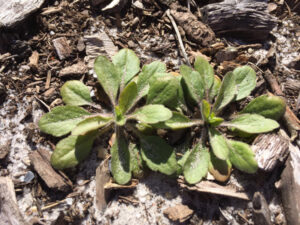
Horseweed

Horseweed / Marestail

With T3 stage scheduled for early April  it’s now time  to consider your residual herbicide application before bud-break!

Residual herbicides should be applied prior to weed seed germination. If applied to weeds that are already out of the ground, most of these products will not control them.

Keep also in mind that these herbicides should receive at least ½” rainfall or irrigation one to seven days after application (depending on herbicides) to move the herbicide into the soil


In order to reduce the potential of selecting for herbicide-resistant weeds, it is highly recommended mixing two residual herbicides with different MOA whenever you apply pre-emergence (residual) herbicides. Make sure the herbicides you plan to apply will be effective at controlling the weed species in your field by checking the herbicide label. Usually, residual herbicides will suppress weed for 6 to 8 weeks depending on irrigation as well as soil and weather conditions. After this period, another residual herbicide can be needed to control weeds through harvest and could be mixed with a postemergence herbicides to control emerged weeds. Roundup (glyphosate), Rely 280 (glufosinate,) and Gramoxone (paraquat) are postemergence herbicides that may be applied with pre-emergence herbicides before bud break with little risk for crop injury.

  •  MOA 2: Solida (rimsulfuron) and Sandea (halosulfuron) are ALS inhibitors that have both preemergence and postemergence activity. They control most annual broadleaves but are weak on common groundsel, common lambsquarters and eastern black nightshade. Sandea is ONLY recommended for postemergence control of yellow nutsedge. However, these two herbicides will not control ALS resistant weeds (horseweed, ragweed…) already widespread in New Jersey. Thus, these herbicides should always be tank mixed with a partner effective at controlling these weeds
  • MOA 3: Kerb (pronamide) and Surflan (oryzalin) are mitosis inhibitor that will be effective at controlling many annual grass species for 4 to 6 weeks after application. Kerb also help controlling perennial quackgrass. If applied to warm soils (> 55°F), Kerb persistence (and weed control) is much reduced; therefore, reserve Kerb for fall/winter application. Do not use Kerb on blueberries that have not been established for about a year.
  • MOA 5 and 7: The photosynthesis inhibitors (PS II inhibitors) have a broad spectrum of control and will be effective against many broadleaves and annual grasses when applied in spring. Karmex (diuron) and Princep (simazine) have relatively low solubility and have been very safe on blueberries. Sinbar (terbacil) has a longer residual life in the soil and also is more soluble, so it should be used infrequently on light, wet soils. Velpar (hexazinone) is very soluble and should not be used on New Jersey sandy soils. These herbicides are effective on a many broadleaf weed species, including common chickweed, common lambsquarters, common groundsel, henbit, nightshade, redroot pigweed, pineappleweed, shepherd’s-purse, smartweed, and some mustards. Sinbar and Princep will also control most of the annual grasses and help suppressing quackgrass.
  • MOA 12: Solicam (norflurazon) is a pigment inhibitor that may be applied in fall or early spring primarily for annual grass control and quackgrass suppression. Solicam may also provide partial control of many broadleaf weeds as well as of yellow nutsedge. Do not use Solicam on blueberries that have not been established for about a year.
  • MOA 14: Chateau (flumioxazin), Zeus XC (sulfentrazone), and Zeus Prime XC (sulfentrazone plus carfentrazone) are PPO inhibitors with activity against many broadleaves (including redroot pigweed, catchweed bedstraw, common mallow, common lambsquarters, ladysthumb, wild mustard, and shepherd’s-purse) when applied preemergence in spring. Chateau and Zeus Prime XC also have some postemergence activity on newly emerged seedlings of annual weeds. Zeus products may also provide some suppression of yellow nutsedge. Chateau has a 7 day preharvest interval (PHI) and Zeus Prime XC have 3 day PHI, and can therefore be applied later in the season to extend preemergence broadleaves control into late summer. Blueberry plants must have been established at least two years prior to use of these herbicides.
  • MOA 15: Devrinol (napropamide) and Dual Magnum (s-metolachlor) are long chain fatty acid inhibitor. Devrinol will provide good control of annual grasses and should therefore be tank mixed with a PSII or a PPO inhibitor for controlling broadleaf weeds. Devrinol is rapidly degraded if left exposed on the soil surface, so it should be applied less than 24 hours before a rain event to incorporate the herbicide in the soil. Dual Magnum has a 24c Special Local Need label for blueberry in New Jersey. This herbicide controls many annual grasses and some small-seeded broadleaf annual weeds such as redroot pigweed, nightshade and common purslane. Dual Magnum also suppresses emergence of yellow nutsedge. Use Dual Magnum only on plants established for more than one year, and lower rates are suggested on 2- to 3-year-old plantings.
  • MOA 20: Casoron (dichlobenil) is a cellulose synthesis inhibitor recommended for fall application to control many annual and perennial broadleaves, grasses and yellow nutsedge. If left on the soil surface or if applied to warm soil (> 55°F or 70°F depending on dichlobenil formulation), Casoron can lose much of its activity. So, reserve this herbicide ONLY for fall/winter applications. Plants must be at least one year old before Casoron should be used.
  • MOA 21: Trellis SC (isoxaben) is a cell wall synthesis inhibitor currently currently registered for bearing and non-bearing blueberry. Trellis SC primarily controls annual broadleaf weeds, such as horseweed, common lambsquarters, wild mustards, shepherd’s- purse, purslane, and common chickweed; higher rates may also suppress field bindweed and curly dock. However, Trellis SC will have to be mixed with a Group 3, 12, or 15 residual herbicide for controlling annual grasses.
  • MOA 27: Callisto (mesotrione) is an HPPD inhibitor recommended for spring application to control many annual broadleaf weeds as well as annual sedges. It controls large crabgrass but no other grasses, such as goosegrass. Callisto may be used as a broadcast spray between rows to control broadleaves and crabgrass without injuring the fescue sod. Callisto has both preemergence and postemergence activity and can be used in spring prior to bloom to control ALS-resistant horseweed at the rosette stage.
  • MOA 29: Alion (indaziflam) is a cellulose biosynthesis inhibitor recommended for fall or spring application to control annual broadleaf and grassy weeds. Alion has no effect on emerged weeds or established perennials. It should be applied before weeds emerge or tank-mixed with a postemergence (POST) herbicide to control emerged weeds. Do not use Alion on soil classed as sand, or with more than 20% gravel.

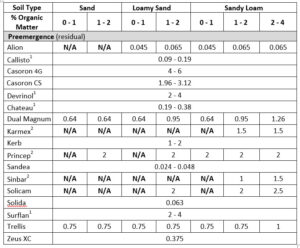
Soil-Applied Herbicide Rates (in Active Ingredients) for Common Soil Types

Graph of Soil-Applied Herbicide Rates

N/A = NOT LABELED (DO NOT USE).
1Use the lower recommended rate when tank-mixing with another pre-emergence herbicide, unless annual grass pressure is severe.
2Use one-half the recommended rate when tank-mixing with another pre-emergence herbicide.

The 2021 Commercial Blueberry Pest Control Recommendations for New Jersey will soon be available on https://njaes.rutgers.edu for rates and additional information. The information above is correct to the best of our knowledge. Other formulations with the same active ingredient as some of the products listed above may exist that may or not may be labeled for the same uses. Always consult the label before making pesticide applications. Information was current as of March 5, 2021

Comparing the Efficacy of Various Integrated Weed Management Tactics

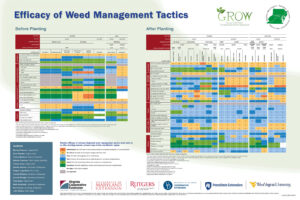
Efficacy of Weed Management Tactics

Integrated weed management (IWM) combines various methods to reduce or eliminate the effect of weeds on crop production over time, using a combination of practices that are most effective for solving specific weed issues. These weed management techniques form a “toolbox” in which each “tool” can be integrated into a weed management plan catered to the particular farm and problem. The toolbox includes preventative, biological, chemical, cultural, and mechanical strategies. IWM also considers the weed species present and tailors strategies for these species.

A collaborative effort led by Dr. Michael Flessner with Virginia Tec has been developed to compare the efficacy of various integrated weed management tactics before and after planting at reducing the impact of common troublesome weed species. Other universities of the Mid-Atlantic Region (Rutgers, West Virginia University, Penn State, University of Delaware, and University of Maryland) have also participated to this project.

A poster providing relative effectiveness of various integrated weed management tactics for summer annual crops is now available (https://agweedsci.spes.vt.edu/extension/publications/iwm.html) and will help growers identify the most effective tactics to manage weeds.