The Rutgers Farm Health and Safety Working Group is conducting a survey to evaluate the priority needs of New Jersey farmers for training and resource development related to safety and health. As a New Jersey farmer, you are invited to complete this survey by Friday, May 1, 2026. Click here to access the survey and learn more. [Read more…]
Fruit Crops Edition - Blueberry Section
Seasonal updates on diseases, insects, weeds impacting small fruit (blueberry, cranberry, and wine grape). Fruit Pest Alerts are also available via this category feed.
Subscription is through the general Fruit feed available via EMAIL and RSS.
April 10, 2026 Hemant Gohil
Assessing the Severity of Frost Damage to Peach and Apple Flower Buds

Figure 1. The brown and shrunken pistil (L) indicates the flower is dead; a green and upright pistil indicates that the flower is alive. Photo by H. Gohil.
The below-freezing temperatures on Wednesday (4/8/26) and Thursday (4/9/26) early mornings are likely to cause frost damage in several peach and a few apple orchards in New Jersey. It got down to 25°F–28°F in Southern NJ, and 22°F -27°F in Central and Northern NJ, and those temperatures could have killed vulnerable blossoms. The night of April 8th saw wind speeds above 10 mph, which mixed the cold air at the bottom with the warm air above. This prevented cold-air stratification and reduced the heat loss from the soil surface and plant tissues. The night of April 9th was even colder, and the wind dropped below 5 mph, almost coming to a standstill for a few hours. This causes the rapid loss of thermal energy from the soil and plant tissues. Most unprotected peach and a few apple orchards were affected by these conditions on the night of April 9th. In several parts of New Jersey, peach flower buds were at full bloom, the most susceptible stage to frost (Fig. 1). In Apples, though most orchards were in the tight cluster or earlier stages of bud development, and few varieties were in the first pink. The critical temperatures for 90% bud kill at these stages are 21°F for the tight cluster and 24°F for the first pink; hence, only a few apple orchards in South NJ were vulnerable to significant frost damage (Fig. 2).

Figure 2. Frost damage to Apple bloom at first pink
In Peach, not all flowers bloom at the same time, which makes frost-damage assessment a little more difficult. Often, many flowers look damaged, but they still bear fruit. This estimate can be even more difficult in some varieties, simply because they bloom so much that even 90% damage can yield close to the full crop. The natural tendency is to look for open flowers, which can easily lead to overestimating the damage. The developing flower buds will quickly die once damaged by a freeze. You can’t tell what will happen just by looking at the flower. The browning of flower petals doesn’t mean the ovary is dead.
You can do a quick, destructive assessment of loss by randomly opening 10-20 flowers per tree; do this on 5-10 trees across an acre or block for each variety. This can give a relative estimate of bloom loss. If you take a more systemic approach, you may get more accurate results. Due to cold-air stratification, cold air settles to the bottom, so more buds are damaged at the bottom; therefore, you want to sample from both the upper and lower branches. Sometimes, the loss of flower buds could be as good as natural thinning. So, flower bud loss may not result in a crop loss.
After opening the flower, if the pistil is shrunken and brown, consider it dead; and if completely green, consider it alive (Fig 1). The pistil is sticking out, and you see it is brown; it could have been pollinated and is in the senescence stage. It is not brown because of frost, but it’s brown because of the normal progression of development. In another scenario, the pistil is brown because it has frost damage, but it still may have done its job of pollination. It served its purpose and senescence because both frost and pollination are over. After pollination and fertilization, rapid hormonal changes enhance fruit development and make them slightly more cold-hardy. So even the destructive analysis is a close approximation.

Figure 3. Uneven development of peach due to frost injuries, represented by very small ripe fruits in PF Flamin Fury 24 (Left) and Silverglo (right), and a significant number of green unripe fruits in Lady Nancy (middle). Photo by H. Gohil.
If frost occurs at the shuck-split or shuck-off stage, the seed/pit will be damaged. But the fruit looks normal. However, they will not reach full size because the nonviable seed cannot produce the hormones required for fruit growth (Fig. 3). Even if they do grow, they may still face other problems. For example, the pit may have sustained damage, predisposing it to shatter during phase III of fruit growth. If you wait for a week to 10 days, it will be easier and more accurate non-destructive assessment. The live flowers will develop normally, and the dead flowers will be shrunken brown mummies that can be flicked away easily. You will still have plenty of time to adjust fruit thinning to achieve a near-normal crop. You should not be in a hurry to do fruit thinning this year! If you see some fruits that have stopped getting bigger and are distinctly smaller, will you want to thin? Maybe after the June drop.
Frost Protection for Orchards and Perennial Fruit Crops
The forecast for New Jersey statewide is expected to drop below freezing Tuesday and Wednesday overnight into early morning this week. Fruit crops are most vulnerable in the full bloom to petal fall stages.
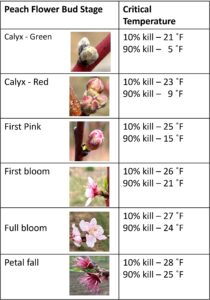
Figure 1. Peach bud development stages and corresponding critical temperatures. Adapted from MSU Fruit Extension. Photos by H. Gohil.
Temperatures beginning at 28°F can kill 10% of the flowers when in full bloom and 90% of the flowers when temperatures drop to 24°F or below for more than 30 minutes (Figure 1). Please refer to your local forecast at nearby weather stations to receive the most accurate temperatures during this time period at www.njweather.org/ or https://newa.cornell.edu/.
Management Options for Frost Protection
- Cloth coverings – This can be an effective tool to protect a small number of trees. Sheets, burlap, or frost blankets can provide some protection. Avoid plastic tarps which do not provide efficient insulation and can increase freeze damage on plant tissue. Ensure the covering reaches the ground.
- Irrigation – Irrigate the soil under the trees the day before so any heat will be absorbed. Overhead irrigation is an option if available. The irrigation must stay on until ice starts to melt.
- Heaters – Heat can be sourced through burning propane, natural gas, or oil burning Smudge pots. This could be a valuable investment for a commercial orchard that experiences frost events at critical bloom times; however, it is expensive and highly inefficient as heat produced dissipates quickly.
- Wind machines & helicopters – These devices can be used in conjunction with heat or alone to mix warm air from higher elevation with cold air in the orchard.
- Frost Rescue Sprays – Plant growth regulators such as Promalin can be applied to apples and pears following a frost event to help increase fruit set. The application must be made within 24 hours of the frost event and the trees must be thawed. Follow the label for use restrictions.
References
Gohil, H., Muehlabuer, M., Polanin, N, and Crassweller, R. (2020). Active Frost Protection Methods for Your Orchard. Rutgers Cooperative Extension Bulletin E363. https://njaes.rutgers.edu/e363/
Gohil, H., Muehlbauer, M., Besancon, T., and Ward, D. (2025). Preparing Orchards Against the Frost – Low Tech Strategies. Plant & Pest Advisory Rutgers Cooperative Extension Preparing Orchards Against the Frost – Low Tech Strategies — Plant & Pest Advisory
Demchak, K. (2020). Frost and Freeze Damage on Berry Crops. PennState Extension https://extension.psu.edu/frost-and-freeze-damage-on-berry-crops
March 30, 2026 Ramandeep Kumar Sharma
Salem County Agronomy Twilight Meeting-1 (May 1, 2026)
SALEM COUNTY AGRONOMY TWILIGHT MEETING-1
Date & Time: May 1, 2026 | 5:00 PM – 7:30 PM
(Program starts at 5:00 PM; please arrive a few minutes early)
Location: Rutgers Cooperative Extension Office, 51 Cheney Rd., Woodstown, NJ 08098
Registration:
Call: 856-769-0090
Email: molly.english@salemcountynj.gov
Credits Applied For:
- CORE: Basic Safety and Handling
- 1A: Agricultural Plant
- 10: Demonstration / Research
- PP2: Private Applicator
- 11: Animal (Livestock) Pest Control
Topics & Speakers:
- The 3R’s of Pesticide Use: Resistance, Rotation, and Regulation
Speaker: Janine Spies, Rutgers Cooperative Extension - The Endangered Species Act Changes to Pesticide Labels
Speaker: William J. Bamka, Rutgers Cooperative Extension - Nitrogen from Air to Soil using Sunlight
Speaker: Joseph R. Heckman, Rutgers University - Agronomist’s Field Guide to Drought Resilience
Speaker: Ramandeep Sharma, Rutgers Cooperative Extension
March 15, 2026 Janine Spies
SOUTH JERSEY CALIBRATION GROWERS MEETING
March 25, 2026
2:30 pm – 6:00 pm
Rutgers Agricultural Research & Extension Center
121 Northville Road
Bridgeton, NJ
Program
Program Chair
Janine Spies, Rutgers Cooperative Extension
Statewide Program Leader in Fruit IPM
2:30 – Registration
3:00 – Welcome and Introductions
3:15 – Airblast Sprayer Calibration Techniques
Chris Lovenduski, Central Jersey Equipment
4:15 – Early season management in peaches
Anne Nielsen PhD, Professor & Extension Specialist in Entomology
4:45 – Light fare & refreshments (Pre-registration required)
5:00 – Coverage Counts: How to make the most of a pesticide application
Karly Regan PhD, Certis Biologicals
5:30 – Pesticide Safety and Regulations for Specialty Crops
Janine Spies PhD, Rutgers Cooperative Extension
6:00 – Pesticide Recertification Credits and Adjourn. Attendees must be present for the entire program in order to apply for NJDEP credits.
THE FOLLOWING NJDEP PESTICIDE RECERTIFICATION CREDITS WILL BE AWARDED
4 CAT-10 4 CAT-1A 3 CAT-3A 4 CORE 4 PP2
Click here to register: South Jersey Calibration Event Registration – Fill out form
PRE-REGISTRATION BY March 18, 2026
Registration cost per person is $10. Cash or check (made payable to Rutgers The State University) will be collected at the door.
If you have any questions please contact Janine Spies: (352)-231-6330, janine.spies@rutgers.edu
March 15, 2026 Janine Spies
NORTH JERSEY CALIBRATION GROWERS MEETING
March 24, 2026
2:30 pm – 6:00 pm
Snyder Research & Extension Farm
140 Locust Grove Road
Pittstown, NJ
Program
Program Chair
Janine Spies, Rutgers Cooperative Extension
Statewide Program Leader in Fruit IPM
2:30 – Registration
3:00 – Welcome and Introductions
3:15 – Airblast Sprayer Calibration Techniques
Chris Lovenduski, Central Jersey Equipment
4:15 – Importance of Calibration for Optimal Pest Control and Resistance Management
Kaitlin Quinn, Rutgers Cooperative Extension
4:45 – Light fare & refreshments (Pre-registration required)
5:00 – Coverage Counts: How to make the most of a pesticide application
Karly Regan PhD, Certis Biologicals
5:30 – Pesticide Safety and Regulations for Specialty Crops
Janine Spies PhD, Rutgers Cooperative Extension
6:00 – Pesticide Recertification Credits and Adjourn. Attendees must be present for the entire program in order to apply for NJDEP credits.
THE FOLLOWING NJDEP PESTICIDE RECERTIFICATION CREDITS WILL BE AWARDED
4 CAT-10 4 CAT-1A 4 CAT-3A 5 CORE 4 PP2
Click here to register: North Jersey Calibration Event Registration – Fill out form
PRE-REGISTRATION BY March 18, 2026
Registration cost per person is $10. Cash or check (made payable to Rutgers The State University) will be collected at the door.
If you have any questions please contact Kim Crommelin: (908)-788-1338, kfrey@co.hunterdon.nj.us
