The COVID-19 pandemic highlighted the critical and essential role of farm labor in getting food from farm to plate. However, health concerns should not stop with a negative COVID test or vaccine, especially if an employee or family member is exhibiting any of the ‘flu-like’ symptoms that are associated with corona virus.
From the Vermont Law School Center for Agriculture and Food Systems (CAFS) – “The CAFS launched the Food System Worker Law and Policy Project in 2021 with research focused on farmworkers, who—despite forming the backbone of a trillion-dollar industry in the U.S.—face a level of occupational risk unrivaled by most workers. From repeated exposure to pesticides and extreme heat, …. ” Their newly published “report titled “Essentially Unprotected: A Focus on Farmworker Health Laws and Policies Addressing Pesticide Exposure and Heat-Related illness,” … May 2021, provides an overview of the findings as well as policy recommendations that are urgently needed to protect farmworkers.”
Typically not seen until July, we’ve already had 3 heat waves beginning in May that expose workers to a number of potential health risks that may present very similar symptoms and can be equally health, and even life, threatening. Published studies from the Rutgers Institute of Earth, Ocean, and Atmospheric Sciences suggest growing numbers of people worldwide are at risk of heat stress and related complications, including farmers and ag laborers working in high heat and humid conditions. Last year, OSHA-NIOSH released a Heat Index App (in English and Spanish at the Apple App Store or Google Play) featuring:
- A visual indicator of the current heat index and associated risk levels specific to your current geographical location
- Precautionary recommendations specific to heat index-associated risk levels
- An interactive, hourly forecast of heat index values, risk level, and recommendations for planning outdoor work activities in advance
- Editable location, temperature, and humidity controls for calculation of variable conditions
- Signs and symptoms and first aid information for heat-related illnesses
For more information about safety while working in the heat, see OSHA’s heat illness webpage, including online guidance about using the heat index to protect workers.
In addition to heat stress, harvesting and other activities along field edges, including going into the woods instead of using a portable bathroom facilities, create a high risk for tick bites which can also carry a number of diseases, many as or more debilitating than Lyme disease. It is critical for your employees’ health and well-being to get proper diagnosis and treatment for all of these ailments. This table illustrates how many tick-born diseases, as well as heat stress, all have potential symptoms very similar to those of COVID-19. Each is linked to additional resources at the CDC. In many cases, it may be the ‘other symptoms’ that may be unique to each disease and assist a medical practitioner with correct identification and lead to better verification with further testing.
|
Disease > Symptoms v |
COVID-19 | Heat Stress | Lyme Disease | Ehrlichiosis | Babe- biosis | Powas-san | Rocky Mtn Spotted Fever |
| Vector* | Human | Black-legged Tick (a.k.a. Deer Tick) (I. scapularis) | Lone Star Tick (A. americanum) & Black-legged | Black-legged Tick | Ground hog(I. cookei), Squirrel (I. marxi) & Black-legged Ticks | American Dog Tick (D. variabilis) | |
| Fever or chills | X | X | X | X | X | X | X |
| Cough | X | X | |||||
| Shortness of breath/difficulty breathing | X | ||||||
| Fatigue | X | X | X | X | |||
| Muscle/body aches | X | X | X | X | X | X | |
| Headache | X | X | X | X | X | X | X |
| New loss of taste or smell | X | ||||||
| Sore throat | X | ||||||
| Congestion or runny nose | X | ||||||
| Nausea/vomiting | X | X | X | X | X | X | X |
| Diarrhea | X | X | |||||
| Rash | X | X | X | ||||
| Other symptoms | X | X | X | X | X | X | |
| Potentially Deadly/Disabling |
X | X | X | X | X | X | X |
*NOTE – main vector listed, but many tick born diseases may be vectored by other species of ticks, or different species causing same disease may be carried by different tick species.
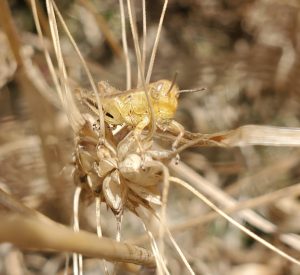 A field of ready to harvest wheat was observed infested with 4th to 5th star grasshopper nymphs in Salem County. While waiting for positive identification from entomologists familiar with the differences in the nymp identification, these nymphs appear to be differential grasshoppers (Melanoplus differentialis). The uniform yellowish color of nymphs observed, is an indication the population is quite high. Lesser populations tend to be more green in color. Additional fields of wheat, corn and soybean on the same farm all had nymphs present but were not at economic threshold yet.