African Swine Fever Q&A with USDA this week

African Swine Fever Action Week

“Every day the week of September 13-17, from 2:00 pm – 3:00pm EDT, APHIS will host a webinar on a different ASF topic. These webinars will also be recorded. The webinars will be as follows:

  • Monday, September 13: African Swine Fever: Where it Exists and What’s at Stake
  • Tuesday, September 14: Steps APHIS is Taking to Prevent and Prepare for ASF
  • Wednesday, September 15: ASF and the Benefits of Biosecurity
  • Thursday, September 16: What to Expect in an ASF Outbreak
  • Friday, September 17: ASF and the Feral Swine Factor”

Interested producers can register at
https://www.aphis.usda.gov/aphis/ourfocus/animalhealth/animal-disease-information/swine-disease-information/african-swine-fever/seminar/asf-action-week

New round of pandemic assistance application opens Sept 23rd

USDA has announced a new program, called Pandemic Response and Safety Grant Program.

“The Pandemic Response and Safety (PRS) Grant Program provides grants to food processors, distributors, farmers markets, and producers to respond to coronavirus, including for measures to protect workers against novel coronavirus 2019 (COVID–19). This program is authorized and funded under section 751 of the Consolidated Appropriations Act of 2021 (Pub. L. No. 116—260). USDA developed the PRS Grant Program in response to extensive stakeholder feedback during listening sessions in March 2021, and written comments provided through March 30, 2021. Information from the listening sessions is available online at: www.ams.usda.gov/services/ams-covid-stimulus.

Important Dates:
Application Period Opens: September 23, 2021
Application Period Closes: 11:59 PM Eastern Time on November 8, 2021

All applications submitted before the deadline will be considered for funding. Applications will not be reviewed on a first-come, first-served basis.” – Pandemic Response and Safety Grant website.

Follow this link for eligibility: https://usda-prs.grantsolutions.gov/usda?id=usda_eligibility_info


Water, Water, Everywhere

Water, Water Everywhere We’re Gonna Get Wet; Such is the refrain in a video that my kids used to watch.  This year we have had plenty of water.  Water is the most important nutrient that we give our animals and the most abundant, cheapest, and least understood of all nutrients required for livestock production.  We usually become concerned with water only when it is in short supply or when flooding results in contamination.  My colleague, Salem County Extension, Melissa Bravo has written previously about flooding and I refer the reader to her comments submitted on September 3rd.

Tropical storm Ida brought extreme flooding to many parts of New Jersey.  In addition to the tornado damage that had devastating effects on many farms, there is the destruction of feed and forage supplies that accompany flooding.

If feed grains or forages stored as hay or silage were flooded and remained underwater during Ida for even a short period, they are probably destroyed.  Feed grains such as corn, oats, or barley will quickly spoil when wet and may result in the production of mycotoxins.  This rotten feed is worthless, may be a risk to animals, and is fit only for the compost pile or other disposal.

How about hay or silage?  These are no different.  They will spoil and may likely produce mycotoxins or other toxins just like feed grains.  They will have to be disposed.

The bottom line, do not feed any spoiled feed grains or purchased feed mixes, or spoiled hay or silage to animals.

What about pasture?   Pasture that has been rained on, even the rain from tropical storm Ida should be edible, provided that flooding did not occur.  Any feed or forage that was in a flood plain, and/or remained under flood waters is a contamination risk.  The risk is not from feed and forage spoilage as described above, but from any toxins that may be associated with the flood waters.

I suggest caution about flood water contamination of pastures.  What was upstream from the flood waters?  Storm water that flooded its banks and ended up on your river bottom land may contain heavy metals or pesticides or dangerous debris, or you or a neighbor may have applied pesticides that resulted in runoff contamination.  Perhaps there was none at all.  How deep was the water?  Was the pasture covered in water?  It may be possible to graze some summer annual forages such as Sudan or Sudan-Sorghum crosses, or Millet.  These are taller growing forages that maybe were not covered in the flood waters.  It may be possible to graze these provided only the top portion of the plants are grazed.  This will require a very short grazing period.  Of course if these were covered in flood waters, caution should be taken.  After a cleansing rain or two on flooded pastures, consumption may possibly continue.  Clipping pastures that have been flooded and waiting for regrowth grazing is perhaps the best suggestion.

Don’t feed “Ditch Hay.”  Ditch hay is feed that has been harvested from roadsides or along major highways such as the Turnpike, Parkway, Route 78, 80, etc.  These may contain pesticides used in roadside weed control and may pose risks for animal consumption.

Contamination of water due to heavy metals, nitrates, and bacterial pathogens, may also be of concern.  Contact your local Extension Office or Public Health officials for assistance.

What feeding options are there?  The purchase of hay or forage from uncontaminated supplies, or feed grains, or available byproducts such as brewer’s grains are all possible feed supplements.

Water requirements; Livestock will suffer more quickly from the lack of water than any other nutrient.  It is essential for a number of physiological functions.  Among these is the transport of nutrients, as a solvent or buffer for chemical reactions in the body, for temperature regulation, and, of course, for milk production, growth, work, or exercise.  The two main sources of water are that which is consumed and the water present in feedstuffs (especially in succulent forages such as silage or grasses).

Often the first sign that water consumption is inadequate is that animals stop eating.  It is essential to maintain adequate feed consumption.  This is most important for animals that are in productive states such as growth, lactation, work, or exercise.  For illustrative purposes, a lactating dairy cow producing 80 pounds of milk per day will require between 30 and 36 gallons of water per day.  Of this amount, approximately 8.4 gallons will appear in the milk, between 15 and 20 gallons in the manure and urine and the remainder as respiratory, evaporative, and metabolic losses.

Water requirements for domestic livestock species are as follows:  lactating dairy cattle will consume on the average between 15 and 35 gallons per day; non-lactating dairy cows and beef cows require approximately 15 gallons per day; an adult horse will consume between 10 and 15 gallons per day; adult sheep between 1.5 and 3 gallons per day; adult swine between 3 and 5 gallons per day; and an adult hen about ½ a quart.  A quick rule of thumb is that for every 2 pounds of dry feed intake, an animal should receive 1 gallon of water.  This will vary with stress, weather conditions, disease, productive state, work, or exercise, as well as the water and salt content of the feed.

Remember, water is the most important nutrient you can supply your animals.  Don’t let them run short.

This is taken from an article appearing in the September 15 article of the New Jersey Farmer.

Concerned about flooded pastures or forage contamination?

If producers have concerns about flooded pastures and forage quality; or concerns about heavy metal contamination in flood contaminated water and soils that can lead to livestock toxicities, here is an article for Progressive Forage I wrote on this topic this spring that may be useful. See the article, Adverse Weather Impacts Essential Nutrient Uptake.

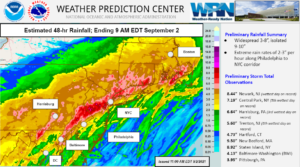
Weather Prediction Center estimated rainfall totals

Weather Prediction Center estimated rainfall totals from Ida as of September 2 2021

In areas impacted by the debris field of tornadic and straight-line winds; and receding flood waters, metal objects and other splintered particles are of concern. Producers (volunteers, workers, families) should review their tetanus vaccinations for themselves and their livestock and be mindful of metal and other small particle debris contamination of any additional forage harvest this season.

Any superficial cuts should be disinfected promptly and monitored for signs of bacterial infection. This is important to remind, as many are wearing rubber boots these days as opposed to hard soled leather boots. Any puncture of any kind should be seen by a doctor if it occurred from an object previously submerged in flood waters.

While this second article in this series focuses on drought bacterial concerns in livestock; it does have useful information on what ingested or respirated bacterial species to be concerned about where livestock have no choice but to consume contaminated forages. See the article, The Biologicak Risk of Drought. 


The third article forthcoming in this series for Progressive Forage focuses on mycotoxins associated with droughty conditions was recently published in the September issue: Adverse Weather and Hidden Dangers of Moldy Feed .


Additional information about past storm mortalities associated with toxic bacteria, poisonous plants, and plant-pest toxins can be found in the Northeastern Plant Pest Conference abstract, Recent Extreme Weather Events: Animal Deaths Linked to Toxic Plant and Pest Outbreaks.

For local information on the storm rainfall estimates from Ida, follow this link: https://www.wpc.ncep.noaa.gov/discussions/nfdscc4.html.

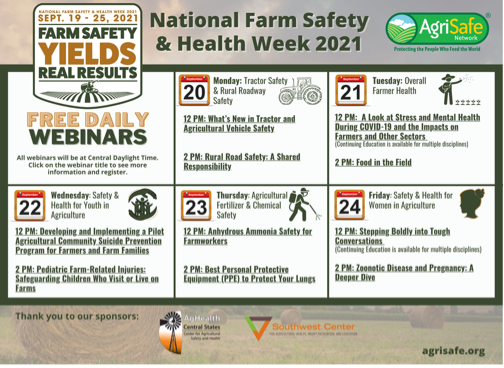
National Farm Safety and Health Week: September 19-25, 2021

Flyer for NFSHW 2021 Webinars

NFSHW webinars to be held 9/20-9/24/2021. Click here to register.

September precedes one of the busiest and most dangerous seasons of the year in agriculture – fall harvest time. For this reason, National Farm Safety and Health Week (NFSHW) is recognized annually during the third week of September. The theme this year is “Farm Safety Yields Real Results”.

AgriSafe will host two FREE webinars each day during NFSHW to highlight new technology, discuss incident prevention, and inform your decision-making and conversations. The webinars will feature discussion on each of the daily topics. Visit The National Education Center for Agricultural Safety website to register (scroll down to ‘Webinars’). Note that the webinar times are posted for Central Daylight Time.

Take an active role in keeping yourself and others safe this harvest season. Plan to join in on a webinar, encourage others to do the same, and take to social media to spread the message: “Farm Safety Yields Real Results”. Stay tuned to the Rutgers Agriculture and Natural Resources Facebook page for content to share each day during NFSHW!


Harvesting forage and cover crops on prevent plant acreage

USDA’s Risk Management Agency updated their 2021 ‘Prevented Planting Coverage’ in July. This update allows crops planted on insured acreage to be harvested as forage, including cover crops, without resulting in a penalty or reduction of payment if certain conditions apply.

https://rma.usda.gov/News-Room/Frequently-Asked-Questions/Prevented-Planting-Coverage

Scroll down on their page ‘Frequently Asked Questions’ and read the “What are my options for planting forage on prevented planting acres?” sample questions and example scenarios. And the same question is posed related to planting a cover crop.