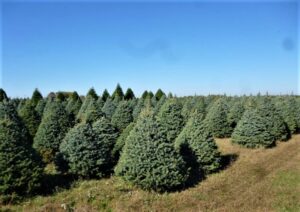
Christmas Trees Edition

EMAIL | RSS
Seasonal pest alerts and news about insects, diseases, and weeds impacting Christmas Tree production including Commercial Ag Updates (meetings and marketing); and Pesticide Program updates from the Rutgers Pest Management Office News Blog.

Companion Website Links:

Rutgers Weather Forecasting - Meteorological Information important to commercial agriculture.

Nursery IPM.

Updated 2023 Pest Scouting Guides are up – Getting prepared for the season ahead

The updated Pest Scouting Guides are here, and have a few improvements that enable YOU to share what YOU are seeing in the field with RCE.

Please click, download, and print these scouting guides for use at your nursery, landscape, or conifer plantation. Once printed you can scan the QR at the top of document to link back to the digital copy. These are much larger documents than 2022, as they are sorted by GDD, NEW-Insect “Group”, and by NEW-“favored host plants”. 

Nursery and Landscape Pest Scouting Guide – Scouting with Growing Degree-days (GDD) 2023 (click here)

Conifer and Christmas Tree Pest Scouting Guide – Scouting with Growing Degree-days (GDD) 2023 (click here)

Refer to this post “Obtaining your local growing degree-days (GDD)” for additional information (click here)  or contact Tim Waller twaller@njaes.rutgers.edu for help.

It is important to note that the GDD ranges do not replace scouting and that many of these GDD ranges have not been validated in New Jersey and would greatly benefit from local feedback. Therefore you will notice a QR code at the bottom of the cover-page. If you scan this code it will take you to a form that asks for details about pest occurrence, host plants, any observations, and after you submit your comments it allows the user to upload photographs. This is also a great place to leave feedback on what you would like to see in future iterations (such as pictures…).

PLEASE REPORT – pest observations that deviate from the stated GDD ranges in the guides

PLEASE SHARE PICTURES OF PESTSwe are working to develop insect ID pocket guides and other resources for our NJ growers…but we need your help

LONT – Comment and Photo upload REPORTING LINK (click here) 

Conifer – Comment and Photo upload REPORTING LINK (click here) 

If you would like to interact with the raw data yourself or incorporate it more closely into your businesses needs download this data file (click here) (file will download once clicked!). Please note it is a Microsoft Excel file, that is protected / cannot be modified on all but the two sheets labeled “GDD ACCU”. If you would like help with this or a non-protected file please contact twaller@njaes.rutgers.edu.


Regular updates will be utilizing this resource throughout the 2023 season. Have a great Spring Season everyone.  


White Pine Weevil: Overwintering Adults Become Active in March & April

Many arborists & landscapers often find it difficult to prevent white pine weevil pests (Pissodes strobi), because they are typically applying fertilizer & dormant oil treatments during the control window. In the state of NJ, the control window against feeding white pine weevil adults occurs in March & April. Adults over-winter in the duff beneath trees. The WPW adults will often crawl or sometimes fly to the top terminal leaders of pine, spruce, or Douglas-fir trees. Eastern white pine & Norway spruce species are the most severely attacked & the death of the terminal leaders of these trees will often occur.

Treatment timing is critical with this pest and controlling the adult female before egg laying is necessary. Apply preventative sprays (e.g., pyrethroids) only to the terminal leaders during this time. Before mating & egg laying, adults will feed by chewing holes within the central leader & cause a characteristic pitch flow that becomes white in color when dry. Then females will lay eggs in new cut-out holes within the top 12 inches of the leader just below the terminal bud. This blog will describe with the help of photographs the 7-stage lifecycle of this native weevil borer. Control & management options will also be provided.   

Beetle on stem

White pine weevil adults are about 1/4+ inch long & have a long snout with two white spots on back of wing covers. Adults feed at terminal leaders during March & April. Most eggs will then be laid during April & May. (Photo Credit: Michigan State University)


Infected pine tree

Severe white pine weevil infestations to terminal leaders can destroy two or more years worth of growth to pine, spruce, & Douglas-fir trees. (Photo Credit: Steven K. Rettke, Rutgers Coop. Ext.)

[Read more…]

Resources for Attendees of 2023 Central Jersey Vegetable Growers Meeting

      Central Jersey Vegetable Growers Meeting 2023 Private Applicator Resource Guide

December Prices Received by Farmers Data

The ‘December Prices Received by Farmers’ section of the USDA NASS Agriculture Prices publication contains useful price-margins-costs of production forecasting information for producers.

The report highlights prices received by farmers for principal crops, livestock and livestock products; indexes of prices received by farmers; feed price ratios; indexes of prices paid by farmers; and parity prices. Historical data covering years 1910-60 reported in 1962 publication.

To access the December report go to: https://downloads.usda.library.cornell.edu/usda-esmis/files/c821gj76b/gx41nx339/2b88rs02s/agpr0123.txt

Future reports will be released on: Upcoming releases:Feb 28 2023 3:00 PM. Mar 31 2023 3:00 PM. Apr 28 2023 3:00 PM. May 31 2023 3:00 PM. Jun 30 2023 3:00 PM. Jul 28 2023 3:00 PM. Aug 31 2023 3:00 PM. Sep 29 2023 3:00 PM. Oct 31 2023 3:00 PM. Nov 30 2023 3:00 PM. Dec 29 2023 3:00 PM.


Rutgers Soil Testing Laboratory adds Sulfur to Soil Fertility Analysis

Plant-available sulfur (sulfate) values have been added to Rutgers Soil Testing Laboratory fertility reports in the micronutrient reporting line. There are four interpretive categories: Low, Medium-low, Sufficient, and High. An explanatory paragraph follows near the end of the report to help interpret the reported value.

Photo illustrating sulfur deficiency in sweet corn.

Symptoms of sulfur deficiency include yellowing or light green coloring on youngest tissue, thin stems and petioles, slow growth, and delayed maturity. Photo Credit: G. Brust, University of Maryland.

As the interpretative statements within the reports explain, sulfur analysis/interpretation is very complicated (similar to nitrogen) due to the many factors influencing it. Also, there is not full consensus among soil fertility experts on a best extraction method and critical values. Still, the sulfur value on the revised reports will provide an extra degree of information for understanding the soil & plant health. As with all micronutrient interpretations on the reports, the relevant RCE publication is referenced for further information; in the case of sulfur, RCE bulletin E365.

[Read more…]

Help PA stop Hipath Avian Influenza spread. Sanitize vehicle tires, boots.

With increasing numbers of positive flock detections in Lancaster County, PA, and circulation of the virus in wild birds, please remember to wash farm truck vehicle tires and implement footwear-vehicle-pedal sanitation steps when driving to/from the feed mills, seed stores, and farm machinery dealers located in this region of Pennsylvania.  Map current as of 2-22-2023.

Map of avian spread

The following link will take you to the control zone maps for current detections in Pennsylvania.

https://padeptag.maps.arcgis.com/apps/webappviewer/index.html?id=a9066a3d68a443a08043766cb84bf4ae

Additional information on protecting your backyard flock from exposure to Hipath avian influenza can be found in prior Plant Pest Advisory posts, and at the USDA website, ‘Defend the Flock’. https://www.aphis.usda.gov/aphis/ourfocus/animalhealth/animal-disease-information/avian/defend-the-flock-program/defend-the-flock-program