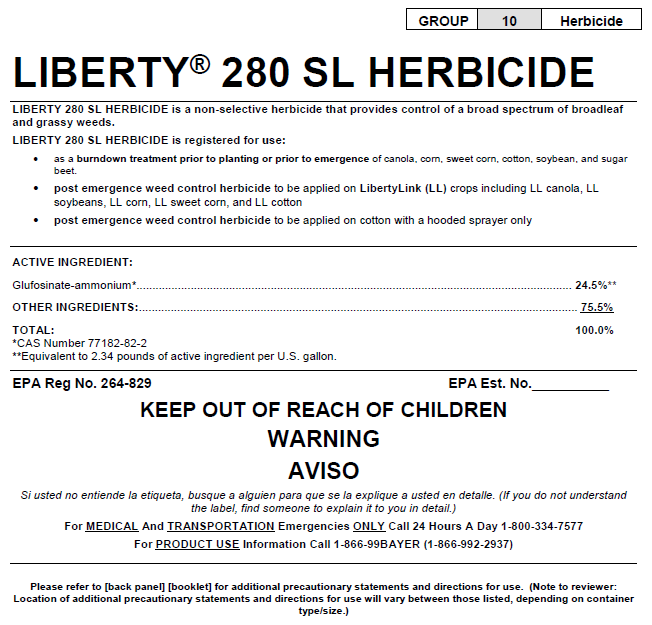
EPA has recently approved a new version of Liberty 280 SL label (see picture).
This new label includes increased LibertyLink (LL) corn rates, increased yearly maximum rates, and a sweet corn section for LL varieties.
Liberty 280 SL is a non-selective herbicide that provides control of a broad spectrum of broadleaf and grassy weed species. Liberty can be used as a burndown treatment prior to planting or prior to emergence of corn, sweet corn, or soybean, as a post-emergence herbicide to control emerged weeds in LL varieties of corn, sweet corn and soybean.
Liberty is a group 10 herbicide (glutamine synthetase inhibitor) that has contact activity and control emerged weeds at the time of application. Liberty provides good to excellent control of various annual grass species, including barnyardgrass, crabgrass, foxtail spp., and fall panicum. Excellent control (> 85%) of tough to control broadleaf weeds has also been notes for pigweed, cocklebur, jimsonweed, lambsquarters, marestail, common ragweed, and smartweed.
Applications of Liberty should be made between dawn and 2 hours before sunset to avoid the possibility of reduced weed control. As with all contact herbicides, uniform spray coverage is necessary to achieve consistent weed control (use at least 15 gal/A in normal situations, 20 gal/A if dense vegetation is present). For best results, apply when weeds are 2-4 inches tall. Apply ONLY over the top of LibertyLink corn, sweet corn, and soybean varieties.
The mention of trade names and rates is for educational purposes and does not imply endorsement by the author or the New Jersey Agricultural Experiment Station. Always defer to the product label for instructions on properly applying an herbicide.
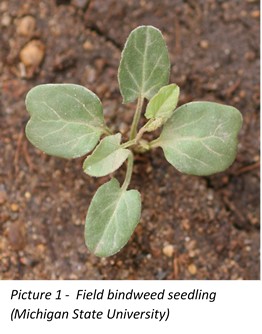
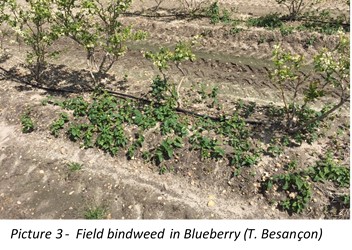
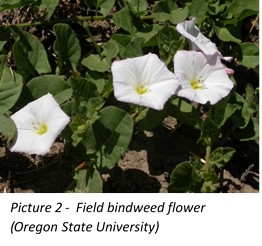 ome. When juvenile stems are broken, they exude a milky sap. On mature plants, leaves are arranged opposite along the stem and are arrow shaped. Lobes at the base of the leaf point away from the petiole. Stems are smooth to slightly hairy.
 ydrates produced in the leaves to the roots. It is critical that NO timing be missed or be late! One single missed tillage can negate all the effort expended up to that point. Expect to continue the effort for 4 to 6 months! Success may require more time if the effort was not started when carbohydrate reserves in the weed were low at the start of the process.
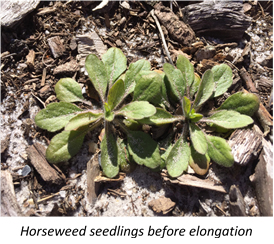 of the first weeds that will break through the residual herbicide coverage provided by preemergence applications is horseweed, aka marestail. Horseweed has two primary periods of emergence, from late March through June and from late summer through late fall. Some of the most problematic horseweed emerges in the fall and over winters as small rosettes. If growers don’t control it with fall-applied residual herbicides, the weed has an excellent head start on the spring growing season, especially after a mild winter. Horseweed plants remain in the rosette stage through mid-April, followed by stem elongation (bolting) and rapid growth to an height of 3 to 6 feet. Plants that emerge the previous fall will bolt earlier than spring-emerging plants. Horseweed is most easily controlled when in the seedling, or rosette stage, and spring postemergence herbicides should be applied before stem elongation.
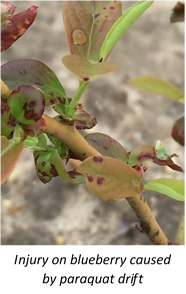
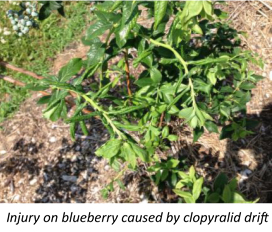 Clopyralid – Use Stinger at 3 to 4 fl oz/A of. Stinger has a 24(c) Special Local Need label for weed control in blueberry since 2013. Stinger acts as both a postemergence foliar absorbed herbicide and a residual herbicide. The initial twisting and curling observed after application to susceptible species is due to the foliar absorption. Do not apply Stinger from one week prior to bloom until one week after bloom. Stinger can eventually be tank-mixed with Gramoxone to increase the spectrum of weeds controlled and defoliate existing foliage of perennial asters, goldenrod species and mugwort. Donot allow spray or drift to contact green bark, leaves, or fruit as crop damage may result as shown on the picture. Time all applications to maintain a 30-day PHI (PreHarvest Interval). Do NOT apply Stinger in a hand-held sprayer used to “spray until wet”. Stinger is a residual herbicide that must be applied on a rate per acre basis with a precisely calibrated sprayer. Read safety precautions on the label.