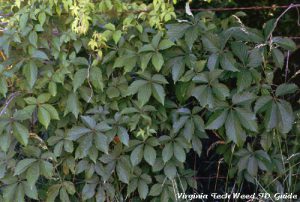
Late summer and fall are perfect times to work on tough-to-control perennial weeds such as Virginia creeper vine, bindweed, green-brier, Canada thistle, goldenrod, and poison ivy. These perennials are among the most difficult weeds to eradicate, especially because of their ability to generate new shoots from their root systems. Successful management strategies will mostly rely on herbicide that can move from the leaf to the below-ground plant parts. Timely initial application and consistency at controlling any regrowth with follow-up spot treatments are crucial for long-term control of these weeds.
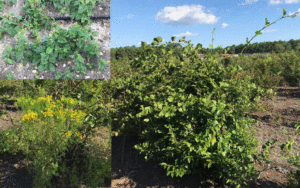
Field bindweed (upper left), goldenrod (lower left) and green-brier (right) are some tough weed species of NJ blueberry and will warrant extra time for achieving successful control
Glyphosate (Roundup or other generic products) is the only postemergence herbicide labeled on blueberry that can provide good control of perennial weeds. Late summer and fall are good times for applying glyphosate as plant sap movement is mostly directed toward the roots where nutrients will be stored in anticipation of next season. Therefore, large volume of glyphosate can easily be translocated from the leaves to the roots, improving the efficiency of the herbicide at killing below-ground storage organs. It is VERY IMPORTANT for glyphosate to be applied when weed leaves are still green before fall colors appear.
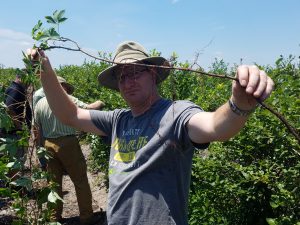
Use extreme care not to contact crop green tissues (stems and leaves) with glyphosate. Glyphosate absorbed by crop green leaves and bark moves within the plant and can severely damage or kill above-ground and below-ground parts of annual crop and perennial treess. Weeds such as bindweed, Virginia creeper, and greenbrier may need to be pulled out of the trees so they can be treated safely. This may seem too slow to be practical, but consider what these weeds cost in lost income. For example, blueberry bushes covered by Virginia creeper vine may yield just 20% of their potential. This easily equates to a $5 to $10 loss per bush. The loss is incurred each year and increases as the vines spread to neighboring bushes. Investing 15 minutes to carefully pull vines out of that bush and safely treat them on the ground is money well spent.
Glyphosate should be applied through low pressure spot treatment to limit drift movements. Glyphosate absorption will be improved if ammonium sulfate (17 lbs / 100 gal water) is added to your spray mixture. For effective control, at least 50% of the foliage should be wet with glyphosate applied as a 2% solution (see your product’s label for rate necessary to reach this concentration).
Consider also “cut stump” applications for Virginia creeper or poison ivy that have large diameter stems. Apply a 2% glyphosate solution to the cambium (inner bark area) IMMEDIATELY after cutting the stem. Don’t let time for cutting to dry as this would prevent glyphosate absorption and translocation to below-ground plant parts.
Always apply glyphosate on weeds that are actively growing and not under drought stress.
Always refer to the commercial product label for rates and additional information.