PHI for Select and Poast herbicides in peppers

The 1 day pre-harvest intervals (PHI) listed for Select 2EC, Select Max, and Poast herbicides in the pepper section of the 2019 Mid Atlantic Commercial Vegetable Production Recommendations is false.

The actual PHI as found on the most recent labels of these herbicides are as follows:

  • Select 2EC: 20 days
  • Select Max 0.97EC: 20 days
  • Poast 1.5 EC: 7 days

Errors will be addressed in the 2020 updated version of the guide.


Suppression of cranberry seed germination with preemergence herbicides

Self-pollination or cross-pollination between undomesticated cranberries and selected cultivars occur frequently and produce fruits containing fertile seeds. Seedlings germinating from these seeds are off-type varieties that may have lower fruit yield potential and higher vegetative vigor. Contamination by off-type varieties may result in decreased long-term productivity of planted cranberry beds and loss of profitability for the New Jersey cranberry industry in an increasingly competitive environment.

In response to questions from New Jersey growers on the efficacy of preemergence herbicides at controlling off-type cranberry seedlings, we recently conducted an experiment at the Marucci Center for screening currently labeled preemergence herbicides.

Seeds were collected from three different varieties (Haines, Mullica Queen, and Stevens), stratified at 3°C for 2 months, and seeded on Petri dishes containing preemergence herbicide mixed in agar. The trial was replicated 5 times and two different runs were conducted during the winter 2018-2019. Cranberry seed germination was quantified several times a week and the experiment was terminated by 40 days after seeding cranberry seeds.

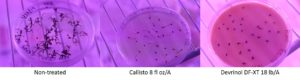
Three different petri dishes of seeds under a microscope


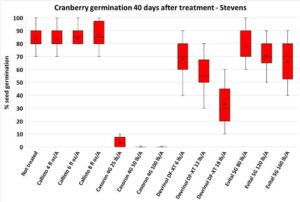
Results: Callisto, regardless of rate applied, did not provide any control of cranberry seed germination compared to the untreated check. Similarly, Evital 5G did not reduce seedling emergence more than 17% when used at the highest labeled rate (160 lb/A). Devrinol DF-XT had higher activity, reducing seed germination by 30% at 12 lb/A and by 50% at 18 lb/A. However, only the 12 lb/A rate is labeled for sandy beds. Casoron 4G was the most effective treatment with complete inhibition of cranberry seed germination at 50 or 100 lb/A. Similar results were noted by Dr. Jed Colqhoun in Wisconsin on cranberry grown on peat plugs for Casoron and Callisto. However, Devrinol was noted having no activity on cranberry seed germination in the WI study. This might be caused by organic matter binding of the herbicide in peat plug, which is less of a problem in agar. The study will be continued this summer by looking at germination of seed grown in a mix of sand and peat moss and treated with some of the preemergence herbicides mentioned here.

Graph of cranberry germination after treatment

These results highlight the need for rotating preemergence herbicide with different modes of action, not only for preventing the onset of herbicide resistant weed species, but also for expanding the spectrum of weeds controlled by these herbicides, including off-type cranberry seedlings.


Optimizing preemergence weed control in established blueberry  for 2019

Several long-residual herbicides with different modes of action (MOA) are labeled for established blueberry. In order to reduce the potential of selecting for herbicide-resistant weeds, it is highly recommended mixing two residual herbicides with different MOA whenever you apply preemergence herbicides.

Casoron (dichlobenil) is a cellulose synthesis inhibitor recommended for fall application to control many annual and perennial broadleaves, grasses and yellow nutsedge.

The photosynthesis inhibitors (PS II inhibitors) have a broad spectrum of control and will be effective against many broadleaves and annual grasses when applied in spring. Karmex (diuron) and Princep (simazine) have relatively low solubility and have been very safe on blueberries. Sinbar (terbacil) has a longer residual life in the soil and also is more soluble, so it should be used infrequently on light, wet soils. Velpar (hexazinone) is very soluble and should not be used on very sandy or wet soils.

Kerb (pronamide) and Surflan (oryzalin) are mitosis inhibitor that will be effective at controlling many annual grass species for 4 to 6 weeks after application. Fall or spring application of Kerb can also be considered for perennial quackgrass suppression.

Solicam (norflurazon) is a pigment inhibitor that may be applied in fall or spring primarily for annual grass and sedges control. Solicam may also provide partial control of many broadleaf weeds as well as of yellow nutsedge.

Chateau (flumioxazin), Zeus XC (sulfentrazone), and Zeus Prime XC (sulfentrazone plus carfentrazone) are PPO inhibitors with activity against many broadleaves when applied preemergence in fall. They also have some postemergence activity on newly emerged seedlings of annual weeds.  Chateau has a 7 day preharvest interval (PHI) and Zeus/Zeus Prime have 3 day PHI, and can therefore be applied later in the season to extend preemergence broadleaves control into late summer.

Callisto (mesotrione) is an HPPD inhibitor recommended for spring application to control many annual broadleaf weeds as well as annual sedges. It controls large crabgrass but no other grasses, such as goosegrass. Callisto may be used as a broadcast spray between rows to control broadleaves and crabgrass without injuring the fescue sod.

Matrix (rimsulfuron) and Sandea (halosulfuron) are ALS inhibitors that have both preemergence and postemergence activity. They control most annual broadleaves but are weak on common groundsel, common lambsquarters and eastern black nightshade. Sandea is recommended for postemergence  control of yellow nutsedge. However, these two herbicides will not control ALS resistant weeds (horseweed, ragweed…) already widespread in New Jersey. Thus, these herbicides should always be tank mixed with a partner effective at controlling these weeds.

Devrinol (napropamide) and Dual Magnum (s-metolachlor) are long chain fatty acid inhibitor. Devrinol will provide good control of annual grasses and should therefore be tank mixed with a PSII or a PPO inhibitor for controlling broadleaf weeds. Dual Magnum has a shorter residual activity compared to other blueberry residual herbicides but will provides good yellow nutsedge, eastern black nightshade and pigweed control.

Make sure the herbicides you plan to apply will be effective at controlling the weed species in your field by checking the herbicide label. Usually, residual herbicides will suppress weed for 6 to 8 weeks depending on irrigation as well as soil and weather conditions. After this period, another residual herbicide can be needed to control weeds through harvest and could be mixed with a postemergence herbicides to control emerged weeds. Roundup (glyphosate), Rely 280 (glufosinate,) and Gramoxone (paraquat) are postemergence herbicides that may be applied with preemergence herbicides before bud break with little risk for crop injury.


2019 Mid-Atlantic Field Crop Weed Management Guide

The 2019 updated version of the “Mid-Atlantic Field Crop Weed Management Guide” is available. This guide is collaboratively developed by weed scientists from Penn State, , Univ. of Delaware, Univ. of Maryland, Rutgers University, Virginia Tech, and West Virginia Univ.


The guide covers weed management  for field corn, sorghum, soybean, small grains, and forage and pastures. Information concerning the use,  restrictions, and recommendations of burndown, preemergence, and postemergence herbicides labeled on these crops can be found in the guide, including relative effectiveness data from locally conducted research. Description of the various premixes as well as guidance for  managing troublesome weeds are also part of the guide.

The guide  can be ordered on-line at https://extension.psu.edu/mid-atlantic-field-crop-weed-management-guide. Available on-line are the printed copies for $25; an enhanced pdf copy for use on computers and tablets for $15 or both a hard copy and pdf for $35.

A sample of the guide can be downloaded at the following address https://extension.psu.edu/downloadable/download/sample/sample_id/880/

Webinar on Best Practices for Pesticide Aerial Application


Office of Pesticides Programs Updates


Register for September 27 Webinar on Best Practices for Pesticide Aerial Application

EPA is hosting a webinar titled “Best Practices for Aerial Application” on September 27, 2018, from 2 – 3:30 pm ET. This webinar is tailored for growers, pesticide applicators, pest management professionals, and other interested stakeholders who work in crop production.

Webinar presenter, Dr. Bradley Fritz, is an agricultural engineer from the United States Department of Agriculture (USDA), and serves as the Research Leader of the Aerial Application Technology Research Unit at USDA’s Agricultural Research Service. The presentation will cover different methods of aerial application, best practices for reducing spray particle drift when using aerial application equipment, nozzle selection, and the use of adjuvants as they relate to aerial application.

Register for the webinar.

Learn more about reducing pesticide drift.


Stinger 24(c) Special Local Need Label for Perennial Weed Control in Blueberries

The 24(c) Special Local Need Label for Stinger® that had expired on December 31, 2017 has finally been renewed up to December 31, 2020.

Stinger® is especially useful in blueberry for controlling composite and legume weeds. Common composite weeds found in our orchards include Canada thistle and other thistles, goldenrod species, aster species, common dandelion, mugwort (wild chrysanthemum), horseweed (marestail), and ragweed species. Legume weeds include vetch species and clover species.

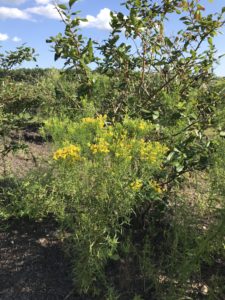
Golden Rod

Deep rooted perennials like goldenrod require multiple Stinger applications


The 24(c) Special Local Need Label for Stinger® is associated with some restrictions:

  •             Preharvest Interval (PHI): 30 days
  •             Maximum Stinger® amount per acre per year: 10.6 fl oz
  •             Maximum Stinger® amount per application: 4 to 5.3 fl oz/a depending upon weed species
  •             Rainfastness: 5 hours
  •             Maximum Stinger® amount per acre per year: 10.6 fl oz
  •             Stinger® can not be air-applied or chemigated


The application of Stinger® should be timed to match the emergence of the perennial weeds in the spring when the carbohydrate food reserves in the plant are at the lowest point. Treatment at this time reduces the weed’s chance of recovery and survival. Optimum results controlling deep rooted and hard to control perennial weeds, including Canada thistle, perennial asters, goldenrod species, and mugwort (wild chrysanthemum) will be obtained if the Stinger®® application is split.

  • First application: apply Stinger® at the rate of 1/3 pint/acre after blueberry bloom, in late April when the weed is emerging. Some weeds can “survive” for months on established existing foliage even though Stinger® suppresses all new growth. Tank-mix with Gramoxone to increase the spectrum of weeds controlled and kill existing foliage of perennial asters, goldenrod species and mugwort.
  • Second application: Apply another one third pint of Stinger® immediately after harvest in mid-summer. Spray the second application even though no growth of the target weed is evident. The second application is essential for the elimination of the hard to kill established perennial weeds. If the second application is skipped, expect to see the weed re-emerge in late August or September.

Stinger® is both preemergence residual herbicide and a postemergence foliar absorbed herbicide. The initial twisting and curling observed after application to susceptible species is due to the foliar absorption. Control of established perennials is due to residual activity of Stinger® in the soil which prevents regrowth from the roots.  In certain species, such as mugwort, Stinger® prevents regrowth but does not kill the mature leaves. The plant will survive unless another herbicide, such as Gramoxone® SL 2.0 or Rely® 280, is used to defoliate the plant.

Do NOT apply Stinger® in a hand held sprayer used to “spray until wet”.  Stinger® is a residual herbicide that must be applied on a rate per acre basis.  When treating “patches” of perennial weeds, apply the recommended rate per acre with a calibrated sprayer.  Treat ten to fifteen feet beyond the weed “patch” on all sides.  Spray the sod or row middles adjacent to the weed “patch” in the row.

The label is available online on the CDMS website at the following address: http://www.cdms.net/ldat/ld02P048.pdf

The use of any pesticide inconsistent with the label directions is a violation of Federal law.®