Marketing Tip: Consider Pre-Bagging Produce at Farm Markets

By, Michelle Infante-Casella and Meredith Melendez, Agricultural Agents

Farm marketers can learn from recent behaviors observed in supermarkets and other food outlets as we start the produce season in New Jersey. Besides facilitating social distancing and having employees and customers wear masks and other protective gear, farm owners and workers can help ease shopping anxiety by pre-bagging items.Person grabbing an orange from a bag with a glove

To date there is no scientific evidence to support the transmission of COVID-19 through food, but customer buying patterns have shown that packaged produce is selling better than loose produce. Customers are fearful of virus transmission from many different sources regardless of the science. Most people are very suspicious when touching every object around them whether it be door handles, shopping carts, checkout counters, credit card machines and also on the list – loose fruits and vegetables on shelves that may have been handled by other people. These fears are certainly understandable.

Some food stores are reporting bagged items are selling faster than loose items. The public sentiment is wrapped produce has a barrier that acts as a safety measure against contamination. Produce items in pre-packaged containers, such as bagged lettuces, bagged broccoli, bagged cucumbers, bagged peppers, packaged tomatoes and other items wrapped in plastic have increased in sales over their unpackaged counterparts. In addition, items in highest demand tend to be more shelf-stable produce like potatoes, apples, onions, unpeeled carrots, winter squashes and cabbage.

The media has been publicizing milk dumping from tanker trucks, in-season produce fields being plowed, and issues with food distribution across the country due to issues from COVID-19. Consumers are questioning many issues right now. Is the U.S. food supply safe? Will there be enough food to go around? Will the food stores be closing? Is it safe to buy fresh produce? Should I worry when I see empty store shelves?

To ensure a domestic food supply in the future, it is more important than ever for customers to buy local and US farm products. This is a message the entire agriculture industry can share with the public.

Some questions about food and COVID-19 can be answered by reading the U.S. Food & Drug Administration’s website https://www.fda.gov/food. This is also a good site to send your customers to help answer their questions. Resources specific for the agricultural community are listed on the Rutgers On-Farm Food Safety COVID-19 website.

In summary, farm market proprietors may want to keep produce displays well stocked with plenty of bagged and packaged produce items. This will also help facilitate having customers in the market for shorter periods. Customers can just pick up bags and go rather than pick through a pile and taking extra time to bag their own items. In addition, pricing bags ahead of time, that don’t need to be weighed, can also quicken check out times. Shoppers are in a hurry to get in and out of stores to ease fears of potential virus transmission. Making it as easy as possible to help facilitate shopping and check out may go a long way to lessen customer anxiety in current times. Keep engaged with customers for suggestions on what they may need from your market.

Farmers and farm markets will be playing a major role in food distribution and food security in the near future and beyond. Thank you to all farmers, farm workers, and other essential workers in this time of crisis.

April 10: Governor Murphy’s EO 122 – Impacts to the Landscaping Industry

NJ Governor Murphy’s Executive Order 122 pertaining to non-essential construction and landscaping as of Friday, April 10, 2020:

• Maintenance including cutting grass, weed wacking and leaf blowing (including cleanups) Permitted
• Install patios, walkways, pools, etc – NOT PERMITTED, unless project has begun before Friday 4/10 at 8:00 pm or there is an emergency fix to the front walkway
• Install plantings, including flowers and shrubs – Permitted
• Install irrigation systems – NOT PERMITTED, unless project has begun before Friday 4/10 at 8:00 pm. System startups and emergency repairs are permitted.
• Perform pruning and trimming – Permitted
• Provide weed and pest control services – Permitted
• OK Put down mulch or top dress – Permitted
• Install sod or seed lawns – Permitted (however, note that irrigation systems cannot be installed, so this would be at the discretion of the company if they can properly irrigate).

In addition, there is a limit of 5 crew members on site at all times. Masks (or some type of facial covering) and gloves must be worn and pPerson blowing leavesrovided by company to employees. Start times and lunch times should be staggered to avoid employees having close contact. Previous social distancing rules still apply. Employees/customers must keep six feet apart at all times except when workers must do a task together.

Seed Corn Maggots in the Fields Early this Spring

Even though most people are focused on the pandemic, life on the farm still goes on. That also means, plant pests and crop production will be business as usual during the growing season. With the mild winter and earlier than usual warm springtime temperatures, many insect pests we often see in spring are emerging earlier than usual. One that has already been detected in Southern New Jersey is the seed corn maggot. This pest is about 2-3 weeks ahead of schedule in our region.

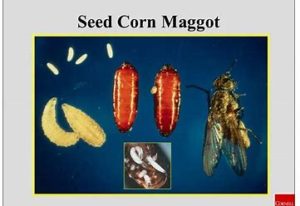
Seed Corn Maggots

Eggs, larvae, pupae and adult flies of the Seed Corn Maggot, photo credit Cornell University

Seed corn maggot adult flies have been seen in Gloucester County this past week. As vegetable farmers begin planting crops affected by seed corn maggot (snap beans, lima beans, corn, turnips, peas, cabbage, and cucurbits – mainly squash and cucumber), it is important to use insecticidal seed treatments to protect these crops. Adult flies are most likely in other areas of New Jersey right now. Cool to moderate temperatures and wet weather increase activity and survivability of this early season pest. When adult maggots lay eggs near the planting hole, eggs can hatch in just a few days after being laid. Maggots then can burrow into seeds or seedlings, feed for a period of 2 to 3 weeks and then develop into egg-laying adults. There can be many generations per year, but activity is heightened during periods of cool and wet weather.

Adult flies are most abundant in fields with cover crops, soils with high organic matter, fields where leaves have been applied, fields that have just been tilled, or in fields that have had manure applied. When a seed or seedling is attacked, it may continue to grow, but will be weak and not produce a crop. Preventative control methods are most effective, since once larvae are found causing damage in the field, they are difficult to control underground. Some commercial insecticide seed treatments are available and to find products for individual crops see the 2020-2021 Mid-Atlantic Commercial Vegetable Production Recommendations guide. This information can be downloaded free at https://njaes.rutgers.edu/pubs/publication.php?pid=E001 .

Other preventative methods include row covers to create a barrier between the insect pest and the seeds or seedlings, waiting to plant in fields until soils and air temperatures are warm enough to quicken germination and plant growth, and selecting fields for early plantings with low organic matter and that do not remain wet for long periods.

Later in the season, even though this pest may be present, most crops can germinate and grow fast enough to overcome low numbers of larvae present in the field. When warmer temperatures and drier conditions occur seed corn maggot populations generally decrease.

Status of U.S. Consular Operations in Mexico in Light of COVID-19

In response to the global pandemic COVID-19, and in line with the Mexican government’s call to increase social distancing, the U.S. Embassy in Mexico City and all U.S. consulates in Mexico will suspend routine immigrant and nonimmigrant visa services starting March 18, 2020, and until further notice. For farmers this means, H-2A workers and others from Mexico may be prevented from entering the U.S. until further notice. NJ Farm Bureau is researching the subject for more clarification. For now to see more information go to the U.S. Embassy’s website at: Field of plantershttps://mx.usembassy.gov/status-of-u-s-consular-operations-in-mexico-in-light-of-covid-19/

Tomato Fruit Worm Found in Southern New Jersey

Cut tomato

← Back

Thank you for your response. ✨

Tomato fruitworm was confirmed in a tomato field in Gloucester County on June 12th. Tomato growers should be applying insecticides to control this pest when monitoring for eggs and small larvae result in seeing any signs of worm activity. There is no economic threshold for tomato fruitworm. When control is needed, it is essential to treat before large numbers of larvae enter fruit, where they are protected from sprays.

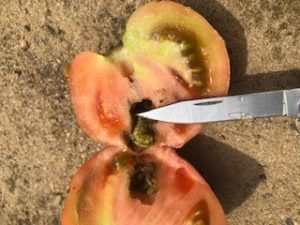
When there is fruit present, the tomato fruitworm will complete its larval development inside fruit. Early stage larvae enter the stem end of fruit when it is between 0.75 to 2 inches in diameter. During development, caterpillars may emerge from one fruit and enter another. Their feeding results in a messy, watery, internal cavity filled with cast skins and feces. Damaged fruit will ripen prematurely. Small larvae are difficult to detect and, thus, may be a problem to find. Any amount of feeding results in unmarketable fruit that will need to be culled at harvest or in the packing shed.

For insecticide recommendations see the 2019 Mid-Atlantic Commercial Vegetable Production Recommendations: https://njaes.rutgers.edu/pubs/commercial-veg-rec/tomatoes.pdf

Pesticide Credits Half Day Seminar in Gloucester County

On Wednesday, October 24th from 9:00AM to 12:00PM there will be a pesticide applicators seminar at the Rutgers Cooperative Extension Office of Gloucester County, located at 254 County House Rd, Clarksboro, NJ at the Shady Lane County Complex. The following credits have been applied for with NJDEP: 4-CORE, 3-PP2, 3-3A, and 3-3B category credits. There is a $50 fee for this course and only cash or checks can be accepted.

For more information see the Rutgers NJAES Events page at http://events.rutgers.edu/njaes

Please also call Rutgers Cooperative Extension of Gloucester County at 856-224-8040 ext. 1 to register. You can also email Joan Medany at jmedany@co.gloucester.nj.us

Space is limited, so please register.