Archives for August 2025

Veg IPM Update 8/29/25

Greetings from the Veg IPM team!

Sweet Corn

Corn earworm (CEW) moth captures have increased and are now in the typical range for late August, with most southern and central locations needing 3-day spray intervals (see map). When temperatures are high (>85 degrees F), shorten the spray interval by one day. Rotation is important for avoiding resistance, and there are four IRAC groups that are registered in silking sweet corn: 1 (carbamates), 3 (pyrethroids), 5 (spinosyns), and 28 (diamides). CEW is at least partly resistant to several pyrethroids, so a spray program should not rely solely on pyrethroids, although they can be useful in tank-mixes or as pre-mixed products, such as Besiege or Elevest (Group 28 + Group 3). For detailed information about resistance and potential spray programs, the University of Delaware has an excellent resource on corn earworm management.
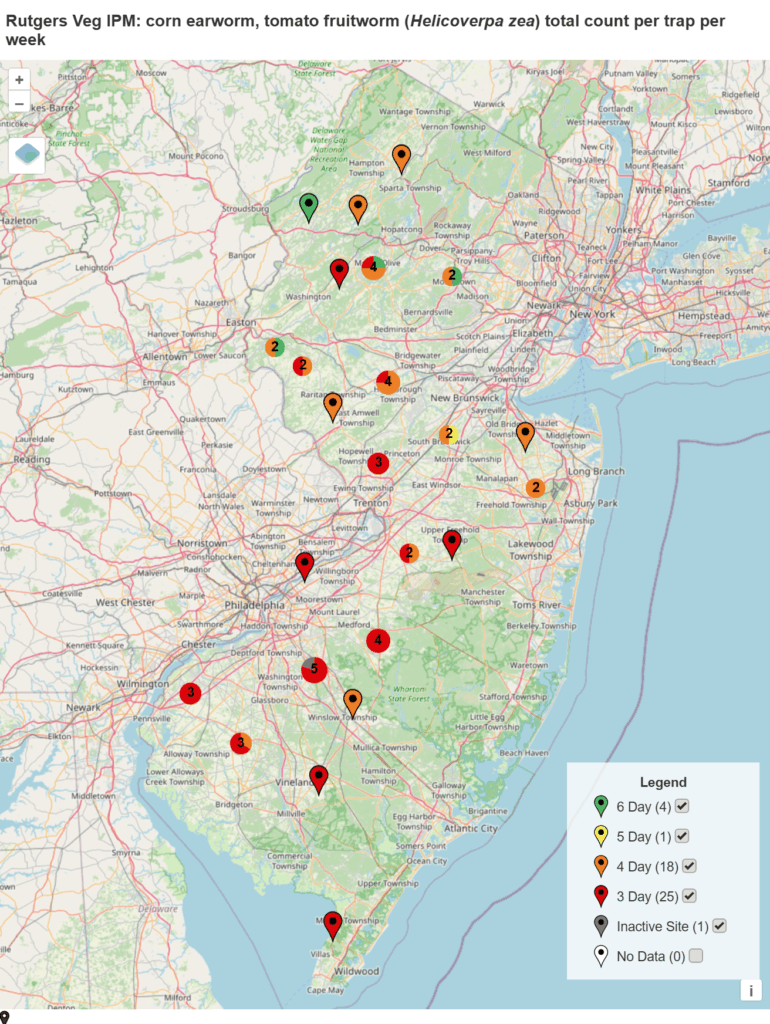
Spray intervals based on nightly pheromone moth captures for the southern part of New Jersey. Note that not all locations in the IPM program are currently trapping. This map is based on the following thresholds: 0 moths = 6-7 day schedule, 1 moth = 5 day spray schedule, 2-20 moths = 4 day spray schedule, 20+ moths = 3 day spray schedule.


We’re seeing fall armyworm (FAW) infestations in many locations. Young larvae will cause damage known as “window paning”, in which the top surface of the leaf is eaten away, leaving behind thin, white, membranous-looking scratch marks. As the larvae get bigger, these feeding marks become more ragged (A). The damage can look somewhat similar to European corn borer feeding, but FAW damage will be more severe and will lead down into the whorl. The caterpillars have a dark head capsule with a distinct, inverted Y-shaped suture (B). They can also be identified by four dark dots arranged in a square on their last segments. We use a treatment threshold of 16% fresh feeding damage in pre-tassel corn. Below this level, treatments for FAW are unlikely to pay off and can flare up aphids. For treatment, we recommend using products other than diamides (IRAC Group 28) when treating whorl-stage infestations, as diamides are important to save for silk protection. Effective products include Lannate (Group 1A), Radiant (Group 5), Intrepid (Group 18), Intrepid Edge (5+18), and Avaunt (Group 22). Note that Avaunt can only be used through tassel push.
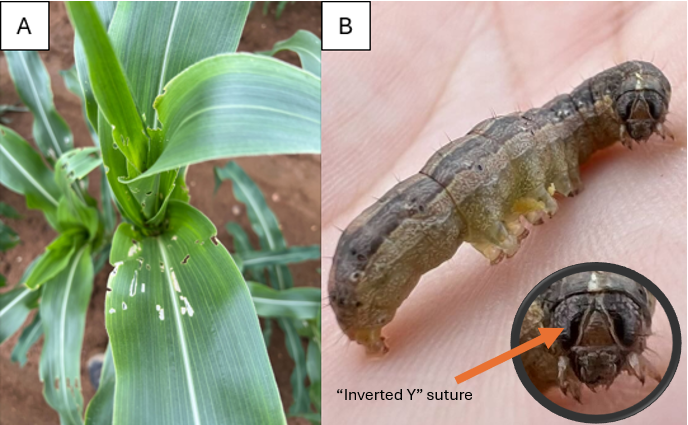
Fall armyworm damage (A) and larva (B). Note the distinctive suture on the head, which will differentiate FAW from other caterpillar pests of corn. Photos by Amanda Quadrel

We continue to see corn leaf aphids in sweet corn tassels and ears. In high numbers they can reduce pollination or cause honeydew and sooty mold on ears that harm marketability. Broad spectrum insecticides, especially pyrethroids, can flare up aphids by disrupting the natural enemies that typically control them. We have seen several instances where FAW sprays in the vegetative stage may have caused high aphid populations during silking. If you’re seeing a lot of aphids on corn tassels, you can start your CEW spray rotation with Lannate (group 1A), which has some efficacy for aphids. Come back a week later and check ear tips for aphid populations. If they are high, as in the below picture, use a product more targeted for aphids, such as Assail 30SG or 30 SC (group 4A), Transform WG (group 4C), or Sivanto Prime (group 4D). Keep in mind that Transform WG and Sivanto Prime have 7 day PHIs.

Close up of the silks and leaves at the tip of a corn ear with many blue-green aphids clustered on the leaf.

Corn leaf aphids on the tip of an ear. Note blue-green color with dark tail pipes (also called cornicles), legs, and antennae. Picture by Maria Cramer.

Tomatoes

Throughout New Jersey we’re continuing to see high thrips counts both in tunnels and in the field.  Thrips management is especially important because of their ability to vector tomato spotted wilt virus (TSWV), a growing problem in New Jersey where we have resistance-breaking strains. There have been many outbreaks of TSWV (in both peppers and tomatoes) throughout south Jersey this season. Scouting and roguing out these plants while continuing to manage thrips can help contain losses. Additionally, follow best management practices for reducing TSWV risk throughout the season.

For scouting, we consider 1-5 thrips on 10 leaves to be a low count and more than 5 thrips a high count. Other guides suggest a treatment threshold of 3-5 thrips per flower or the presence of stippling damage on fruit. Western flower thrips, the primary vector of TSWV, has resistance to some carbamates (group 1A) and organophosphates (group 1B) as well as pyrethroids (group 3), so few are useful for management. They are also broad-spectrum and hard on natural enemies, potentially flaring up secondary pests like spider mites. The following products have varying efficacy for western flower thrips management:

  • Group 5 insecticides (e.g. Radiant, Entrust) historically have given the best control, but growers have been finding resistance throughout south Jersey. If you have applied Radiant or Entrust and have not gotten good control, your local thrips populations may be resistant. Group 5 insecticides can also only be used twice per season in a planting.
  • Lannate (Group 1A) gives the next best thrips knockdown, but is broad spectrum and is not a part of all growers’ spray programs.
  • Beleaf 50SG (Group 29) can be very effective applied through drip irrigation, but takes a while to decrease thrips populations. It is systemic, making it safer for natural enemies than some other products.
  • Group 28 products with the active ingredient cyantriniliprole (e.g. Minecto Pro, Verimark, Exirel) provided suppression in trials.
  • Movento (Group 23, active ingredient spirotetramat) — provided suppression in trials.
  • Requiem EC (no group, active ingredient Chenopodium extract) — provided suppression in trials.

Many products only suppress thrips, meaning they kill larvae but not adults, or kill only the active life stages (larvae and adults, not the egg or pupal stages). Rotate between active ingredients and try to avoid getting to very high thrips numbers which are more difficult to knock back down.
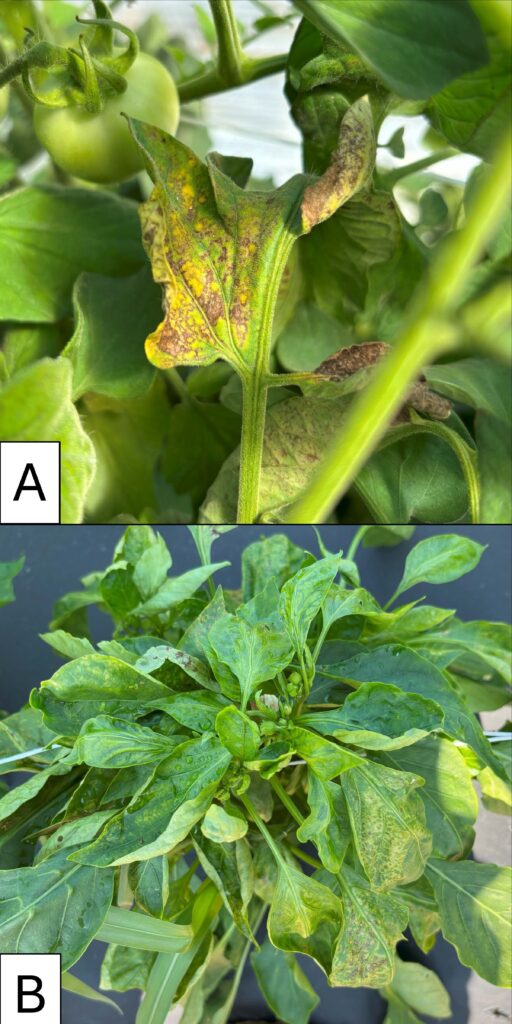
Top picture shows curled tomato leaf with brown circles covering it. The bottom picture shows a pepper plant with distorted, slightly cupped leaves, and yellow markings, including circles, on many leaves.

A) TSWV on a tomato leaf. Note the circle-shaped brown lesions. B) TSWV on a pepper plant. Note the distortion of leaves all over the plant as well as the yellow wavy lines and circles visible on leaves. Photos by Maria Cramer.

We’ve seen some fruit damage from caterpillars, and tomato fruitworm (AKA corn earworm), beet armyworm, and hornworms on plants and fruit. There are no reliable thresholds for determining when to spray for these caterpillar pests, however scouting and consulting the corn earworm pressure map for the state will help give a sense of risk to the crop. When corn earworm pressure indicates a 3 or 4 day spray interval in corn (2-20 moths per night) as is currently the case in much of the state, tomatoes should be scouted weekly for feeding damage. Beet armyworm moth numbers in traps in Salem and Cumberland counties have been low (>10 per night). Pyrethroid resistance is widespread in tomato fruitworm/corn earworm and beet armyworm, so other classes of insecticides should be used if management is needed.

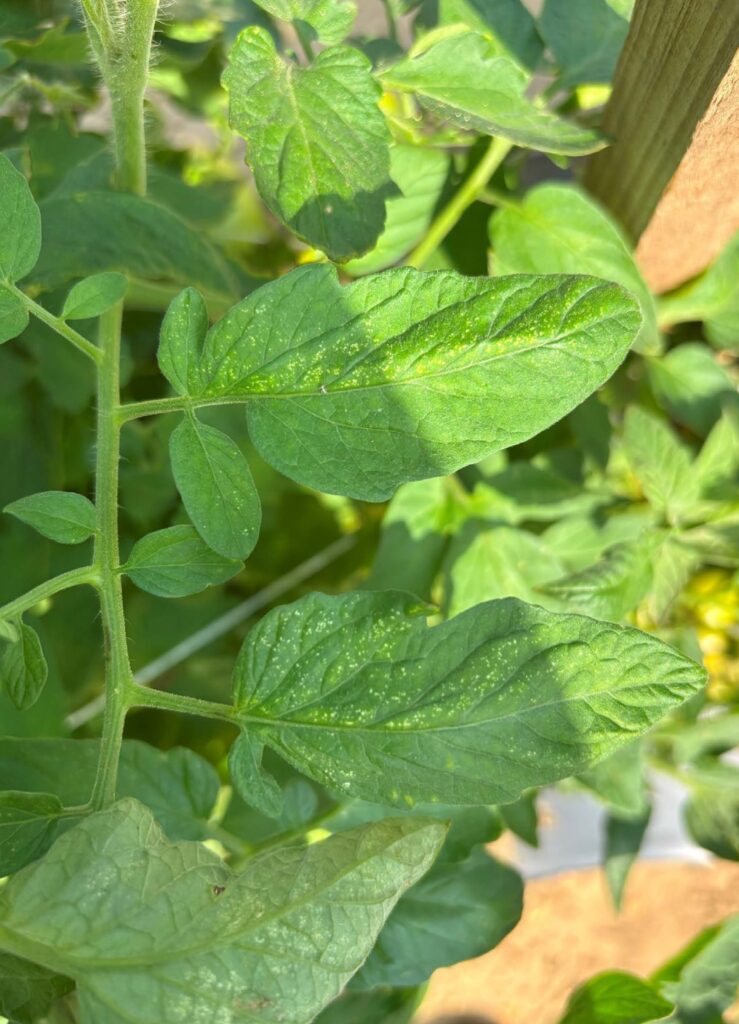
We continue to see high spider mites in many plantings. Spider mites tend to be worse in hot, dry conditions, and their populations can dramatically increase following broad-spectrum insecticides, which reduce their natural enemies. The first sign of their presence is often light-colored stippling seen on the top surface of tomato leaves. The mites causing this damage are usually found on the undersides of leaves, though with bad infestations mites will be found on the upper surface as well. When sampling spider mites, check 10 upper leaflets in at least 5 sites per field. The treatment threshold is 2 mites per leaflet on average (one of the individual leaves that makes up the compound tomato leaf). On farms where crop rotation is limited and the same miticides have been used for multiple years we’re seeing some miticide resistance — check whether and application has decreased mite populations, and if it did not work well, do not keep using it. Rotate between miticides and only treat when above threshold. Some products for spider mites in tomatoes include:

  • Nealta (group 25)
  • Oberon (group 23)
  • Portal (group 21A)
  • Agri-Mek (group 6) *7 day PHI
  • Kanemite (group 20B)
  • Acramite (group 20D) *3 day PHI
Tomato leaves with tiny yellow or white dots on visible on the top surface of the leaf.

Spider mite stippling visible when looking at tomato leaves from above. The spider mites are generally found on the undersides of the leaves. Photo by Maria Cramer.

Peppers

In terms of most insect pests, peppers have been looking very good. We have seen aphids, spider mites, and thrips at low levels so far, however it’s important to keep in mind that thrips can transmit TSWV to peppers as well, and so monitoring and staying on top of thrips populations is crucial. As with tomatoes, finding and roguing out infected plants is important as well. See previous section for an example of TSWV symptoms in peppers.

As a reminder, we have found pepper weevils on pepper weevil traps in Gloucester, Cumberland, and Salem Counties this summer. Read more about pepper weevil biology and management here. If you think you may have pepper weevil on your farm or are interested in monitoring, please contact Maria Cramer.

Cole Crops 

We are seeing flea beetle and caterpillar (diamondback moth, imported cabbageworm, and cross striped cabbageworm) activity in fall cole crop plantings. For flea beetles, treatments are justified if 50% of plants are infested. For caterpillars, seedlings can tolerate up to 10% infestation. For heading cole crops between early vegetative and cupping, the treatment threshold is 30%. As heads form, the treatment threshold goes down to just 5% infestation. Sprayable Bt products (IRAC 11A) such as Dipel, Xentari, or Javelin can be effective on young imported cabbage worm caterpillars. Other materials approved for caterpillar control include Entrust/Radiant (IRAC 5), Proclaim (IRAC 6), Torac (IRAC 21A), and Exirel (IRAC 28). Diamondback moth (the primary caterpillar found in southern NJ) has resistance to many insecticide groups, and pyrethroids (IRAC 3A) and Bt products (IRAC 11A) are not effective for their management. For Bt products and contact insecticides, coverage on the undersides the leaves is essential.
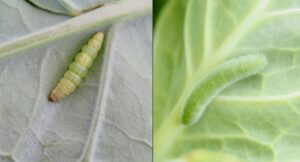
Two caterpillars on brassica leaves. Diamondback moth caterpillar on the left is smooth and tapered at each end. Imported cabbageworm on the right is fuzzy.

Left: Diamondback moth caterpillar, showing characteristic tapering at each end. Right: Imported cabbageworm caterpillar showing characteristic fuzziness. Pictures by Maria Cramer.

Pumpkins and Other Cucurbits

Cucurbit downy mildew was first reported on 7/11/25 on cucumbers in central NJ and has been found on cucumbers and cantaloupe at the Snyder Research Farm in Pittstown. Growers should be applying protectants on cucumbers and cantaloupes for cucurbit downy mildew at this time. As of this post, we still haven’t found any instances of the disease on pumpkins, squash, or watermelon. For information on how to build an effective cucurbit down mildew control program, please reference this post by Dr. Andy Wyenandt and consult the Mid-Atlantic Production Guide for additional materials that can be used.
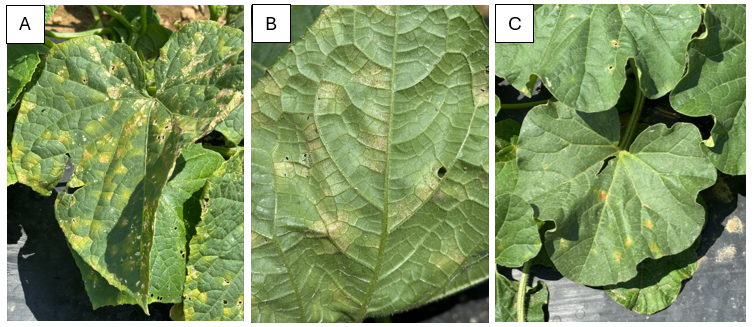
Cucurbit downy mildew symptoms on the upper surface (A) and underside (B) of cucumber leaves and symptoms on cantaloupe (C). Photos by Amanda Quadrel

In pumpkins, we continue to see squash bug eggs and nymphs. Consider treating for squash bug if you see more than one egg mass or group of nymphs per plant (see photos below). Aphid and mite populations are also increasing in many locations. Consult the Mid-Atlantic Production Guide for a list materials appropriate for aphids or mites.
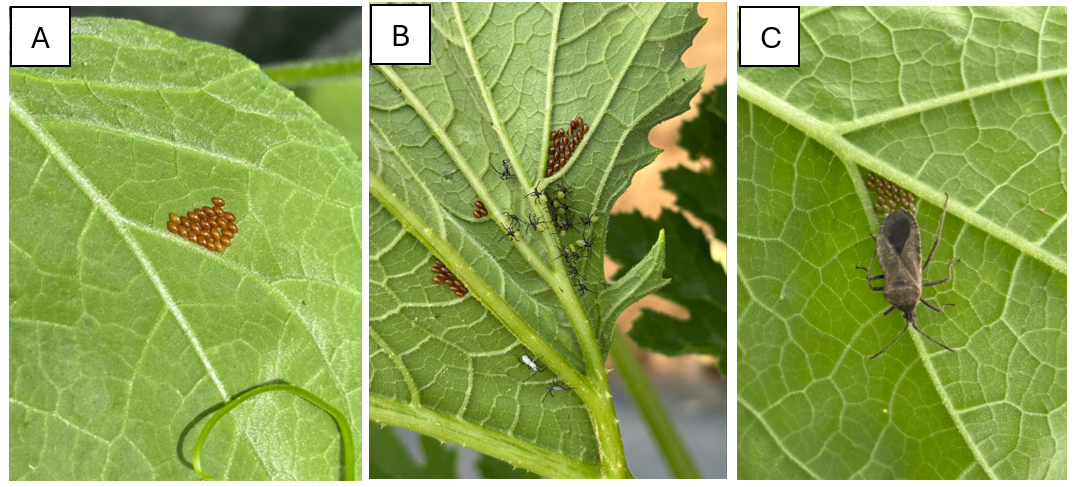
Squash bug eggs (A), newly hatched nymphs (B), and an adult (C). Photos by Amanda Quadrel

Powdery mildew has shown up in most scouted sites. If more than one leaf in a 50 leaf sample is infected, fungicide programs for powdery mildew should be initiated.
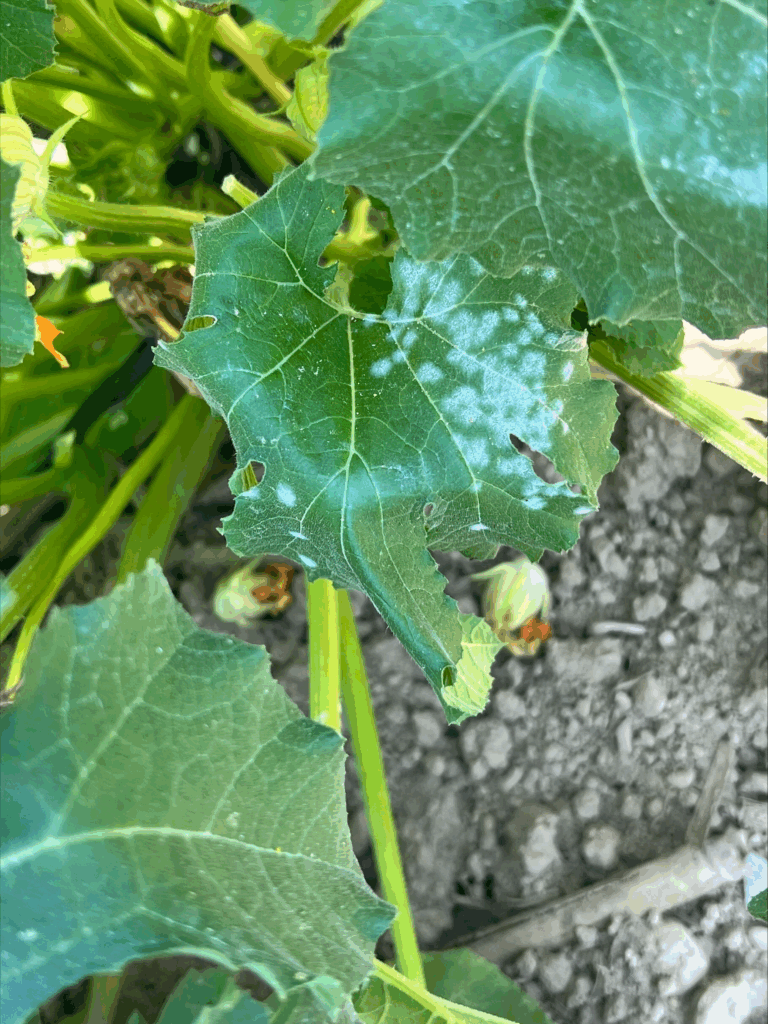
Powdery mildew on pumpkin leaf. Photo by Amanda Quadrel.

We have also seen isolated cases of anthracnose, bacterial wilt, plectosporium, and phythophthora root rot. A preventative diseases management plan based on recommendations from the Mid-Atlantic Production Guide is important for suppressing many of these diseases. If you suspect diseases in your pumpkins (or other cucurbits), reference the “Diagnosing important diseases in Cucurbit crops” guide or send/bring samples to Rutger’s Plant Diagnostic Lab.

As always, please consult the Mid-Atlantic Commercial Vegetable Production Guide for a comprehensive list of materials that are labeled for specific crops and pests. As always, be sure to follow label rates and application instructions.

The Vegetable IPM Program wishes to thank the following Field Technicians, without whom much of the information presented weekly here would not be available:

Southern team: Renee Carter, Kris Szymanski, and Nick Vergara

Northern team: Martina Lavender, Coco Lin, and Cassandra Dougherty

Traceability Rule (Section 204) in the Food Safety Modernization Act Delayed

The Food and Drug Administration (FDA) has proposed extending the deadline for the traceability rule (Section 204) under the Food Safety Modernization Act until July 2028.  The rule was to go into effect in 2026, but FDA is allowing more time for the industry to comply based on the complexity of the rule.  The extension only relates to implementation.  There are no proposed changes to the rule itself.   Growers should take this time to discuss with their buyers how traceability will be implemented.  This is a very involved rule so do not wait until the last minute to start developing your system which meets all the provisions.

Agricultural Water Assessment Questionnaires

Anna Loewald, Research Specialist with the Northeast Center for the Advancement of Food Safety (NECAFS), in collaboration with an advisory group of regional regulatory and educational partners, has developed an Agricultural Water Assessment Questionnaire.  This tool guides growers through a structured series of questions- helping to simplify the assessment process and highlight risk areas.
➡️ They are available for download at the Food Safety Resource Clearinghouse: Agricultural Water Assessment Questionnaire.

Who Must Comply

Under the Produce Safety Rule (PSR), the new pre-harvest water rule requires many fresh fruit and vegetable growers to perform an agricultural water assessment. Compliance is phased in based on farm size (measured by sales):

  • Over $500,000 in annual sales → Rule in effect now
  • $250,000 – $500,000 → Rule takes effect in 2026
  • $25,000 – $250,000 → Rule takes effect in 2027

When the Assessment Must Be Done

  • At the beginning of each growing season
  • Anytime there are major changes to the water system or source (e.g., switching from well to pond, damage from flooding, new distribution lines, etc.)

What the Assessment Must Include

The assessment must:

  • Be written, dated, and signed by the grower or responsible party.
  • Address multiple factors, such as:
    • Water source and distribution system
    • Protection against contamination
    • Crop type and surface characteristics.
    • Method and timing of water application
    • Environmental conditions (weather damage, flooding, etc.)
    • Water test results (used as supporting evidence, not the sole factor)

Takeaway: The agricultural water assessment is not optional for covered farms. It is a documented process that must be updated regularly and reflect real-world changes in the water system. Using tools like the NECAFS questionnaire can make this process more consistent and straightforward.

When evaluating the safety of agricultural water, multiple factors must be considered together. Testing is only one component; a holistic risk assessment includes the following:

  1. Location & Nature of the Water Source
  • Ground water (e.g., wells) – typically lower risk if properly constructed and maintained.
  • Surface water (ponds, rivers, streams) – higher risk due to potential animal access and runoff.
  • Mixed sources – may require additional protective practices.
  1. Water Distribution System
  • Underground mains or buried pipe – generally more protected.
  • Above-ground pipe, lay flat, or open canals – increased potential for contamination.
  • Storage tanks or reservoirs – evaluate for exposure to animals, debris, or microbial buildup.
  1. Protection from Contamination
  • Animal intrusion (wildlife, livestock, domestic animals).
  • Manure applications and proximity to fields.
  • Cross-connections with untreated or wastewater.
  1. Agricultural Water Practices
  • Methods of application: overhead irrigation, drip, flood, etc.
  • Timing: interval between last irrigation and harvest (shorter intervals = higher risk).
  1. Crop Characteristics
  • Surface type:
    • Smooth/waxy (e.g., cabbage, tomatoes) → less microbial adhesion.
    • Netted/rough (e.g., cantaloupe, leafy greens) → higher risk.
  • Growth habit: crops close to the soil are at greater risk of contamination.
  1. Environmental Conditions
  • Weather damage: frost cracks, hail wounds, sandblasting.
  • Soil splash during rain/irrigation.
  • Flood events – significant contamination risk.
  1. Other Considerations
  • Water testing: periodic microbial testing provides valuable data but must be considered alongside the full risk profile.
  • Historical issues: prior contamination events, known sources of runoff, or nearby land uses (e.g., livestock, septic systems).

 Exemptions from the Agricultural Water Assessment Requirement

Not all farms are required to complete a pre-harvest water assessment under the Produce Safety Rule. If the operation meets any one of the following conditions, the assessment is not required:

  • No untreated surface water is applied to covered produce.
  • Untreated groundwater is used, and it is tested following the harvest/post-harvest water protocol:
    • Four samples collected in the first year, tested for generic coli.
    • If all results are compliant (no generic coli detected), only one sample per year is required in subsequent years.
  • The public water system is the source (documentation required).
  • Water is treated and monitored to ensure it remains of safe and adequate sanitary quality for its intended use.

Takeaway: Farms using treated water, municipal water, or groundwater verified with ongoing testing do not have to perform a full agricultural water assessment.

Please take the opportunity to review the questionnaires and use them to meet the requirements for the pre-harvest water assessment!

Food Safety Training Season Starting

Fall and winter are the prime time for food safety training.  We will be starting in October with basic hands-on training for anyone starting to farm or wanting a basic refresher.  That is followed by a two day online Produce Rule Training.  This training is required for most fresh fruit and vegetable growers before the New Jersey Department of Agriculture inspects the operation.  See the details below on dates and how to register.

 October

Hands-on Produce Safety Workshop: Wednesday, October 8 from 10 am-2 pm EST.

This hands-on produce safety class in Cream Ridge, NJ is for farm owners, farm employees, farm managers, and those thinking about starting a farm. The class is focused on the various actions that can be part of a strong produce safety plan whether you have one or are just getting started. These activities include building a DIY hand-washing station, assessing wildlife risks in the field and developing an action plan, an interactive cleaning and sanitizing demonstration, and more.

December

Two-day online Food Safety Modernization Act: Produce Safety Rule Training: December 9 – 10.

You’ll need to attend both days to receive a certificate, and you must always have a camera on during the training according to the Produce Safety Alliance Online Training Policies.

The PSA Grower Training Course is one way to satisfy the FSMA Produce Safety Rule requirement outlined in § 112.22(c) that requires ‘At least one supervisor or responsible party for your farm must have successfully completed food safety training at least equivalent to that received under a standardized curriculum recognized as adequate by the Food and Drug Administration.’

For more information on any of these classes or to sign up go to: Our Trainings – Rutgers On-Farm Food Safety (onfarmfoodsafety.rutgers.edu)


Fruit IPM Report August 26 2025

Peach:

Oriental Fruit Moth (OFM): Overall, OFM trap captures have been low and treatments should be over for the third generation flight statewide. Additional treatments should be made if trap captures are over 6 moths per trap.

Scale Insects: Scale crawler emergence is past peak and declining. White Peach scale has a third generation in September and San Jose scale may have a third generation in October. Options at this point include Group 4A products labelled for scale including Assail, and the bioinsecticide Venerate. Venerate has a 0-day PHI, making it useful for blocks near or at harvest (Figure 1).

Figure 1. San Jose scale on apple.

Lesser Peachtree Borer (LPTB) and Peachtree Borer (PTB): Trap counts for borers have been high at several farms this season throughout the state (Figure 2). Where mating disruption is not being used, trunk sprays using pyrethroids can be applied early to mid-September followed by an additional application in mid to late September. Since this would be a labor intensive practice it would be most efficient to give priority to younger and most productive orchards. See the NJ Tree Fruit Production for effective materials and rates.

Figure 2. Lesser peachtree borer adult.

Apples and Pears:

Summer Diseases: Disease control is over for Early season apple varieties. Mid to late season varieties will need further applications on a two-week schedule until mid-September for sooty blotch and fly speck. See the NJ Tree Fruit Production guide for effective materials.

Brown Marmorated Stink Bugs (BMSB): Brown Marmorated Stink bug and native stinkbug populations have been low this season, although we have seen an increase in trap captures at some farms. If stinkbugs are a concern for your orchard, see the NJ Tree Fruit Production guide for effective materials.

Codling Moth (CM): Most orchards have very low CM pressure. Additional treatments should be made if trap captures are over 5 moths/trap.

Phenology Table: Based on annual observations made in Gloucester County.

Pest Event or Growth Stage Approximate Date 2025 Observed Date
 Bud Swell (Redhaven/PF-17)  March 23 +/- 15 Days March 30
1/4″ Green Tip Red Delicious March 31 +/- 13 Days March 30
Pink Peach (Redhaven/PF-17) April 4 +/- 15 Days April 1
Tight Cluster Red Delicious April 9 +/- 13 Days April 5
Full Bloom Peach (Redhaven/PF-17) April 9 +/- 14 Days April 10
Pink Apple (Red Delicious) April 14 +/- 12 Days April 16
Full Bloom Apple (Red Delicious) April 22 +/- 11 Days April 25
Petal Fall (Redhaven) April 22 +/- 10 Days April 19
Petal Fall (Red Delicious) April 27 +/- 13 Days May 2
Shuck Split (Redhaven) April 30 +/- 11 Days April 26
Pit Hardening June 15 +/- 9 Days June 15

Tree Fruit Trap Captures – Southern Counties

Week Ending STLM TABM-A CM BMSB OFM-A DWB OFM-P TABM-P LPTB PTB
4/5/2025 0 0 0 0 0 0 0 0 0 0
4/12/2025 0 0 0 0 6 0 0 0 0 0
4/21/2025 0 0 0 0 36 0 1 0 0 0
4/27/2025 25 0 0 0 24 0 5 0 1 0
5/2/2025 517 0 4 0 12 0 6 0 13 0
5/9/2025 159 4 10 0 3 16 5 4 46 0
5/16/2025 91 11 6 0 1 36 2 14 69 0
5/23/2025 299 21 3 0 1 23 1 26 23 0
5/30/2025 399 14 2 0 0 41 1 11 10 3
6/6/2025 733 13 1 0 0 36 2 12 29 1
6/13/2025 684 19 2 1 0 81 2 17 22 8
6/20/2025 724 24 2 0.5 1 60 1 23 19 12
6/27/2025 932 5 1 0.8 1 40 0 5 24 14
7/4/2025 643 0 0 0.75 1 17 0 0 6 16
7/11/2025 194 0 0 0.5 0 18 8 0 24 15
7/18/2025 190 0 0 1 0 16 2 1 5 12
7/25/2025 222 2 1 1.6 0 16 1 2 12 21
8/1/2025 450 1 0 2 1 24 2 1 21 18
8/8/2025 523 2 1 2 0 35 5 2 30 19
8/15/2025 595 1 0 2 0 37 1 2 32 15
8/22/2025 125 5 0 3.75 1 49 4 4 40 14

Tree Fruit Trap Captures – Northern Counties

Week Ending STLM TABM-A CM BMSB OFM-A DWB OFM-P TABM-P LPTB PTB AMBROSIA BEETLE
4/5/2025 387 0 0 0 0 0 0 0 0 0 0
4/21/2025 435 0 0 0 0 0 1.3 0 0 0 0
4/27/2025 26 0 0 0 0 0 25 0 0 0 72
5/2/2025 86 0 0.33 0 72.5 0 47.2 0 0 0 136
5/9/2025 56 0 5.3 0 58.8 0 22.9 0 0 0 145
5/16/2025 13.75 2.6 7.3 0 4 0 5 0 0 0 50.5
5/23/2025 4.8 10.3 10.5 0 0.6 31.25 4.2 0 14.6 1 22.2
5/30/2025 2.2 4.8 1.8 0 0 12.4 9.6 0 9.6 1.9 22.1
6/6/2025 3 4.83 2.8 0.25 0 20 4.1 0 21.2 1.8 40.3
6/13/2025 65 20 11.4 0.6 0 12.3 4 0 10.5 1.5 59.2
6/20/2025 26 26 8 0.75 1 13 4.5 0 11 0.75 52
6/27/2025 145 19 6 1.3 6 35 5.4 0 16 1.6 38
7/4/2025 212 6 3 0.6 12.5 40 2 0 8.4 1.1 27
7/11/2025 125 2.5 0.5 0.14 5 41 3 0 20 4.5 48
7/18/2025 64 0.5 0.4 0.16 2 42 2 0 8.4 1.9 64
7/25/2025 110.5 0.4 2.3 0.24 7.5 44 4 0 6.8 12.2 69
8/1/2025 132 0.5 2.8 0.4 5.7 42.5 2.9 0 8 6.2 71.5
8/8/2025 157 1.9 0.6 0.41 6 27.8 8.3 0 10.8 5.5 78
8/15/2025 36.8 2 2.6 0.3 2.9 25.8 2 0 11.6 4.8 24
8/22/2025 25 6 1.4 0.05 1.6 40.4 7 0 18 4.8 67.6

Grape

Figure 3. Sour rot of grapes.

Disease management continues to focus on downy and powdery mildew and also bunch rots (Figure 3).

Downy mildew has been particularly prevalent this season in vineyards throughout the state. Refer to the NJ Commercial Grape Production Guide for information on control.

Figure 4. Spotted lanternfly on grapevine.

Grape Berry Moth: The timing for the third generation is past. In some hot summers a fourth generation may occur, however no further treatments should be needed, especially where insecticides are being applied for Spotted lanternfly and Spotted-wing drosophila.

Spotted Lanternfly (SLF): SLF adults are now appearing in vineyards in low numbers mostly on vineyard edges (Figure 4). As we move into September adult migration will increase and at that point growers should apply materials with long residual efficacy. More information on biology and control can be found from Penn State.


Blueberry

As we look to postharvest management in blueberries, the focus is on sharp-nosed leafhopper, scales, black shadow, and fall weed management. Sharp-nosed leafhopper and scale crawler numbers remain low but will continue to be monitored into September.

For weekly reports on blueberry pests and recommendations read the Rutgers Blueberry Bulletin.

Spanish Course for Ag Workforce – Registration Open

People shaking hands in a field with the sun setting behind themThe Rutgers Office of Continuing Professional Education will host a course on ‘Spanish for Ag and Horticulture Workforce’ from January 16-March 6, 2026. This is an online, self-paced course with approximately 21 hours of course content designed to help participants study conversational Spanish and gain technical vocabulary specific to those in the agriculture and horticulture workforce.

There is a registration fee of $825 per person. Register by January 9, 2026 for the early bird registration rate of $795.

For more information and to register, visit https://cpe.rutgers.edu/spanish-for-ag-and-horticulture-workforce.