Archives for March 2025

Allium Leafminer Update 3/24/2025- First oviposition scars spotted

The first Allium leafminer (ALM) oviposition scars were reported in Cape May this past weekend (38.9588N, 74.9082W), suggesting that adults are active in the southern part of the state. ALM are active around 250 GDDs. If you want to know how many GDDs have accumulated in your area, the NEWA website https://newa.cornell.edu/ has a helpful GDD calculator. From the NEWA home screen, select the nearest weather station from the drop-down menu at the center of the page.  Next, scroll down to “Weather Tools” on the right side of the page and select “DD Calculator.”  Select your start date (1/01/25) and end date, as well as Degree Day Type (39 F) from the menu at the left of the page.  The site will automatically generate the accumulated GDD base 39 F to the last day of your requested sample, and then offer a forecast of accumulated GDD for the next week.

ALM can cause injury to chives, scallions, garlic, onions and leeks, but leeks and scallions seem to be the most effected. Look for neat rows of white spots descending from the upper tips of allium leaves (see photo below). Initial injury often occurs on the tallest leaves. Adults may be seen in warmer conditions at the tips of the leaves- look for small flies with grey-black bodies and yellow heads (see photo below).

If you are concerned about crop injury due to Allium leafminer, you may want to prepare for control efforts. Floating row covers, kept on until the first flight ends (around the end of May) can restrict ALM’s access to vulnerable plants. Adults can be targeted through insecticide sprays. Appropriate materials that are labeled for ALM control include spinosyns (Radiant, Entrust (OMRI approved)), pyrethroids (Mustang Maxx, Warrior), neonicotinoids (Scorpion, Venom), and the insect growth regulator Trigard. The first application should be applied 2- 3 weeks after initial detection of ALM flies (if you see oviposition scars or the fly itself) and subsequent sprays should be completed in 1–2-week intervals. Two or three sprays should provide adequate control.

Field Scouting Guide: Allium Leafminer - Growing Produce

Notice the white oviposition scars and an adult female ALM. Photo: Brian A. Nault, Cornell AgriTech. 

If you have any questions/concerns, feel free to reach out to me at amanda.quadrel@rutgers.edu or 732-742-8441.
Cleaning and Sanitizing Tools for the Production Season

Now is the time to think about where there are potential sanitation issues on your farm.    At the start of the season all your bins, totes and harvesting tools that come in contact with the harvestable part of the crop should be washed and sanitized before using. First, they should be cleaned and scrubbed with a  soap then rinsed off prior to sanitizing. Rinsing is important since some sanitizers will interact with the soap and that could reduce the efficacy of the sanitizer. Once they are cleaned and sanitized let them dry then place in a protected area.  Train workers on how to decide whether a container should be cleaned and the process for cleaning and sanitizing.

During the season picking baskets should be checked after each use to see if cleaning and sanitizing is required.  You do not need to do this every day, but when a sufficient number of containers are dirty, take the time to clean them. We cannot get rid of risks on farms completely, but this step is essential to reducing risks.

If you use a packing or wash line, it should be cleaned and sanitized at the beginning of the season and after each use.  This could be done at the end of the day or just before using the next time.  There are four steps to cleaning and sanitizing a piece of equipment.

  1. Remove any obvious dirt or debris from the surface.
  2. Apply an appropriate detergent and scrub the surface. There are no set recommendations as to which detergent to use.  Scrubbing is important to remove dirt that sticks to the surface and any biofilms that can have formed.  Biofilms are a community of microorganisms that stick together and form a protective layer around themselves.
  3. Rinse the surface with clean water making sure to remove all the detergent and soil. If the detergent is not removed, it may react with the sanitizer making it ineffective.
  4. Apply a sanitizer approved for use on a food contact surface. Make sure to read the label for the concentration and contact time.  Each product may require different contact time from a few seconds to several minutes.  Remember the label is the law so follow what the label requires.

There is a difference between cleaning and sanitizing.  Cleaning is the physical removal of soil from the surface which includes the use of clean water and a detergent. Sanitizing is the treatment of a cleaned surface to reduce or eliminate microorganisms.  Remember you cannot sanitize a dirty surface!  The surface must be cleaned first!

For more information please see the links below or visit our website

onfarmfoodsafety.rutgers.edu

Video on cleaning and sanitizing a packing line:  Single Line Pass Surface Sanitation: Deep Clean

Choosing the correct sanitizers: PSA EPA-Labeled Sanitizers for Produce

Correct dosage rates for sanitizers: Sanitizer Dose Calculator

Food Safety Modernization Act Traceability Rule Delayed

The Food and Drug Administration (FDA) announced March 20 that the Traceability Rule is being delayed for 30 months.  The rule was to go into effect January 1, 2026, but now enforcement will not start for at least 2.5 years.  FDA will be publishing a proposed rule at a later date.  There are no indications at this time what changes they plan to make or how it will impact growers of different size operations.

Stop the Bleed Training: Burlington County

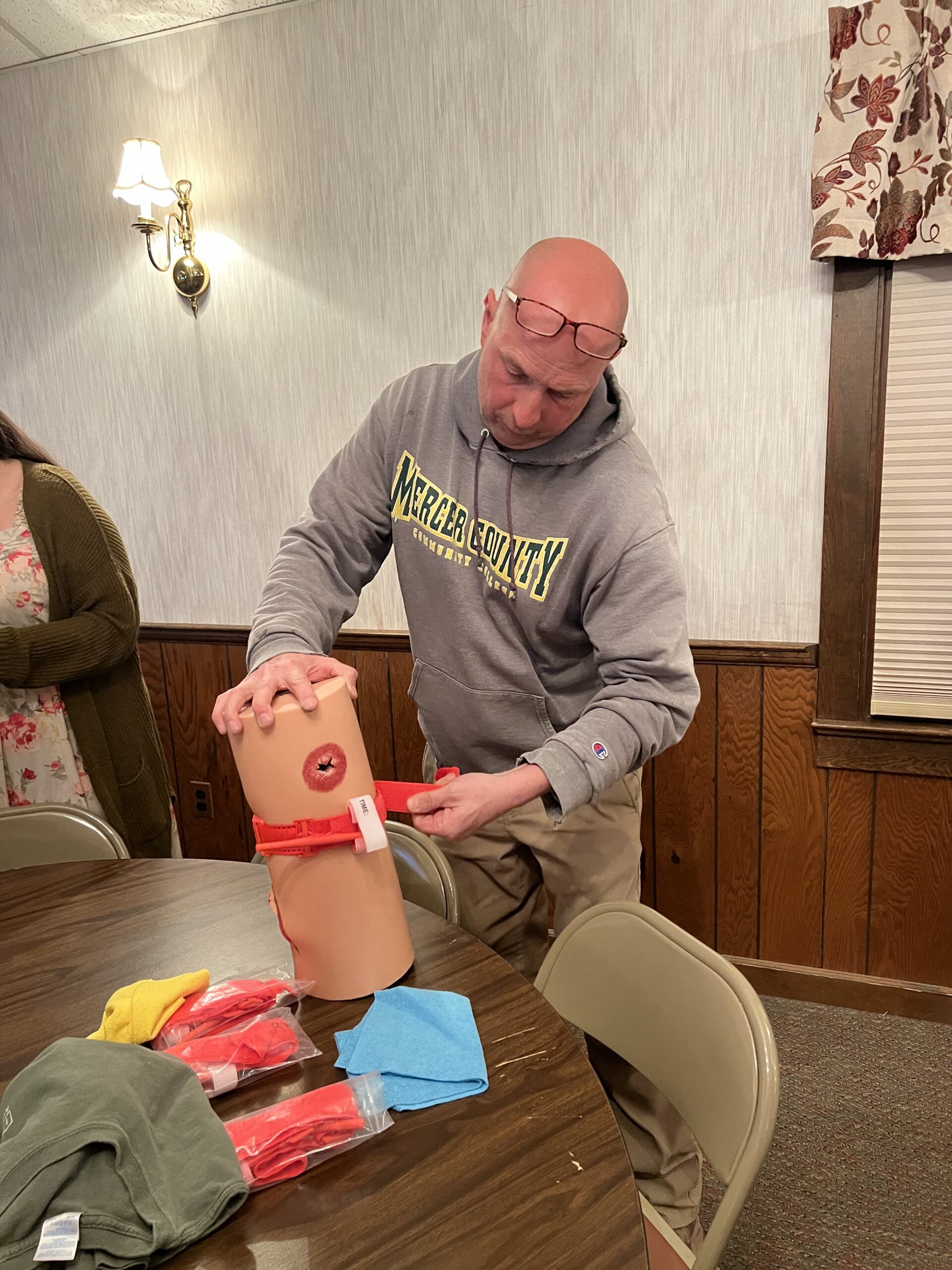
Person applying a tourniquet to a mannequin Rutgers Cooperative Extension, in partnership with the Vegetable Growers Association of NJ and the Rutgers NJ Medical School, will host a Stop the Bleed training on Tuesday, April 8, 2025 from 10:00 am to 12:00 pm at the Rutgers EcoComplex located at 1200 Florence Columbus Rd, Fieldsboro, NJ 08505.

Don’t miss this opportunity to learn the life-saving skills of pressure application, wound packing, and use of tourniquets. Attendees of this free training will also receive a complementary bleeding control kit. Space is limited, register today! Please complete our pre-registration form by Monday, April 1.

Questions? Email Kate Brown, RCE-Somerset County Ag Agent, at kbrown@njaes.rutgers.edu or call 908-526-6293.

Allium Leafminer Update 3/20/2025

Happy first day of Spring! Many parts of New Jersey are close to accumulating 250 growing degree days (GDDs) base 39˚F, which is when the first emergence of Allium leafminer (ALM) adults is predicted to occur. In some areas of New Jersey, 250 GDDs are forecasted to be surpassed as early as this weekend. In Cape May, oviposition scars have already been spotted. If you would like to know how many GDDs have accumulated in your area, the NEWA website https://newa.cornell.edu/ has a helpful GDD calculator. From the NEWA home screen, select the nearest weather station from drop down menu at the center of the page.  Next, scroll down to “Weather Tools” on the right side of the page, and select “DD Calculator”.  Select your start date (1/01/25) and end date, as well as Degree Day Type (39 F) from the menu at the left of the page.  The site will automatically generate the accumulated GDD base 39F to the last day of your requested sample, and then offer a forecast of accumulated GDD for the next week.

ALM can cause injury to chives, scallions, garlic, onions and leeks, but leeks and scallions seem to be the most effected. Look for neat rows of white spots descending from the upper tips of allium leaves (see photo below). Initial injury often occurs on the tallest leaves. Adults may be seen in warmer conditions at the tips of the leaves- look for small flies with grey-black bodies and yellow heads (see photo below).

If you are concerned about crop injury due to Allium leafminer, you may want to prepare for control efforts. Floating row covers, kept on until the first flight ends (around the end of May) can restrict ALM’s access to vulnerable plants. Adults can be targeted through insecticide sprays. Appropriate materials that are labeled for ALM control include spinosyns (Radiant, Entrust (OMRI approved)), pyrethroids (Mustang Maxx, Warrior), neonicotinoids (Scorpion, Venom), and the insect growth regulator Trigard. The first application should be applied 2- 3 weeks after initial detection of ALM flies (if you see oviposition scars or the fly itself) and subsequent sprays should be completed in 1–2-week intervals. Two or three sprays should provide adequate control.

Field Scouting Guide: Allium Leafminer - Growing Produce

Notice the white oviposition scars and an adult female ALM. Photo: Brian A. Nault, Cornell AgriTech. 

If you have any questions/concerns, feel free to reach out to me at amanda.quadrel@rutgers.edu or 732-742-8441.

Stop the Bleed Trainings: Hunterdon and Burlington County

Rutgers Cooperative Extension has partnered with the Vegetable Growers Association of NJ to offer two upcoming Stop the Bleed trainings. Don’t miss this opportunity to learn the life-saving skills of pressure application, wound packing, and use of tourniquets. Attendees of this free training will also receive a complementary bleeding control kit. Space is limited, register today!

HUNTERDON COUNTY:

  • Wednesday, March 19, 2025 from 6:30-8:00 pm
  • Amwell Valley Fire Company located at 22 County Road #579, Ringoes, NJ 08551
  • Training will be delivered by trainers from Robert Wood Johnson University Hospital
  • Please complete our pre-registration form by Friday, March 14

BURLINGTON COUNTY:

  • Tuesday, April 8, 2025 from 10:00 am to 12:00 pm
  • Rutgers EcoComplex located at 1200 Florence Columbus Rd, Fieldsboro, NJ 08505
  • Training will be delivered by students from Rutgers New Jersey Medical School
  • Please complete our pre-registration form by Monday, April 1

Questions? Email Kate Brown, RCE-Somerset County Ag Agent, at kbrown@njaes.rutgers.edu or call 908-526-6293.