Archives for May 2024

Heat and Pollen Combine For Uncomfortable Outdoor Working Conditions

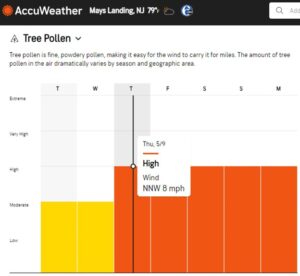
Accuweather Tree Pollen Forecast graph 05082024

Accuweather Tree Pollen Forecast for Southern NJ

Though the CDC Heat Risk Forecast indicates minor risk today, and little to none for the rest of the week, NJ pollen forecasts indicate tree pollen counts will be high for the next several days. It doesn’t take much outdoor work to see, and feel, the amount of pollen in the air. 
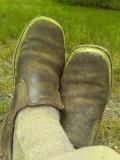
pollen covered shoes

Pollen quickly accumulating on surfaces during this week’s tree shedding.

Working in these conditions can be uncomfortable with that combination of heat and pollen, and risky for those with respiratory health problems and/or allergies. Those KN-95 masks used for COVID-19 prevention can reduce the discomfort of working in high pollen and other dusty conditions, so keep a supply on hand for all your workers.
 

Controlling strawberry fruit rots with an emphasis on mitigating fungicide resistance development

Fruit rots in strawberry can cause significant losses if not recognized early and properly controlled. The use of good cultural practices such as keeping fields weed-free, promoting good drainage and air movement, long crop rotations, and preventative fungicide applications are critically important for reducing the potential development of fruit rots in strawberry.

Pathogens such as anthracnose fruit rot (Collectotrichum spp.), gray mold (Botrytis cinera), and leather rot (Phytophthora cactorum) can become systemic problems in strawberry fields and can be difficult to manage over the lifetime of the planting. Importantly, fungicide resistance development in the pathogens that cause fruit rot in strawberry are widely documented; mostly in Botrytis.

Anthracnose Fruit Rot

Anthracnose fruit rot of strawberry

Anthracnose Fruit Rot of Strawberry

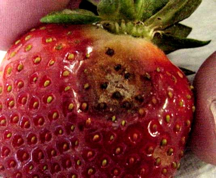
Anthracnose fruit rot can cause serious losses if not controlled. Symptoms of anthracnose include the development of circular, sunken lesions on infected fruit. Often pinkish/tan colored spore masses will develop in the center of lesions. Anthracnose in strawberry is caused by Colletotrichum spp. Spore production, germination and fruit infection are favored by warm, humid weather. The fungus can overwinter on infected plants, in plant debris or on weed hosts. Spores are dispersed by splashing water and can infect green and mature fruit. Control begins with protectant fungicides from flowering through harvest.  Begin sprays no later than 10% bloom or prior to disease development and continue on a 7 to 10 day interval.  Use the higher fungicide rate and shorter intervals when disease pressure is high.  Do not make more than two consecutive applications of the same fungicide before switching to a fungicide in a different FRAC group. Fungicide resistance in C. acutatum and C. gloeosporioides to FRAC group 11 fungicides (azoxystrobin and pyraclostrobin) have been reported in FL in recent years.


Leather Rot

Strawberry-Leather-Rot-2013-300x235

Strawberry Leather Rot

Leather rot caused by Phytophthora cactorum can cause losses during warm, wet weather with extended periods of rainfall. Infection can take place during all stages of fruit development as long as favorable conditions are present. Infected fruit turn brown and have blotchy tough appearance. Infections typically occur in fruit that are in direct contact with the soil, but the pathogen can also be splashed onto fruit via rainfall and wind. Research by Dr. Mike Ellis, Using Fungicides to Control Strawberry Fruit Rots in Ohio, has shown that FRAC code 11 fungicides such as Cabrio, Abound, and Pristine are effective against leather rot. Pristine being the fungicide of choice because it also provides control of gray mold and anthracnose. Follow the link above for an excellent review of all three of these diseases and a useful efficacy table. Resistance to mefenoxam has been reported only in SC to date and resistance to QoI fungicides (FRAC group 11) in P. cactorum, from both crown and fruit infections, have been reported in FL in the past 5 years.


Gray Mold (Botrytis Fruit Rot)

Botrytis fruit rot of strawberry

Gray Mold (Botrytis Fruit Rot)
of Strawberry

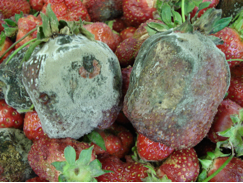
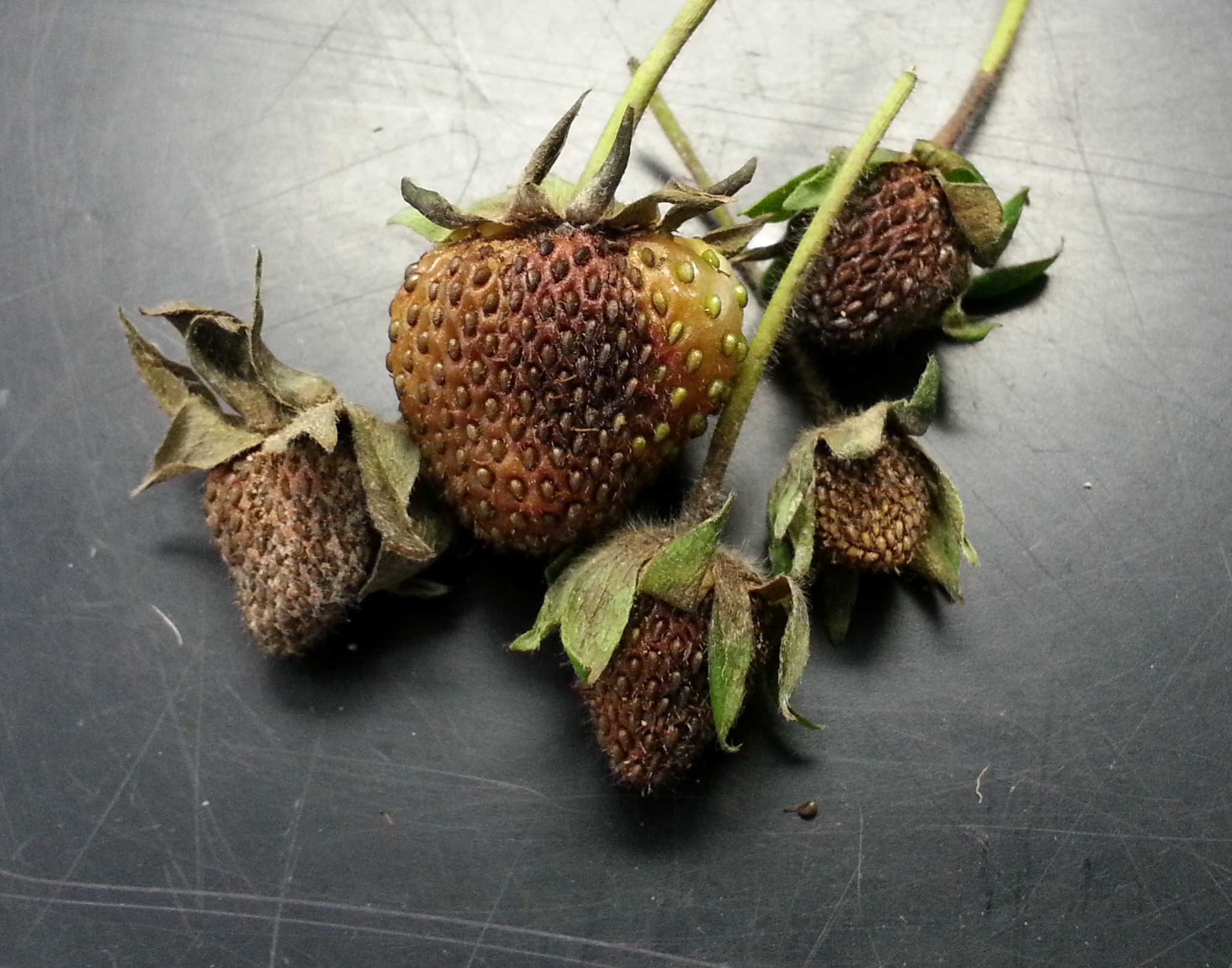
Gray mold is often a serious problem during extended cool, wet periods when fruit are sizing and reaching maturity. Symptoms of gray mold are the diagnostic grey, fuzzy growth that will cover entire fruit. Control of gray mold, like the other diseases, begins with recognizing the conditions for its development, its symptoms, and preventative fungicide applications. Start sprays when plants begin to bloom, because 90% of fruit infections occur through the flower, and repeat every 7-10 days. Increase spray intervals during persistent dry periods, but decrease intervals to 5-7 days during very wet periods.  Four weekly sprays starting at 5-10% bloom are usually sufficient for season-long control. Tank-mix and rotate fungicides from different FRAC codes to reduce the chances for fungicide resistance development.

Fungicide resistance in Botrytis is widely known and documented. Resistance development has been documented in MBC fungicides (FRAC code 1) to benomyl (no longer on the market) and thiophanate-methyl;  the DC fungicides (FRAC group 2) with iprodione; the SDHI fungicides (FRAC group 7) with boscalid, fluxapyroxad, and penthiopyrad; the AP fungicides (FRAC group 9) with pyrimethanil and cyprodinil; the strobilurin fungicides (FRAC group 11) with azoxystrobin, trifloxystrobin, and pyraclostrobin; and the Hyd fungicides (FRAC group 17) with fenhexamid. Cross resistance to fungicides within specific FRAC groups has also been widely documented. Most importantly, resistance to multiple FRAC groups has also been widely reported in Botrytis in the US. Recent studies across the southeast have shown that some Botrytis isolates can carry resistance to 2, 3, 4, or 5 different FRAC groups. A study from 2015 examining 2,000 Botrytis isolates collected across the southeast discovered that some isolates carried resistance to 6 or 7 different FRAC groups. As described the authors, this was likely the result of “selection by association” in which resistance was selected by the fungicide applied but also indirectly because the selected isolates were also inherently resistant to fungicides in other FRAC groups.

How to manage fruit rots and fungicide resistance development

The use of mulch to prevent/reduce soil splashing and keeping fruit from coming into direct contact with the soil surface can be beneficial in conventional production as well as organic production systems where conventional fungicides cannot be used. Long crop rotations and staying away from fields with known history of any of these pathogens is also extremely important, although this may be difficult on farms with U-pick operations where fields need to be close to the market and accessible. Adjusting plant populations to improve air movement and the drying of leaves and fruit within the canopy, and avoiding overhead irrigation are some of the cultural practices growers can do to help reduce losses to fruit rot.

Strawberry growers need to pay careful attention to the efficacy of all high-risk fungicides used during the season. Fields should be scouting regularly, particularly before and after a fungicide application. Remember, due to the specificity of high-risk fungicides, once resistance develops to any one particular fungicide chemistry the likelihood of cross-resistance development increases significantly to other fungicides within the same FRAC group. If loss of efficacy is noticed, growers should discontinue the use of that FRAC group during that growing season. Growers developing season-long fungicide programs for fruit rot control need to use as many different modes-of-action (i.e., different FRAC groups) as possible and limit the use of any single mode of action as much as possible to help mitigate resistance development. This is especially important when growers are applying fungicides with more than one mode of action. Careful attention needs to be made to both fungicide chemistries so that the same mode of action isn’t used during the next application. As a general rule, growers need to use as many different modes of action as possible and to space them out as far apart as possible during the production season.

For more information on the control of anthracnose fruit rot, gray mold, and leather rot in strawberry please see the 2024/2025 Commercial Vegetable Production Recommendations Guide for the mid-Atlantic Region.

NJDA Announces 2nd RFP for Underserved, Beginning and Military Veteran Farmers Mini-Grant Program

Last Friday, the NJDA closed the Request for Proposals (RFP) period for our Underserved, Beginning and Military Veteran Farmers Mini-Grant Program. Due to a recent increase in interest in the program, we have decided to extend a second RFP window to members of our specialty crop community who qualify. The second RFP will be open to the public starting May 10th, with the final application deadline now May 31st @ 5PM.

A number of exciting applications from members of NJ’s specialty crop community were received during this first application period. To expedite the review process, all applications submitted prior to May 3rd will be reviewed over the next few weeks. Applicants from the first RFP period can expect a funding decision following the NJ Board of Agriculture meeting on May 22nd. Applicants who apply during the second RFP period can expect a decision following the June 26th NJ Board of Agriculture meeting.

For those interested in learning more about this program, the NJDA will be hosting a webinar to promote the Underserved, Beginning and Military Veteran Farmers Mini-Grant Program on Friday, May 10th at 11 am EDT. Please join to learn more about the program guidelines, eligibility, and application process. Q&A will follow the presentation.  Registration is not required. A recording of the webinar will be available for those who are unable to attend.

More information about the program is available at the following links:

Program Webinar – May 10th at 11am.

Program Webpage

Beat the Heat: Tools for Evaluating Heat Risk

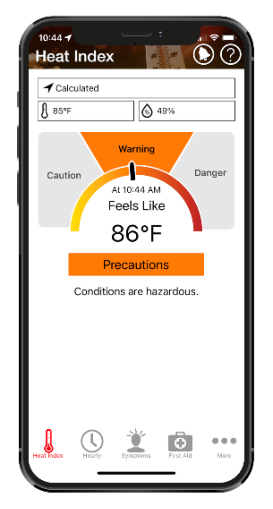
Heat index phone application

Heat safety tool phone app created by OSHA and NIOSH.

As the weather warms up, prepare yourself to evaluate the heat risk for outdoor tasks. We often use a weather application on our phone to check the daily high and low temperature, but air temperature alone is not sufficient to evaluate heat risk. Heat index is a more appropriate measurement because it combines the effects of air temperature and humidity to indicate the level of discomfort felt by the average person. 

One easy way to check the heat index is the Heat Safety Tool phone app (see photo) developed by the Occupational Safety and Health Administration (OSHA) and the National Institute for Occupational Safety and Health (NIOSH). The app calculates heat index at your specific site and displays the risk level to outdoor workers. It also provides insight into protective measures for the given risk level. This mobile phone app is available for both Android and iPhone

A similar, web-based tool is the HeatRisk website created by the U.S. Centers for Disease Control and Prevention (CDC). The HeatRisk homepage has a color-coded map to indicate today’s heat risk (no risk to extreme risk) for each county in the U.S. You can also enter your zip code to get the daily and 5-day forecasted heat risk for your site plus corresponding actions to reduce heat-related health risks. 

 Stay tuned for weekly posts on how beat the heat this summer!

Tree Fruit IPM Report for May 1, 2024

Tree Fruit Phenology: In southern counties all peach orchards are shuck split to shuck off. Redhaven /PF-17 was at approximately at petal fall on April 15. Red Delicious is at petal fall. Apple bloom has been prolonged this year, with some varieties still in various stages of bloom. Sweet cherries are at past bloom and tart cherries are at petal fall.

Peach:

Bacterial Spot: Copper formulations should be used starting at petal fall to suppress bacterial spot. Generally we recommend starting at 0.5 ozs metallic copper and gradually lowering the rate as the season progresses. The rate applied will depend on the formulation. Dr. Lalancette published a chart listing common copper formulations and rates for peach and nectarine applications. Avoid combining copper with captan especially if it has been overcast for several days. Also avoid acidic spray solutions when applying copper. Dr. Lalancette has published a handy guide for copper applications in early covers. Antibiotics containing oxytetracycline may also be used and may offer slightly more residual activity during long wetting periods.

Peach Scab: In addition to Rusty Spot and Bacterial Spot, Peach Scab requires protective applications starting at petal fall. Peach scab cankers begin to expand at bloom and by shuck split begin to shed spores during wetting periods. Topsin, Topsin/Captan combinations, Flint Extra, Inspire Super, and especially Quadris Top applied at petal fall are the best materials for blocks that had scab last year. Quadris Top, Flint Extra or Topsin should be used at the high rate to suppress overwintering lesions on the wood. Quadris Top contains azoxystrobin which is phytotoxic to many apple varieties. Phytotoxic residues can remain in the tank for long periods after an application is made, even if a tank cleaner is used. Do not use Quadris Top or Abound in the same sprayer used for apples. Bravo (chlorothalonil) is also a good protectant that may be applied no later than shuck split. Captan is also helpful in cover sprays after shuck split where scab was troublesome last year.

Oriental Fruit Moth: A biofix point for OFM was set on 4/10 in both northern and southern counties.  The first of two insecticide timings for first generation Oriental Fruit Moth control fall at 170-200 degree days base 45 after biofix. This timing generally coincides with 100% petal fall in peaches. Timings are updated below: Note that timings have been pushed back from last week due to cooler than forecast weather. Do not apply insecticides until all bloom is off. No Insecticides for OFM are needed where Mating Disruption is implemented.

OFM 1st Generation Timing
Insecticide Type
County/Region Degree Days by  4/12 base 45 Conventional

170-200, 350-375

Diamide

100-150, 300-350

Gloucester – Southern 266 1st –past

2nd – 5/5-5/7

1st –past

2nd –5/2-5/5

Middlesex – Northern 202 1st –past

2nd –5/12-5/14

 1st – past

2nd –5/7-5/12

Green Peach Aphid: GPA colonies begin forming sometime during bloom. Examine trees for the presence of colonies from pink to shuck split. Count the number of colonies on ten trees and use a treatment threshold of 2 colonies/tree at petal fall for peach, and 1 colony/tree for nectarine. The best way to scout for aphids during bloom is with a beating tray. Blossoms may also be collected, opened, and examined for the presence of aphids using a hand lens. This is particularly important for nectarine blocks. Check 10 trees per block with the beating tray. Collect 50 blossoms per block and examine for the presence of aphids. If more than 1 colony of aphids are found in nectarines, or 2-3 colonies are found in peaches, an insecticide for aphids will be needed when all petals are off. See the NJ Commercial Tree Fruit Production Guide for recommended materials and rates. The first aphid colonies curling leaves was noted in southern counties last week.

Plum Curculio; Tarnished Plant Bugs; and Other Catfacing Insects: Plum Curculio start to move into orchards at about 88-100 degree days base 50 after January 1. Applications for PC should be initiated once all petals are off, with a second application made with ovicidal materials at 379-402 DD. Currently we have accumulated about 239 DD base 50 in southern counties, and 164 DD base 50 in northern counties. Growers can monitor degree day development at their site by finding the nearest weather station and using the degree day development tool at NEWA. Catfacing insects are starting activity but cause little damage at this time of the year. Catfacing insects will become more of an issue as temperatures warm and mowing and other ground cover activities become more common after bloom. Insecticides for catfacing insects are not recommended until after all petals are off.

Scale Insects: Dormant oil applications are standard recommendations for scale control but in some years when conditions are not optimal for oil application scale control may be less than desired. Where oil was not applied or in orchards where scale is a recurring problem, an application of Centaur at petal fall or Movento between petal fall and shuck split should “clean up” problem blocks. Centaur is recommended at 34.5 ozs./ac and Movento should be applied at 6-9 ozs./ac. A penetrant must be included to Movento as per the product label. Movento will also control green peach aphid when used at this timing.

Lesser and Greater Peach Tree Borers: Growers using mating disruption for borer control can begin placing dispensers around the end of April and should have them in place by mid-May.

Apples and Pears:

Diseases: Fire Blight, Apple Scab, Rust diseases, and Powdery Mildew are the main targets at this stage. The NEWA apple scab model is estimating about 98% ascospore maturity as of 4/22 in southern NJ with 92% of cumulative ascospores discharged. The model estimates about 98% ascopsore maturity for Northern Counties with 90% ascospores released. Primary apple scab spores are released during any substantial infection period. Between tight cluster and first cover include products effective for powdery mildew and cedar apple rust. To manage Fire Blight in both apples and pears, consider using Kasumin at bloom. Kasumin is an antibiotic like Streptomycin and Oxytetratracycline. It contains Kasugamycin which is a different chemistry. Kasumin is only labeled for bloom and petal fall applications while strep and oxytet are labeled for post bloom use (Note that Fireline 45 is only labeled for 1 post bloom application on apple.). Using 3 different chemistries in rotation allows for resistance management while extending the protection into the post bloom period when late blossoms typically appear which ever material you use, the addition of Actigard, Lifegard, or other plant defense elicitors may improve control.

Rust Diseases: The two most common rust diseases that affect pome fruit are Quince Rust and Cedar Apple Rust. In some years these diseases can be troublesome in commercial orchards. Most disease control programs for scab will also control rust. In organically managed blocks in the east options are limited for approved materials that are effective for rust. Potassium Bicarbonate products have shown good efficacy for rust diseases in trials performed in Virginia. Organic growers should seek out and plant rust resistant cultivars. Cultural controls are not practicable due to the widespread presence of alternate host Junipers both wild and cultivated. Rust disease development on junipers should now be producing large spore releases during wetting periods. See this link for pictures of rust on pome fruit and juniper.

Codling Moth: A Codling Moth Biofix was set in Southern counties on 4/22. See the NJ Commercial Tree Fruit Production Guide for recommended materials and rates. Where Mating Disruption has been employed, supplemental Madex applications should be made at the timings listed below.

Codling Moth Degree Day Timing
Application and Insecticide Type
County Area Biofix Rimon:

75-100DD + 14-17 days later


Intrepid

150 + 450 DD

Diamides – Altacor, Voliam mixes: (150-200 DD)

Madex

250 DD + every 7-9 days during brood hatch (later if first spray is an IGR)

Standard Insecticides –  Delegate, Avaunt, OP’s, carbamates, pyrethroids

250 DD + 550 DD


DD 75 100 150 450 250 250 550
Southern April 22 4/30 5/2 5/8 Too far off Too far off Too far off Too far off
Northern May 1 5/7 5/9 5/13 Too far off Too far off Too far off Too far off


Scale Insects/Apple Aphids: Dormant oil applications are standard recommendations for scale control but in some years when conditions are not optimal for oil application scale control may be less than desired. Where oil was not applied or in orchards where scale is a recurring problem, an application of Centaur at petal fall or Movento at petal fall should “clean up” problem blocks. Centaur is recommended at 34.5 ozs./ac and Movento should be applied at 6-9 ozs./ac. A penetrant must be included with Movento as per the product label. Movento should also control apple aphids, including Wooly Aphid, when used at this timing. In pears Movento may also control aphids and suppress 1st generation pear psylla when applied at petal fall.

Rosy Apple Aphid:  If a pre-bloom application was not made, monitor for colonies during bloom and use a treatment threshold of 1 colony/tree at petal fall. Low levels of rosy aphid colonies were observed in southern county orchards this week.

Ambrosia Beetle : Across all northern counties, we are seeing this pest attacking our wood dowel traps. We were catching fewer beetles on our clear sticky traps, however the these past hot days have a marked an increase in captures. This likely means the first-generation flight slowed from cool weather as they are moving into orchards in search of stressed trees to attack. Once these beetles bore into the trunk, they will form a gallery in the heartwood of the tree to lay their eggs and farm the ambrosia fungus to feed themselves and their larvae. Once the female lays her eggs, it will take about 30 days for them to become adults and emerge from their host tree to begin the second flight. If you have had a history of this pest in your orchard, you should begin scouting for damage and remove any trees that have been attacked. It may be beneficial to leave attacked trees in the orchard for a few weeks before removal so they can act as trap trees to reduce populations.

Pear Psylla:  In lieu of oil or insecticides, Surround may also be applied starting at swollen bud and continued through petal fall. If using Surround through the bloom period stop at petal fall and switch to applications of 1% summer oil @ 1gal/100 in no less than 150 gals/ac. these should be made at no more than 2 week intervals. At petal fall insecticide options for Psylla control include Actara, Assail, Belay, Movento, Sivanto Prime, and Agri-mek. See the NJ Commercial Tree Fruit Production Guide for recommended materials and rates.

Pear Diseases:  Include effective materials such as Ziram or EBDC formulations for Pear Scab and Rust diseases beginning at the cluster bud stage. At white bud use products effective for pear scab, rusts, and fabrea leaf spot. For both apples and pears, consider using Kasumin at bloom. Kasumin is an antibiotic like Streptomycin and Oxytetratracycline. It contains Kasugamycin which is a different chemistry. Kasumin is only labeled for bloom and petal fall applications while strep and oxytetracycline are labeled for post bloom use. Using 3 different chemistries in rotation allows for resistance management while extending the protection into the post bloom period when late blossoms typically appear. Whichever material you use, the addition of Actigard, Lifegard, or other plant defense elicitors may improve control.

Grapes Grapes: The most important diseases to manage at this time are Phomopsis and Powdery Mildew. At 3″ growth start managing for Black Rot. More information about early season disease control can be found in this blogpost from Virginia Tech. Insect pests to monitor are Grape Flea Beetle, and Climbing Cutworms. Controls for these insects are rarely needed. If control is determined to be necessary, use one of the materials recommended in the New Jersey Commercial Grape Production Guide. Spotted Lantern Fly nymphs (Fig. 1) usually begin to emerge around this time in southern counties. We have not observed any yet. There is no need to control SLF at this time.

Fig. 1 SLF Nymphs on Grape.

Phenology Table: Based on annual observations made in Gloucester County.

Pest Event or Growth Stage Approximate Date 2024 Observed Date
 Bud Swell (Redhaven/PF-17)  March 23 +/- 15 Days March 13
1/4″ Green Tip Red Delicious March 31 +/- 13 Days March 18
Pink Peach (Redhaven/PF-17) April 4 +/- 15 Days March 18
Tight Cluster Red Delicious April 9 +/- 13 Days March 30
Full Bloom Peach (Redhaven/PF-17) April 9 +/- 14 Days April 5
Pink Apple (Red Delicious) April 14 +/- 12 Days April 9
Full Bloom Apple (Red Delicious) April 22 +/- 11 Days April 20
Petal Fall (Redhaven) April 22 +/- 10 Days April 15
Petal Fall (Red Delicious) April 27 +/- 13 Days
Shuck Split (Redhaven) April 30 +/- 11 Days  April 22
Pit Hardening June 15 +/- 9 Days


Tree Fruit Trap Captures – Southern Counties

STLM TABM-A CM BMSB OFM-A DWB OFM-P TABM-P LPTB PTB
3/23/2024 70 0
3/30/2024 29 0 0
4/6/2024 421 0 0
4/13/2024 415 7 1
4/20/2024 900 7 0
4/27/2024 312 2 22  1

Tree Fruit Trap Captures – Northern Counties

STLM TABM-A CM BMSB OFM-A DWB OFM-P TABM-P LPTB PTB AMBROSIA BEETLE
3/23/2024
3/30/2024
4/6/2024 0 0
4/13/2024 3.25 37.6
4/20/2024 11.75 93
4/27/2024 0 19 50

EPA Proposes to Cancel All But One Use of Pesticide Acephate to Protect Human Health

[EPA  April 30, 2024].   Today, the U.S. Environmental Protection Agency (EPA) is releasing a proposed interim decision (PID) to cancel all but one use of the pesticide acephate. This decision is based on EPA’s updated human health draft risk assessment (HH DRA) and drinking water assessment (DWA) that were released last year, which showed significant […]