Archives for May 2021

Vegetable IPM Update 5/19/21

Sweet Corn

The black light trap network in New Jersey is now operational.  To date, one corn earworm (CEW) at Green Creek (Cape May County), and several European corn borer (ECB) moths have been captured.  As numbers increase, look for population maps of ECB, CEW, brown marmorated stink bug (BMSB) and CEW catches from pheromone traps in this weekly publication.  The resulting full-state maps will include interpretive information.

The highest nightly trap catches of ECB for the week ending 5/19/21 are as follows:

Centerton   1 Jones Island   1
Clinton   1 Woodstown   1

[Read more…]

Fruit IPM for 5/18/21

Peach:

Oriental Fruit Moth: First generation timings are updated below. Growers that have utilized mating disruption for OFM can focus on PC; GPA; and catfacing insect pests as described below.

[Read more…]

Letter from Secretary Fisher Regarding Governor’s Executive Order #241 Eliminating Requirement for Masks in Outdoor Spaces

On May 12, NJ Governor Murphy signed Executive Order #241 eliminating the requirement for wearing masks in outdoor spaces taking effect immediately. Secretary of Agriculture Douglas Fisher has summarized the changes that may impact agriculture operations. The full text of his letter can be read in this attached file.

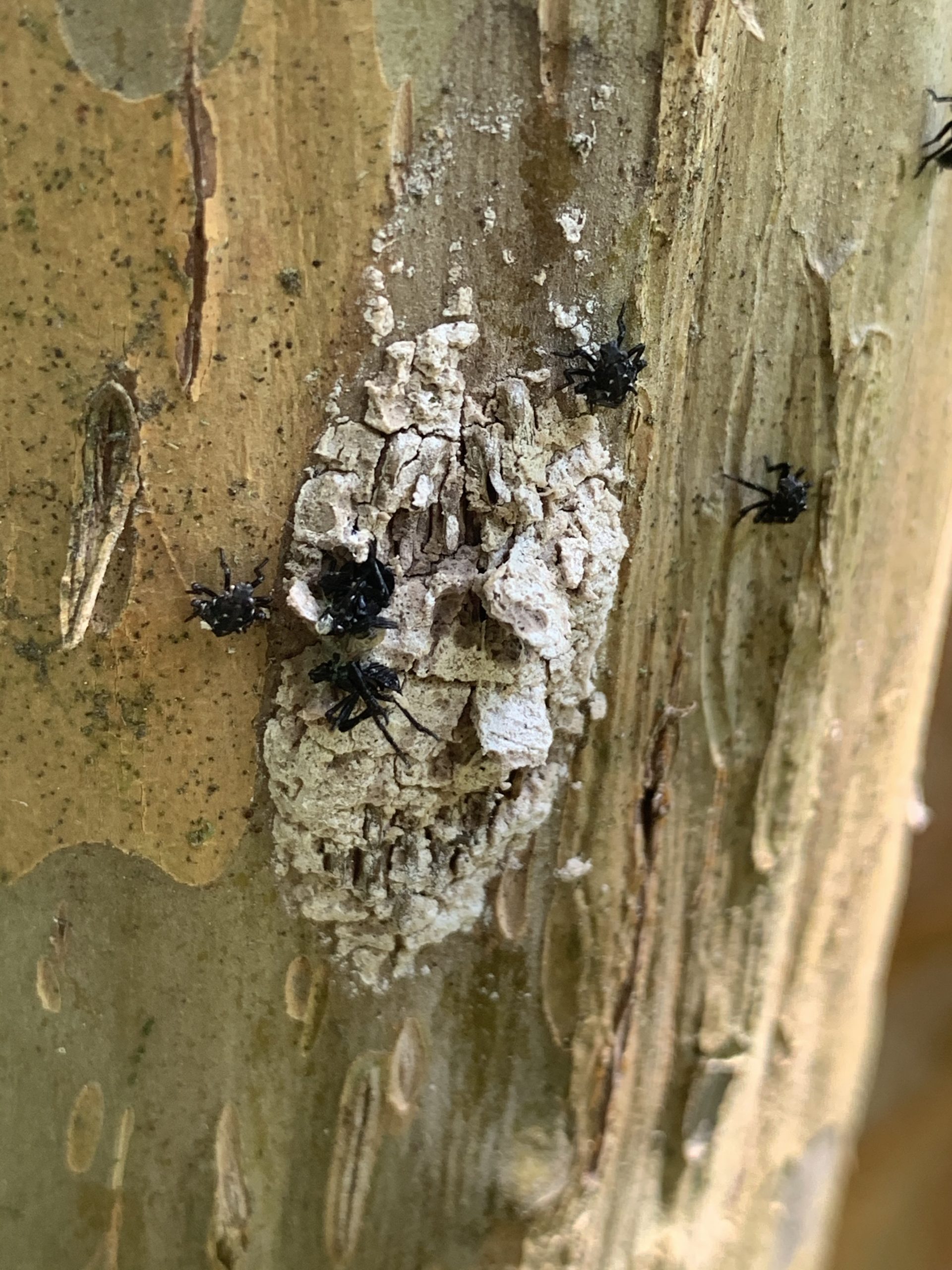
Spotted Lanternfly Hatch

Spotted lanternfly nymphs

photo by Autumn Angeles

Spotted lanternfly nymphs are hatching throughout the state and first instars are present in multiple vineyards. Lanternfly overwinters in the egg stage and hatch is quite protracted, likely depending on the microhabitat where eggs are laid. In our surveys in 2019-2020, we identified a 2 year delay from the time SLF adults are first identified in the woods bordering vineyards and movement of the adults into the vineyard and laying eggs at levels that require management.

While it may seem counterintuitive, management is not needed as soon as SLF hatches. There is currently no evidence that the nymphs cause any yield loss or plant injury. However, this is an invasive species that requires management and there is no threshold for management against the nymph stage.

Best management practices against SLF nymphs in vineyards are to time management with other key insect management such as grape berry moth or Japanese beetle. This will not only save on insecticide costs but will also allow for all of the nymphs to hatch from the egg masses. See the table below on efficacy of materials targeting multiple vineyard pests.

Trade name Active ingredient Class Rate per acre Days of activity SLF GBM JB
Brigade 10WSB bifenthrin Pyrethroid 16 oz. 14 E E
Actara 25WDG thiamethoxam Neonicotinoid 3.5 oz 7 E G
Assail 30SG acetamiprid Neonicotinoid 5.3 oz <7 G G F
Carbaryl 4L carbaryl Carbamate 2 qt 7 E G G
Avaunt 30DG indoxicarb Oxadiazine 6 oz 7 E G G
Danitol 2.4EC fenpropathrin Pyrethroid 21.33 fl oz 7 E E E
Belay clothianidin Neonicotinoid 6 oz. G G G
Baythroid cyfluthrin Pyrethroid 3.2 oz 7 E E

E = excellent control
G = good control
F = fair control

It is time to put Bagworms on your radar in Southern NJ

Bagworms

Photo: Rich Buckley

Bagworms should begin hatching in the next 2-6 weeks throughout NJ, starting in the southern regions. Now is an optimal time to get this pest on your radar and prepare materials or approaches to attack first/second instar caterpillars. The control window for this pest is typically between 600-900 GDD50 (growing degree-days) and treatments should be in use prior to their mobile, airborne, “ballooning” phase. Check that the eggs have hatched prior to application of pesticides – as most compounds will not be effective at all if the first instar caterpillars are not present. Lethal pesticide doses are important, as sub-lethal doses can trigger early pupation, making the pest all but invincible to chemical or biological treatments.


Bagworm management – mechanical: If eggs have not hatched: hand-remove sacs/bags. Typically female/egg filled sacs are higher in the canopy so keep that in mind while scouting.

Treatment options for Lepidoptera (caterpillars) to have at the ready – containing: B.t. (Bacillus thuringiensis)(Dipel), spinosad (Entrust SC), bifenthrin (Talstar, UP-Star), cyfluthrin (Decathlon 20WP), carbaryl (Sevin SL), chlorantraniliprole (Acelepryn), cyclaniliprole (Sarisa), cyclaniliprole + flonicamid  (Pradia), Lambda-cyhalothrin (Scimitar GC), cyantraniliprole (Mainspring), Indoxacarb(Provaunt)

IT IS CRITICAL TO ROTATE AS MUCH AS POSSIBLE BETWEEN IRAC GROUPS DUE TO THE NUMBER OF POTENTIAL APPLICATIONS

DISCLAIMER: The label is the law, always refer to it for allowable host crops, use-restrictions, application rates, reapplication intervals, re-entry intervals (REI), and mix compatibility information. Production and pesticide information on this site are for private/commercial pesticide applicators and landscape professionals only, and are NOT for home gardener use. Provided materials represent examples and do not cover all possible control scenarios. Trade-names listed do not imply endorsement and are used as examples only. Please contact your local agent or chemical sales representative for more information or to discuss additional pest management options.

More information on Bagworms:

Steve Rettke’s 2020 PPA Post – Bagworm caterpillars have hatched throughout most of NJ

RU Bagworm FactSheet 

Bagworms on Ornamental Landscape Plants


Photo Credits: Rich Buckley (Plant Diagnostics Laboratory) https://njaes.rutgers.edu/plant-diagnostic-lab/


Managing Blunt-nosed Leafhoppers in Cranberries

Blunt-nosed leafhoppers (BNLH) continue to be an increasing threat to cranberries in NJ. BNLH has one generation a year. It overwinters as

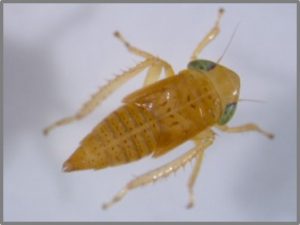
BNLH nymph

Picture 1. BNLH nymph. Photo by Elvira de Lange.

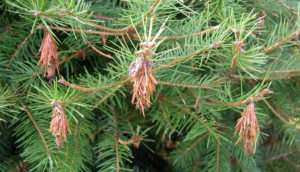
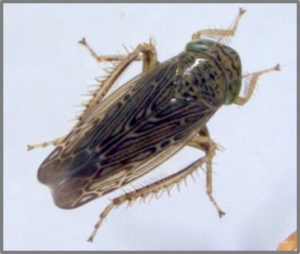
eggs, which begin to hatch in early May. The nymphs (Picture 1) will go through five instars in about a month. The adults (Picture 2) begin to appear by the end of June and are most abundant in mid-July. Numbers of this species start to diminish by the end of July. The adults have a characteristic blunt head and vary from light yellowish-gray to dark brown. Eggs are laid in June-July. Nymphs and adults get their food by sucking the juices of the cranberry vines with their piercing-sucking mouthparts. This direct injury is, however, not noticeable. They are most important as vectors of false blossom disease (Picture 3). Typical disease symptoms include distinctive branching of the upright shoots (witches’ broom) and malformed flowers where flowers stand erect and petals are redder than normal.

Here are some guidelines to consider when managing BNLH in cranberries:

  1. The most important point in BNLH control is locating the sites of infestation. Monitoring for this insect is accomplished best with an insect sweep net. Nymphs should be monitored before bloom using sweep nets (this time of year). Nymphs before bloom are small; thus, you may need to freeze the samples (to kill them), and then count the number of nymphs under a microscope or using a magnifying lens.
  2. To monitor, perform sweep sets of 25 sweeps each. The recommended number of sweep sets is: 1–3 sweep sets per 1–
    BNLH adult

    Picture 2. BNLH adult. Photo by Elvira de Lange.

    10 acres, at least 10 sweep sets per 10–20 acres, and 1 sweep set per 2 acres for more than 20 acres.

  3. A challenge for managing BNLH is the fact that they vector a phytoplasma that causes false blossom disease. For this reason, it is difficult to establish economic thresholds for this pest because we do not know the proportion of individuals that are infected in the population. Moreover, this proportion can vary depending on the variety. For instance, we have observed higher incidence of infection in the newer varieties even when populations of leafhoppers are low.
  4. Although they need to be tested, based on experience, I came up with the following tentative treatment thresholds: An average of 20 nymphs per sweep set if it is a new variety bed, bed with young plantings, and/or a bed that has a recent history of false blossom. Or, an average of 40 nymphs per sweep set if it is an older bed and older variety with no previous history of false blossom.
  5. If BNLH populations are increasing compared to previous years and the beds have not been treated for BNLH for 2-3 years, growers should consider treatment.
  6. If growers have treated for BNLH in the previous year and populations are low (average of less than 10–20 BNLH per sweep set), there is no need to treat again. Keep a record of the BNLH numbers and check those same beds again the following year to see if the numbers increase.

    False blossom-infected cranberry vine

    Picture 3. False blossom-infected cranberry vine.

  7. In most cases, there is no need to apply broad-spectrum insecticides (organophosphates, carbamates) to control BNLH for two or more consecutive years. These insecticides will disrupt the biological control of other pests such as Sparganothis fruitworm and therefore cause increases in insecticide use.
  8. If treatment is necessary, we have limited options to manage BNLH. The best timing for insecticide treatment is before bloom to target the young nymphs. We recommend the use of organophosphates such as Lorsban (chlorpyrifos) and Diazinon (diazinon), and carbamates like Sevin (carbaryl). The neonicotinoid Assail (acetamiprid) also works well against nymphs, but we do not recommend the use of neonicotinoids before bloom due to potential negative effects on bees-neonicotinoids are systemic insecticides that can accumulate in the pollen and nectar. A new registered insecticide, Closer (sulfoxaflor), is also effective against BNLH nymphs. Although Closer has a similar mode of action as the neonicotinoids, it belongs to a different class of insecticides. Closer use is prohibited during bloom (between 3 days prior to bloom and until after petal fall).
  9. Trials will be conducted this year at the Rutgers P.E. Marucci Center with existing and new insecticides against BNLH nymphs.