Archives for May 2020

JUST RELEASED – INTERIM COVID-19 Guidance For Migrant & Seasonal Farmworkers, Their Employers, & Housing Providers

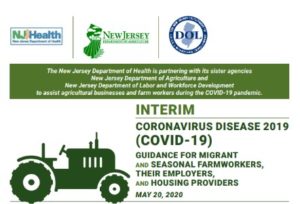
Cover 5-20-2020 NJ DOH Interim Guidance for Migrant-Seasonal Farmworkers

My apologies for not including our nursery growers that may also be impacted by this guidance when originally posted last week.

NJ Dept of Agriculture Secretary Douglas Fisher just announced, “At 3:30 today, we just received final approval to release the attached official guidance on migrant seasonal farmworker housing.”

The New Jersey Department of Health is partnering with its sister agencies New Jersey Department of Agriculture and New Jersey Department of Labor and Workforce Development to assist agricultural businesses and farm workers during the COVID-19 pandemic.

Please review the attached document carefully. This is titled INTERIM CORONAVIRUS DISEASE 2019 (COVID-19) GUIDANCE FOR MIGRANT AND SEASONAL FARMWORKERS, THEIR EMPLOYERS, AND HOUSING PROVIDERS.

Adopt these recommendations carefully for the protection of not only your workforce, but for you, your family and the entire ag community.
 

COVID-19 and Animals

Currently, there is no evidence that animals play a significant role in spreading SARS-CoV-2, the virus that causes COVID-19.  Based on the limited data available, the risk of animals spreading COVID-19 to people is low.  In some rare situations, people may be able to spread the virus to animals.  Further studies are needed to understand if and how different animals could be affected by the virus, and the role animals may play in the spread of COVID-19.  The clinical spectrum of illness for the SARS-CoV-2 virus remains largely undefined in animals.  Animals may present with respiratory or gastrointestinal clinical signs based on the presentation of other coronaviruses more commonly found in animals as well as other emerging coronaviruses, including SARS-CoV-1 infection.   Clinical signs expected to be compatible with possible SARS-CoV-2 infection in mammalian animals may include fever, coughing, difficulty breathing or shortness of breath, lethargy, sneezing, nasal/ocular discharge, vomiting,and diarrhea.

Although there have been limited reports of domestic companion animals testing positive for COVID-19, the risk of transmission from animals to humans is thought to be low. Routine COVID-19 testing is not recommended.

Please see the following factsheet from the State Department of Agriculture Division of Animal Health :

COVID-19 and Animals.

10 Best Management Practices to Avoid Herbicide Drift 

The last few weeks have been very windy, and we already received numerous calls from specialty crops growers inquiring about the risk of herbicide drift or investigating if observed crop damages may be the result of herbicide drift.

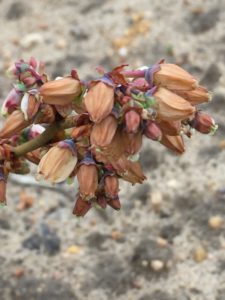
Blueberry flowers

Fig.1 Paraquat drift on blueberry flowers

Why does it seem like crops are more affected by herbicide drift in the spring? Well, mostly because this is the time when newly planted crops develop new shoots or reproductive structures that may be very sensitive to herbicide drift (Figure 1). This is also the time of the year when most postemergence herbicide are applied to control emerged weeds and subsequent new flushes. When both events coincide and if weather conditions favor herbicide drift, this could lead to disastrous injury on sensitive non target crops!

Drift is defined as physical movement of an herbicide through air, at the time of application or soon thereafter, to any site other than that intended. It can be particle drift from fine herbicide spray droplets that can travel over long distances during period of high wind. High wind speed, low relative humidity, high temperatures, small droplet size, and spray boom maintained high above the ground are factors that increase the risk of particle drift. Depending on the herbicide, application and weather conditions, fine droplets can travel up to several miles! It can also be vapor drift which results from the ability of an herbicide to vaporize and mix freely with air. Volatility of any herbicidal substance is characterized by its vapor pressure. The higher the vapor pressure of a substance, the greater its tendency to volatilize (Table 1). However, other factors such as herbicide formulation and weather conditions will influence volatility. Some herbicides classified as growth regulators (2,4-D, dicamba, triclopyr or clopyralid) are well known for the higher risk of vapor drift associated with their use when herbicide formulation and/or weather conditions increase volatility (Figure 3).

Herbicide Vapor Pressure (mmHg)
Glyphosate IPA 1.58 x 10⁻⁸
Glyphosate Ammonium Salt 6.75 x 10⁻⁸
2,4-D DMA <1.0 x 10⁻⁷
2,4-D Acid 1.4 x 10⁻⁷
Atrazine 2.9 x 10⁻⁷
2,4-D BEE 2.4 x 10⁻⁶
2,4-D EHE 3.6 x 10⁻⁶
Trifluralin 1.1 x 10⁻⁴
Clomazone 1.4 x 10⁻⁴
Table 1 Vapor Pressures for 2,4-D Formulations and Several Commonly Used Herbicides. Abbreviations: IPA, isopropylamine; DMA, dimethylamine; BEE, butoxyethyl ester; EHE, 2-ethylhexyl ester.

So, there are a few things that you need to consider reducing the risk of potentially expansive damages to sensitive crops:

  1. Select nonvolatile or low volatility herbicides to minimize the risk of vapor drift. Growth regulator herbicides such as 2,4-D, MCPA or triclopyr can be formulated as ester or amine salt. The ester formulation is notorious for its volatility; therefore, always use these herbicides formulated as amine salt to reduce the risk of vapor drift. Other herbicides than growth regulators have high vapor pressure that makes them prone to vapor drift (clomazone, trifluralin, EPTC), but either should be soil incorporated or are formulated in a way (micro-encapsulation) that will limit the risk of vapor drift.

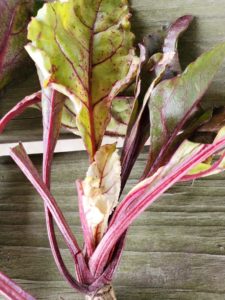
    Beet plant

    Fig. 2 New growth chlorosis on beet. A WSSA group 27 herbicide (“bleacher”) was applied preemergence at planting in a neighboring corn field and drifted to the beet field because of high wind.

  2. Carefully read the herbicide label. The product label will provide information regarding when it is not safe to apply the product based on various parameters such as wind speed, temperature, humidity. You may also find information buffer requirement when spraying near sensitive downwind plants or information on the type of nozzle you must use for a specific herbicide.
  3. Select nozzles that produce the large size droplets while providing adequate coverage at the intended application rate and pressure. You can also select specifically designed drift-reduction nozzles (for example, drift-guard or air induction types) operate at lower pressure (15 to 30 psi) and produce large droplets that will have less potential for drift. A good source of information on droplet characteristics and operating pressure for various nozzle types is the TeeJet nozzle catalog (https://www.teejet.com/CMSImages/TEEJET/documents/catalogs/cat51a_us.pdf).
  4. Use low application pressure and drive at low speed when applying herbicides. Herbicide drift will increase with application pressure and speed…
  5. Keep the boom stable and the nozzles close to the soil as this will minimize herbicide drift but also potential injury to the crop on which herbicide is applied. You may want to consider using a shielded boom when spraying herbicide that are prone to drift or may injure your crop. Keep in mind that postemergence herbicide will provide optimal weed control when applied timely with regards to weed development. If the weeds are too tall (see the maximum weed size for each weed species on the label), then it’s too late to spray!

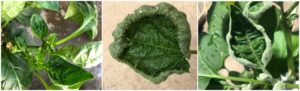
    Damaged crops

    Fig. 3 Damages to pepper (left), cucumber (center), and eggplant (right) caused by dicamba herbicide applied at 1/1000 of the labeled rate on soybean.

  6. Mix spray additives recommended by the label to reduce the production of fine spray droplets. Avoid tank mix ammonium sulfate with volatile herbicides as ammonium sulfate increases volatility. You can also consider the use of drift retardants that reduce drift by increasing the viscosity or surface tension of a spray solution. However, research shows that while some drift retardants may help under some conditions, the prevention of herbicide drift should primarily rely on nozzle selection, boom height, application pressure, and environmental conditions.
  7. Do not apply herbicides when wind is blowing toward sensitive plants or when wind speed exceeds 10 mph. Ideal spray conditions are when wind speed is between 3 and 10 mph. Low winds (< 3 mph) tend to be unpredictable and variable in direction and may indicate conditions that help the development of a temperature inversion. Applying any herbicide when wind speed exceeds 10 mph may result in catastrophic consequences for neighboring sensitive vegetable or horticultural crops (Figure 2).
  8. Do not apply herbicides when temperature inversion occurs. Inversions occur when warm light air rises upward into the atmosphere and heavy cool air settles near the ground, preventing the mixing of air layers. Temperature inversion will cause small-suspended droplets to form a concentrated cloud that can move long distances (up to several miles). Typically, temperature inversions start at dusk and break up with the sunrise because of vertical air mixing. To confirm the presence of an inversion, air temperature should be measured carefully at two heights out of the direct sun: 6 to 12 inches above the ground or the top of a nearly closed-crop canopy, and at a height of 8 to10 feet above the surface to be sprayed. When the temperature at the higher level is greater than the temperature at the lower level, an inversion exists. The greater the temperature difference between the two levels, the more intense the inversion, and the more stable the lower atmosphere. To test for sure, you can use smoke by burning a small amount of dry vegetation to see if the smoke dissipates or hangs low to the ground. If the smoke hangs in the air together then moves off slowly without dissipating, it indicates that a temperature inversion exists and that you do not want to spray as  long as the temperature inversion persists. Usually, temperature inversion will dissipate when temperature rises 3 degrees or more above the morning low, or when the wind speed increases to more than 3 mph.
  9. Spray when temperatures remain below 80°F to minimize vaporization and droplet evaporation. This will minimize vapor drift but also help with weed control by avoiding that spray droplets evaporate before reaching the target…
  10. Leave a buffer zone between treated fields and sensitive plants. Herbicide labels may specify the width of the buffer zone. The buffer zone will allow larger droplets to settle before reaching sensitive plants. The buffer zone may not be effective in settling small droplets.

Remember that all herbicides are capable of drift, no exception.

When spraying a pesticide, you have a moral and legal responsibility to prevent it from drifting and contaminating or damaging neighboring crops and sensitive areas. Always monitor weather conditions and their evolution carefully when spraying an herbicide. Overall, do not spray if all conditions are not suitable, and stop spraying if conditions change and become unsuitable.

JUST RELEASED – INTERIM COVID-19 Guidance For Migrant & Seasonal Farmworkers, Their Employers, & Housing Providers

Cover 5-20-2020 NJ DOH Interim Guidance for Migrant-Seasonal FarmworkersNJ Dept of Agriculture Secretary Douglas Fisher just announced, “At 3:30 today, we just received final approval to release the attached official guidance on migrant seasonal farmworker housing.”

The New Jersey Department of Health is partnering with its sister agencies New Jersey Department of Agriculture and New Jersey Department of Labor and Workforce Development to assist agricultural businesses and farm workers during the COVID-19 pandemic.

Please review the attached document carefully. This is titled INTERIM CORONAVIRUS DISEASE 2019 (COVID-19) GUIDANCE FOR MIGRANT AND SEASONAL FARMWORKERS, THEIR EMPLOYERS, AND HOUSING PROVIDERS.

Adopt these recommendations carefully for the protection of not only your workforce, but for you, your family and the entire ag community.
 

Wednesday Discussions: Ask the Ag Agent

Last night on “Ask the Ag Agent” we discussed The NJ Department of Health’s “Interim Coronavirus Disease 2019 (COVID-19) Guidance for Migrant and Seasonal Farmworkers, Their Employers, and Housing Providers” guidance document. We will continue to facilitate discussion on “Ask the Ag Agent” forum for this topic and others next week. Please feel free to bring up any ag-related topics for discussion on this forum.

“Ask the Ag Agent” weekly 1-hour sessions for farmers will be hosted weekly and continue each Wednesday until May 27th. The online conferencing/call in events will begin at 7:00PM with an open forum to discuss ag-related questions about production, marketing, regulations and any other topics farmers wish to discuss. All are welcome. Events are hosted by William Bamka, Stephen Komar, Meredith Melendez and Michelle Infante-Casella – Agricultural Agents.

To access via WebEx on a computer go to https://go.rutgers.edu/rc9n3kxt

Or, Join by phone
+1-650-429-3300 USA Toll
Access code: 799 743 872

For additional Rutgers Cooperative Extension educational programs check out https://events.rutgers.edu/njaes/

IPM Update 5/20/20

Sweet Corn

The black light trap network is  complete at this time.  To date, one corn earworm (CEW) was captured at Eldora, Cape May County.  A very few European corn borer (ECB) moths have been captured this past week, indicating that as warmer weather begins to arrive, we should see increasing numbers over the next several weeks.   This pest poses little threat at this time, as they are few in number and the earliest sweet corn plants are only just reaching suitable size to support larvae.

The highest nightly trap catches of ECB for the week ending 5/20/20 are as follows:

Downer   1
Hackettstown   1
Medford   1

[Read more…]
