Webinar for Annual Dicamba Applicator Training

BASF will host several Live Virtual Webinars for annual dicamba applicator training.  his training is required for Engenia herbicide and other dicamba products approved for over-the-top (OTT) applications on dicamba-tolerant soybean and cotton. Dicamba training is also offered through an online module.

These webinars are designed to learn about new application requirements and label enhancements for the 2021 season. Applicator training and certification can be obtained in multiple formats based on your schedule and needs. Due to COVID-19, dicamba applicator training will be primarily available through online offerings such as a self-paced training module and live virtual webinars.

Please visit http://www.engeniastewardship.com/ for training options.

Please also review PPA previous post on The 10 Best Management Practices to Avoid Herbicide Drift!

Live Virtual Webinars: 

There are a total of 6 remaining events that are scheduled to occur every Tuesday @ 10 am eastern with the next one scheduled for March 9, 2021. Attendance is limited to the first 250 attendees per event so register early for the event that best fits your schedule. Live Virtual Webinars are scheduled for:

  • March 9, 2021 @ 10 am eastern
  • March 23, 2021 @ 10 am eastern
  • March 23, 2021 @ 8pm eastern
  • March 25, 2021 @ 10am eastern
  • March 30, 2021 @ 10am eastern

Online Module: 

This option will take approximately 1 hour to complete and contains a quiz at the end of the module. Once the module is completed a certificate is displayed that should be kept for your records. You will have the option to print and/or save your dicamba certificate. It is recommended that you complete this training on a web browser through a computer with a reliable internet connection.

As a reminder only certified applicators may apply Engenia herbicide or other OTT dicamba herbicides.
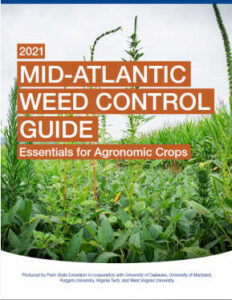
2021 Mid-Atlantic Field Crop Weed Management Guide

2021 Mid-Atlantic Field Crop Weed Management Guide

The 2021 updated version of the “Mid-Atlantic Field Crop Weed Management Guide” is available. This guide is produced by Penn State Extension in cooperation with weed scientists from University of Delaware, University of Maryland, Rutgers University, Virginia Tech, and West Virginia University.

The guide covers weed management  for field corn, sorghum, soybean, small grains, and forage and pastures. Information concerning the use,  restrictions, and recommendations of burndown, preemergence, and postemergence herbicides labeled on these crops can be found in the guide, including relative effectiveness data from locally conducted research. Description of the various premixes as well as guidance for  managing troublesome weeds are also part of the guide.

The guide  can be ordered on-line at https://extension.psu.edu/mid-atlantic-field-crop-weed-management-guide. Available to order are the paper copy for $10, the digital guide for $8, or both a hard copy and pdf for $18.


Command 3 ME Label Change for Lima Beans

FMC Corporation, Rutgers University and the New jersey Department of Environmental Protection collaborated on labeling Command 3ME for use on lima beans through the release of a 24(c) Special Local Need Label. The label is available online at https://www.cdms.net/ldat/ld324024.pdf.

In the past, the Command 3ME label allowed use in lima beans, but this use was removed a couple of years ago. This new labeling essentially restores the previous use pattern. This labeling only applies to FMC’s brand of Command.

Command 3ME can be applied at 4 to 6 fluid ounces immediately after seeding, with the lower rate recommended for coarse-textured soils. This low rate does not provide control of pigweed species or most broadleaf weeds (including Palmer amaranth), rather it provides early-season weed suppression that allows for improved control with cultivation. This label also allows for planting lima beans 60 days after application in a preceding crop. This allows use for Command use in peas and planting lima beans at least 60 days later.

Currently, Command 3ME received a 24(c) SLN label for use on lima beans only in New Jersey, Delaware, Maryland, and Virginia.

Carolina redroot control in cranberry with Callisto® herbicide

Figure 1. Carolina redroot infestation in cranberry bog

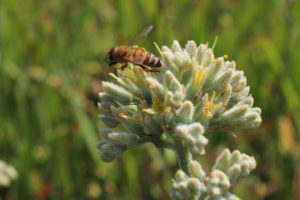
Carolina redroot (Lachnanthes caroliniana), a native plant of New Jersey Pine Barrens, has becoming an increasingly troublesome weed for cranberry production across the state (Figure 1). Carolina redroot is a perennial herbaceous weed species belonging to the Haemodoraceae family. It competes for nutritional resources during the cranberry growing season, and its rhizome serve as a feeding resource for wintering waterfowl that can cause severe uprooting damages of cranberry vines when bogs are flooded. Carolina redroot blooms after cranberry and its flower is very attractive to pollinators (Figure 2) at a time when insecticides may be applied to cranberry bogs. Additionally, the desiccated seed head of Carolina redroot can be picked up by harvesting equipment and broken in small pieces that will be difficult to eliminate during fruit processing.

Invasive species

Figure 2. Carolina redroot is very attractive for pollinators… at a time when insecticides may be applied!


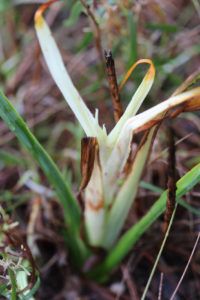
Studies have been conducted at Rutgers since 2017 to screen various herbicides that can properly control or suppress Carolina redroot without injuring cranberry. In greenhouse screenings, Callisto® 4SC (mesotrione) has provided good control of Carolina redroot while maintaining excellent crop safety. Callisto is a systemic herbicide that will cause bleaching of weed leaves by indirectly inhibiting the biosynthesis of carotenoid that protect chlorophyll from photodegradation. Cranberry is highly tolerant because it is capable of rapidly metabolizing the mesotrione. Callisto will not kill Carolina redroot outright, but will weaken it and stunt it, preventing the formation of the floral stem (Figure 3). We are still evaluating if continued annual use of Callisto for two or three years will completely eliminate Carolina redroot.

Bee pollinating flower

Figure 3. Bleaching and stunting of Carolina redroot floral stem following Callisto applied at 4 fl oz/A

Spot application: ideally, Carolina redroot should be controlled before it starts colonizing large areas of a cranberry bogs. Therefore, scouting and mapping is a crucial and necessary step to detect early infestation that be treated with spot application of Callisto. We obtained in 2019 a 24(c) Special Local Need label for spot application of Callisto at rates that will help controlling perennial weeds such as Carolina redroot. We recommend mixing 3.2 teaspoons of Callisto per gallon of water and add crop oil concentrate (COC) at 1% v:v or 2.5 tablespoon per gallon of water. This rate will allow to spray up to 15 gallons of solution per acre while not exceeding the maximum labeled rate of 8 fl oz per acre and per application.

Stunted plant

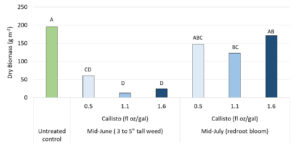
Figure 4. Reduction of Carolina redroot biomass with spot application of Callisto at three different rates and two different timings of application

At this rate and if Callisto is applied when Carolina redroot emerge above cranberry canopy in early to mid-June, we observed a reduction of Carolina redroot biomass by 70% at the end of the season. Higher rate will not significantly increase Carolina redroot suppression and later application in mid-July will not be effective (Figure 4). Spot applications will be sprayed with a backpack or hand-held sprayer that needs to be properly calibrated. Calibration of hand sprayers is determined by the walking speed of the applicator and the discharge rate from the nozzle along with the concentration of the material in the tank. Use great care in spot-treating. The difference between an 8-oz application and an 80-oz application is only seconds on the trigger. Spot treatments made to runoff will exceed the maximum application rate.

Stunted plant

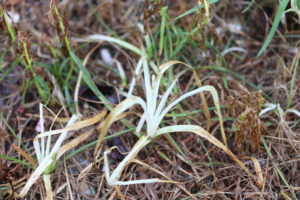
Figure 5. Annual sedge control with Callisto applied at 4 fl oz/A

Broadcast application: in bogs where Carolina redroot has colonized large areas, chemigation using irrigation sprinklers or boom application should be considered for broadcasting Callisto.  Callisto can be applied at up to 8 fl oz per acre per application, but we observed bleaching and stunting of Carolina redroot floral stem with Callisto at a 4 fl oz/A rate applied with a regular boom. If chemigating, we recommend Callisto to be applied at 8 fl oz/A. Always use a COC adjuvant at 1% v:v. All application should be made when Carolina redoot leaves emerge from cranberry canopy but before the on-start of bloom because COC adjuvant may injure cranberry flowers and reduce pollination. A second application at 8 fl oz/A can eventually be applied after cranberry bloom to help suppressing Carolina redroot. Callisto will also help controlling sedges or rushes (Figure 5). Callisto applications cannot exceed 2 per acre per year and a maximum of 16 fl oz per acre per year.


Residual Weed Control in Cabbage and Other Cole Crops

Good weed control in transplanted and seeded cole crops requires planning and the use of pretransplant or preemergence herbicide applications.

Cabbage treated pretransplant with Goal and never cultivated.

Cabbage treated pretransplant with Goal.  The crop was never cultivated.

Preplant incorporate Treflan HFP at 1 to 1.5 pt/A for seeded and up to 2 pt/A for transplanted, or apply Dacthal 6F at 6 to 14 pt/A or Prefar 4E at 4 to 9 qt/A preemergence or post-transplant to control annual grasses and certain broadleaf weeds. Choose Dacthal or Prefar in early spring when soils are cold and wet when Treflan may cause temporary stunting. Please make sure to check the label before mixing as these herbicides are registered for use only on certain cole crops.

Goal 2XL and GoalTender 4F are labeled for transplanting ONLY!.  Goal 2XL can ONLY be used pretransplant whereas GoalTender 4F can be used pre-transplant or post-emergence with a 24(c) Special Local Needs label on broccoli, cabbage and cauliflower in New Jersey (NJ 24(c) SLN GoalTender 4F). Build beds, spray, and transplant through the herbicide barrier. Use Prefar or Dacthal post-transplant for grass control. Treflan or Dual Magnum applied preplant incorporated may increase the risk Goal injury. Do NOT cultivate unless weeds appear. Incorporation of Goal reduces or eliminates the effectiveness of the product for weed control. Goal and GoalTender are registered for use only on certain transplanted cole crops.

Dual Magnum 7.62E has a 24 (c) Special Local Needs label for use on cabbage in New Jersey. Use Dual Magnum at the rate of 0.5 to 1.33 pt/A  depending on soil type. Use the lower rate on soils that are relatively coarse-textured or low in organic matter; use the higher rate on soils that are relatively fine-textured or high in organic matter. Apply to weed free soil in transplanted cabbage after transplanting, or to direct seeded cabbage when the seedlings have developed 3 to 4 true leaves. The delayed use in directed seeded cabbage reduces the risk of slight temporary stunting of the crop. Dual Magnum controls annual grasses, nightshade species, and galinsoga. Yellow nutsedge will be suppressed or controlled at the rates and use patterns on the Dual Magnum label for cabbage. To obtain a label, an indemnification agreement must be filled out on line agreeing not to hold the manufacturer responsible for crop damage. Obtain a copy of the label and complete the indemnification agreement on the Syngenta website. Register or sign in, select state and product, and submit. You will then be asked to select your crop before accepting or not the waiver of liability and indemnification agreement. You must have a copy of this 24(c) label if you want to use Dual Magnum on cabbage!

Consult the 2020/2001 Mid-Atlantic Commercial Vegetable Production Recommendations for rates and additional information.


Weather Conditions and Herbicide Performances

Temperature and Herbicide Performance

With air temperatures remaining relatively low this spring, growers have asked about how temperature may affect the efficacy of herbicide applications. The effect of cool temperatures on weed control efficacy will depend on the type of herbicide application, the rate applied, and the physiological status of the target weed.

Summer annual weeds such as lambsquarters or crabgrass require good soil moisture and soil temperatures between 60 and 70F to start the germination process. It is important for preemergence applications to be effective that residual herbicides are applied before soil reaches this optimum temperature range. Of course, herbicides should never be applied on frozen ground. However, cool and wet weather can increase the potential for crop injury with preemergence herbicides because of slower herbicide metabolization by the crop.

Grass and broadleaf weeds are controlled more effectively when plants are actively growing. The ideal air temperature for applying most post-emergence herbicides is between 65°F and 85°F. At lower temperature, weed control will be slower, especially with systemic herbicides such as glyphosate, Poast, Select, or Sandea that are more slowly absorbed and translocated by the weeds compared to applications at higher temperatures. Also, slower herbicide uptake by the weeds will increase the required rainfast period and slows the development of herbicide symptoms on the plants. Weeds that have been damaged (by mechanical equipment for example) or that are under stress (drought, water excess) at the time of herbicide application or before herbicide has properly translocated will not be properly controlled. Reduced herbicide rate treatments are less likely to provide acceptable control under adverse conditions than when plants are actively growing. Thus, it is best to avoid applications of postemergence herbicides during periods of cool temperatures (<40°F at night; <55°F during the day).

High temperatures increase the loss of volatile herbicides. 2,4-D ester or dicamba will rapidly evaporate at temperatures above 80°F, causing. The use of such ester formulations should be restricted to fall, winter, and early spring because sensitive plants are not present and lower temperatures reduce vapor drift hazard.

Adjuvants may also affect crop safety and weed control. Oil additives may increase risk of crop injury but may be necessary for greatest weed control. Refer to each herbicide label for specific information on adjuvant use during stress conditions. Use an oil additive if risk of crop injury is acceptable for those herbicides that allow use.

Ideally, you should be waiting for the right conditions to apply the herbicide. However, if weeds are at growth stage that require a rapid intervention, select a herbicide with excellent efficacy for controlling your target weeds. Remember that the efficacy pf postemergence applications is mainly dictated by weed size… spraying weeds beyond the size range recommended on the label will result in porr weed control.

Rainfast Period

The rainfast period is the minimal period of time that must elapse between herbicide application and subsequent rainfall to ensure good postemergence herbicide performance. Generally, herbicide rainfast ratings are based on good growing conditions (table 1). Poor conditions may require a longer interval between application and any rainfall to ensure adequate herbicide translocation within the weed before the herbicide is washed off. For many herbicides, any amount of rainfall soon after spraying has the potential to reduce absorption, translocation, and subsequent weed control. If you apply herbicide and it rains before it’s rainfast, herbicide performance will be reduced.

Table 1. Rainfast time for postemergence herbicides commonly used in New Jersey Specialty Crops.

*Rainfall will improve control from root uptake.

**Rainfall within 6 hr. after application may reduce effectiveness. Heavy rainfall within 2 hours after application may wash the chemical off foliage and a repeat treatment may be required.