Safely Using Herbicides in Re-Used Plastic Mulch

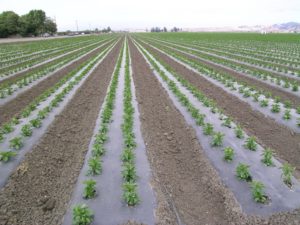
Crops covered with plastic protection

Plastic mulch and trickle irrigation are expensive. Re-using the mulch for a second crop after the first can be an effective way to spread the cost.

Plastic mulch and trickle irrigation are expensive. Re-using the mulch for a second crop after the first can be an effective way to spread the cost. When the cost of supplies and labor are evaluated, re-using a field with trickle irrigation and black plastic mulch is an attractive idea, but weed control can be a problem.

The herbicides used under the plastic and between the rows of mulch for the first crop must be safe and labeled for use in the second crop. Prefar applied at 6 quarts per acre in a band when the mulch is laid is a good choice for under the plastic. Prefar is labeled for many vegetable crops but ALWAYS check the label to see if the crop you plan to plant is listed on it. Prefar and Gramoxone plus NIS (nonionic surfactant), applied as a shielded banded spray between the rows of mulch, are also labeled for a wide range of vegetable crops. Be sure post plant applications of Gramoxone plus NIS are shielded, applied at low pressure, and a low drift agent is used.

Often the greatest challenge is eliminating the first crop and any weeds in the field prior to planting the second crop in the mulch. No herbicide should be sprayed broadcast over the mulch except Gramoxone, which is quickly broken down by sunlight.

Roundup and other glyphosate products should NEVER be used on plastic mulch. Gyphosate has no residual activity due to strong and immediate adsorption by the soil where it is slowly broken down by soil microorganisms as a food source. On plastic mulch without contact with the soil, glyphosate does not easily wash off the plastic with rain or irrigation. The simple act of letting the root ball in contact with the plastic during transplanting can expose the crops roots to enough glyphosate to cause lasting injury and crop loss!

Residual herbicides must be banded between the rows of plastic mulch, NEVER sprayed broadcast over the mulch. Broadcasting residual herbicides over plastic mulch can increase the risk of washing the herbicide from the plastic into the planting hole when it rains or if you irrigate overhead. Herbicide concentration in the planting hole will be way higher than the safety threshold for any crop! If the herbicide from 1 square foot of plastic washes into the 3 square inch planting hole, that will increase increase 48 times the intended herbicide rate in the planting hole!!! You can certainly not expect good crop safety from any herbicide at 48 times the intended rate! Keep all residual herbicides off the plastic mulch.

In summary, the greatest weed control challenge in re-used plastic is weeds growing under and through holes in the mulch. Gramoxone is broken down by sunlight, so it can be used to kill the first crop and emerged weeds. Consider fumigating under the mulch with a water soluble fumigant injected through the trickle irrigation to provide weed control in the second crop. Disease control may be another added benefit. Remember to wait until the fumigant has dissipated before planting.
2020 Recommendations for Preemergence Weed Control in Established Blueberry

With T3 stage scheduled for late March, it’s really time now to apply your preemergence herbicides before blueberry bud break!

Preemergence herbicides should be applied prior to weed seed germination. If applied to weeds that are already out of the ground, most of these products will not control them. Keep also in mind that these herbicides should receive at least ½” rainfall or irrigation one to seven days after application (depending on herbicides) to incorporate the herbicide in the soil

In order to reduce the potential of selecting for herbicide-resistant weeds, it is highly recommended mixing two residual herbicides with different MOA whenever you apply preemergence herbicides. Make sure the herbicides you plan to apply will be effective at controlling the weed species in your field by checking the herbicide label. Usually, residual herbicides will suppress weed for 6 to 8 weeks depending on irrigation as well as soil and weather conditions. After this period, another residual herbicide can be needed to control weeds through harvest and could be mixed with a postemergence herbicides to control emerged weeds. Roundup (glyphosate), Rely 280 (glufosinate,) and Gramoxone (paraquat) are postemergence herbicides that may be applied with preemergence herbicides before bud break with little risk for crop injury.

  •  MOA 2: Solida (rimsulfuron) and Sandea (halosulfuron) are ALS inhibitors that have both preemergence and postemergence activity. They control most annual broadleaves but are weak on common groundsel, common lambsquarters and eastern black nightshade. Sandea is ONLY recommended for postemergence control of yellow nutsedge. However, these two herbicides will not control ALS resistant weeds (horseweed, ragweed…) already widespread in New Jersey. Thus, these herbicides should always be tank mixed with a partner effective at controlling these weeds
  • MOA 3: Kerb (pronamide) and Surflan (oryzalin) are mitosis inhibitor that will be effective at controlling many annual grass species for 4 to 6 weeks after application. Kerb also help controlling perennial quackgrass. If applied to warm soils (> 55°F), Kerb persistence (and weed control) is much reduced; therefore, reserve Kerb for fall/winter application. Do not use Kerb on blueberries that have not been established for about a year.
  • MOA 5 and 7: The photosynthesis inhibitors (PS II inhibitors) have a broad spectrum of control and will be effective against many broadleaves and annual grasses when applied in spring. Karmex (diuron) and Princep (simazine) have relatively low solubility and have been very safe on blueberries. Sinbar (terbacil) has a longer residual life in the soil and also is more soluble, so it should be used infrequently on light, wet soils. Velpar (hexazinone) is very soluble and should not be used on New Jersey sandy soils. These herbicides are effective on a many broadleaf weed species, including common chickweed, common lambsquarters, common groundsel, henbit, nightshade, redroot pigweed, pineappleweed, shepherd’s-purse, smartweed, and some mustards. Sinbar and Princep will also control most of the annual grasses and help suppressing quackgrass.
  • MOA 12: Solicam (norflurazon) is a pigment inhibitor that may be applied in fall or early spring primarily for annual grass control and quackgrass suppression. Solicam may also provide partial control of many broadleaf weeds as well as of yellow nutsedge. Do not use Solicam on blueberries that have not been established for about a year.
  • MOA 14: Chateau (flumioxazin), Zeus XC (sulfentrazone), and Zeus Prime XC (sulfentrazone plus carfentrazone) are PPO inhibitors with activity against many broadleaves (including redroot pigweed, catchweed bedstraw, common mallow, common lambsquarters, ladysthumb, wild mustard, and shepherd’s-purse) when applied preemergence in spring. Chateau and Zeus Prime XC also have some postemergence activity on newly emerged seedlings of annual weeds. Zeus products may also provide some suppression of yellow nutsedge. Chateau has a 7 day preharvest interval (PHI) and Zeus Prime XC have 3 day PHI, and can therefore be applied later in the season to extend preemergence broadleaves control into late summer. Blueberry plants must have been established at least two years prior to use of these herbicides.
  • MOA 15: Devrinol (napropamide) and Dual Magnum (s-metolachlor) are long chain fatty acid inhibitor. Devrinol will provide good control of annual grasses and should therefore be tank mixed with a PSII or a PPO inhibitor for controlling broadleaf weeds. Devrinol is rapidly degraded if left exposed on the soil surface, so it should be applied less than 24 hours before a rain event to incorporate the herbicide in the soil. Dual Magnum has a 24c Special Local Need label for blueberry in New Jersey. This herbicide controls many annual grasses and some small-seeded broadleaf annual weeds such as redroot pigweed, nightshade and common purslane. Dual Magnum also suppresses emergence of yellow nutsedge. Use Dual Magnum only on plants established for more than one year, and lower rates are suggested on 2- to 3-year-old plantings.
  • MOA 20: Casoron (dichlobenil) is a cellulose synthesis inhibitor recommended for fall application to control many annual and perennial broadleaves, grasses and yellow nutsedge. If left on the soil surface or if applied to warm soil (> 55°F or 70°F depending on dichlobenil formulation), Casoron can lose much of its activity. So, reserve this herbicide ONLY for fall/winter applications. Plants must be at least one year old before Casoron should be used.
  • MOA 21: Trellis SC (isoxaben) is a cell wall synthesis inhibitor currently currently registered for bearing and non-bearing blueberry. Trellis SC primarily controls annual broadleaf weeds, such as horseweed, common lambsquarters, wild mustards, shepherd’s- purse, purslane, and common chickweed; higher rates may also suppress field bindweed and curly dock. However, Trellis SC will have to be mixed with a Group 3, 12, or 15 residual herbicide for controlling annual grasses.
  • MOA 27: Callisto (mesotrione) is an HPPD inhibitor recommended for spring application to control many annual broadleaf weeds as well as annual sedges. It controls large crabgrass but no other grasses, such as goosegrass. Callisto may be used as a broadcast spray between rows to control broadleaves and crabgrass without injuring the fescue sod. Callisto has both preemergence and postemergence activity, and can therefore be used in spring to control ALS-resistant horseweed at the rosette stage.

Consult the 2020 Commercial Blueberry Pest Control Recommendations for New Jersey available on https://njaes.rutgers.edu for rates and additional information. The information above is correct to the best of our knowledge. Other formulations with the same active ingredient as some of the products listed above may exist that may or not may be labeled for the same uses. Always consult the label before making pesticide applications. Information was current as of February 25, 2020.

Getting the Upper Hand on Virginia creeper

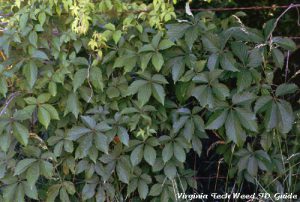
Picture 1 – Virginia creeper vine

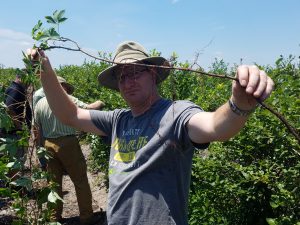
Virginia creeper (Parthenocissus quinquefolia) is a perennial woody vine that climbs on other objects or trails along the ground.  It is a common weed of orchards, vineyards and blueberry plantation. It is best identified by the typical palmate leaf with 5 leaflets that originate from the same point (picture 1).  Virginia creeper will produce many tendrils with adhesive disks at their tips that will allow the vine to climb upward and to attach to any support. It can grow under a wide range of conditions including dry sandy or moist organic soils, sunny or shady sites, and is tolerant to high salinity.  Plants will often establish through seeds dropped by birds who consumed the small blue berries in fall, but also by the spread of crawling stems that will produce new roots in contact with soil (picture 2). Virginia creeper is often confused with Poison-Ivy (Toxicodendron radicans). However, poison-ivy has 3 leaflets instead of 5 for Virginia creeper and lacks the tendrils and adhesive disks.

As a perennial weed, Virginia creeper will be tough to control as it can easily regrow after foliar injury from its extensive underground root system. When established, Virginia creeper will most often not be controlled with a single herbicide application, and multiple applications will be necessary to achieve acceptable control. Only nonselective postemergence herbicide (glyphosate) must be used to suppress or control this weed. In order to increase the efficiency of postemergence applications during the growing season, remove the vine from their support during winter pruning and lay it on the ground or plan a “cut stump” treatment during the growing season. Do NOT “prune out” the vine during the dormant season.

Picture 2 – Virginia creeper rooting stem

Spot treatment.  Glyphosate may be applied in mid- to late summer after vine flowers in early July until the first signs of fall color appear in the foliage. Good growth and maximum leaf area is needed at the time of herbicide application during the summer.  Wet a minimum of 50 percent of the weed foliage with a 1% glyphosate solution (1.25 oz of 4.5lb acid material per gallon of water) for effective control. For best control, don’t apply on stressed/wilted weeds.

Cut stump treatment. Best results are often obtained in late summer and early fall, but before fall color is observed in the foliage. Apply a 1% glyphosate solution to the cambial areas (inner bark area) of the stump of woody plants IMMEDIATELY after cutting. Cut and treat stumps only when the Virginia creeper is actively growing and not under stress.

WARNING. Injury due to root grafting may occur in adjacent plants. Do not treat cut stumps if there is a possibility of root grafting to desirable vegetation. Do NOT allow contact with green bark, trunk wounds, leaves, or root suckers of blueberry bushes.

The mention of trade names and rates is for educational purposes and does not imply endorsement by the author or the New Jersey Agricultural Experiment Station. Always defer to the product label for instructions on properly applying an herbicide.

“In-Row” Control of Annual Weeds in Established Blueberries with Residual Herbicides

The program for the control of annual weeds in blueberries should consider the weed free strip under the row and the row-middles, sodded or tilled, separately. The “Weed Control Season” in blueberries starts in late fall.  The program implemented in the spring depends on what herbicides were applied the previous fall.  If herbicides were applied in late fall, applications may be able to be delayed until later in the spring.  Residual herbicides should be applied before bud break in late winter or early spring after the soil is no longer frozen if no late fall treatment was applied.

Winter annual weeds germinate in the fall or late winter, flower in the spring or early summer, then die.  Summer annuals germinate in the spring and early summer, flower, and die in late summer or fall.  Perennial weeds are weed species that live for more than two years.  Control of these weeds must be considered separately.

Emerged annual weeds under the row are controlled with a postemergence herbicide.  Annual weeds that germinate throughout the remainder of the season are controlled with residual herbicides.  Two applications of postemergence herbicide plus residual herbicides are recommended annually in the weed free strip under the row.

  1. The first application should be applied in late fall, after the blueberries are dormant, but before the soil freezes, or in late winter before the buds break in the spring.  This application targets the control of winter annuals and provides early season control of summer annual weeds.  The fall can be a less busy time to apply herbicides to the fields, usually after Thanksgiving in New Jersey.  In March, growers find themselves scrambling to apply insecticides and fungicides, and prune.  Pruned branches must be removed or chopped before weed spraying can be accomplished after pruning.
  2. The second application of residual herbicides should be applied before bloom or later spring, depending on the herbicides to be applied.  A postemergence herbicide may not be needed to control annual weeds in the spring if residual herbicides were applied in late fall. However, a postemergence herbicide may be included to control certain perennial weeds such as yellow nutsedge, Canada thistle, goldenrod species, or aster species.

Most residual herbicides primarily control annual grasses or annual broadleaf weeds (BLWs).  A combination of an annual grass herbicide and an annual BLW herbicide is usually recommended.  Rate ranges are recommended for most residual herbicides and will depend on soil type and organic matter content (see Table 3 in the 2017 Blueberry Weed Control Recommendations for New Jersey).  Use the lower rates in fields with coarse textured (sandy) soil low in organic matter, and the higher rate when soils are fine textured (silt and clay) and have higher organic matter. For efficient weed control, residual herbicides require a clean soil (no weeds, organic mulch or pruning residues) before spraying and need to be activated with a minimum of ½” of rain or irrigation in the week following application.

Casoron (dichlobenil), applied in late fall, followed by a spring application of a residual annual grass herbicide is the most effective residual weed control program recommended.  More different species of weeds are controlled than any other residual herbicide combination available.  Apply 4.0 lb active ingredient Casoron CS (2.7 gallons per acre) or 4.0 to 6.0 lb active ingredient Casoron 4G (100 to 150 lb per acre) in late fall when soil and air temperatures will remain below 50 degrees Fahrenheit until rainfall moves the herbicide into the soil.  The active ingredient in the granular formulation can be lost to volatilization in warm weather.  The Casoron CS formulation is encapsulated, which prevents loss due to volatilization.  Casoron provides annual broadleaf weed control until fall and annual grass control until early summer the next year.  Certain herbaceous perennials, including goldenrod species, aster species, and yellow nutsedge will also be controlled or suppressed by Casoron applied in late fall.  Late winter applications provide less consistent winter annual and perennial weed control.  Apply an additional residual annual grass herbicide in early or late spring to provide late summer annual grass control following the late fall application of Casoron.

If Casoron has not been applied in late fall, choose your residual annual grass herbicide for the coming season before the late fall or late winter herbicide application.  Options include Devrinol (napropamide), Surflan (oryzalin), or Solicam (norflurazon). All three residual annual grass herbicides can be used at the rate of 4.0 lb active ingredient per acre per year.  Apply half the yearly labeled rate, 2.0 lb active ingredient per acre, in the late fall, and the second half, an additional 2.0 lb active ingredient per acre, in the spring, or the full rate in early spring, in no late fall application was applied.

Your residual BLW herbicides should be chosen considering crop safety, effectiveness, and price.  For many years Princep (simazine) was recommended at 1.0 to 2.0 lb active ingredient per acre in the late fall, and Karmex (diuron) was recommended at 1.0 to 2.0 lb active ingredient per acre in the spring.  Both herbicides have been safe, reliable, and cost effective choices for many years, and continue to good options where their use provides good weed control.  Both Princep and Karmex share the same mode of action, inhibition of the light reaction of in photosynthesis.  Unfortunately, triazine resistant weeds (horseweed, common lambsquarters) with cross resistance to urea herbicides are present at some sites.

Where a triazine resistant weed has become established, switch to a BLW herbicide(s) with a different mode of action.  Use Chateau (flumioxazin) at 0.19 to 0.38 lb of active ingredient per acre or Callisto (mesotrione) at 0.094 to 0.19 lb of active ingredient per acre in late fall or late winter.  Chateau and Callisto must be applied before bud break in early spring to avoid crop injury.  Chateau can cause speckling and crinkling the crop’s foliage if spray drift occurs.  The activity of Chateau occurs at the soil surface as sensitive BLW seedlings emerge.  Do not disk, till or otherwise mechanically mix Chateau into the soil after application, or the effectiveness of the herbicide will be reduced or eliminated.  Callisto bleaches foliage white.  Horseweed, also called marestail or stickweed, and common lambsquarters are very sensitive to Callisto both pre and postemergence.  Chateau and Callisto can be used in combination, or either herbicide can be tank- mixed with Princep (simazine) and Karmex (diuron) to improve BLW control.

Sandea (halosulfuron) controls BLWs and yellow nutsedge in blueberries, and has postemergence and residual activity.  Sandea is an ALS inhibitor.  Herbicides with this mode of action rely on a single site of action in susceptible weeds, putting herbicides with this mode of action at high risk for weed resistance development.  Weed resistance to ALS inhibitor herbicides is already present in the New Jersey and the surrounding mid-Atlantic region.  Due to resistance management concerns, Sandea is recommended ONLY for emerged yellow nutsedge control later in spring, but not for residual annual weed control.

Stinger (clopyralid) is a growth regulator herbicide with postemergence and residual activity labeled in New Jersey for use in blueberries to control annual and perennial weeds in the legume and composite plant families.  Legume weeds found in blueberries include vetch and clover species.  Composite weeds targeted include horseweed, dandelion, aster species, goldenrod species, Canada thistle, and mugwort (also called wild chrysanthemum).  Stinger rates and application timing depend on the weed targeted.

When annual weeds have emerged before residual herbicides are applied, a postemergence herbicide should be included in the tank. Potential options include the following herbicides:

  • Gramoxone or other labeled generic paraquat formulations applied at 0.6 to 1.0 lb active ingredient per acre plus nonionic surfactant to be 0.25% of the spray solution will control most of broadleaf and grass seedlings that are 2 inches tall or less. As a contact herbicide, paraquat will not be translocated and regrowth may occur from the root system of established weeds (taller than 2 inches).
  • Roundup and other labeled generic glyphosate products can also be used to control emerged weeds as a spot treatment, and can be especially useful where susceptible perennial weeds are a problem. Take great care when spot treating with Roundup or other glyphosate formulations to never contact the blueberry bush, or serious crop injury could occur. The rate depends on the perennial weed targeted and the glyphosate product used.
  • Rely 280 (glufosinate) is an alternative to glyphosate that is registered for use in blueberries. It is not as fast as Gramoxone, but tends to provide more complete and faster control than glyphosate without the concern for systemic movement in the blueberry bush. Similarly, to glyphosate, do not allow spray to contact desirable foliage or green bark as this would result in serious injury. Consult the label for preemergence herbicides that can be tank mixed to broaden the spectrum of weed control.

Consult the Commercial Production Recommendations for rates and additional information.
